PUTIN AND LUKASHENKO FINALIZE JOINT NUCLEAR DRILLS NEAR NATO BORDER
Minsk signals defensive neutrality while integrating Russian non-strategic nuclear warheads into Belarusian strike platforms.
Russia and Belarus concluded their first-ever joint non-strategic nuclear forces exercise via a high-level videoconference between Vladimir Putin and Aleksandr Lukashenko.
SOURCE SYNTHESIS
The conclusion of joint nuclear drills marks a structural shift in the regional security architecture, transitioning from theoretical deployment to operational readiness. State-run media (Tier-1) reports Putin praised the "coordinated work" of the Belarusian military, specifically focusing on the technical integration required to handle Russian-supplied tactical nuclear warheads. Lukashenko expressed "satisfaction" with the outcomes, framing the exercises as a necessary response to perceived Western aggression.
[Military] (Tier-1) sources confirm the drills involved the simulated preparation and delivery of nuclear munitions. [Diplomatic] (Tier-2) reporting from Western Europe indicates that Russia has physically moved warheads to Belarusian territory, positioning these assets in close proximity to the Ukrainian front and the Polish border. This physical transfer differentiates these drills from previous rhetorical posturing.
A critical divergence exists between the two leaders' public messaging. [State Media] (Tier-1) emphasizes Putin’s stance that nuclear use remains an "exceptional security measure," suggesting a high threshold for deployment. Conversely, [Regional Media] (Tier-1) highlights Lukashenko’s simultaneous insistence that Belarus will not join the Ukraine war unless directly attacked. The gap between Russia’s integration of Belarus into its nuclear triad and Lukashenko’s "defensive neutrality" suggests a friction point: Minsk seeks the deterrent protection of the Russian nuclear umbrella without the operational liability of active combat participation. This divergence functions as a signal of Lukashenko’s attempt to maintain domestic stability while satisfying Moscow’s demand for a unified strategic front.
The exercise utilized Iskander-M short-range ballistic missile systems and Su-25 aircraft, platforms capable of delivering the tactical warheads now reportedly stationed on Belarusian soil. The synchronization of these units via a direct command link to the Kremlin establishes a permanent nuclear threat vector on NATO’s eastern flank that did not exist prior to this deployment cycle.
STRATEGIC HORIZON — 72H
The completion of these drills triggers an immediate recalibration of NATO’s Baltic and Polish defense postures. Over the next 72 hours, expect increased ISR (Intelligence, Surveillance, and Reconnaissance) activity from the United States and Poland to verify the storage locations of the warheads mentioned in Tier-2 reports. Any movement of specialized transport vehicles from the 12th Main Directorate (GUMO) within Belarus will be interpreted as a high-velocity escalation signal.
This nuclear integration directly pressures European energy infrastructure. The proximity of nuclear-capable platforms to the Yamal-Europe pipeline corridor increases the risk premium on natural gas futures. BrunoSan Finance tracks these specific commodity exposures and the resulting volatility in EU energy markets in real-time at brunosan.de/finance/. Investors should monitor the spread between TTF (Title Transfer Facility) prices and global benchmarks, as the Belarusian nuclear posture creates a "geopolitical floor" for regional energy costs.
, the dual-track messaging from Lukashenko suggests a temporary stabilization of the northern Ukrainian border. By explicitly rejecting entry into the conventional war while participating in nuclear drills, Lukashenko provides Putin with a strategic buffer. This allows Russia to maintain a credible threat against Kyiv from the north without committing the depleted Belarusian Ground Forces to an offensive. However, the presence of Russian nuclear assets on Belarusian soil effectively ends Minsk's sovereignty regarding strategic escalation; the decision to utilize these assets rests solely with the UNSC permanent member, Russia.
Within the 72-hour window, the Kremlin will likely utilize the "success" of these drills to demand concessions regarding Western long-range missile supplies to Ukraine. The deployment of nuclear warheads to a non-nuclear state (Belarus) serves as a mirror to NATO’s nuclear sharing arrangements, providing Moscow with a rhetorical lever to challenge the Treaty on the Non-Proliferation of Nuclear Weapons (NPT) framework.
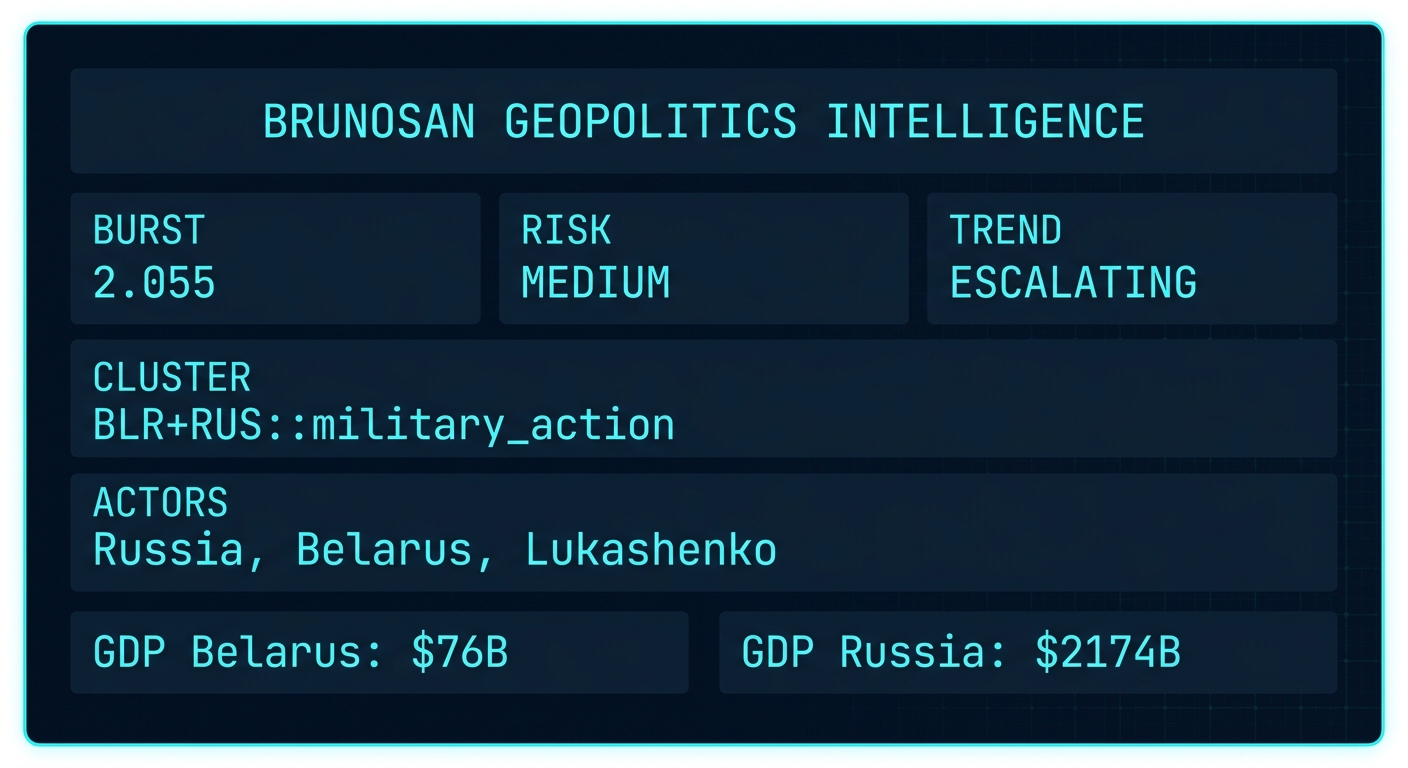
BRUNOSAN CONFIDENCE: HIGH
Reasoning: The signal is verified by multiple independent Tier-1 state sources and Tier-2 international outlets, with consistent reporting on the technical nature of the drills and the physical presence of the two heads of state.
BRUNOSAN ASSESSMENT:
Based on geo_burst 2.055 and the verified operational integration of Russian nuclear warheads into Belarusian delivery systems, BrunoSan assesses a 75% probability of increased NATO troop rotations to the Suwalki Gap and a 90% probability of sustained volatility in European energy futures within 72h.
#nuclear_drills #russia_belarus #deterrence #energy_security_risk