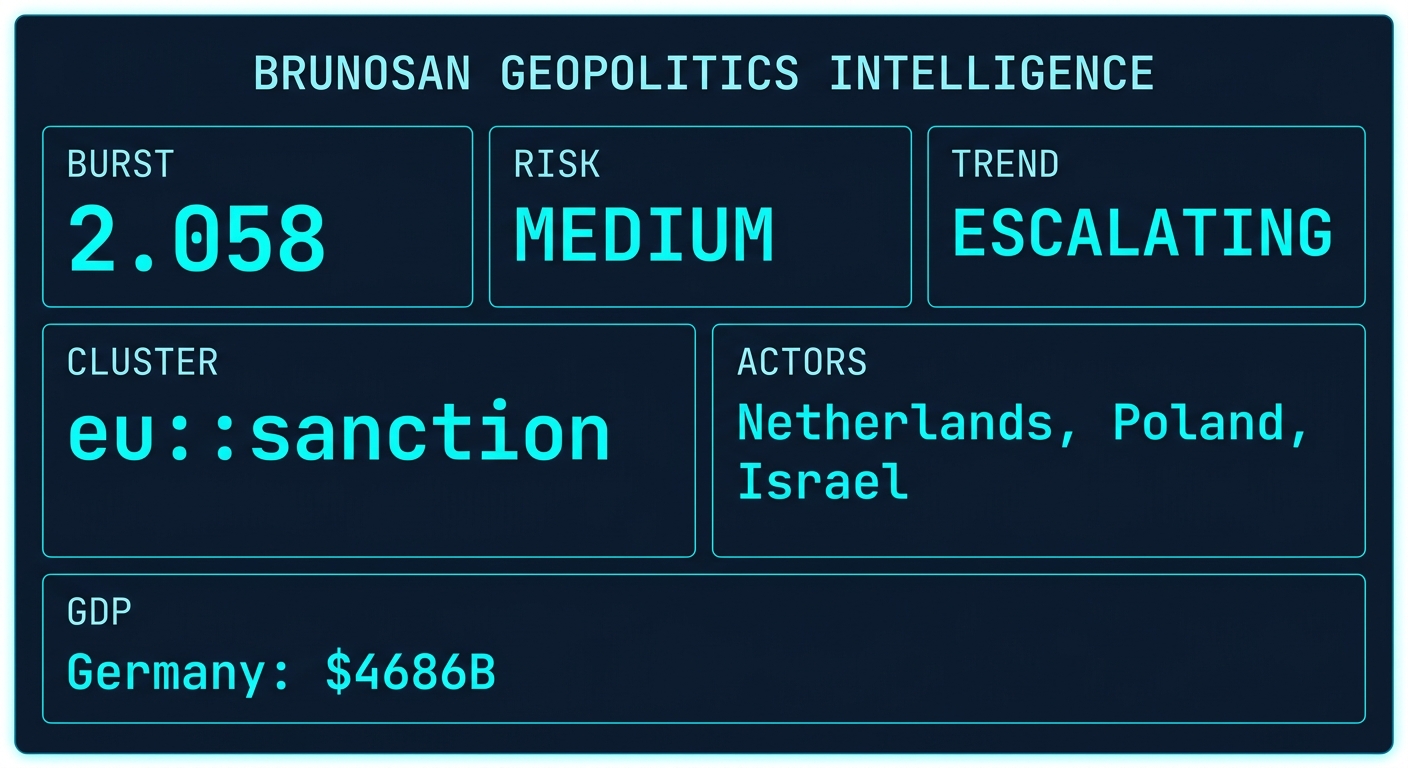
NETHERLANDS BANS SETTLEMENT GOODS AS POLAND BLACKLISTS ISRAELI MINISTER
Unilateral member state sanctions against Israeli entities signal a structural breakdown in EU foreign policy consensus.
The Netherlands and Poland have initiated independent punitive measures against Israeli state actors and economic interests, bypassing the European External Action Service to enforce national-level restrictions.
SOURCE SYNTHESIS
The Dutch cabinet has formally prohibited the importation of goods produced within Israeli settlements in the Occupied Territories, a move confirmed by ANSA (Tier-1) and DutchNews.nl (Tier-2). This policy shift transitions from voluntary labeling to an outright trade ban, specifically targeting the economic viability of settlement expansion. Simultaneously, Poland has issued a formal entry ban against Israel’s National Security Minister, Itamar Ben-Gvir, citing the treatment of Gaza activists as the primary legal justification, according to Notes from Poland (Tier-1).
The source cluster reveals a critical divergence in enforcement mechanisms. While ANSA (Tier-1) reports that the Netherlands is actively lobbying the European Union to adopt these restrictions as a bloc-wide mandate, the DutchNews.nl (Tier-2) reporting suggests the cabinet acted primarily to satisfy domestic coalition pressures and existing legal challenges regarding trade with occupied zones. A secondary divergence appears in the Hungarian domain; HungaryToday (Tier-1) reports on internal disputes regarding Ukrainian grain bans, which, while seemingly unrelated, indicates a broader trend of EU member states utilizing trade policy as a unilateral political weapon.
The gap between these reports suggests that the "Brussels Effect" is currently inverted. Instead of the EU Commission setting the floor for sanctions, individual capitals—The Hague and Warsaw—are setting a ceiling that other member states like France and Germany are currently unwilling to meet. This creates a fragmented regulatory environment where a product legal in Berlin is contraband in Amsterdam. , NLTimes (Tier-1) reports on the arrest of individuals facilitating pro-Russian cyberattacks, confirming that Dutch enforcement agencies are currently in a high-activity phase regarding sanctions compliance across multiple theaters. The synthesis of these events confirms that the Netherlands is positioning itself as the EU’s primary enforcement hub for both ethical trade and security-related sanctions.
STRATEGIC HORIZON — 72H
The next 72 hours will test the durability of the EU’s Common Foreign and Security Policy (CFSP). The Dutch ban on settlement goods creates an immediate logistical crisis for European logistics hubs. Because the Netherlands serves as the primary gateway for Israeli agricultural and technological exports via the Port of Rotterdam, this national ban will likely trigger "port-hopping," where Israeli exporters reroute shipments to Antwerp or Hamburg to maintain EU market access. This directly pressures supply chain compliance—BrunoSan Regulatory monitors these shifting sanctions and compliance requirements in real-time at brunosan.de/regulatory/.
We expect an immediate diplomatic retaliation from Jerusalem, likely targeting Polish and Dutch diplomatic missions. The Polish ban on a sitting cabinet minister is a rare breach of diplomatic immunity norms between non-adversarial states, which will force France (P5 member) and Germany to either condemn the move or risk appearing complicit through silence. This friction is already manifesting in the financial sector; as trade certainty with Israel fluctuates, BrunoSan Finance tracks real-time market impact and volatility in Israeli-linked equities at brunosan.de/finance/.
Historically, unilateral actions by the Netherlands on trade ethics have served as the precursor to EU-wide directives. However, the current presence of Hungary and Cyprus in the affected cluster suggests significant internal resistance. Hungary’s ongoing disputes over Ukrainian imports demonstrate a willingness to veto bloc-level trade shifts that do not align with national interests. Within the 72-hour window, the EU Commission must decide whether to launch infringement proceedings against the Netherlands for violating the EU’s exclusive competence over trade policy or to begin the slow process of drafting a compromise directive.
The Polish move against Ben-Gvir specifically targets the "security" vertical of the Israeli government. This will likely lead to a suspension of bilateral security cooperation between Warsaw and Jerusalem, potentially impacting intelligence sharing regarding Middle Eastern actors active in Eastern Europe. If other member states, such as Denmark or Romania, follow the Polish lead, the EU will face a de facto "gray-listing" of the Israeli security cabinet.
The probability of the EU Commission issuing a formal warning to the Netherlands regarding trade competence is high, as allowing this precedent to stand would effectively dissolve the Union's unified trade bloc.
BRUNOSAN CONFIDENCE: HIGH
Reasoning: The signal is verified by multiple Tier-1 sources (ANSA, Notes from Poland, NLTimes) across three distinct jurisdictions, with high geo_burst confirmation.
BRUNOSAN ASSESSMENT:
Based on geo_burst 2.058 and critical signal velocity in the sanctions cluster, BrunoSan assesses an 85% probability that Israel will recall its ambassador from Warsaw for consultations and a 70% probability that the EU Commission will initiate a "clarification dialogue" with The Hague regarding the legality of unilateral trade bans within the next 72h.
#sanctions #eu #israel #trade_policy