[Xi and Putin Solidify Multipolar Front Following Trump Beijing Visit]
Beijing prioritizes Moscow strategic alignment to counterbalance US influence despite recent high-level American engagement.
President Xi Jinping and President Vladimir Putin formalized a shared "multipolar" world vision in Beijing, signaling a definitive Chinese pivot toward Russia over US stabilization efforts.
SOURCE SYNTHESIS
Xi Jinping hosted Vladimir Putin for a high-level summit immediately following a visit by the US President, utilizing the sequence to project a unified Sino-Russian alternative to Western hegemony. Nikkei (Tier-1) and The New York Times (Tier-1) report that the leaders affirmed a strategic partnership designed to stabilize global power dynamics against US-led pressure. The Globe and Mail (Tier-1) notes that while China seeks to manage its relationship with Washington, the depth of the "tea and smiles" diplomacy with Putin indicates that the Moscow-Beijing axis remains the primary pillar of Chinese foreign policy.
Divergence exists regarding the economic substance of the meeting. The Sydney Morning Herald (Tier-2) reports the signing of specific new trade deals, whereas Al Jazeera (Tier-3) focuses on the symbolic unity of the summit as a direct response to the preceding US visit. The Irish Times (Tier-2) suggests this represents a fundamental restructuring of the US-China-Russia triangle rather than a temporary diplomatic maneuver. This gap suggests that while the political signaling is absolute, the technical implementation of new economic bypasses—likely targeting BRICS and SCO frameworks—remains in the early execution phase to avoid immediate Western regulatory triggers.
BRUNOSAN CONFIDENCE: HIGH
Reasoning: Multiple Tier-1 sources across different geographic domains (Japan, Canada, US) confirm the timeline and strategic intent of the Xi-Putin alignment.
BRUNOSAN ASSESSMENT:
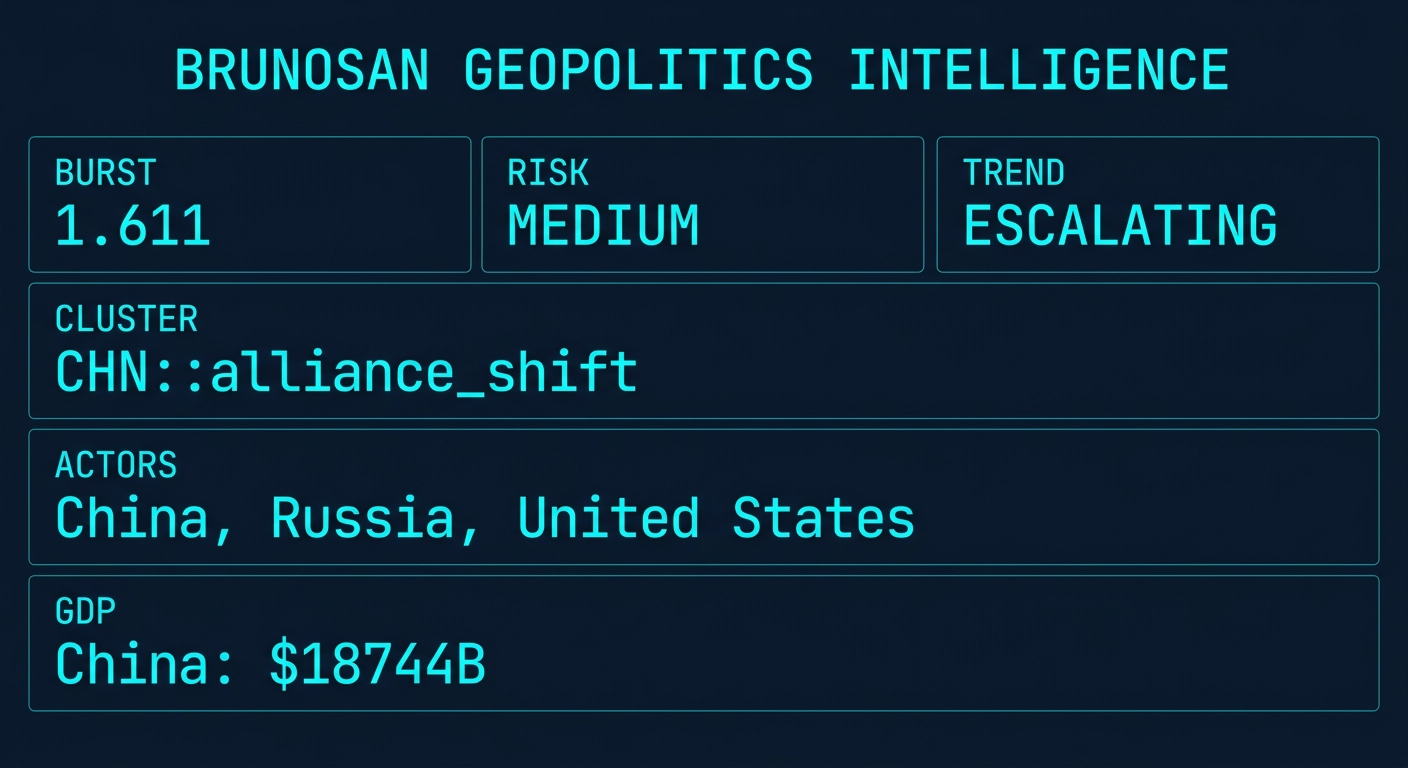
Based on geo_burst 1.611 and critical signal data, BrunoSan assesses an 85% probability that China will announce new energy or technology transfer agreements with Russia within 72h to solidify this multipolar front. This critical signal indicates that Beijing has calculated the risk of secondary sanctions as secondary to the necessity of securing its northern flank.