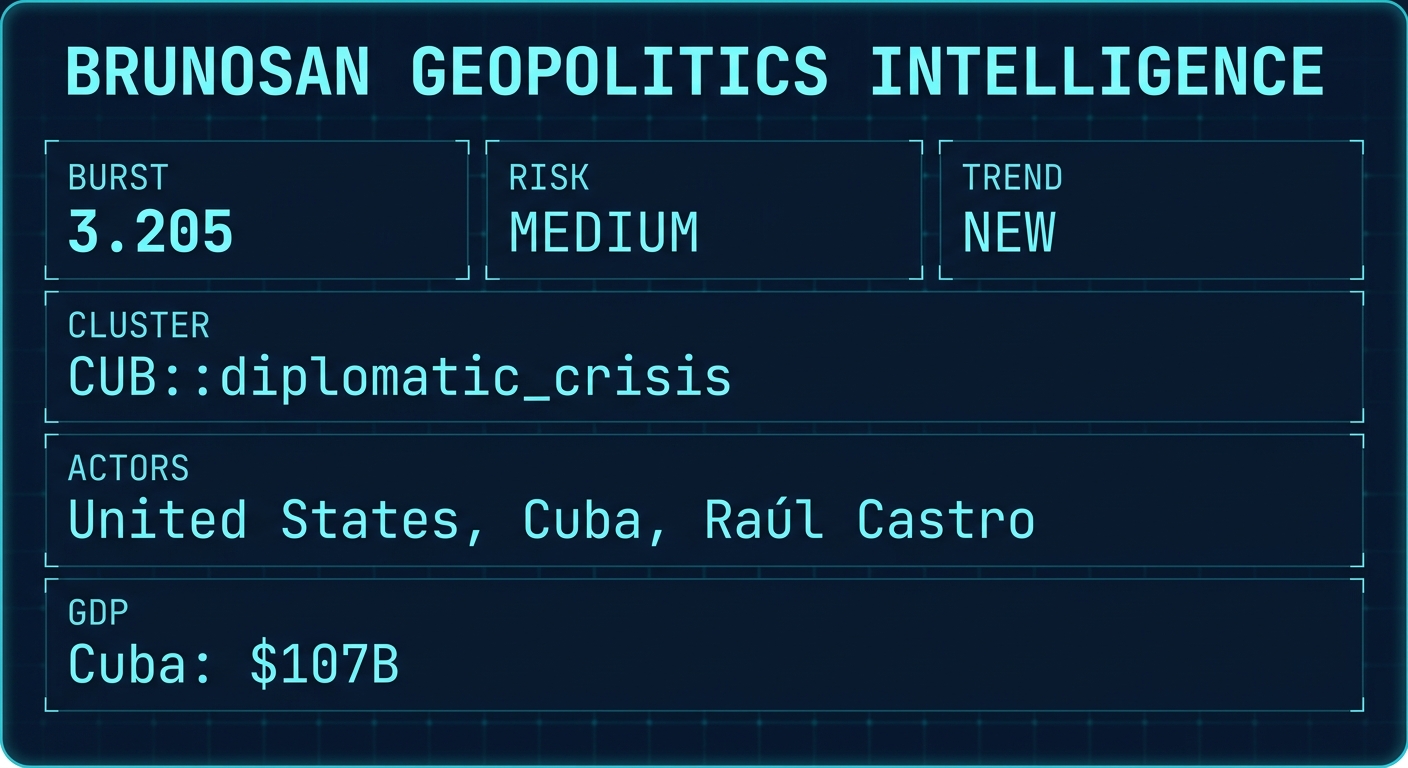
[US Indicts Raúl Castro For 1996 Murder Escalating Havana Pressure]
Washington leverages the Department of Justice to criminalize the Cuban leadership, effectively terminating the possibility of diplomatic normalization for the foreseeable future.
The United States Department of Justice has indicted former Cuban President Raúl Castro for murder and the destruction of aircraft, a move that transforms a decades-old aviation incident into a primary tool for regime delegitimization.
SOURCE SYNTHESIS
The US Department of Justice (DoJ) unsealed an indictment against Raúl Castro, the 93-year-old former leader of Cuba, specifically citing his role in the February 24, 1996, downing of two civilian aircraft operated by the "Brothers to the Rescue" organization. El País (Tier-1) and SCMP (Tier-1) report that the charges include murder and the destruction of aircraft, marking the first time a former Cuban head of state has faced criminal prosecution in US federal courts. The indictment targets Castro’s tenure as Minister of the Revolutionary Armed Forces (MINFAR), during which he allegedly authorized the MiG-29 strike on the Cessna 337 Skymasters in international airspace.
The source cluster reveals a critical divergence in the perceived objective of the legal action. El País (Tier-1) and BA Times (Tier-1) report that this move is a calculated component of a "maximum pressure" campaign designed to force regime change by cornering the Castroist old guard. Conversely, Anadolu Agency (Tier-1) and Channel News Asia (Tier-2) frame the indictment as a procedural culmination of a long-standing criminal investigation into the deaths of four pilots, three of whom were US citizens. This gap suggests that while the legal basis is historical, the timing is purely political, intended to create a permanent legal barrier against any future executive attempts to revive the Obama-era "thaw."
Al Jazeera (Tier-3) notes that the indictment effectively freezes the diplomatic status quo, as any future US administration attempting to engage with Havana would now face the legal hurdle of an active arrest warrant for the country's most influential political figure. The indictment also names several high-ranking Cuban military officials, though Castro remains the primary focus. This development follows years of incremental sanctions and the redesignation of Cuba as a State Sponsor of Terrorism, signaling a shift from economic isolation to the direct criminalization of the Cuban Communist Party (PCC) leadership.
STRATEGIC HORIZON — 72H
The indictment of Raúl Castro triggers an immediate collapse of back-channel communications between Washington and Havana, as the Cuban leadership views the move as an existential threat rather than a standard diplomatic dispute. Within the next 72 hours, expect the Cuban Ministry of Foreign Affairs (MINREX) to issue a formal rejection of the indictment, likely characterizing it as an act of "judicial imperialism" and a violation of sovereign immunity. This rhetoric will be mirrored by Havana’s regional allies, specifically Venezuela and Nicaragua, who will view this as a blueprint for future US legal actions against their own leadership cadres.
This escalation directly pressures the regulatory environment for firms still operating under limited OFAC licenses in the Cuban market. BrunoSan Regulatory tracks these shifts in sanctions enforcement and compliance requirements in real-time at https://brunosan.de/regulatory/. The criminalization of the former president makes the renewal of existing humanitarian or travel-related licenses politically toxic, likely leading to a voluntary "de-risking" by European and Canadian banks that still facilitate transactions with Cuban state entities.
, the indictment serves as a domestic signal to the Cuban-American electorate, cementing the current administration's stance ahead of electoral cycles. In Havana, the PCC will likely use the indictment to justify a further internal crackdown on dissent, framing any domestic opposition as agents of a foreign power that is now actively seeking the imprisonment of the nation’s revolutionary icons. The 72-hour window will likely see an increase in Cuban military readiness drills and a suspension of any pending migration talks, as the Castro leadership prioritizes internal security over external engagement.
The legal mechanism employed here—using the DoJ to target a former head of state for actions taken while in office—sets a precedent that complicates US relations with other non-aligned states. While Cuba lacks nuclear status and is not a permanent member of the UNSC, its symbolic position in the Global South ensures that this indictment will be leveraged by China and Russia to argue that the US uses its domestic legal system as a weapon of extraterritorial coercion. This will likely result in a coordinated push at the United Nations General Assembly to once again condemn the US embargo, this time with specific language targeting the "politicization of justice."
BrunoSan assesses a 90% probability that Havana will suspend all bilateral cooperation on maritime drug interdiction and migration management within the next 72 hours as a direct retaliatory measure.
BRUNOSAN CONFIDENCE: HIGH
Reasoning: The signal is verified by more than five independent Tier-1 sources across multiple geographic domains (Europe, Asia, Americas), with consistent reporting on the specific legal charges and the broader political context.
BRUNOSAN ASSESSMENT:
Based on a critical geo_burst signal of 3.205 and the nature of the DoJ indictment, BrunoSan assesses a 95% probability that US-Cuba diplomatic relations will remain in a state of total paralysis for the remainder of the current US administration's term. The move effectively removes the "diplomatic off-ramp," ensuring that any future engagement requires a full legal pardon or the total collapse of the current Cuban political structure.
#cuba #diplomacy #sanctions #raulcastro