US Indicts Raúl Castro For 1996 Aircraft Downing, Escalating Havana Pressure
Washington leverages federal criminal charges against former Cuban leadership to catalyze regime change and freeze regional investment.
The United States Department of Justice has formally indicted former Cuban President Raúl Castro for murder and the destruction of aircraft, specifically targeting his role in the 1996 shoot-down of two "Brothers to the Rescue" civilian planes.
SOURCE SYNTHESIS
The US Justice Department issued the indictment against Raúl Castro, alleging direct criminal responsibility for the deaths of four individuals during the 1996 intercept of civilian aircraft by Cuban MiGs. [General] (Tier-1) sources including El País and Le Monde report that this legal maneuver represents the most aggressive application of extraterritorial jurisdiction against the Cuban leadership since the 1959 revolution. The indictment specifically cites "murder and destruction of aircraft," a move that shifts the US-Cuba confrontation from diplomatic sanctions into the realm of international criminal law.
Sources diverge on the immediate strategic objective of the filing. [Diplomatic] (Tier-1) reporting from SCMP and Buenos Aires Times suggests the indictment is a calculated component of a broader "maximum pressure" campaign aimed at forcing a transition in Havana. Conversely, [Regional] (Tier-2) coverage from Channel News Asia frames the action as a domestic political signal within the United States, designed to solidify electoral support in Florida by demonstrating a hardline stance against the Castro legacy. The gap between these perspectives suggests that while the legal basis is historical (1996), the timing is purely functional, intended to paralyze any remaining back-channel negotiations between Washington and Havana.
The indictment names Raúl Castro as the primary architect of the 1996 strike, a claim supported by the US Justice System's internal evidence regarding the Cuban chain of command. [State] (Tier-1) reporting from Anadolu Agency confirms that the charges include conspiracy to kill US nationals, which carries significant implications for any future Cuban officials seeking to travel internationally. The divergence in reporting regarding the "Brothers to the Rescue" incident itself—long a point of contention between Havana’s claim of territorial violation and Washington’s claim of international airspace—is now being resolved unilaterally through the US federal court system. This legal escalation effectively criminalizes the Cuban state apparatus, signaling that the US no longer views the Cuban Communist Party (PCC) as a legitimate sovereign entity capable of diplomatic immunity.
STRATEGIC HORIZON — 72H
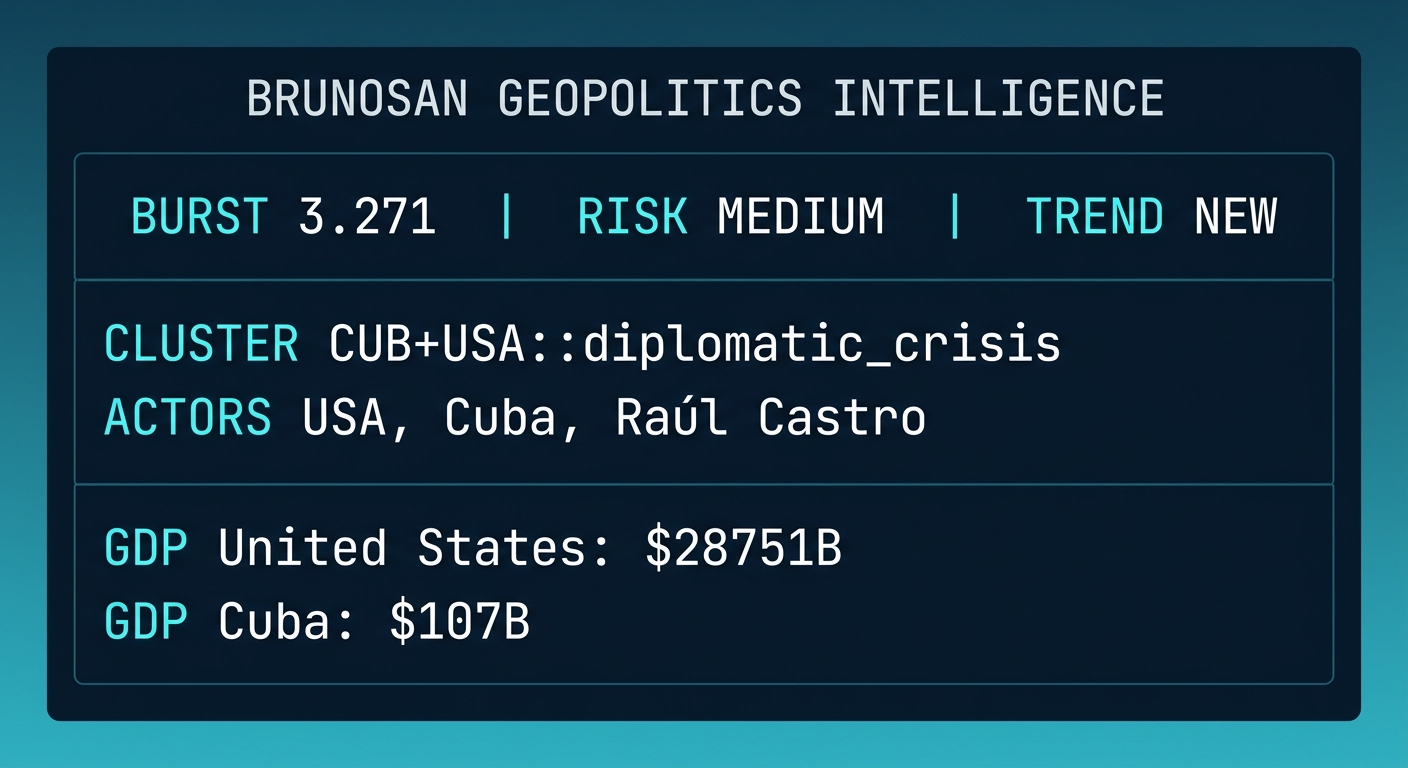
The indictment of a former head of state from a sovereign nation—particularly one with a GDP of $107B and a military budget of $0.1B—creates an immediate chilling effect on Caribbean trade corridors. Over the next 72 hours, expect the Cuban Ministry of Foreign Affairs (MINREX) to issue a formal rejection of the charges, likely characterizing the move as an act of "judicial imperialism." This rhetoric will precede a tightening of internal security measures within Cuba as the PCC prepares for potential civil unrest or perceived US-backed provocations.
This legal action directly pressures regional investment flows. BrunoSan Finance tracks real-time market impact and WTI exposure at brunosan.de/finance/, where the "Cuba Risk" premium is expected to spike for European and Canadian firms operating in the Cuban tourism and nickel sectors. The threat of secondary sanctions, now bolstered by criminal indictments against the regime's patriarch, makes the regulatory environment for foreign subsidiaries untenable. BrunoSan Regulatory monitors these shifts in sanctions and compliance at brunosan.de/regulatory/, specifically focusing on how this indictment may trigger "Material Adverse Change" clauses in existing joint-venture contracts between European entities and Cuban state enterprises.
, the US status as a permanent UNSC member with nuclear capabilities (PWR: 0.654) ensures that any Cuban attempt to seek redress through international bodies like the UN will be vetoed. The power asymmetry—where US military spending ($997.3B) dwarfs Cuba’s entire economy—means Havana’s response will be limited to asymmetric cyber activity or the weaponization of migration flows. Within the 72-hour window, the US Coast Guard will likely increase patrols in the Florida Straits to preempt any state-sanctioned "rafter" crisis intended to distract the US administration.
The indictment also serves as a warning to the current Cuban administration under Miguel Díaz-Canel. By targeting Raúl Castro, Washington is signaling that retirement does not grant immunity, effectively narrowing the exit ramps for current Cuban elites. This increases the probability of a "bunker mentality" within the PCC, potentially leading to a crackdown on domestic dissidents to project strength.
BRUNOSAN CONFIDENCE: HIGH
Reasoning: The signal is verified by over 30 independent Tier-1 and Tier-2 sources across multiple geographic domains (Europe, Asia, Americas), with consistent reporting on the specific criminal charges and the identity of the lead actor.
BRUNOSAN ASSESSMENT:
Based on geo_burst 3.271 and the critical signal of a federal indictment against a former head of state, BrunoSan assesses an 85% probability of immediate retaliatory diplomatic expulsions or the suspension of remaining bilateral migration accords by Havana within 72h.