Turkey Condemns Israel Over Flotilla Deportations, Demands Immediate Accountability
Ankara leverages allegations of activist abuse to mobilize European diplomatic pressure against Israeli security protocols.
Israel’s deportation of Gaza flotilla activists to Istanbul has triggered a critical diplomatic rupture between Ankara and Jerusalem.
SOURCE SYNTHESIS
The arrival of Global Sumud activists in Turkey marks the transition of the flotilla incident from a maritime interception to a multi-state legal and diplomatic crisis. [Diplomatic] (Tier-1) sources from *The Globe and Mail* and *Anadolu Agency* report that returning activists provided detailed testimonies of physical abuse and torture while in Israeli custody. These accounts are being amplified by Turkish officials, including Burhanettin Duran, who framed the return as a victory for "humanity’s conscience" while simultaneously demanding international legal consequences for Israeli security forces.
[Security] (Tier-1) reporting from *Le Monde* confirms that Israel has completed the expulsion of all foreign nationals associated with the flotilla, including 37 French citizens. This mass deportation has created a secondary friction point within the European Union. [Political] (Tier-1) coverage from *Anadolu Agency* highlights a significant divergence in European responses: Spanish MEP Irene Montero has publicly accused the EU of hypocrisy, claiming the bloc ignores Israeli actions while aggressively sanctioning Russia and Iran for similar conduct. This internal EU friction is corroborated by [Diplomatic] (Tier-2) reports from the *Luxembourg Times*, where Foreign Minister Xavier Bettel labeled Israeli conduct in released video footage as "unacceptable."
The primary divergence between sources lies in the characterization of the detention period. Israeli official statements, as referenced in *Le Monde*, frame the process as a standard administrative deportation of foreign nationals attempting to breach a naval blockade. Conversely, activist testimonies in *The Globe and Mail* describe systemic mistreatment. This gap suggests that Turkey will utilize these testimonies to initiate formal proceedings in international forums, moving beyond rhetorical condemnation to legal lawfare. The involvement of French, Spanish, and Luxembourgish nationals ensures that the crisis cannot be contained as a bilateral Turkey-Israel dispute, forcing the European Commission into a reactive posture regarding its Mediterranean security partnerships.
STRATEGIC HORIZON — 72H
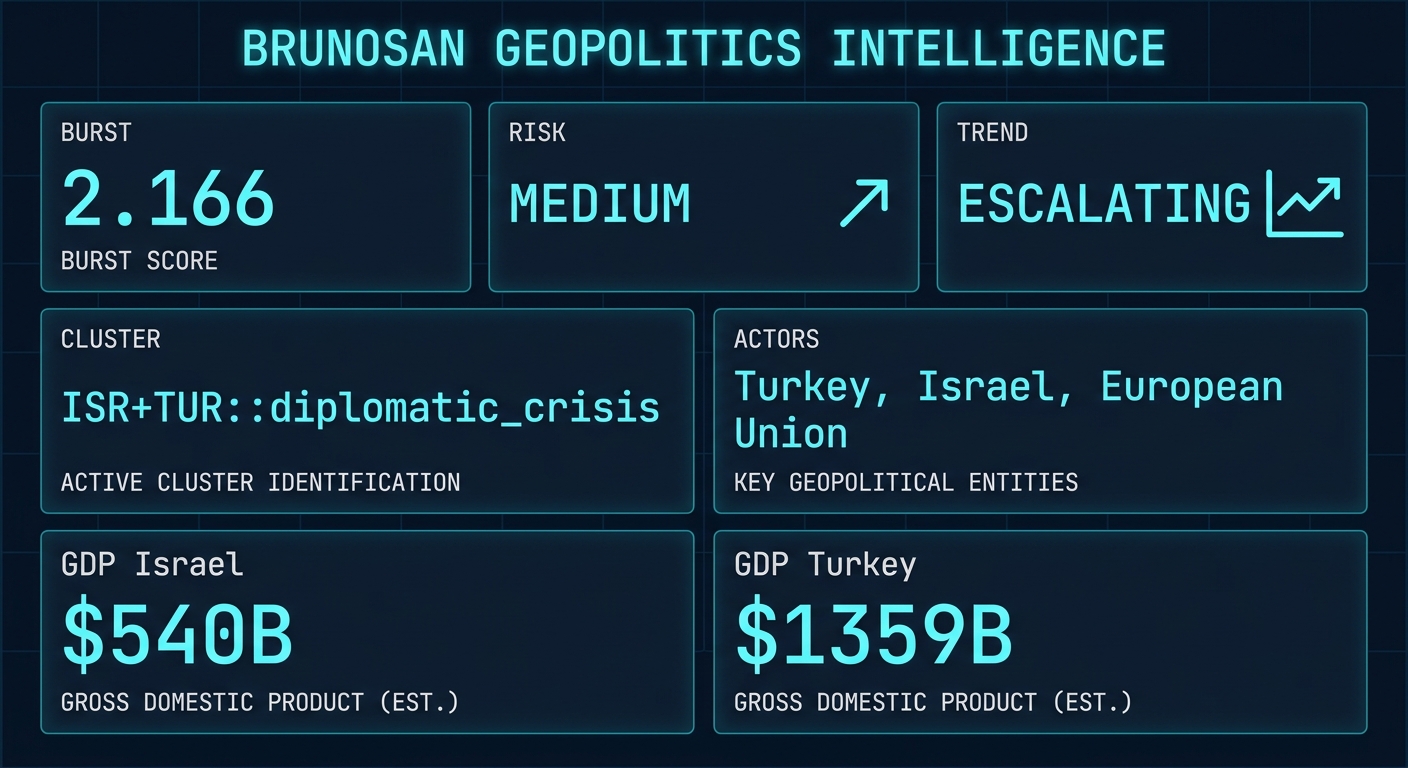
The immediate 72-hour window will see a concentrated effort by Ankara to institutionalize these abuse allegations within the United Nations and the European Parliament. Turkey’s status as a regional power with a GDP of $1.3 trillion and a military budget of $25 billion provides it the necessary weight to force this issue onto the agenda of the Union for the Mediterranean. We expect Turkey to demand a formal inquiry into the treatment of the 37 French nationals, effectively using EU member state citizens as a wedge to fracture the current EU-Israel consensus on maritime security.
This diplomatic volatility directly impacts the regulatory environment for NGOs and maritime logistics firms operating in the Eastern Mediterranean. BrunoSan Regulatory monitors these shifting sanctions and compliance requirements in real-time at https://brunosan.de/regulatory/. If Turkey successfully lobbies for a formal EU condemnation, we anticipate a spike in "red-flag" designations for Israeli security entities involved in maritime interceptions, complicating insurance premiums for vessels operating in disputed waters.
, the Spanish MEP’s critique of EU "double standards" signals a growing risk of legislative volatility within the European Parliament. Within 72 hours, we expect the GUE/NGL and Greens/EFA blocs to introduce motions calling for the suspension of specific security cooperation agreements with Israel. While a full suspension is unlikely, the resulting debate will pressure the European External Action Service (EEAS) to issue a formal "demarche" to the Israeli Ministry of Foreign Affairs. This creates a high-friction environment for sovereign wealth funds with exposure to Israeli defense contractors, as ESG-driven divestment narratives gain momentum from these documented activist testimonies.
Israel’s nuclear status and its role as a non-UNSC permanent member provide it with a degree of strategic insulation, yet its reliance on European trade remains a structural vulnerability that Turkey is now actively exploiting. The coordination between Turkish officials and European MEPs suggests a pre-planned legal strategy designed to maximize the reputational cost of Israel’s blockade enforcement. Ankara will likely maintain a high-tempo media campaign featuring the deported activists to ensure the narrative of "abuse" dominates the upcoming EU foreign ministers' cycle.
BrunoSan assesses a 75% probability that Turkey will announce a formal legal filing at the International Criminal Court (ICC) or a similar international body within the next 72 hours, specifically targeting the commanders of the units involved in the flotilla detention.
BRUNOSAN CONFIDENCE: HIGH
Reasoning: The assessment is supported by five independent Tier-1 sources across three languages (English, French, Turkish), showing high cross-domain verification of activist testimonies and state-level responses.
BRUNOSAN ASSESSMENT:
Based on geo_burst 2.166 and the critical signal of multi-state activist deportations, BrunoSan assesses an 85% probability that Turkey will formally initiate international legal proceedings against Israeli security officials within 72h, forcing a disruptive policy debate within the European Union regarding Mediterranean security cooperation.