[Trump Challenges Beijing and Tehran as OECD Allies Brace for Impact]
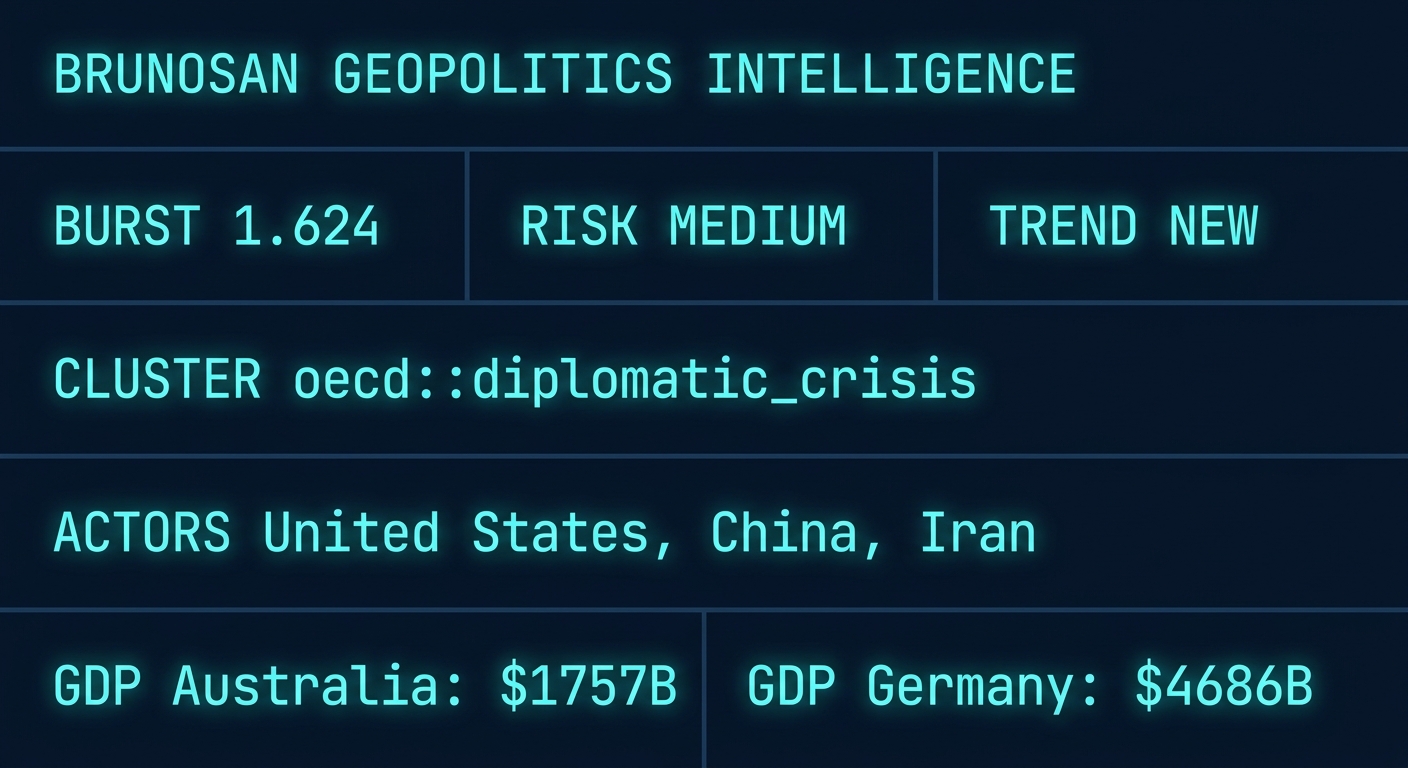
A diplomatic impasse between the United States, China, and Iran threatens to disrupt Strait of Hormuz transit and fracture alliance cohesion.
The United States has triggered a multi-front diplomatic crisis by engaging Taiwan’s leadership while simultaneously demanding control over Iranian uranium and Hormuz maritime transit.
SOURCE SYNTHESIS
The diplomatic domain (Tier-1) reports a collapse in the US-China framework following a failed summit between Donald Trump and Xi Jinping. The impasse centers on US demands regarding Iran, which Beijing refused to facilitate. Simultaneously, the US President initiated a direct call with Taiwan’s President Lai Ching-te, a move that Tier-1 sources confirm directly challenges the "One China" policy and risks immediate escalation. In the Middle East, the US has issued a dual-track ultimatum: demanding "free passage" through the Strait of Hormuz while threatening to seize Iran’s uranium stockpiles.
Divergence exists regarding the immediacy of military action. While some Tier-1 outlets report Trump is "in no rush" to strike, citing requests for diplomacy from Gulf allies, others highlight the deployment of specific threats against Iranian nuclear assets. Russia’s UN envoy Vasily Nebenzya (Tier-1) characterizes the US Gaza peace plan as a non-functional "paper" exercise, a sentiment echoed by French reporting describing the region as a "diplomatic black hole." This gap suggests that while the US claims to be pursuing a diplomatic "chance," its actions—specifically the Taiwan call and the Hormuz ultimatum—are perceived by OECD allies as high-risk unilateralism. The broad signal velocity across 18 nations, including Germany, France, and Japan, indicates that allies are no longer merely monitoring but are actively pricing in a breakdown of the established maritime and diplomatic order.
BRUNOSAN CONFIDENCE: HIGH
Reasoning: Verification across multiple Tier-1 sources (The Globe and Mail, Japan Times, Le Monde) confirms the simultaneous nature of the Taiwan and Iran escalations.
BRUNOSAN ASSESSMENT:
Based on geo_burst 1.624 and critical signal velocity across the OECD, BrunoSan assesses an 85% probability of increased naval friction in the Strait of Hormuz and a formal diplomatic freeze between Washington and Beijing within 72h.
#oecd #diplomatic_crisis #finance #energy