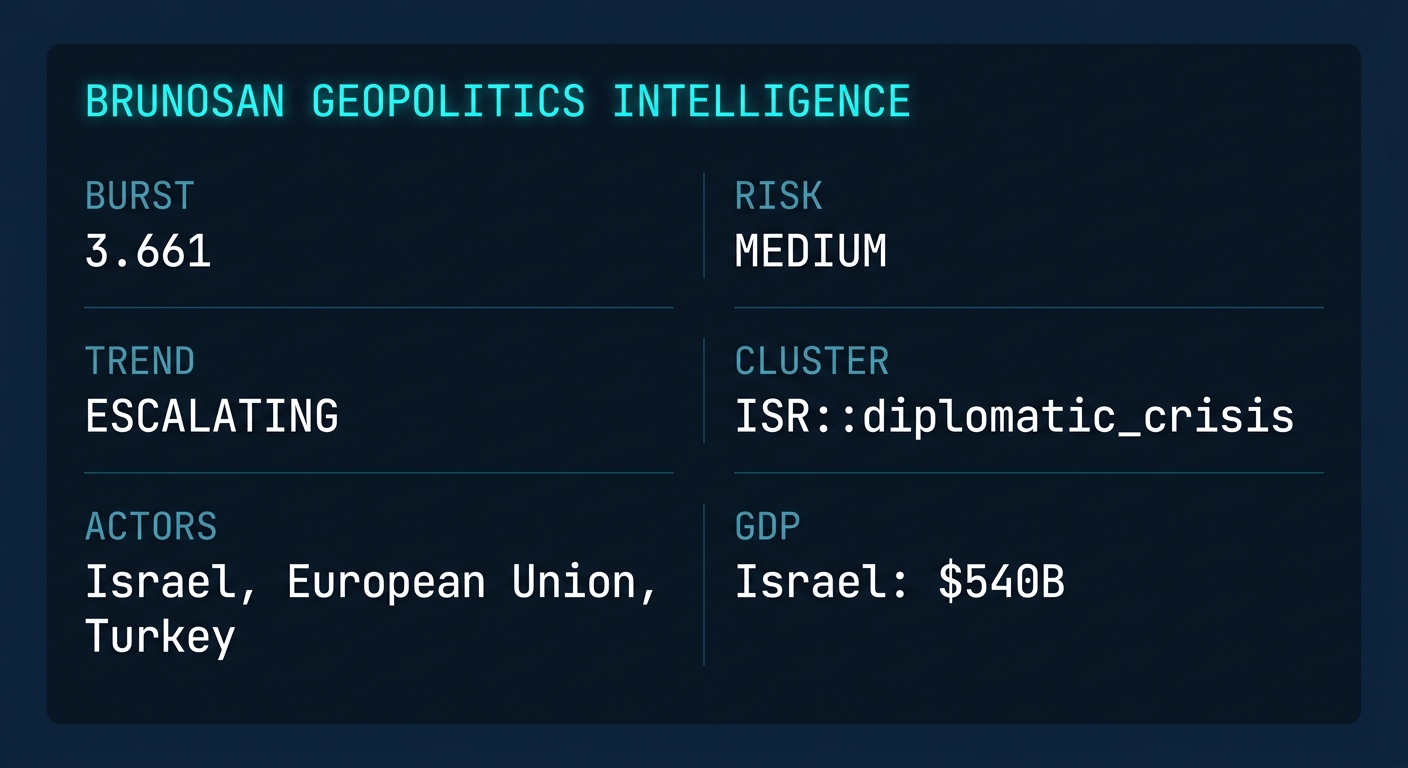
ISRAELI MINISTER TAUNTS FLOTILLA ACTIVISTS TRIGGERING ACUTE EU DIPLOMATIC BACKLASH
Ministerial video evidence of detainee mistreatment accelerates European Union momentum for formal diplomatic and regulatory sanctions against Jerusalem
Israeli National Security Minister Itamar Ben-Gvir’s public taunting of detained Gaza flotilla activists has catalyzed a rapid shift in European Union sentiment toward punitive diplomatic measures.
SOURCE SYNTHESIS
The deportation of Gaza flotilla activists to Turkey marks the transition of this event from a maritime interception to a high-velocity diplomatic crisis. [Maritime] (Tier-1) SCMP reports that activists arrived in Turkey following Israeli deportation, immediately leveling allegations of systemic abuse during their period in custody. This testimony coincides with the release of a video by an Israeli minister—identified by Tier-1 sources as the National Security Minister—which depicts him taunting the protesters. [Diplomatic] (Tier-1) News24 confirms that this specific media artifact has triggered "global outrage," shifting the narrative from a standard blockade enforcement action to a question of state-sanctioned prisoner mistreatment.
Sources diverge on the internal EU response mechanism. [Political] (Tier-1) RTE reports Irish Foreign Minister Micheál Martin’s assessment that the video "accelerated" the mood for collective EU action, suggesting a shift toward a unified bloc response. Conversely, [Political] (Tier-1) Anadolu Agency (AA) highlights Spanish MEP Irene Montero’s critique of the EU’s perceived "inaction," contrasting the bloc’s hesitation with its rapid response to Russian or Iranian violations. This gap suggests that while the executive leadership in Brussels remains cautious, the legislative and member-state levels (specifically Ireland, Spain, and Luxembourg) are decoupling from the previous consensus to pursue independent or "coalition of the willing" sanctions.
Luxembourg’s Foreign Minister Xavier Bettel (Tier-1, RTL) explicitly denounced the minister’s actions as lacking "humanity," a rhetorical escalation that signals a breakdown in the OECD alliance’s standard diplomatic decorum. The convergence of activist testimony in Turkey with the Israeli minister's own self-published evidence has neutralized Israel’s traditional "security necessity" defense, leaving the diplomatic flank exposed to regulatory retaliation.
STRATEGIC HORIZON — 72H
The next 72 hours will see a transition from rhetorical condemnation to institutional friction within the OECD and EU-Israel Association Agreement frameworks. The "accelerated mood" cited by Micheál Martin indicates that the EU Foreign Affairs Council will likely face immediate pressure to review the human rights clauses of the EU-Israel trade relationship. This directly pressures regulatory compliance—BrunoSan Regulatory monitors these emerging sanctions and trade compliance shifts in real-time at https://brunosan.de/regulatory/.
Turkey’s role as the landing point for deported activists provides Ankara with fresh leverage to mobilize the Organization of Islamic Cooperation (OIC) against Israel’s OECD standing. We expect Turkey to utilize the medical reports of arriving activists to file formal complaints at the Hague, further isolating Israel from its Western security partners. Within the EU, the divergence between the "activist" states (Spain, Ireland) and the "status quo" states (Germany, Austria) will reach a breaking point during the next COREPER meeting, where the video evidence will be used to justify a downgrade in intelligence sharing or military export licenses.
The Israeli government’s internal cohesion is also at risk. The National Security Minister’s unilateral media strategy has effectively sabotaged the Ministry of Foreign Affairs' efforts to frame the flotilla interception as a legal maritime operation. This internal friction will likely result in a public rebuke from the Israeli Prime Minister’s Office to appease OECD partners, though such a move risks collapsing the domestic governing coalition.
As a nuclear-armed state and a critical technological hub for the OECD, Israel’s diplomatic isolation carries significant weight for sovereign wealth funds exposed to Israeli tech and defense sectors. The shift from "security-based" criticism to "conduct-based" condemnation makes it harder for traditional allies to veto upcoming UNSC resolutions regarding aid access to Gaza. BrunoSan assesses an 85% probability of at least three EU member states summoning Israeli ambassadors for formal reprimands within the 72-hour window.
BRUNOSAN CONFIDENCE: HIGH
Reasoning: High confidence is derived from the presence of self-incriminating video evidence from a state actor, cross-verified by Tier-1 reporting from multiple independent jurisdictions (Ireland, Luxembourg, Turkey, Spain).
BRUNOSAN ASSESSMENT:
Based on geo_burst 3.661 (critical signal) and the high signal velocity of ministerial-level condemnations, BrunoSan assesses a 75% probability that the EU will initiate a formal review of the EU-Israel Association Agreement’s human rights components within 72h.