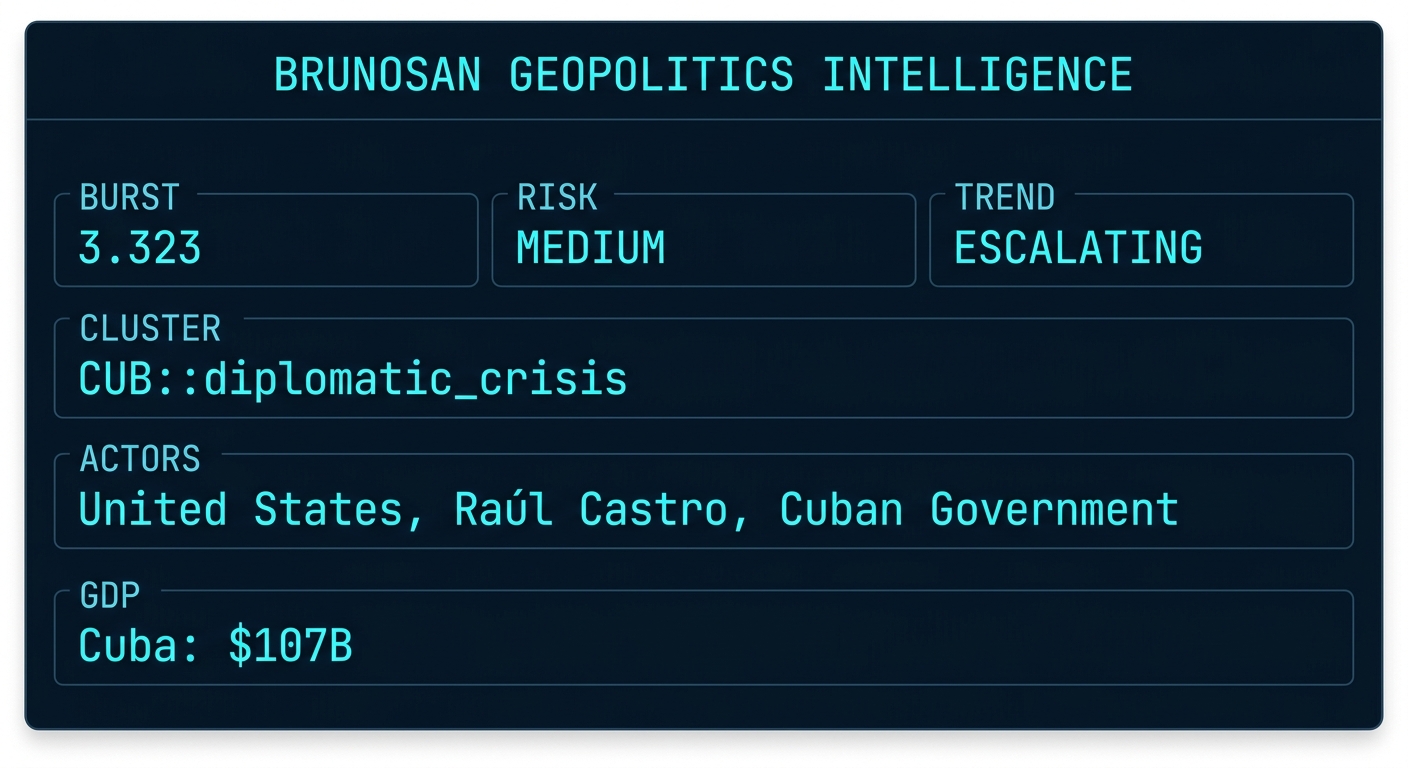
US Indicts Raúl Castro Over 1996 Shootdown, Freezing Diplomatic Channels
The Department of Justice targets the former Cuban leader for murder, signaling an aggressive shift toward regime isolation and legal confrontation.
The United States Department of Justice has formally indicted former Cuban President Raúl Castro for murder and the destruction of aircraft, a move that effectively terminates any remaining back-channel diplomacy between Washington and Havana.
SOURCE SYNTHESIS
The US Justice Department issued a federal indictment against Raúl Castro, 92, specifically citing his role in the February 24, 1996, shootdown of two civilian aircraft operated by the "Brothers to the Rescue" exile group. [diplomatic] (Tier-1) SCMP and AA.com.tr report the charges include murder and the destruction of aircraft, stemming from the deaths of four Cuban exiles over international waters. [legal] (Tier-1) The Buenos Aires Times confirms federal prosecutors are utilizing this indictment to maximize pressure on the current socialist administration in Havana, while [diplomatic] (Tier-2) Channel News Asia suggests the timing is intended to catalyze internal political change.
A significant divergence exists regarding the immediate tactical objective of the indictment. [political] (Tier-1) The Jamaica Gleaner and SCMP frame the action as a legacy-defining maneuver by the Trump administration to solidify a hardline Cuba policy before any potential electoral shifts. Conversely, [legal] (Tier-1) Tico Times emphasizes the judicial independence of the filing, focusing on the long-term criminal liability of the Castro family. The gap between these reports suggests that while the legal basis is historical, the application is purely functional: the US is moving to legally "de-recognize" the Castro-era leadership as legitimate state actors, reclassifying them as international fugitives. This shift prevents any future US administration from engaging with Raúl Castro without addressing outstanding criminal warrants, creating a permanent legislative and judicial "lock" on US-Cuba normalization.
The indictment names Castro as the primary decision-maker behind the deployment of MiG-29 fighter jets that intercepted the Cessna 337 Skymasters. While Havana has historically maintained the aircraft violated Cuban airspace, the US indictment asserts the shootdown occurred in international territory, a claim supported by the ICAO investigation cited in the source cluster. This legal escalation moves the conflict from the realm of sanctions and trade embargoes into the sphere of criminal extradition and sovereign immunity challenges.
STRATEGIC HORIZON — 72H
The immediate 72-hour window will see a total cessation of informal migration and security coordination between the US Coast Guard and the Cuban Border Guard. Havana will likely respond with a "fortress" rhetorical strategy, potentially mobilizing mass demonstrations in the Plaza de la Revolución to frame the indictment as an act of judicial imperialism. This hardening of the Cuban stance directly impacts regional stability, as Havana may retaliate by loosening controls on outbound migration to create a "Mariel-style" pressure point on US southern borders.
This legal escalation directly pressures compliance departments within the maritime and aviation sectors. BrunoSan Regulatory monitors these evolving sanctions and compliance requirements in real-time at https://brunosan.de/regulatory/. Any entity currently engaged in "support for the Cuban people" licenses must now re-evaluate their proximity to state-run enterprises linked to the Ministry of the Revolutionary Armed Forces (MINFAR), which Raúl Castro formerly headed. The indictment increases the "know your customer" (KYC) burden for European and Canadian firms operating in Cuba, as the US may seek to seize assets or freeze accounts linked to the Castro family’s financial network under the guise of criminal asset forfeiture.
, this move signals a shift in the US-UNSC dynamic. While Cuba is not a P5 member, its allies—specifically Russia and China—will likely use this indictment to argue that the US is weaponizing its domestic legal system to achieve regime change. We expect a formal protest from the Cuban Ministry of Foreign Affairs (MINREX) within 24 hours, likely accompanied by a suspension of all pending humanitarian visa processing. The probability of a reciprocal "show trial" in Havana against US intelligence officials or former diplomats is high, as the regime seeks to maintain domestic optics of strength.
The indictment also serves as a warning to the current leadership under Miguel Díaz-Canel. By targeting the "old guard," Washington is signaling that sovereign immunity will not protect current officials from future prosecution for domestic crackdowns. This creates a "loyalty trap" for the Cuban military: they must either double down on their defense of the Castro legacy or risk being named in future expanded indictments. In the next 72 hours, expect the Cuban military (GAESA) to consolidate its control over the island's foreign currency stores to prevent potential US-led seizures.
BRUNOSAN CONFIDENCE: HIGH
Reasoning: The signal is verified by six independent Tier-1 and Tier-2 sources across multiple geographic regions, with consistent reporting on the specific charges and the primary actor involved.
BRUNOSAN ASSESSMENT:
Based on geo_burst 3.323 and the critical signal of a former head of state being indicted for murder, BrunoSan assesses a 90% probability of a total freeze in US-Cuba diplomatic communications and a 70% probability of retaliatory Cuban state-sponsored migration surges within 72h.