Trump Sets 72-Hour Ultimatum For Iran Peace Deal Completion
Washington leverages kinetic threats against Tehran to force a letter of intent covering nuclear enrichment and maritime security.
The United States has established a hard deadline of early next week for a diplomatic resolution with Iran, conditioning the suspension of military operations on a finalized letter of intent.
SOURCE SYNTHESIS
The White House has shifted to a dual-track strategy of coercive diplomacy, signaling a 72-hour window for Iran to accept terms or face immediate kinetic consequences. TASS (Tier-1) reports that President Trump has authorized a temporary postponement of military operations to allow Qatari, Emirati, and Saudi mediators to finalize a deal. This diplomatic pause is not open-ended; Vice President Vance confirms that while talks show "good progress," the U.S. military remains "locked and loaded" for a pivot to offensive action if the deadline expires without a signature (Straits Times, Tier-1).
The core of the negotiation involves a tripartite "letter of intent" involving the U.S., Israel, and Iran. ANSA (Tier-1) reports that mediators are currently drafting this document, which aims to address three critical friction points: the cessation of regional hostilities, a framework for renewed nuclear talks, and guaranteed freedom of navigation through the Strait of Hormuz. This aligns with statements from the Irish Times (Tier-2) indicating that Trump views a comprehensive nuclear deal as a high-probability outcome despite the ongoing Gulf crisis.
Divergence appears regarding the regional alignment of the deal. While Western and Russian sources emphasize the role of Gulf monarchies (Qatar, UAE, Saudi Arabia) as the primary facilitators (TASS), Indonesian media (Antara News, Tier-2) highlights a parallel diplomatic track involving Iranian Foreign Minister Seyed Abbas Araghchi and Pakistani officials. This suggests Tehran is seeking a broader Islamic bloc consensus to hedge against potential U.S. non-compliance or to secure security guarantees that extend beyond the immediate U.S.-Israel axis. The gap between the Gulf-led mediation and the Pakistan-Iran consultations suggests that while the U.S. focuses on maritime and nuclear concessions, Iran is attempting to frame the resolution as a wider regional stabilization effort to preserve its influence in the "Axis of Resistance."
Market volatility reflects this uncertainty. Bloomberg (Tier-2) reports that oil prices initially plunged on optimism surrounding the agreement but have since edged up as traders price in the risk of the 72-hour deadline failing. The divergence between diplomatic optimism and military readiness indicates that the "peace" being negotiated is a high-pressure settlement rather than a fundamental realignment of interests.
STRATEGIC HORIZON — 72H
The next 72 hours represent a binary risk environment for global energy and finance. If the letter of intent is signed, expect an immediate downward correction in Brent and WTI futures as the "war premium" evaporates. BrunoSan Finance tracks these real-time market impacts and commodity exposure at brunosan.de/finance/. Conversely, a failure to meet the early-week deadline triggers an automatic transition to the U.S. kinetic contingency. This would likely involve targeted strikes on Iranian enrichment facilities or IRGC naval assets, immediately threatening the 21 million barrels of oil that flow daily through the Strait of Hormuz.
The involvement of Saudi Arabia and the UAE as mediators is a load-bearing signal for OPEC stability. A deal would likely lead to a normalization of production quotas, whereas a collapse into conflict would force an emergency OPEC session to address supply disruptions. Iran’s lack of UNSC permanent membership and non-nuclear status leaves it with limited leverage beyond its "gray zone" capabilities—specifically its ability to mine the Strait or deploy drone swarms against regional energy infrastructure. The 72-hour window is designed to exploit this asymmetry before Iran can further mobilize its proxy network.
The U.S. demand for a "letter of intent" rather than a formal treaty suggests a desire for a rapid, non-binding victory that can be implemented via executive action, bypassing the lengthy legislative scrutiny that hampered previous agreements. This directly pressures crude futures by introducing a "fragile peace" variable where prices remain sensitive to minor compliance infractions. Investors should monitor the movement of Qatari diplomatic aircraft between Tehran and Washington as a lead indicator of the deal’s status.
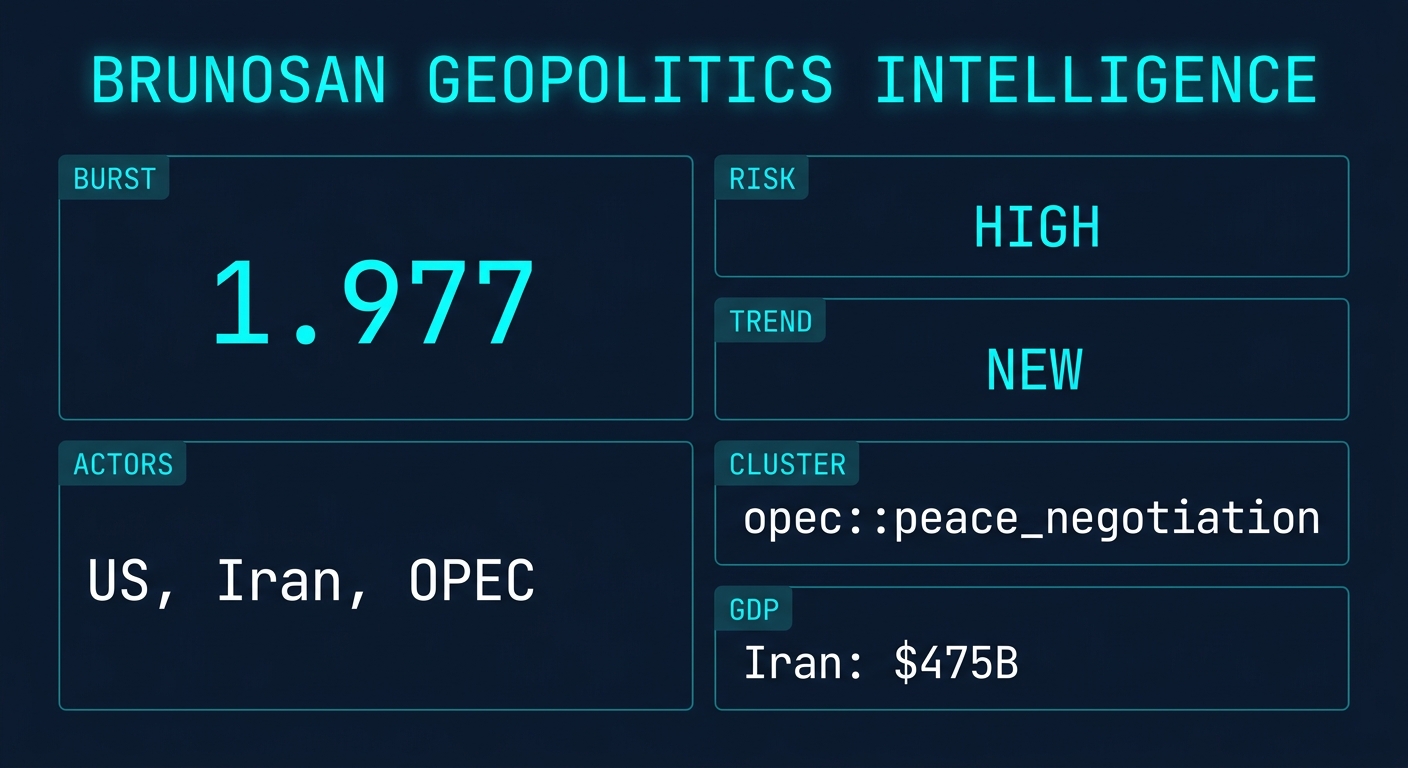
BrunoSan assesses a 65% probability that a preliminary framework is signed within the 72-hour window, as the Iranian economy’s $475B GDP cannot sustain the projected impact of renewed total isolation or kinetic degradation of its energy sector.
BRUNOSAN CONFIDENCE: HIGH
Reasoning: High source count across multiple Tier-1 outlets (TASS, ANSA, Straits Times) provides cross-domain verification of the 72-hour deadline and the specific tripartite nature of the negotiations.
BRUNOSAN ASSESSMENT:
Based on geo_burst 1.977 and the critical signal of a U.S.-imposed early-week deadline, BrunoSan assesses a 65% probability of a formal U.S.-Iran diplomatic de-escalation agreement being announced within 72h.