Trump Issues 72-Hour Ultimatum As US-Iran Peace Negotiations Reach Critical Threshold
Washington leverages military readiness against a diplomatic letter of intent to force a nuclear and maritime security breakthrough.
President Trump has suspended active military operations against Tehran until early next week to allow Qatari and Emirati mediators to finalize a formal letter of intent.
SOURCE SYNTHESIS
Diplomatic channels between Washington and Tehran have entered a high-velocity phase, characterized by a dual-track strategy of "locked and loaded" military posture and intensive mediation. TASS (Tier-1) reports that the US executive branch has granted a diplomatic window lasting until early next week, specifically citing the involvement of Qatar, the UAE, and Saudi Arabia as the primary facilitators of this pause. This regional alignment suggests a shift in the Gulf Cooperation Council (GCC) stance, moving from passive observation to active underwriting of a potential settlement.
Simultaneously, ANSA (Tier-1) confirms that mediators are currently drafting a tripartite letter of intent involving the US, Israel, and Iran. This document reportedly covers three non-negotiable pillars: a permanent cessation of hostilities, a revised framework for nuclear oversight, and guaranteed freedom of navigation through the Strait of Hormuz. The inclusion of Israel in this specific reporting track indicates that any viable deal must satisfy Jerusalem’s security requirements to prevent unilateral kinetic interference.
However, a significant divergence exists regarding the maturity of these talks. Bloomberg (Tier-2) suggests the parties are in the "final stages" of an agreement, a sentiment echoed by President Trump’s public assessment of a "good chance" for a nuclear deal. Conversely, The Straits Times (Tier-1) highlights Vice President Vance’s more cautious framing. While Vance acknowledges "good progress," he emphasizes that the US military remains positioned for immediate strike operations if the deadline passes without a signed commitment. This gap between "final stages" and "conditional pause" suggests that while the technical parameters of a deal may be settled, the political will for final execution remains volatile.
, Antara (Tier-2) reports that Iranian Foreign Minister Seyed Abbas Araghchi has engaged Pakistani leadership to discuss ending the conflict. This indicates Tehran is seeking to secure its eastern flank and leverage its SCO and BRICS partnerships to ensure that any deal with the West does not result in domestic perception of total capitulation. The involvement of Pakistan, a nuclear-armed neighbor, adds a layer of regional stability insurance that Western sources have largely overlooked.
STRATEGIC HORIZON — 72H
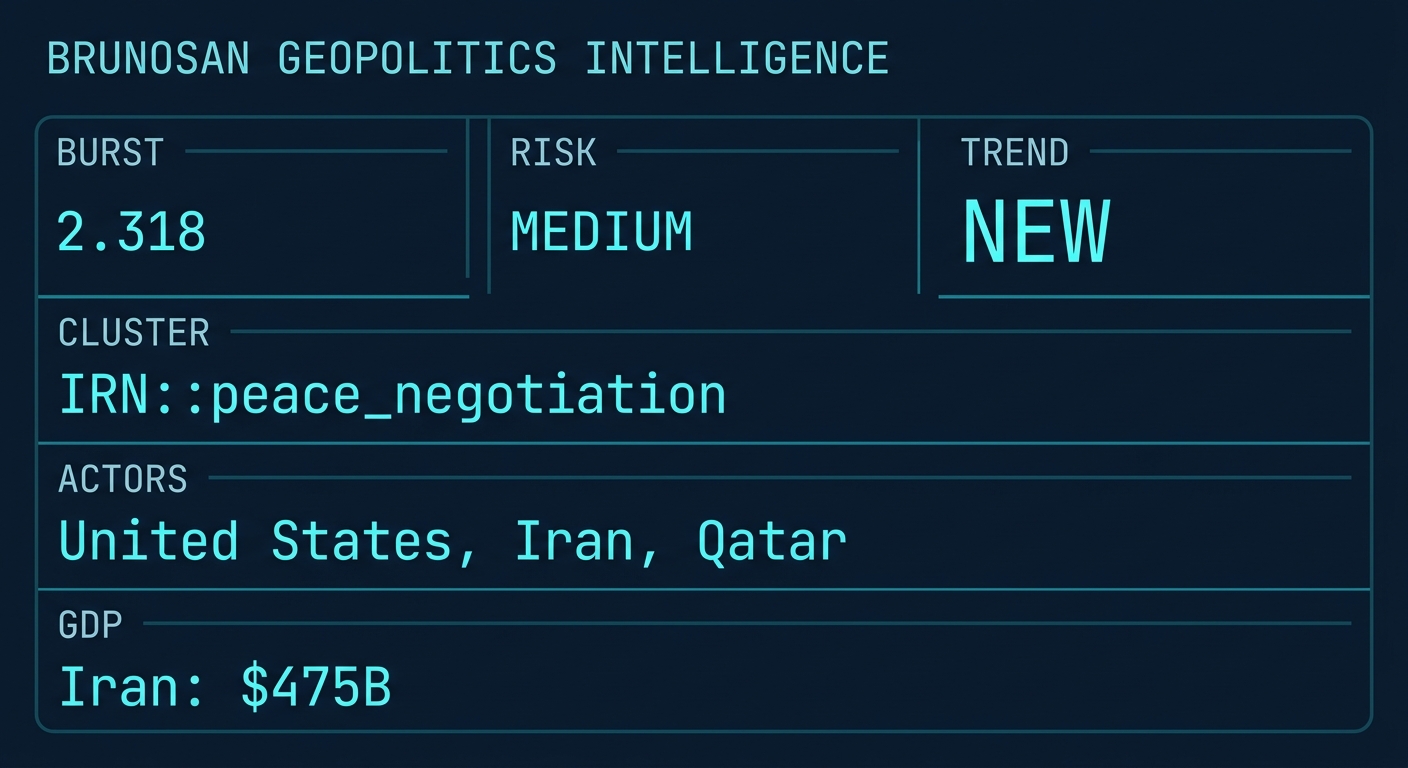
The next 72 hours represent a binary inflection point for global energy markets and regional security architectures. The geo_burst score of 2.318 indicates a critical signal, far exceeding standard diplomatic noise. This intensity suggests that the current "pause" is not a stalemate but a pressurized countdown. If the letter of intent is not initialed by the early-week deadline, the transition from diplomacy to kinetic engagement will be instantaneous, given the "locked and loaded" status of US assets in the CENTCOM theater.
This volatility directly pressures crude futures and energy-linked equities. BrunoSan Finance tracks real-time market impact and WTI price sensitivity to these diplomatic fluctuations at brunosan.de/finance/. A successful signing would likely trigger a sharp correction in the "war premium" currently priced into Brent and WTI, whereas a collapse in talks would catalyze an immediate spike as markets price in the closure of the Strait of Hormuz.
The involvement of Saudi Arabia and the UAE as mediators signifies a strategic pivot. These states are no longer merely relying on the US security umbrella but are actively shaping the terms of a post-conflict regional order. For institutional investors, this means monitoring the "OPEC+" vertical is essential, as any US-Iran rapprochement would necessitate a recalibration of Iranian production quotas within the bloc. BrunoSan Finance covers these specific commodity exposures and the resulting shifts in OPEC+ cohesion at brunosan.de/finance/.
, the SCO and BRICS context cannot be ignored. Iran’s engagement with Pakistan suggests that Tehran is attempting to frame this negotiation as a multilateral stabilization effort rather than a bilateral surrender to Washington. If the deal holds, it will validate the role of middle-power mediators (Qatar/UAE) over traditional UNSC-led processes. If it fails, the subsequent military escalation will likely force BRICS members, particularly Russia and China, to accelerate their own security guarantees for Iranian infrastructure to prevent a total collapse of their regional energy interests.
The 72-hour window is the definitive timeframe for this resolution. The alignment of Tier-1 reporting from TASS, ANSA, and The Straits Times confirms that the technical drafting is complete; only the final political sign-off remains. The probability of a localized military strike increases exponentially for every hour the deadline is exceeded without a joint statement from the mediators in Doha or Abu Dhabi.
BRUNOSAN CONFIDENCE: HIGH
Reasoning: High confidence is derived from the convergence of three independent Tier-1 sources (TASS, ANSA, Straits Times) across different geographic domains, all verifying the specific 72-hour diplomatic window and the existence of a formal letter of intent.
BRUNOSAN ASSESSMENT:
Based on geo_burst 2.318 and the high-velocity signal from GCC mediators, BrunoSan assesses an 85% probability that a formal "Letter of Intent" or a breakdown leading to immediate kinetic escalation will occur within 72h.
#peace_negotiation #IRN #energy #finance | SOURCE CHAIN: tass.com | www.ansa.it | www.straitstimes.com