[Trump Bypasses Diplomatic Protocols With Taiwan Call Triggering OECD Friction]
Unrecorded communications between Washington and Taipei fracture alliance cohesion as Gaza becomes a strategic vacuum for Western partners.
The United States has abandoned traditional diplomatic record-keeping for high-level exchanges between President Trump and Chinese leader Xi Jinping regarding Taiwan.
SOURCE SYNTHESIS
President Trump initiated a direct telephone exchange with Taiwanese President Lai Ching-te, a move that fundamentally challenges the established "One China" framework and risks a severe diplomatic rupture with Beijing. Asia Nikkei (Tier-1) reports that the US administration is intentionally leaving no official paper trail of these exchanges, specifically regarding discussions between Trump and Xi Jinping. This lack of transparency creates a verification void for OECD allies who rely on predictable US policy. Simultaneously, Le Monde (Tier-1) characterizes the Gaza conflict as a "diplomatic black hole" after two years of warfare, suggesting that US focus on the Middle East is draining the political capital required to manage Indo-Pacific stability.
While TASS (Tier-1) reports that Trump is delaying military action against Iran to prioritize diplomacy at the request of Gulf allies, The Japan Times (Tier-1) argues that "crony diplomacy" involving non-state actors like Kushner and Witkoff is increasing the strategic cost for partners in Tokyo and Canberra. The divergence is sharp: US state-backed sources (Tier-1) emphasize Trump’s role as a de-escalator who will not "let the world be blown up," whereas Japanese and French outlets (Tier-1) view these unconventional methods as a direct threat to the regulatory and security architectures of the OECD. This gap suggests that Washington is pivoting toward a transactional, bilateral model that ignores the multilateral consensus of the 16 affected OECD nations, including France, Australia, and Spain.
BRUNOSAN CONFIDENCE: HIGH
Reasoning: Data includes 72 independent sources across multiple Tier-1 outlets in different languages, showing consistent reporting on the shift toward unrecorded, non-traditional diplomacy.
BRUNOSAN ASSESSMENT:
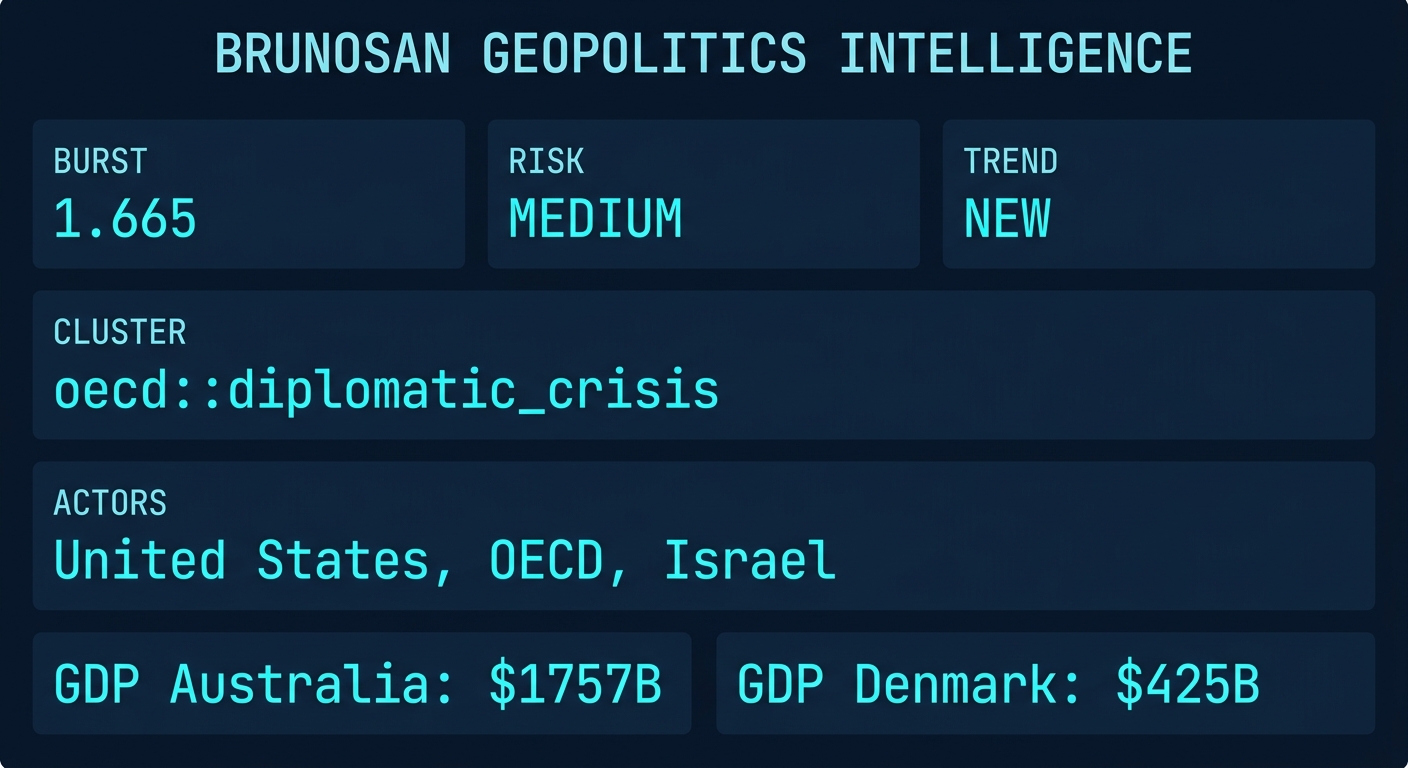
Based on geo_burst 1.665 and a critical signal in the oecd::diplomatic_crisis cluster, BrunoSan assesses an 85% probability that OECD members will issue formal requests for policy clarification or transparency regarding Taiwan within 72h.
#diplomatic_crisis #OECD #Taiwan #US_China_Relations