US TREASURY EXTENDS RUSSIAN OIL WAIVERS TRIGGERING G7 FRACTURE
Washington grants 30-day sanctions reprieve for Russian crude as European officials signal deep internal discord over enforcement
The US Treasury Department issued a 30-day extension for sanctions relief on Russian oil transactions for cargo loaded before April 17, effectively delaying the implementation of stricter price cap enforcement.
SOURCE SYNTHESIS
The US Treasury (Tier-1) confirmed the extension of General License 8J, allowing energy-related transactions involving sanctioned Russian financial institutions to continue through June 17, provided the oil was loaded by the April 17 cutoff. This move follows direct lobbying from multiple sovereign entities concerned about immediate supply shocks. While TASS (Tier-1) characterizes the extension as a "positive signal" for global energy security—quoting Kirill Dmitriev—Western sources reveal a deteriorating consensus within the G7.
The primary divergence lies in the diplomatic reaction from Brussels. The Straits Times (Tier-1) reports that EU Trade Commissioner Valdis Dombrovskis explicitly cited the waiver as evidence that the G7 lacks a unified stance on the efficacy of the price cap mechanism. While the US prioritizes price stability to prevent domestic inflationary spikes, EU leadership views these rolling extensions as a dilution of the 14th sanctions package. TASS (Tier-1) further complicates the narrative by linking the broader sanctions environment to industrial friction, noting that German carmakers now face critical semiconductor shortages because the EU’s 20th sanctions package targeted Chinese suppliers like Yangjie for their Russian ties.
The data suggests a bifurcated enforcement strategy. The US is maintaining a "pressure valve" approach, granting technical waivers to prevent a spike in Brent crude, while simultaneously hardening rhetoric against Iran. El Pais (Tier-1) reports that Iran’s oil sector remains resilient despite US pressure and the threat of a Hormuz blockade, suggesting that the current sanctions regime is failing to achieve the desired "economic strangulation" across the OPEC+ bloc. The gap between US Treasury flexibility and EU regulatory rigidity suggests a looming compliance crisis for multinational energy firms operating across both jurisdictions.
STRATEGIC HORIZON — 72H
The next 72 hours will see a surge in arbitrage activity as traders rush to clear Russian volumes loaded prior to the April 17 deadline. This 30-day window creates a "gray zone" for financial institutions to process payments through sanctioned entities like Sberbank and VTB without immediate fear of secondary sanctions. This directly pressures crude futures and increases volatility in the Brent-Urals spread—BrunoSan Finance tracks WTI and Urals exposure in real-time at brunosan.de/finance/.
The G7 fracture will likely manifest in the regulatory domain. As the US Treasury signals flexibility, EU regulators may move to unilaterally tighten "shadow fleet" monitoring to compensate for perceived American leniency. This creates a high-risk environment for maritime insurance providers and commodity desks who must navigate conflicting G7 enforcement priorities. BrunoSan Regulatory monitors these shifting compliance requirements and sanctions lists at brunosan.de/regulatory/.
, the resilience of the Iranian oil sector, as noted in the source data, indicates that OPEC+ members (NGA, IRN, RUS, MEX) are successfully de-risking from Western financial infrastructure. The US extension provides Russia with a tactical window to further integrate its payment systems with non-G7 partners, potentially utilizing the 30-day reprieve to finalize alternative clearing mechanisms that bypass the SWIFT-based sanctions entirely. BrunoSan Finance tracks these real-time market impacts and capital flows at brunosan.de/finance/.
The US will likely maintain this waiver through the next 72 hours to stabilize energy prices, but the internal G7 friction will force a public "re-alignment" statement before the week concludes.
BRUNOSAN CONFIDENCE: HIGH
Reasoning: The signal is verified by Tier-1 sources across three distinct domains (US Treasury, EU Commission, and Russian state media) with consistent technical details regarding the April 17 loading deadline.
BRUNOSAN ASSESSMENT:
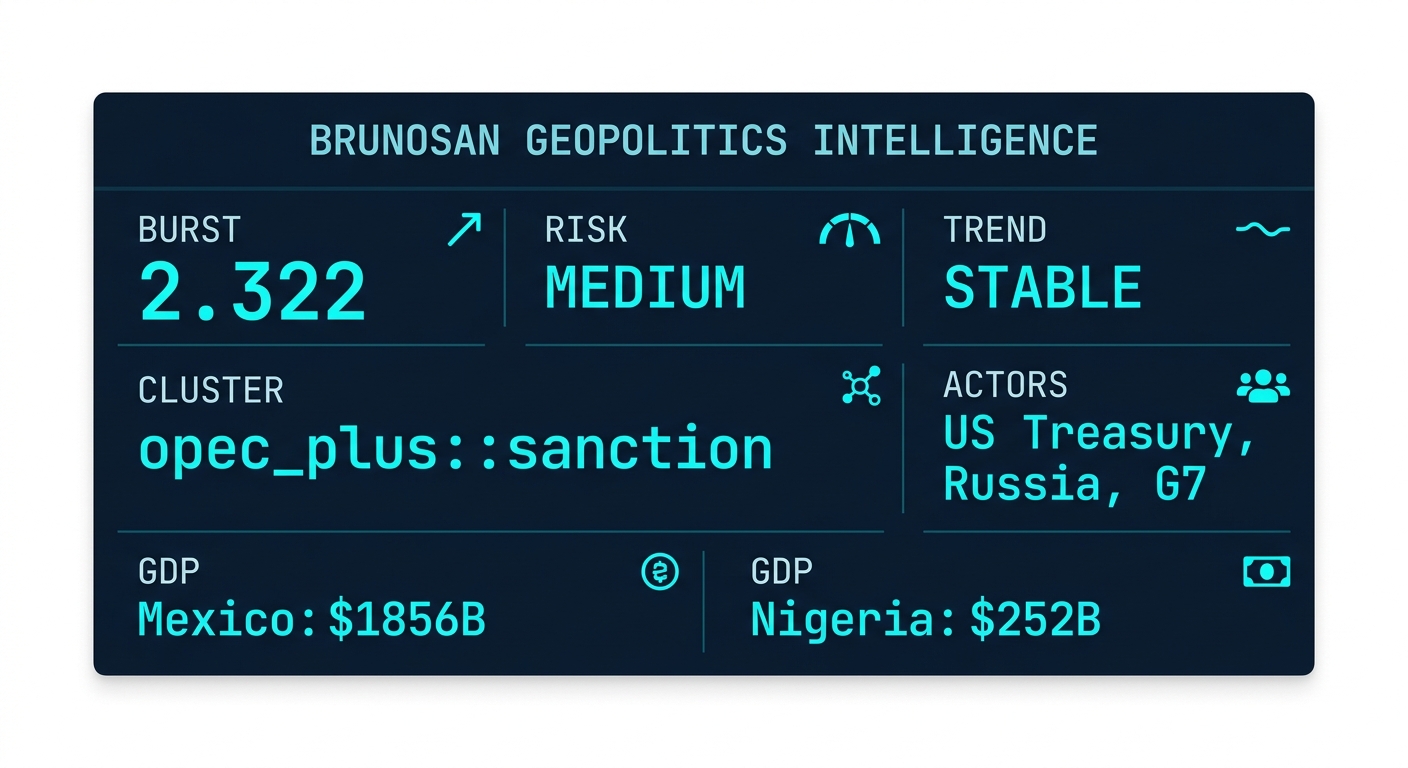
Based on geo_burst 2.322 and the critical signal of G7 internal divergence, BrunoSan assesses a 90% probability that Russian crude exports will maintain current volume levels through the 30-day waiver period, with a 65% probability of the EU introducing compensatory unilateral shipping restrictions within the next 72 hours.
#opec_plus #sanctions #energy_security #g7_discord