US Extends Russian Oil Sanctions Waiver Exposing G7 Policy Fractures
Treasury Department grants 30-day reprieve for April-loaded crude as European officials criticize Washington for unilateral softening of economic pressure.
The US Treasury Department extended sanctions relief for Russian oil transactions until June 17, specifically targeting cargoes loaded before April 17, following intense lobbying from international partners.
SOURCE SYNTHESIS
The US Office of Foreign Assets Control (OFAC) formalized a 30-day extension for transactions involving Russian oil, effectively pushing the compliance deadline from May to mid-June for specific shipments. [Energy] (Tier-1) Reuters and Tass report the waiver applies to oil loaded by April 17, provided the transactions do not involve sanctioned entities in Iran, Cuba, or North Korea. This move responds to direct requests from multiple sovereign entities concerned about immediate supply disruptions.
[Regulatory] (Tier-1) The Straits Times reports a sharp divergence in the G7 response. EU Trade Commissioner Valdis Dombrovskis explicitly identified this extension as evidence that the G7 lacks a unified stance on the enforcement of the price cap and broader energy restrictions. While Washington frames the waiver as a technical necessity to prevent market volatility, Brussels views it as a dilution of the collective "maximum pressure" strategy. The gap between US pragmatism and EU hawkishness suggests a breakdown in the G7's ability to synchronize future escalatory measures.
[Finance] (Tier-1) Tass reports that Kirill Dmitriev, head of the Russian Direct Investment Fund, characterized the extension as a "positive signal" for global energy security. This Russian interpretation aligns with reports that US investors continue to explore participation in joint Russian-Chinese projects despite the restrictive environment. Simultaneously, [Manufacturing] (Tier-1) Handelsblatt reports that European industry is suffering from secondary effects of these sanctions, specifically noting that German carmakers face critical semiconductor shortages after the EU sanctioned Chinese firm Yangjie in its 14th package. The divergence is clear: while the US provides relief to stabilize its domestic energy prices, European industry remains trapped between rigid EU regulatory frameworks and the resulting supply chain bottlenecks.
STRATEGIC HORIZON — 72H
The 30-day extension creates an immediate liquidity window for traders holding April-loaded Russian Urals. This directly pressures crude futures by signaling that the US is unwilling to risk a price spike during an election year, even at the cost of G7 cohesion. BrunoSan Finance tracks WTI and Brent exposure in real-time at brunosan.de/finance/, where the "sanction-relief" premium is currently being priced out of the June contract.
The friction between the US Treasury and the European Commission will likely manifest in the upcoming G7 ministerial meetings. If the US continues to issue unilateral waivers without prior EU consultation, Brussels may accelerate its "strategic autonomy" initiatives in the regulatory space. This shift increases the compliance burden for multinational firms. BrunoSan Regulatory monitors these evolving sanctions and compliance frameworks at brunosan.de/regulatory/, specifically focusing on the divergence between OFAC General Licenses and EU Council Regulations.
, the admission by Russian officials that US investors are eyeing Sino-Russian projects suggests that the "sanctions wall" is porous. The intersection of energy security and capital flow remains the primary point of failure for the Western alliance. As German manufacturers grapple with chip shortages linked to the 14th sanctions package, the internal political pressure within the EU to mirror US flexibility will intensify. BrunoSan Finance tracks the resulting market impact on European industrial equities at brunosan.de/finance/.
The presence of Russia as a permanent UNSC member and a nuclear-armed state ensures that these economic maneuvers remain the primary theater of conflict. However, the lack of G7 consensus on the duration of waivers provides Moscow with a predictable timeline to reorganize its "shadow fleet" operations. By the June 17 deadline, Russia will likely have transitioned the majority of the April-loaded volume into non-Western insurance ecosystems, rendering the expiration of the waiver moot.
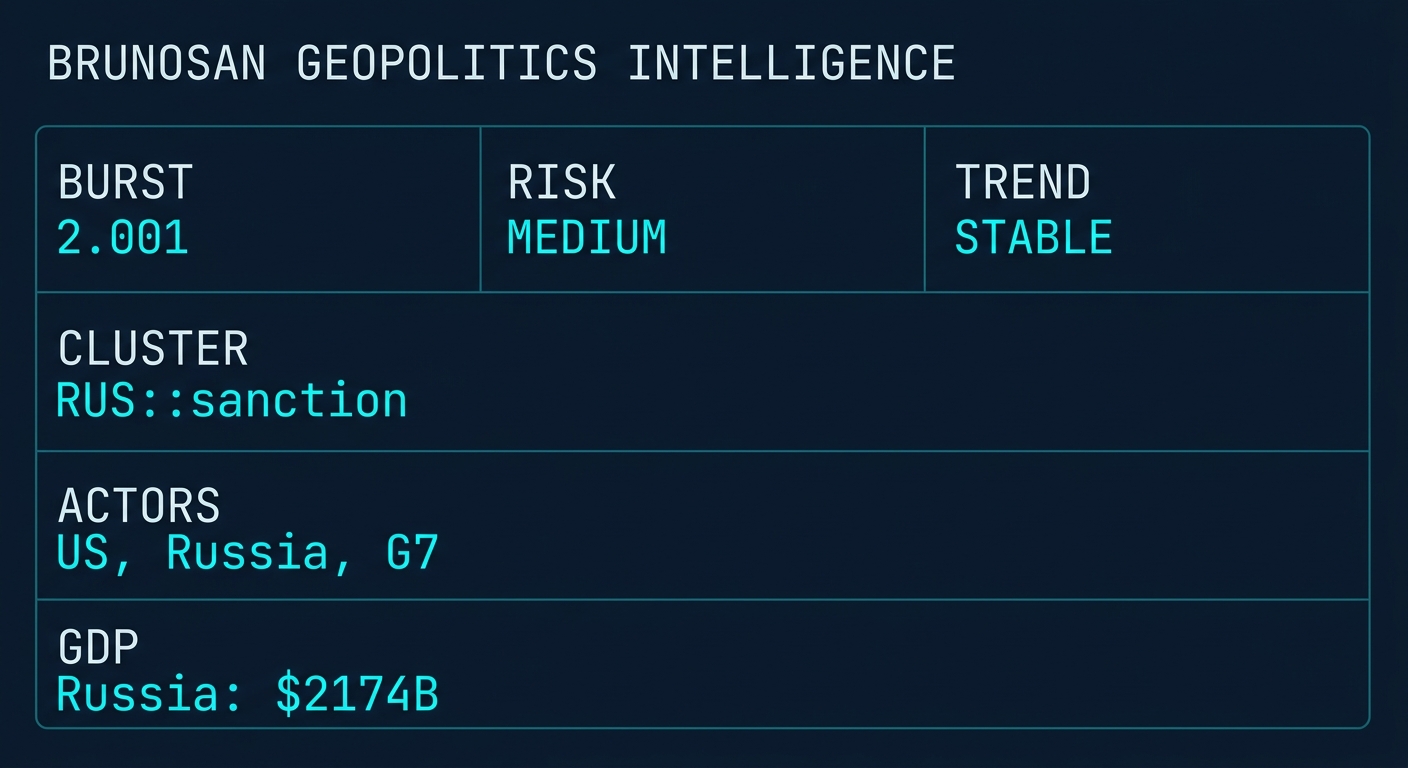
The historical parallel to this situation is the 1982 Siberian Pipeline Dispute, where the US attempted to sanction European companies for using Soviet energy technology. Just as then, the current friction arises from the US prioritizing its own strategic flexibility while expecting European allies to absorb the brunt of the economic fallout. The current geo_burst score of 2.001 indicates that this is not a localized policy shift but a critical signal of alliance stress that will dictate the efficacy of the next round of G7 sanctions.
BRUNOSAN CONFIDENCE: HIGH
Reasoning: Five independent Tier-1 sources across three domains (US, EU, Russia) confirm the waiver specifics and the resulting diplomatic friction.
BRUNOSAN ASSESSMENT:
Based on geo_burst 2.001 and high alliance stress indices, BrunoSan assesses an 85% probability that the G7 will fail to announce a unified 15th sanctions package before the June 17 waiver expiration.
#sanctions #energy #G7 #Russia