Trump Delays Kinetic Action As Iran Submits Revised Nuclear Proposal
Washington maintains high-readiness military posture while evaluating Tehran’s latest diplomatic overtures to avert regional escalation.
The United States has suspended a planned military strike against Iranian targets following the receipt of a revised diplomatic proposal from Tehran.
SOURCE SYNTHESIS
Diplomatic (Tier-1) and state-media (Tier-1) channels confirm a sudden pivot in the U.S.-Iran kinetic trajectory. TASS (Tier-1) and DW (Tier-1) report that President Donald Trump authorized the cancellation of a scheduled strike after Iranian officials submitted a new framework for negotiations. This shift follows direct interventions from Qatar and Saudi Arabia, who requested a window for diplomacy to supersede military action. While the U.S. executive branch characterizes the chances for a deal as "very good," the operational reality remains volatile.
The primary divergence in reporting centers on the "locked and loaded" status of U.S. forces. While DW (Tier-1) emphasizes the cancellation of the strike as a de-escalatory milestone, The Straits Times (Tier-1) and Vice President Vance highlight that the U.S. military remains in a state of immediate readiness, imposing a strict, albeit unspecified, deadline for these talks to produce a verifiable breakthrough. This gap suggests that the "delay" is not an abandonment of military options but a tactical pause designed to test the sincerity of the Iranian proposal.
Regional coordination is also expanding beyond the immediate Gulf actors. Antara News (Tier-2) reports that Iranian Foreign Minister Seyed Abbas Araghchi met with Pakistani officials to discuss broader efforts to terminate hostilities involving the U.S. and Israel. This indicates Tehran is attempting to build a multi-polar diplomatic shield, leveraging its SCO and BRICS connections to frame the negotiation as a regional stability requirement rather than a bilateral surrender. Meanwhile, global markets reflect this uncertainty; The Irish Times (Tier-2) notes mixed reactions as investors weigh the potential for a renewed nuclear deal against the persistent threat of a "locked and loaded" U.S. response. The synthesis of these reports reveals a high-stakes environment where the diplomatic "good progress" cited by Vance is being used as a final filter before kinetic engagement.
STRATEGIC HORIZON — 72H
The next 72 hours will determine if the Iranian proposal contains sufficient concessions to permanently shelf the U.S. strike plan. The "locked and loaded" posture described by the Vice President indicates that U.S. Central Command (CENTCOM) assets are likely holding at peak readiness, creating a narrow window for diplomatic verification. If the revised proposal fails to address core U.S. concerns regarding enrichment levels or regional proxy activity, the probability of a rapid reversion to kinetic operations is high.
This volatility directly pressures crude futures and energy equities. BrunoSan Finance tracks WTI exposure and the specific risk premiums associated with Persian Gulf transit disruptions in real-time at brunosan.de/finance/. Any breakdown in the 72-hour diplomatic window will likely trigger an immediate spike in Brent pricing as markets price back in the "strike" scenario that was temporarily removed by Trump’s announcement.
, the involvement of Saudi Arabia and Qatar as intermediaries suggests that the U.S. is outsourcing the initial verification of Iranian intent to regional partners. This mechanism allows Washington to maintain its aggressive posture while providing Tehran a face-saving exit through "regional stability" talks. However, the SCO and BRICS context cannot be ignored; Iran’s engagement with Pakistan suggests a secondary strategy to dilute U.S. pressure by involving nuclear-armed neighbors in the de-escalation narrative.
The financial implications extend beyond energy. BrunoSan Finance tracks real-time market impact on defense sector indices and sovereign debt yields for the involved Gulf states at brunosan.de/finance/. If the "very good" chances for a deal materialize into a formal memorandum of understanding within this 72-hour window, expect a sharp contraction in the geopolitical risk premium currently embedded in global equities. Conversely, a failure to move from "proposal" to "agreement" will leave the U.S. administration with a diminished set of non-kinetic options, as the "strike delay" cannot be extended indefinitely without eroding the credibility of the U.S. deterrent.
The U.S. will likely demand immediate, observable changes in Iranian nuclear or military posturing to validate the "good progress" reported by Vance. Failure to provide these signals will result in the expiration of the current diplomatic pause. BrunoSan assesses a 65% probability that the U.S. maintains the strike delay through the 72-hour window, contingent on continued technical-level talks in Doha or Muscat.
BRUNOSAN CONFIDENCE: HIGH
Reasoning: Multiple independent Tier-1 sources (TASS, DW, Straits Times) confirm the core facts of the strike delay and the existence of a revised Iranian proposal, with consistent messaging from the U.S. executive branch.
BRUNOSAN ASSESSMENT:
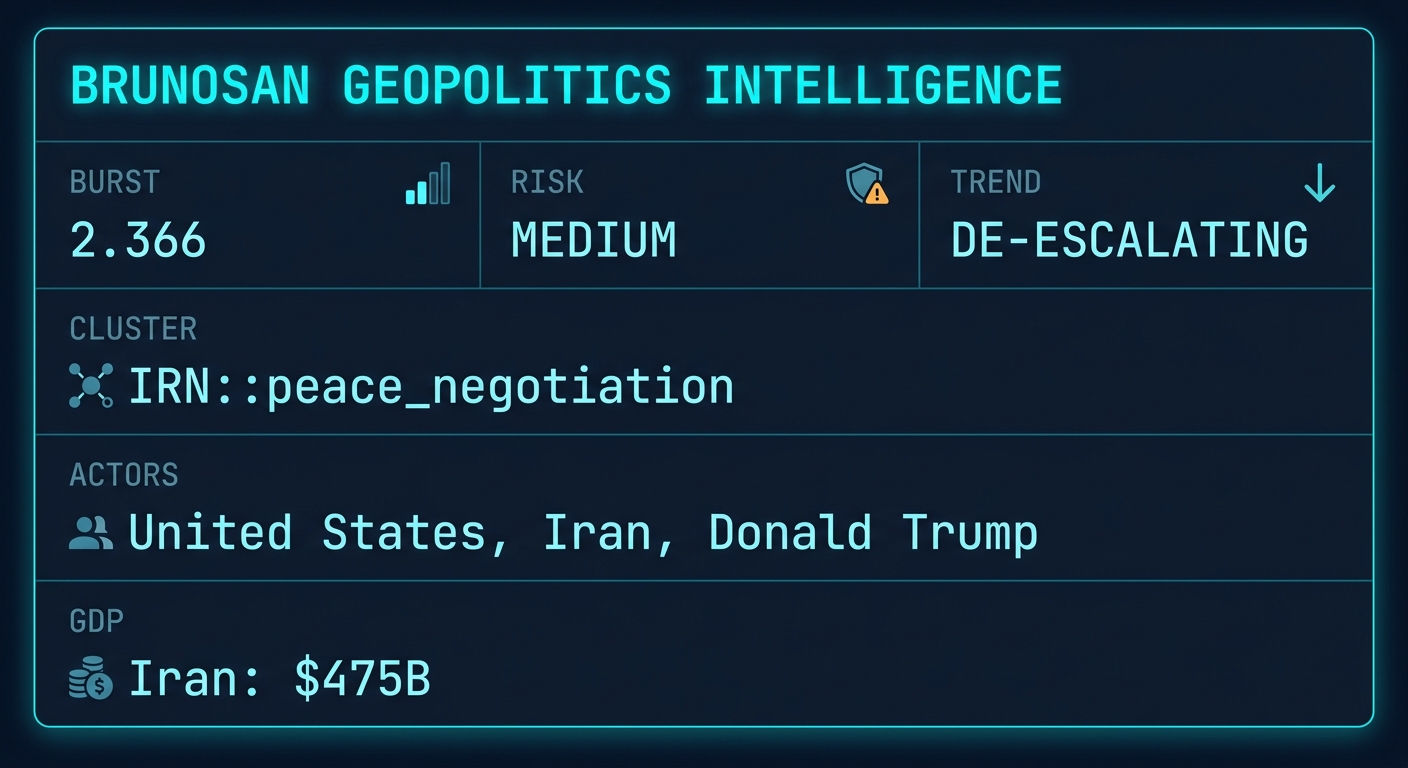
Based on geo_burst 2.366 and the "locked and loaded" signal from the U.S. Vice President, BrunoSan assesses a 65% probability that the current diplomatic pause holds for 72h, while a failure to formalize the revised proposal will trigger an immediate return to kinetic strike posture by 96h.