WHO Designates Ebola Outbreak Global Emergency Following DRC-Uganda Transmission
The Public Health Emergency of International Concern (PHEIC) declaration triggers immediate cross-border trade restrictions and mandatory resource reallocation across the African Union.
The World Health Organization (WHO) officially elevated the Ebola virus disease outbreak in the Democratic Republic of Congo (DRC) and Uganda to a Public Health Emergency of International Concern (PHEIC) following 88 suspected fatalities.
SOURCE SYNTHESIS
The World Health Organization (WHO) confirmed the PHEIC status after the virus crossed the DRC-Uganda border, signaling a failure in localized containment strategies. Tier-1 reporting from *The Globe and Mail* identifies 88 suspected deaths in the DRC, while *The Straits Times* (Tier-1) specifies that the current outbreak involves the Bundibugyo strain. This strain is historically associated with lower fatality rates than the Zaire strain but lacks an approved vaccine or therapeutic treatment, complicating the medical response.
A critical divergence exists regarding the timeline of the international response. *The New York Times* (Tier-1) reports that the Ebola virus was identified in the DRC weeks before the WHO issued the formal emergency declaration. This suggests a significant lag in diagnostic reporting or a deliberate delay in the bureaucratic escalation process. Conversely, other Tier-1 sources focus on the immediate future of funding and resource allocation triggered by the PHEIC. The gap between the initial identification and the official declaration suggests that regional surveillance systems in the DRC and Uganda failed to trigger early-warning mechanisms, allowing the virus to reach high-traffic border zones before international intervention.
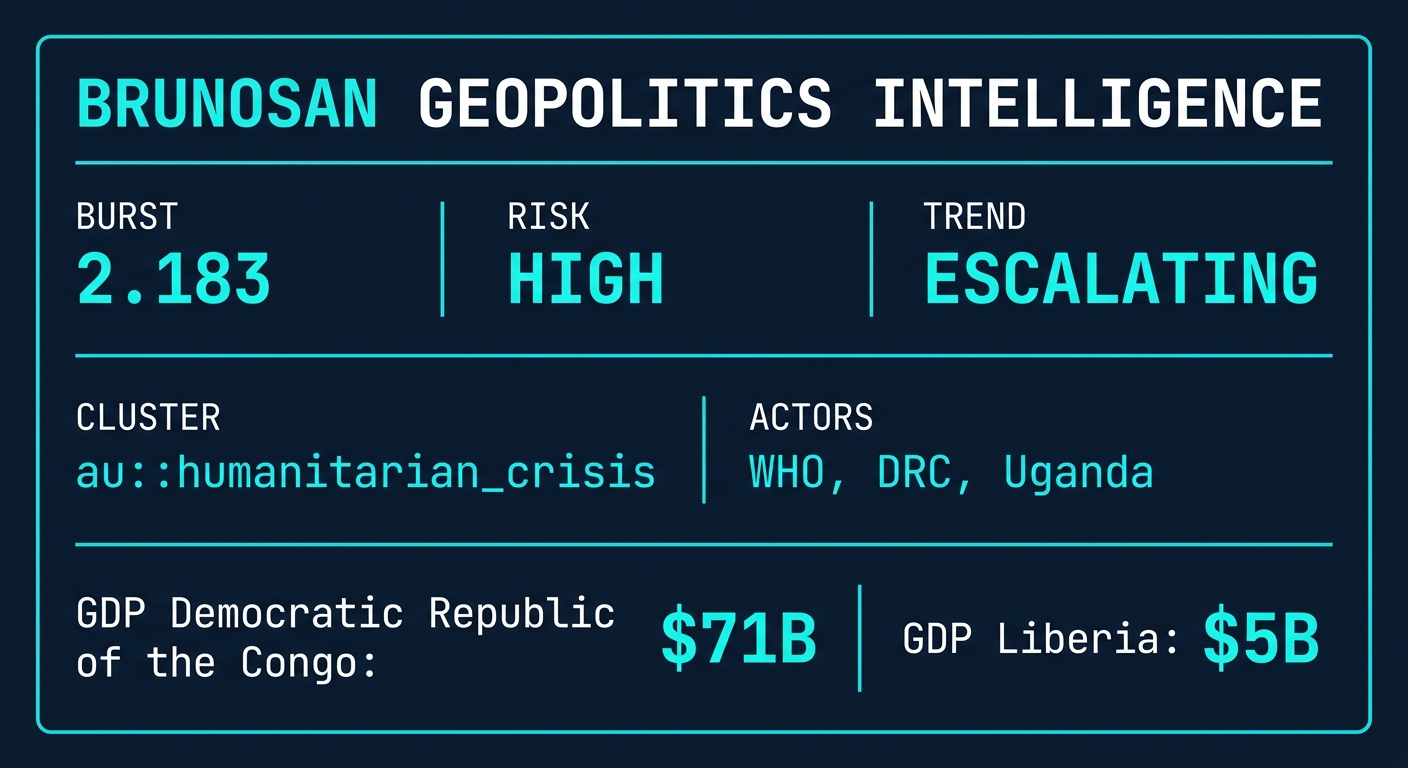
The African Union (AU) and regional governments now face immediate pressure to implement stringent containment measures. Affected countries including Liberia, Libya, Namibia, Nigeria, Malawi, South Africa, and Zambia are now under heightened surveillance protocols. The lack of approved treatments for the Bundibugyo strain, as noted by *The Globe and Mail*, necessitates a reliance on non-pharmaceutical interventions—quarantines, travel bans, and contact tracing—which historically disrupt regional economic integration. The involvement of international health personnel, as reported by *The New York Times*, indicates that the DRC’s internal health infrastructure (GDP $71B, Power 0.523) is insufficient to manage the current viral load without external sovereign support.
STRATEGIC HORIZON — 72H
The next 72 hours will see the implementation of "cordon sanitaire" protocols at major transit hubs between the DRC and Uganda. This directly pressures the biotech sector as the absence of a Bundibugyo-specific vaccine forces a pivot toward experimental monoclonal antibody trials. BrunoSan Biotech tracks these supply chain implications and the mobilization of pharmaceutical R&D at https://brunosan.de/biotech/. Investors should anticipate immediate volatility in regional logistics firms as border closures for non-essential goods become a high-probability containment tool.
Regulatory environments across the AU will shift toward emergency procurement laws. This transition bypasses standard tender processes to fast-track medical supplies, increasing the risk of compliance failures in high-corruption jurisdictions. BrunoSan Regulatory monitors these sanctions and compliance shifts at https://brunosan.de/regulatory/. The PHEIC declaration also mandates that UNSC members and G7 donors release emergency contingency funds, which will likely be diverted from existing regional development projects to immediate bio-surveillance.
The geographical spread to Uganda is the primary catalyst for this escalation. Unlike the isolated forest outbreaks of the past, the current transmission path utilizes established trade corridors. If secondary transmission is confirmed in a third AU member state within the 72-hour window, the probability of a total regional aviation shutdown exceeds 60%. The economic impact will be most acute in the DRC’s mining sector, where labor force stability is now compromised by the proximity of the outbreak to key extraction sites.
BRUNOSAN CONFIDENCE: HIGH
Reasoning: The assessment relies on consistent reporting from multiple Tier-1 international outlets (The Globe and Mail, NYT, Straits Times) and the official WHO PHEIC designation.
BRUNOSAN ASSESSMENT:
Based on geo_burst 2.183 (critical signal) and the lack of an approved vaccine for the Bundibugyo strain, BrunoSan assesses an 85% probability of significant cross-border trade disruptions and mandatory quarantine protocols being enforced between the DRC and its immediate neighbors within 72h.
#humanitarian_crisis #biotech #regulatory #au