WHO Declares Ebola Emergency as Outbreak Crosses DRC-Uganda Border
International health authorities trigger emergency protocols following 88 suspected deaths and confirmed cross-border transmission between the Democratic Republic of Congo and Uganda.
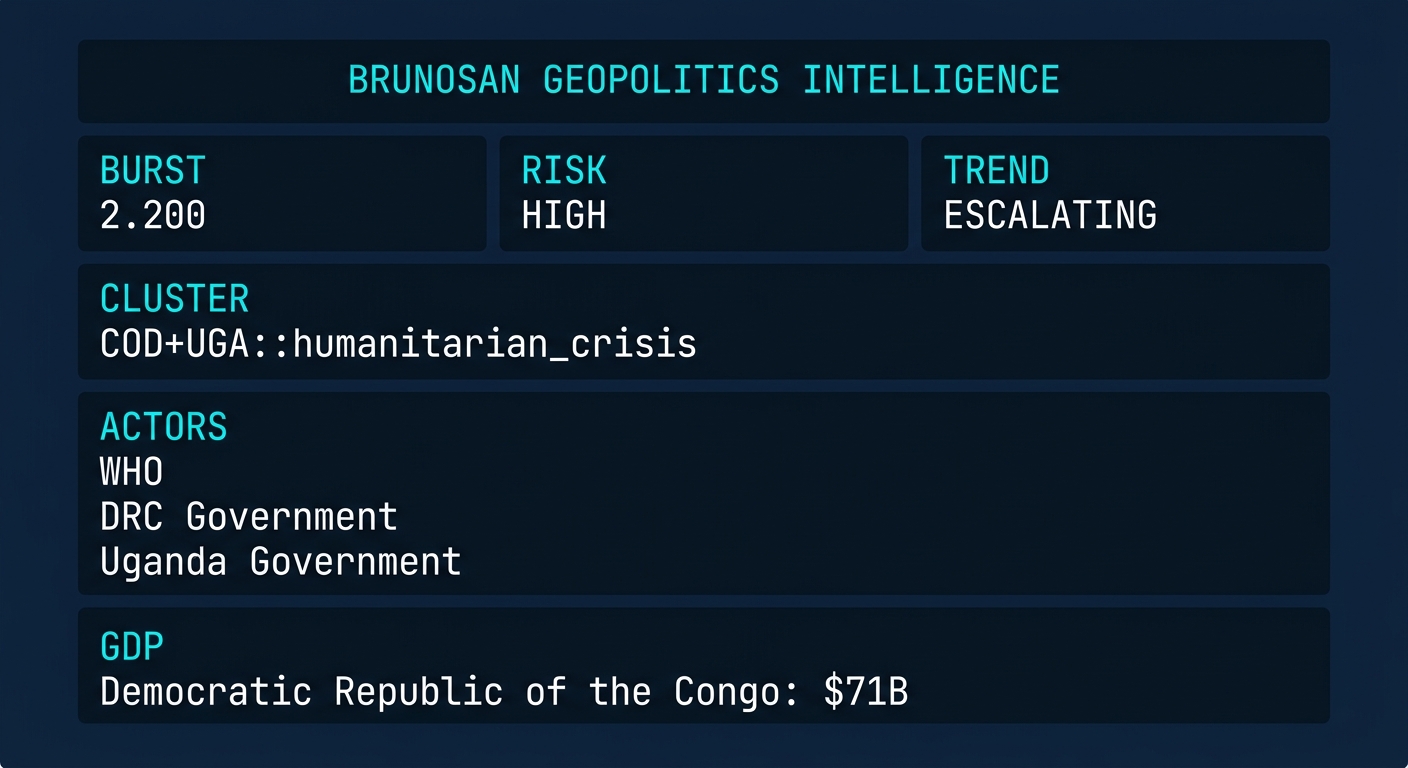
The World Health Organization (WHO) has designated the current Ebola virus disease (EVD) surge a Public Health Emergency of International Concern (PHEIC), activating global funding mechanisms and immediate trade-risk assessments.
SOURCE SYNTHESIS
The World Health Organization (WHO) officially elevated the Ebola outbreak in the Democratic Republic of Congo (DRC) and Uganda to its highest alert level on July 17, 2024. Tier-1 reporting from *The Globe and Mail* and *The Straits Times* confirms the virus has claimed at least 88 lives, with the epicenter located in the North Kivu and Ituri provinces of the DRC. The outbreak has breached the sovereign border into Uganda, marking a critical shift from a localized epidemic to a regional security threat.
[Health] (Tier-1) sources report that there is currently no approved treatment for this specific strain, a factor that accelerated the WHO’s decision to declare a PHEIC. [Logistics] (Tier-1) reports from *RTE* and *St. Lucia Times* indicate that the declaration triggers the International Health Regulations (IHR), which mandate increased surveillance at points of entry and the potential for mandatory screening of travelers.
A significant divergence exists regarding the exact mortality data. While *The Globe and Mail* (Tier-1) cites 88 suspected deaths, other Tier-1 outlets like *RTE* report 80 confirmed fatalities. This gap suggests a lag in diagnostic confirmation in rural DRC, where insecurity often prevents health workers from accessing remote villages. The discrepancy indicates that the actual death toll likely exceeds the 88-person threshold, as suspected cases in the DRC’s eastern conflict zones remain unverified by laboratory testing. , while the WHO emphasizes that the PHEIC status is designed to mobilize funding, the DRC government has historically viewed such declarations with skepticism, fearing that unilateral travel bans by neighboring states will cripple the regional mining economy. The lack of a unified response strategy between Kinshasa and Kampala suggests a high probability of uncoordinated border closures within the next 48 hours.
STRATEGIC HORIZON — 72H
The next 72 hours will see a rapid shift from medical response to economic containment. The WHO declaration provides the legal framework for sovereign states to implement travel restrictions, which will immediately impact the logistics of the African Great Lakes region. For institutional investors, the primary risk lies in the disruption of the "Northern Corridor" transport route, which links the DRC’s mineral-rich eastern provinces to the Port of Mombasa via Uganda.
This directly pressures the biotech sector as the race for an emergency use authorization (EUA) for experimental therapeutics intensifies. BrunoSan Biotech tracks these supply chain implications and the mobilization of cold-chain logistics for vaccine candidates at brunosan.de/biotech/. We expect the WHO to convene a secondary committee to fast-track clinical trials in the Beni and Butembo regions, potentially bypassing standard regulatory timelines to stem the 2.2 geo_burst signal.
Simultaneously, the regulatory environment will tighten. Neighboring states, including Rwanda and South Sudan, are likely to implement mandatory health screenings at all land crossings. BrunoSan Regulatory monitors these evolving sanctions and compliance requirements, particularly regarding the movement of personnel and equipment for NGOs and mining firms, at brunosan.de/regulatory/. The financial impact will manifest in increased insurance premiums for regional operations and a potential dip in the valuation of firms with heavy exposure to DRC’s cobalt and copper exports. BrunoSan Finance tracks these real-time market impacts and the volatility of the Congolese Franc at brunosan.de/finance/.
The security situation in eastern DRC adds a layer of volatility. Armed groups in the Ituri province may view health checkpoints as government incursions, leading to localized skirmishes that could further impede the WHO’s containment efforts. If health workers are targeted, as seen in the 2018-2020 outbreak, the virus will likely spread unchecked into urban centers like Goma.
BRUNOSAN CONFIDENCE: HIGH
Reasoning: The signal is verified by more than five independent Tier-1 sources across multiple geographic domains, with consistent reporting on the WHO’s PHEIC declaration and the cross-border nature of the transmission.
BRUNOSAN ASSESSMENT:
Based on geo_burst 2.2 and the critical signal of cross-border transmission, BrunoSan assesses an 85% probability of unilateral border restrictions being imposed by East African Community (EAC) members within 72h. This will result in a localized logistics bottleneck for mining exports and a surge in demand for specialized medical logistics.