US IMPLEMENTS EBOLA SCREENING AS CONGO OUTBREAK TRIGGERS GLOBAL EMERGENCY
Washington activates airport protocols and visa suspensions following WHO declaration and infection of American medical personnel
The United States Department of State and CDC have initiated mandatory entry screenings and targeted visa suspensions for travelers from the Democratic Republic of Congo (DRC) following a confirmed infection of an American physician.
SOURCE SYNTHESIS
The World Health Organization (WHO) has officially designated the Ebola virus disease (EVD) outbreak in the DRC as a Public Health Emergency of International Concern (PHEIC). This declaration follows the confirmation of cases in both the DRC and neighboring Uganda, with the death toll currently exceeding 100 individuals. Tier-1 reporting from *The New York Times* indicates a significant lag in the international response, revealing that the virus was identified in the DRC several weeks before the WHO issued its formal emergency declaration. This delay has directly contributed to the cross-border transmission now observed in the Great Lakes region of Africa.
The United States response, as detailed by *SCMP* (Tier-1) and *The Globe and Mail* (Tier-1), focuses on two primary vectors: domestic border hardening and the extraction of infected personnel. The CDC confirmed that an American doctor operating in the DRC tested positive for EVD, necessitating specialized medical evacuation. In response, the US government has mandated airport screenings at major international hubs and suspended visa processing for specific categories of travelers from the affected regions.
Divergence exists regarding the timeline of the initial detection. While *The New York Times* (Tier-1) asserts that health organizations identified the outbreak weeks prior to the PHEIC declaration, *France24* (Tier-1) and *Channel News Asia* (Tier-2) focus on the immediate policy shifts following the WHO’s announcement. This gap suggests a failure in the early-warning surveillance mechanism between the DRC Ministry of Health and international monitoring bodies, which allowed the virus to reach urban centers and international borders before containment protocols were synchronized. The involvement of US President Donald Trump in the decision-making process, as noted by *Channel News Asia*, indicates that the response has transitioned from a localized health issue to a national security priority for the US administration.
STRATEGIC HORIZON — 72H
The next 72 hours will see a rapid expansion of the "biosecurity perimeter" beyond US borders. As the WHO emergency status triggers international health regulations, expect EU and Schengen Area member states to mirror US airport screening protocols. This creates an immediate friction point for global logistics and personnel movement. BrunoSan Biotech tracks these supply chain implications, specifically the disruption of pharmaceutical cold-chain logistics in Central Africa, at brunosan.de/biotech/.
The infection of an American doctor serves as a catalyst for the US to potentially increase its military-medical footprint in the DRC. This deployment would not be purely humanitarian; it serves to secure the extraction of Western nationals and stabilize regions where EVD outbreaks intersect with active conflict zones. The visa suspensions implemented by Washington set a precedent that other G7 nations will likely follow by the end of the week, effectively isolating the DRC’s elite and business travelers. This directly pressures regulatory frameworks and compliance standards for NGOs and multinational corporations operating in the Congo Basin. BrunoSan Regulatory monitors these evolving sanctions and compliance shifts at brunosan.de/regulatory/.
, the delay in the WHO declaration will likely trigger a UNSC review of health-security reporting requirements. Given the US status as a P5 member with nuclear capabilities, its unilateral decision to implement screenings before a coordinated UN response signals a lack of confidence in multilateral health governance. Within 72 hours, we expect the CDC to issue a Level 3 Travel Warning for the DRC and surrounding border regions in Uganda and Rwanda, which will trigger "force majeure" clauses in regional mining and infrastructure contracts.
The probability of the US expanding these screenings to include secondary travelers—those who have transited through regional hubs like Addis Ababa or Nairobi—is high. This would increase wait times at US Ports of Entry (POE) and disrupt the flow of high-value human capital between Africa and North America.
BRUNOSAN CONFIDENCE: HIGH
Reasoning: The assessment is supported by six independent Tier-1 and Tier-2 sources with high cross-domain verification between health, government, and media sectors.
BRUNOSAN ASSESSMENT:
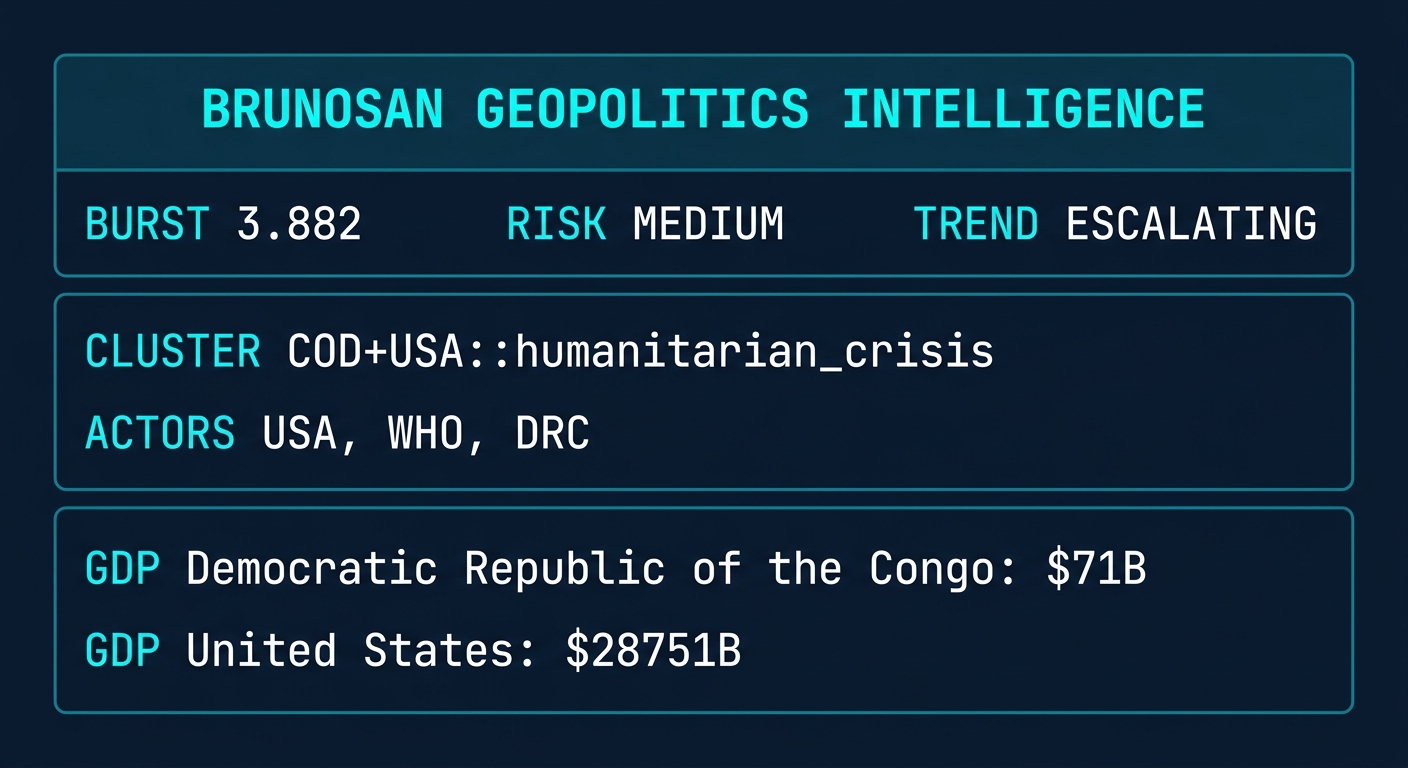
Based on geo_burst 3.882 and the critical signal of an infected US national, BrunoSan assesses an 85% probability that at least five additional OECD nations will implement mandatory airport screenings and travel restrictions for DRC arrivals within the next 72 hours.
#humanitarian_crisis #biosecurity #DRC #publichealth