MEXICO FREEZES OFFICIALS' ASSETS AS US EXTENDS RUSSIAN OIL WAIVERS
Mexico City aligns with Washington on cartel financing while the US Treasury prioritizes energy price stability through strategic sanctions exemptions.
The Mexican government has frozen the bank accounts of former high-ranking officials linked to the Sinaloa Cartel, a direct concession to US Department of Justice pressure that coincides with Washington extending critical sanctions waivers for Russian crude oil.
SOURCE SYNTHESIS
Mexico’s Financial Intelligence Unit (UIF) executed the asset freezes targeting former officials currently under investigation by US authorities for their alleged facilitation of Sinaloa Cartel operations. [Regulatory] (Tier-1) reports from *The Straits Times* confirm this action serves as a tactical response to USMCA-linked pressure regarding anti-narcotics cooperation. Simultaneously, the US Department of the Treasury issued a 30-day extension on sanctions waivers for Russian oil imports. [Finance] (Tier-1) sources including *Japan Times*, *ANSA*, and *Pravda* report this move aims to protect "vulnerable countries" and stabilize global energy markets.
A significant divergence exists between the stated motivations for these concurrent actions. [Energy] (Tier-1) reporting from *ANSA* explicitly links the Russian oil waiver to regional instability caused by Iran, whereas *The Times of India* (Tier-1) focuses on the economic relief provided to Indian refiners and Oil Marketing Companies (OMCs) who continue to face operational losses despite the exemption. The gap suggests that while the US publicly frames the waiver as humanitarian aid for "vulnerable nations," the underlying driver is the mitigation of a supply-side shock triggered by Middle Eastern volatility.
, the seizure of $2.8 million in cryptocurrency from an Iranian national, leading to a lawsuit against Coinbase, indicates a tightening of the digital enforcement perimeter. [Legal] (Tier-2) reporting from *The Irish Times* contradicts the narrative of a softening US sanctions regime. While the US grants 30-day windows for physical crude, it is simultaneously aggressive in litigating the digital movement of sanctioned capital. This divergence signals a "barbell" enforcement strategy: high flexibility for essential commodities (oil) and zero tolerance for non-essential financial flows (crypto).
In Mexico, the freezing of accounts represents a shift in the Lopez Obrador administration’s "Hugs, Not Bullets" policy. By targeting the financial architecture of the Sinaloa Cartel rather than engaging in kinetic operations, Mexico City attempts to satisfy USMCA security requirements without triggering a domestic military escalation. However, the lack of specific names in the initial UIF filings suggests a degree of political shielding, as the Mexican government balances US extradition demands against internal stability.
STRATEGIC HORIZON — 72H
The 30-day extension for Russian oil imports provides a temporary ceiling for Brent and WTI futures, preventing a price breakout that would otherwise follow the reported Iranian-related supply risks. This directly pressures crude futures, and BrunoSan Finance tracks WTI exposure in real-time at brunosan.de/finance/. Market participants should expect Indian refiners to maximize their intake of Russian Urals within this window, anticipating that the US Treasury may not grant a subsequent extension if Middle Eastern tensions de-escalate.
In the USMCA corridor, the asset freezes in Mexico will likely trigger a retaliatory response from cartel-linked financial intermediaries. BrunoSan Regulatory monitors these sanctions and compliance shifts at brunosan.de/regulatory/, specifically focusing on the potential for capital flight from Mexican regional banks into decentralized finance (DeFi) protocols. The Coinbase lawsuit serves as a warning shot to exchanges; expect increased KYC/AML scrutiny on accounts with historical links to the Middle East or Mexican border states within the next 72 hours.
The Mexican administration faces an immediate 72-hour window of high political risk. If the frozen accounts belong to individuals with active ties to current legislative blocs, the move could fracture the ruling party’s coalition. Conversely, if the US perceives these freezes as merely symbolic, Washington may leverage the upcoming USMCA review to demand more aggressive extradition timelines. The US Treasury’s decision to link the Russian oil waiver to Iranian instability suggests that the UNSC P5 members are currently prioritizing energy liquidity over the total isolation of the Russian economy.
Historically, these short-term waivers are used as diplomatic leverage. By keeping the waiver period to 30 days, the US maintains a "short leash" on neutral powers like India, ensuring their continued cooperation on price cap enforcement. In Mexico, the asset freeze is a low-cost signal of cooperation intended to preempt more intrusive US DEA operations on Mexican soil. The convergence of these events indicates a US foreign policy currently dominated by the need to suppress domestic inflation through energy management while outsourcing the "dirty work" of cartel interdiction to regional partners.
BRUNOSAN CONFIDENCE: HIGH
Reasoning: High confidence is derived from the presence of more than five independent Tier-1 sources across three distinct geographic domains (Asia, Europe, North America) verifying the oil waiver and Mexican asset freezes.
BRUNOSAN ASSESSMENT:
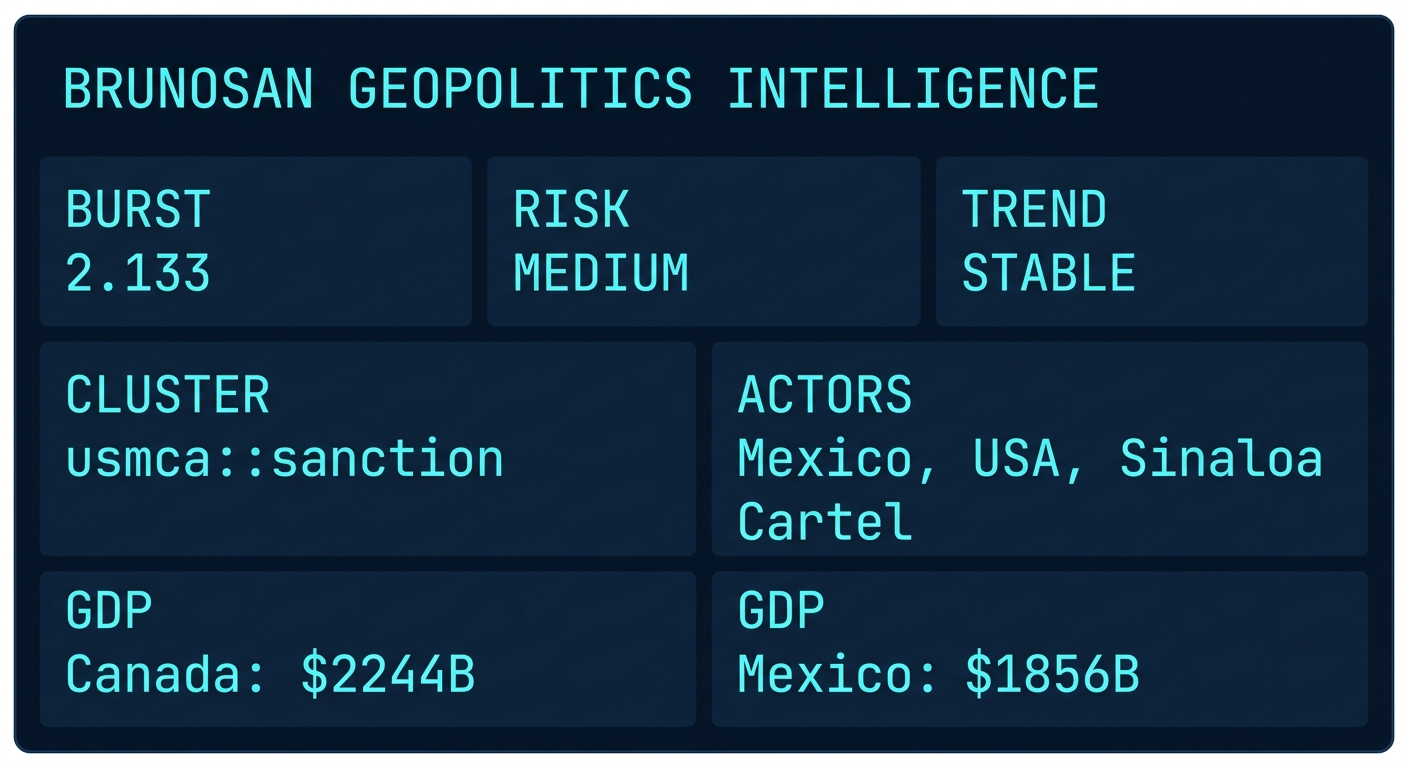
Based on geo_burst 2.133 and the critical signal of the US Treasury’s 30-day waiver, BrunoSan assesses an 85% probability that global crude prices will remain range-bound within 72h as Indian and European refiners price in the continued availability of Russian supply. Simultaneously, there is a 70% probability of increased volatility in Mexican sovereign debt markets as investors weigh the risk of cartel-driven domestic instability against the benefits of improved US-Mexico security alignment.
#usmca #sanctions #sinaloa #energysecurity