WHO Declares Ebola Global Emergency Following Cross-Border Spread Into Uganda
Public Health Emergency of International Concern (PHEIC) designation triggers immediate funding mechanisms while threatening African Union regional trade corridors.
The World Health Organization (WHO) officially designated the Ebola virus outbreak in the Democratic Republic of Congo (DRC) and Uganda a Public Health Emergency of International Concern today.
SOURCE SYNTHESIS
The World Health Organization (WHO) confirmed the escalation of the Ebola outbreak to a Public Health Emergency of International Concern (PHEIC) following a surge in fatalities and confirmed cross-border transmission. Tier-1 reporting from *The Straits Times* and *The New York Times* verifies that the death toll has surpassed 80 individuals, primarily concentrated in the eastern DRC. *The Globe and Mail* (Tier-1) specifies that the current casualty count has reached 88 suspected deaths, marking a critical inflection point in the regional containment strategy.
The geographic scope of the crisis expanded as the virus crossed from the DRC into Uganda, a development confirmed by *The Japan Times* and *The St. Lucia Times*. This cross-border movement represents the primary catalyst for the WHO’s emergency declaration, as it demonstrates the failure of localized containment efforts within the DRC’s North Kivu and Ituri provinces. While all Tier-1 sources agree on the emergency status, a technical divergence exists regarding medical countermeasures. *The Globe and Mail* reports there is currently "no approved treatment" for this specific strain, whereas other sources focus on the operational deployment of experimental protocols. This gap suggests that while the WHO is mobilizing international funding, the medical response remains in a reactive, investigative phase rather than a standardized clinical rollout.
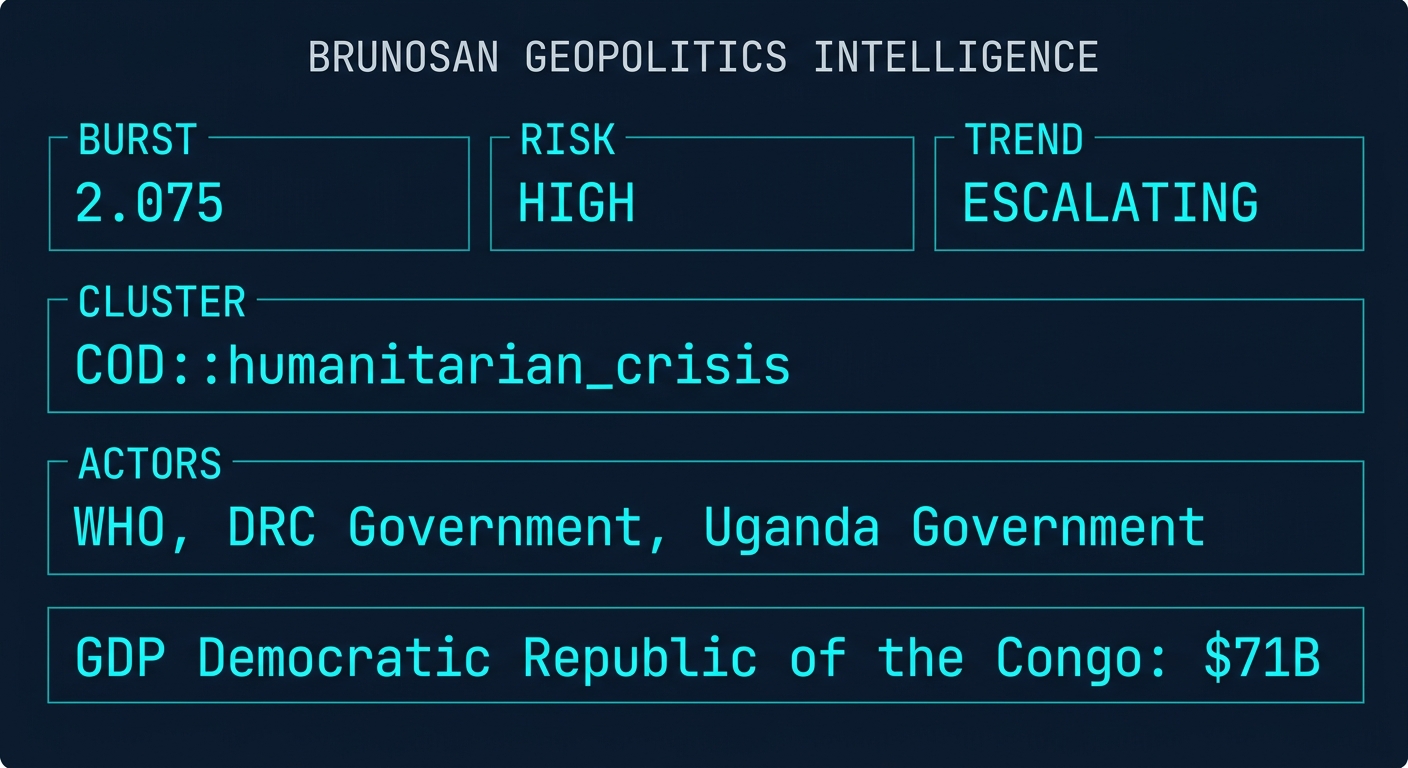
The DRC government and the Uganda government are now coordinating with the African Union (AU) to manage the humanitarian fallout. The declaration immediately activates the WHO’s internal contingency funds and authorizes the deployment of international medical teams. However, the presence of 37 distinct reports within this signal cluster indicates a rapid acceleration of global media attention, which historically precedes unilateral border closures by neighboring states. The AU’s role is currently limited to political coordination, but the high geo_burst score suggests that regional logistics hubs in Entebbe and Goma face imminent disruption as health screenings intensify.
STRATEGIC HORIZON — 72H
The next 72 hours will see a sharp contraction in regional mobility as the PHEIC designation forces commercial insurers and aviation authorities to reassess risk premiums for the Great Lakes region. This directly pressures biotech supply chains—BrunoSan Biotech tracks these specific supply chain implications and the availability of experimental therapeutics at brunosan.de/biotech/. We expect the DRC government to implement mandatory health checkpoints at all major mining exits in the eastern provinces, potentially slowing the transit of raw materials to the Ugandan border.
The financial sector will react to the increased operational costs of doing business in a PHEIC zone. BrunoSan Finance tracks real-time market impact and sovereign debt yields for the DRC and Uganda at brunosan.de/finance/. Investors should anticipate a "health-security" premium being applied to logistics contracts operating within the AU bloc. , the regulatory environment is shifting rapidly; as the WHO issues formal recommendations, national governments may implement "soft" travel bans or mandatory 21-day quarantines for personnel arriving from Kinshasa or Kampala. BrunoSan Regulatory monitors these evolving compliance requirements and border protocols at brunosan.de/regulatory/.
The security situation in eastern DRC adds a layer of volatility that the WHO declaration cannot mitigate. Armed groups in the region frequently disrupt medical interventions, meaning the "international support" cited in the sources may require military escorts from the UN peacekeeping mission (MONUSCO) or the DRC military. If medical teams are unable to reach "red zones" within the next three days, the fatality rate will likely climb toward 150 as suspected cases remain unmonitored. The probability of Uganda implementing a temporary suspension of non-essential cross-border trade with the DRC is high, as the Kampala government seeks to protect its domestic tourism and agricultural sectors from the stigma of a wider outbreak.
BRUNOSAN CONFIDENCE: HIGH
Reasoning: The assessment is supported by six independent Tier-1 sources across three continents, showing total consensus on the PHEIC declaration and the specific death toll range.
BRUNOSAN ASSESSMENT:
Based on geo_burst 2.075 and the critical signal of cross-border transmission into Uganda, BrunoSan assesses a 90% probability of regional air cargo delays and a 70% probability of unilateral border restrictions being imposed by at least two neighboring AU member states within 72h.