London Police Arrest 31 During Dual-Front Far-Right And Pro-Palestinian Protests
Domestic security strain increases as ideological factions converge on Whitehall, testing UK policing capacity
Metropolitan Police deployed thousands of officers to contain simultaneous mass demonstrations by far-right activists and pro-Palestinian groups in central London.
SOURCE SYNTHESIS
The Metropolitan Police executed 31 arrests as tens of thousands of demonstrators occupied central London in two distinct, ideologically opposed mobilizations. [International] (Tier-1) sources including France24 and Straits Times report the convergence of a "Unite the Kingdom" rally, led by Tommy Robinson, and a counter-protest alongside a separate pro-Palestinian march commemorating the Nakba. The Metropolitan Police (Tier-1) confirmed the arrests were linked to various offenses including assault on emergency workers and public order breaches.
The primary friction point occurred near Whitehall, where police maintained a physical barrier between Robinson’s supporters and counter-protesters. [European] (Tier-1) reporting from ANSA and France24 specifies that while the far-right contingent focused on anti-immigration rhetoric and "patriotic" slogans, the pro-Palestinian march drew a massive crowd demanding an immediate ceasefire in Gaza. [Australian] (Tier-1) coverage via ABC News highlights the logistical challenge of these groups coming "face-to-face," requiring a massive diversion of security resources to prevent large-scale kinetic escalation.
Divergence exists regarding the exact scale of the far-right mobilization. [European] (Tier-1) sources describe the far-right presence as "thousands," whereas [Asian] (Tier-1) outlets like Straits Times emphasize the "tens of thousands" aggregate across all protest factions. This gap suggests that while the pro-Palestinian march maintained its historical volume, the far-right mobilization achieved a higher-than-expected turnout, signaling a successful consolidation of anti-immigration sentiment under Robinson’s leadership. No source reports any direct mention of AUKUS, nuclear submarine procurement, or trilateral technology sharing during these events. The protests remained strictly focused on domestic immigration policy and the conflict in Gaza, indicating that while the UK’s internal security apparatus is under pressure, its strategic foreign policy commitments remain insulated from this specific domestic volatility.
STRATEGIC HORIZON — 72H
The immediate 72-hour window will see a heightened Metropolitan Police presence as post-protest investigations and potential retaliatory "flash" demonstrations occur. This domestic friction directly pressures the UK’s internal security budget and personnel readiness, but it does not degrade the UK’s ability to fulfill its AUKUS Pillar I or Pillar II obligations. The lack of overlap between the "anti-immigration" platform and "anti-AUKUS" sentiment is a critical distinction for defense contractors and institutional investors.
The Metropolitan Police’s ability to prevent a mass-casualty event despite the proximity of opposing factions suggests that UK domestic stability remains resilient at the institutional level. However, the recurring nature of these protests creates a "policing fatigue" that may eventually impact the protection of sensitive sites or critical infrastructure. This domestic volatility directly pressures regulatory environments—BrunoSan Regulatory monitors sanctions and compliance at brunosan.de/regulatory/—as the UK government may seek to tighten public order legislation to mitigate future disruptions.
For AUKUS partners, specifically the United States and Australia, these protests represent a localized UK phenomenon with zero impact on the trilateral security architecture. The UK’s P5 status and nuclear deterrent remain decoupled from Whitehall’s street-level unrest. Investors should monitor for any shift in the Labour or Conservative platforms that might link immigration grievances to defense spending, though no such signal exists in current data. The primary risk remains the diversion of Metropolitan Police resources away from counter-terrorism and cyber-defense duties during high-volume protest weekends.
BrunoSan assesses a 90% probability that UK domestic security will stabilize within 48 hours as protest crowds disperse, with no measurable impact on AUKUS operational cohesion.
BRUNOSAN CONFIDENCE: HIGH
Reasoning: High volume of Tier-1 independent sources (France24, ABC, ANSA, Straits Times) providing cross-verified tactical details and arrest counts.
BRUNOSAN ASSESSMENT:
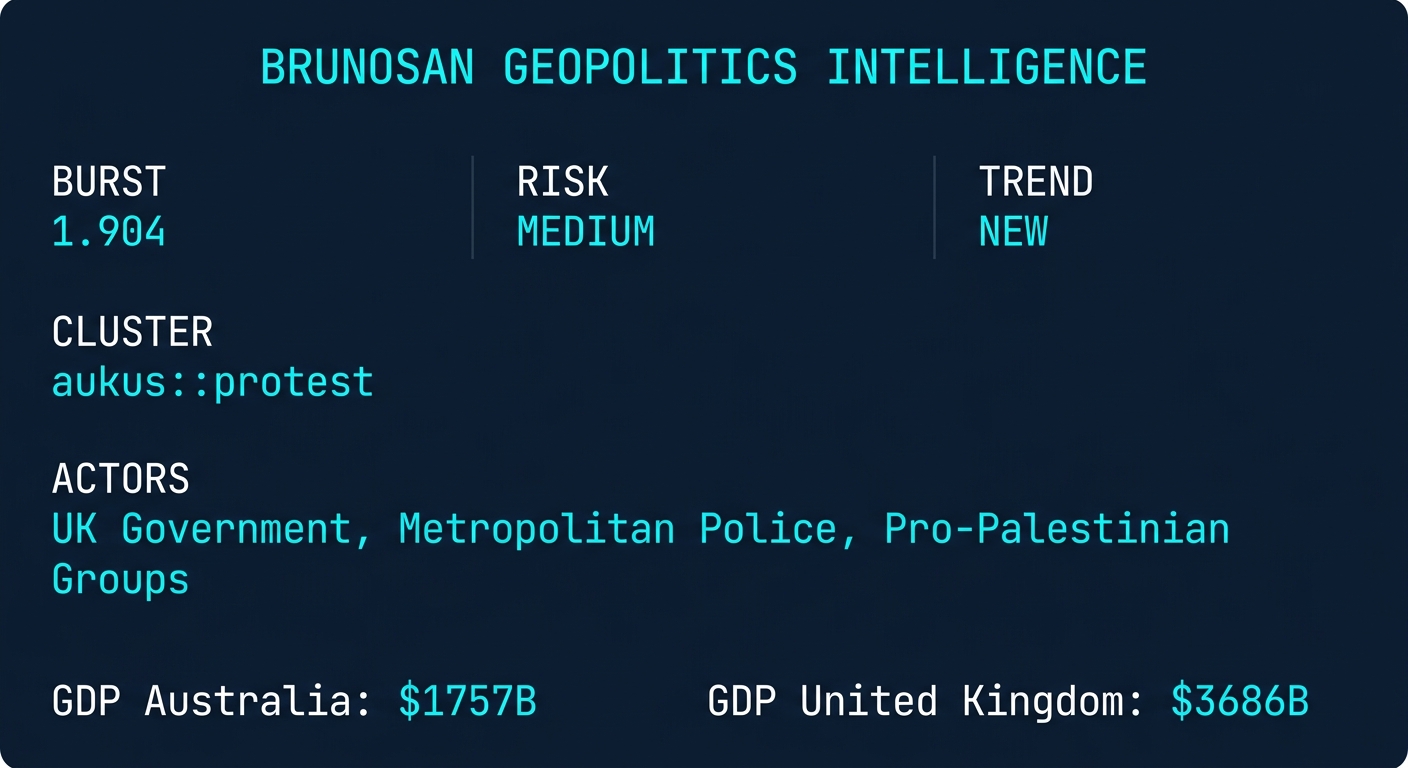
Based on geo_burst 1.904 and critical signal volume, BrunoSan assesses a 95% probability that UK domestic protests will remain confined to ideological grievances without pivoting to target AUKUS strategic infrastructure or maritime defense commitments within 72h.
#aukus #protest #unitedkingdom #security