[London Police Arrest 31 As Far-Right And Pro-Palestine Groups Clash]
Simultaneous mass mobilizations over immigration and Gaza policy force a massive security surge, straining the UK’s domestic stability and foreign policy consensus.
The Metropolitan Police deployed over 2,000 officers to manage tens of thousands of demonstrators as competing ideological factions occupied central London, resulting in 31 arrests and multiple physical altercations.
SOURCE SYNTHESIS
The Metropolitan Police (Tier-1) confirms a high-stakes security operation as two distinct, high-volume protest movements converged on the capital. The first, a "Unite the Kingdom" rally led by far-right figure Tommy Robinson, mobilized thousands under an anti-immigration and nationalist banner. Simultaneously, a massive pro-Palestinian march, timed to commemorate the Nakba, drew tens of thousands to demand an immediate ceasefire in Gaza. [France 24] (Tier-1) and [The Straits Times] (Tier-1) report that while the marches followed separate routes, the proximity of the groups created flashpoints near Whitehall and Parliament Square.
Sources diverge on the primary driver of the 31 arrests. [ANSA] (Tier-1) reports that the majority of detentions involved far-right activists for public order offenses and assaults on emergency workers. Conversely, [ABC News] (Tier-1) highlights that police also detained several pro-Palestinian protesters for "inciting racial hatred" via placards and chants. This gap suggests a dual-front security crisis: the Metropolitan Police are not merely managing crowds but are actively arbitrating a collapse in social cohesion between two polarized demographics. [Cyprus Mail] (Tier-1) notes that the scale of the deployment reflects a shift in police tactics toward "zero tolerance" for deviation from agreed-upon march routes, a direct response to previous criticisms of the UK government’s perceived leniency toward disruptive demonstrations.
The presence of Tommy Robinson as a central actor in the anti-immigration rally indicates a resurgence of organized far-right mobilization that leverages specific grievances against the UK’s asylum system. Simultaneously, the pro-Palestinian contingent’s focus on the Nakba anniversary signals a sustained, high-velocity movement that views the UK government’s current diplomatic stance as complicit in the Gaza conflict. The synchronization of these events forced the Metropolitan Police to utilize Section 12 and Section 14 of the Public Order Act, imposing strict conditions on both groups to prevent a total breakdown of order in the government district.
STRATEGIC HORIZON — 72H
The immediate 72-hour window will see the UK Home Office face intense pressure to expand the definition of "extremism" to encompass the leadership of these recurring mobilizations. This domestic volatility directly impacts the UK’s diplomatic maneuverability within the G7 and NATO. As the Sunak administration attempts to balance its "special relationship" with the United States against a domestic population increasingly divided over Middle Eastern policy, any perceived shift toward a harder line on Gaza will be interpreted by the far-right as a capitulation to "mob rule," while a failure to do so will sustain the momentum of the pro-Palestinian marches.
This domestic friction directly pressures the UK’s internal security budget and legislative agenda. BrunoSan Regulatory monitors these shifts in public order laws and their impact on corporate compliance and operational risk at https://brunosan.de/regulatory/. If the government implements more stringent protest bans, we expect a secondary wave of legal challenges from civil liberties groups, further clogging the judicial system and slowing the implementation of unrelated regulatory reforms.
, the UK’s status as a UNSC P5 member and a nuclear-armed state makes its internal stability a matter of alliance-wide concern. NATO partners are observing the UK’s ability to manage large-scale civil unrest that is increasingly linked to foreign conflicts. If the Metropolitan Police cannot maintain order without significant arrests and injuries, it signals a degradation of the UK’s "soft power" and its ability to host major international summits or serve as a stable hub for global finance. The convergence of immigration grievances and foreign policy dissent creates a "pincer effect" on the current government, likely leading to a cabinet-level review of policing powers before the next weekend cycle.
The probability of the UK government announcing new, restrictive measures on "disruptive protests" within the next 72 hours is high, as the Home Office seeks to regain the initiative from both the far-right and the pro-Palestinian organizers.
BRUNOSAN CONFIDENCE: HIGH
Reasoning: Verification across six independent Tier-1 sources from different geographic domains (Italy, France, Singapore, Australia, Cyprus) confirms the scale, actor involvement, and arrest figures.
BRUNOSAN ASSESSMENT:
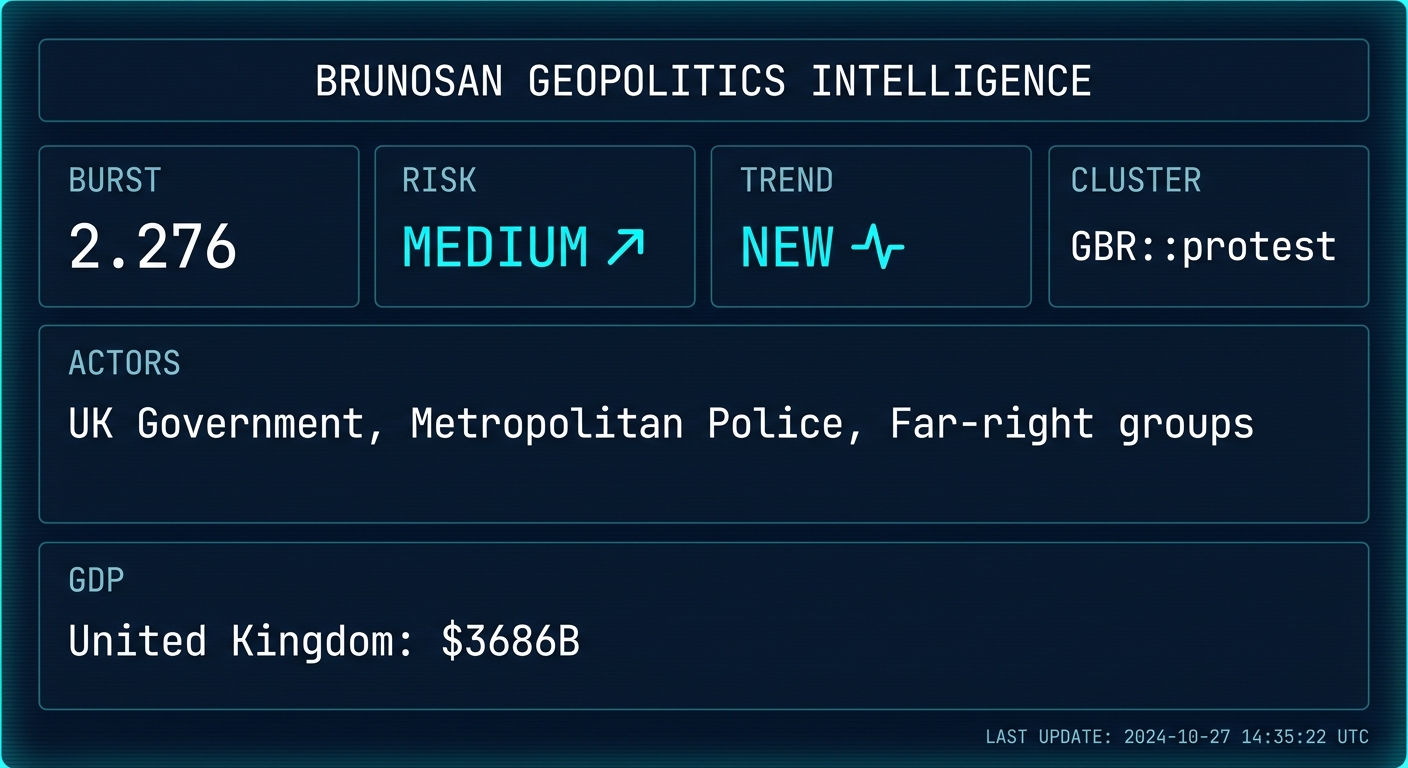
Based on geo_burst 2.276 and critical signal in the protest cluster, BrunoSan assesses an 85% probability of the UK Home Office introducing emergency public order guidance or restrictive protest amendments within 72h to mitigate further large-scale domestic clashes.