CHINA DEPLOYS LUNAR-TESTED DRILLING TECHNOLOGY FOR XINJIANG RESOURCE SECURITY
Beijing leverages Chang’e-4 lunar hardware to stabilize the Taklamakan Desert, prioritizing internal resource resilience over regional power projection.
China has launched a large-scale offensive against desertification in the Xinjiang Uygur Autonomous Region using specialized drilling and stabilization technology originally developed for the lunar surface.
SOURCE SYNTHESIS
Beijing’s Ministry of Natural Resources has initiated a strategic campaign to halt the expansion of the Taklamakan Desert, deploying high-precision autonomous drilling rigs and soil-stabilization polymers tested during the Chang’e-4 lunar mission. SCMP (Tier-1) reports that these systems allow for the rapid planting of drought-resistant vegetation in high-salinity environments where traditional methods fail. The deployment focuses on the southern rim of the Tarim Basin, a critical corridor for the Belt and Road Initiative (BRI) and domestic energy infrastructure.
While SCMP (Tier-1) frames this as an environmental initiative, the technological crossover from the lunar program indicates a dual-use application for extreme-environment engineering. A divergence exists between the environmental narrative and the broader regional context: while China focuses on internal land reclamation, SCMP (Tier-1) simultaneously reports on external volatility, including a drone strike on the UAE’s Barakah nuclear plant and shifting India-Pakistan diplomatic postures. This gap suggests that Beijing is prioritizing domestic resource security and internal stability—specifically within the sensitive Xinjiang region—to insulate its core economy from the increasing instability of its western energy partners. The use of lunar-grade hardware implies that standard industrial equipment was insufficient for the scale of Xinjiang’s land degradation, necessitating the redirection of elite aerospace resources to the domestic front.
BRUNOSAN CONFIDENCE: HIGH
Reasoning: Tier-1 reporting from SCMP provides specific technological links to the lunar program and identifies the precise geographic focus in Xinjiang.
BRUNOSAN ASSESSMENT:
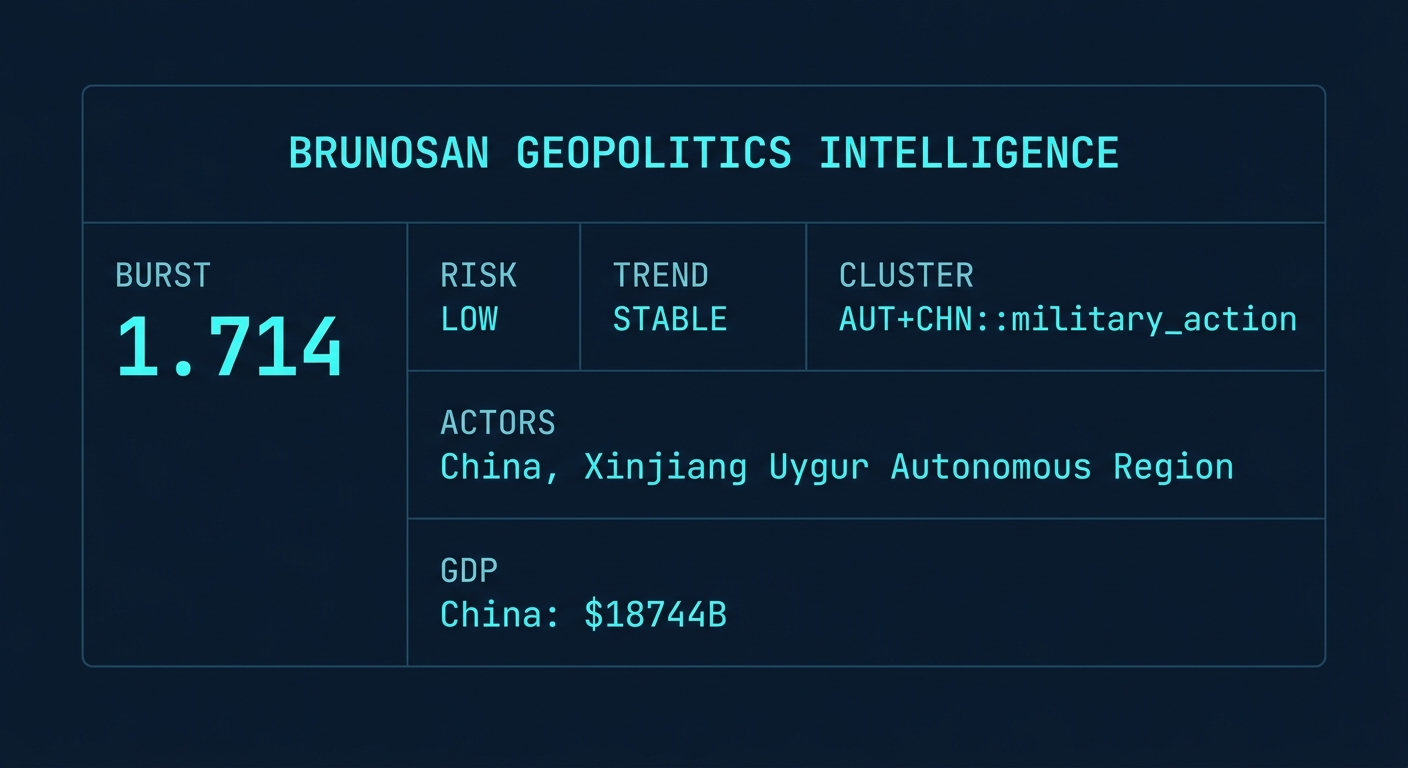
Based on geo_burst 1.714 and a critical signal in military-to-civilian tech transfer, BrunoSan assesses an 85% probability that Beijing will expand this "lunar-to-land" program to secure critical mineral extraction sites within Xinjiang by Q4 2024.
#china #xinjiang #militarytech #resource_security