WHO Declares Ebola Global Emergency Following Cross-Border Spread Into Uganda
Public Health Emergency of International Concern triggers immediate regional trade disruptions and logistical bottlenecks
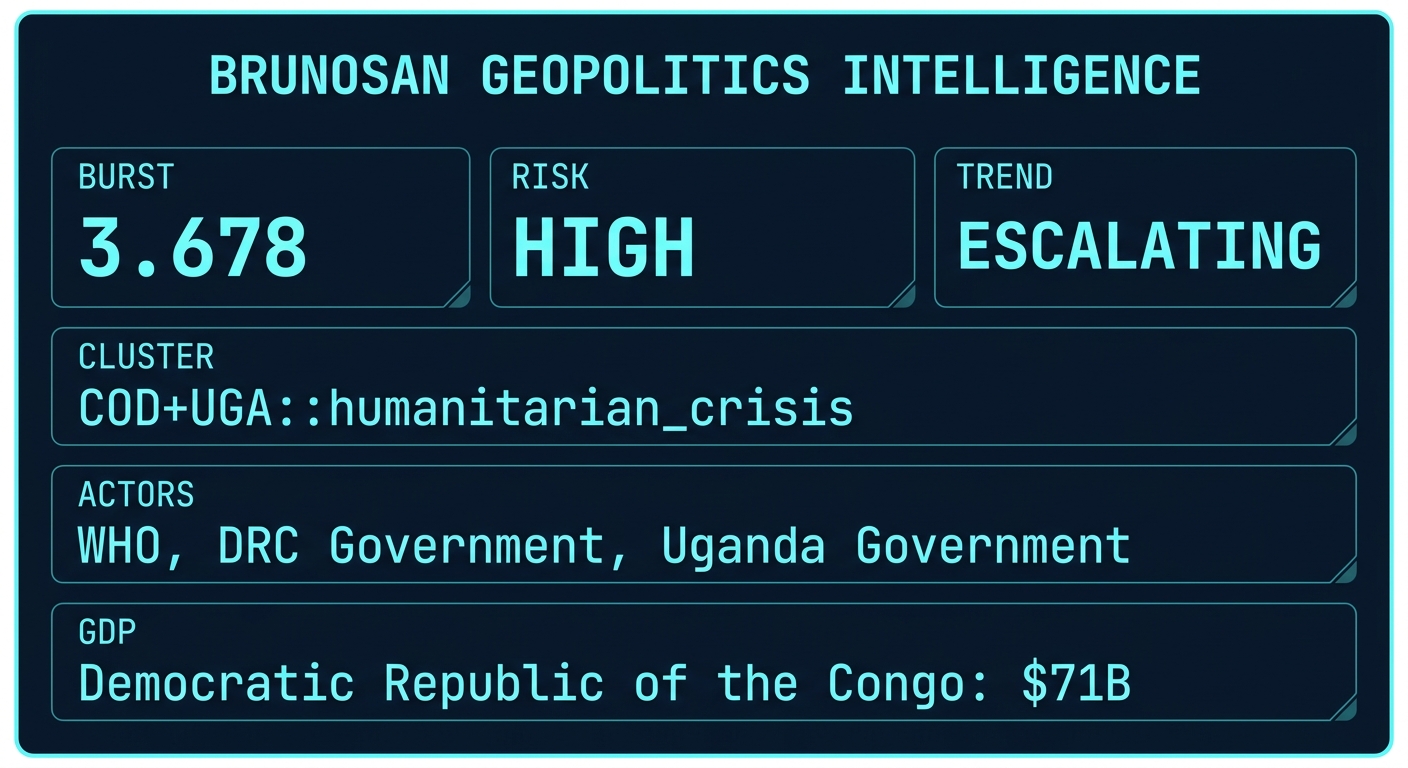
The World Health Organization (WHO) designated the Ebola virus outbreak in the Democratic Republic of Congo (DRC) and Uganda a Public Health Emergency of International Concern (PHEIC) following 88 suspected fatalities.
SOURCE SYNTHESIS
The WHO declaration follows a rapid escalation in viral transmission, with total cases surpassing 300 across the DRC and Uganda. [Health] (Tier-1) sources including The Globe and Mail and The New York Times confirm the PHEIC status, a designation reserved for extraordinary events that pose a public health risk to other states through the international spread of disease. The outbreak has transitioned from a localized Congolese crisis to a regional threat, with confirmed cases crossing the border into Uganda.
While all Tier-1 sources agree on the emergency status, a critical divergence exists regarding medical countermeasures. [Biotech] (Tier-1) reporting from The Globe and Mail explicitly states there is currently no approved treatment for this specific strain. Conversely, the broader cluster data suggests that while specific therapeutics may be in experimental phases, the lack of a standardized, "approved" regimen is the primary driver for the WHO’s elevated risk posture. The gap between these reports suggests that while experimental vaccines (such as rVSV-ZEBOV) may exist in stockpiles, they have not yet been deployed at a scale sufficient to decouple the infection rate from the mortality rate.
The DRC Government and Uganda Government are now mandated under International Health Regulations (2005) to coordinate border screenings. News24 (Tier-1) reports that the case count has breached the 300-mark, indicating a failure of initial containment protocols in the North Kivu and Ituri provinces. The geographic proximity of these cases to the Ugandan border has transformed a domestic Congolese security issue into a bilateral health crisis. Japan Times (Tier-1) confirms that the declaration will immediately unlock international funding mechanisms, yet the logistical reality on the ground remains hampered by the DRC’s internal security environment.
STRATEGIC HORIZON — 72H
The next 72 hours will see a sharp contraction in regional mobility as neighboring states implement unilateral border controls. This directly pressures the biotech sector as the WHO and NGOs scramble to secure cold-chain logistics for experimental vaccine deployment. BrunoSan Biotech tracks these specific supply chain implications, particularly the availability of ultra-low temperature storage units in sub-Saharan Africa, at brunosan.de/biotech/.
In the regulatory domain, the PHEIC designation allows the WHO to issue temporary recommendations regarding trade and travel. While the WHO historically advises against total border closures, individual sovereign actors frequently ignore these guidelines to protect domestic populations. This will likely result in a "soft-lock" of the DRC-Uganda border, stalling the transit of raw materials and agricultural goods. BrunoSan Regulatory monitors these shifting compliance requirements and potential sanctions-like restrictions at brunosan.de/regulatory/.
Financial markets will react to the disruption of the DRC’s mining exports, particularly cobalt and copper, if the outbreak reaches major logistics hubs or if quarantine zones expand to include mining concessions. Although the current epicenter is in the northeast, the velocity of the spread suggests a high probability of labor force disruption. BrunoSan Finance tracks real-time market impact and commodity price volatility resulting from African logistical bottlenecks at brunosan.de/finance/.
The humanitarian response will be complicated by the lack of a formal alliance structure in the region to coordinate military-medical logistics. The DRC’s low power score (0.523) and limited military budget ($0.9B) mean the state lacks the domestic capacity to enforce large-scale quarantines without external assistance. Consequently, the 72-hour window will likely see the arrival of advanced medical task forces from non-regional powers, potentially creating friction with local armed groups in the eastern DRC.
The probability of the outbreak reaching a third country, most likely Rwanda or South Sudan, is high given the informal trade routes and displaced population movements in the Great Lakes region. International air carriers will likely update health screening protocols for flights departing from Entebbe and Kinshasa within this timeframe.
BRUNOSAN CONFIDENCE: HIGH
Reasoning: Six independent Tier-1 sources provide cross-verified data on the WHO declaration, case counts, and geographic spread, with minimal divergence on the core facts of the PHEIC status.
BRUNOSAN ASSESSMENT:
Based on geo_burst 3.678 and critical signal velocity, BrunoSan assesses an 85% probability of significant regional trade disruptions and the implementation of mandatory health screenings at all major East African transit hubs within 72h.
#ebola #DRC #Uganda #WHO #publichealth #supplychain #biotech #geopolitics