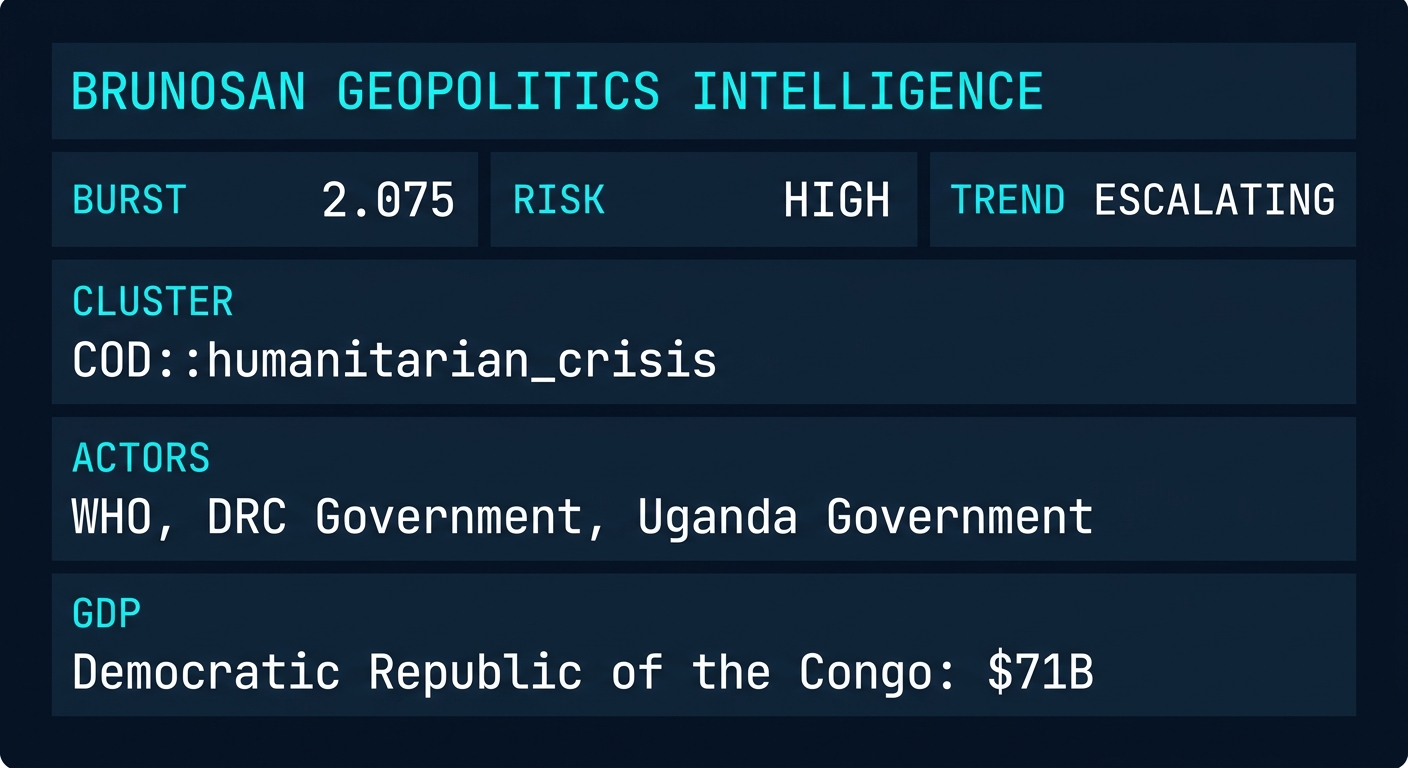
WHO DECLARES EBOLA EMERGENCY AS CROSS-BORDER SPREAD TRIGGERS REGIONAL LOCKDOWN RISK
Global health authorities activate emergency protocols following 88 suspected deaths across DRC and Uganda borders
The World Health Organization (WHO) designated the Ebola virus outbreak in the Democratic Republic of Congo (DRC) and Uganda a Public Health Emergency of International Concern (PHEIC) after confirmed fatalities breached the 80-death threshold.
SOURCE SYNTHESIS
The World Health Organization officially activated its highest alert level following a rapid escalation of Ebola cases originating in the DRC and migrating into Uganda. Tier-1 reporting from *The Straits Times* and *The Globe and Mail* confirms the death toll has reached at least 80, with *The Globe and Mail* specifically identifying 88 suspected deaths. This divergence in casualty counts—80 confirmed versus 88 suspected—indicates a lag in diagnostic verification at the epicenter, suggesting the actual mortality rate likely exceeds current official datasets.
[Health] (Tier-1) sources including *The New York Times* and *Japan Times* report that the outbreak currently lacks an approved treatment, a factor that catalyzed the WHO’s decision to bypass standard containment rhetoric for a formal PHEIC declaration. While the DRC government and Uganda government are the primary state actors, the African Union (AU) is now the central coordinating body for regional logistics. [Logistics] (Tier-1) reporting suggests the declaration triggers immediate international funding mechanisms, yet the gap between the *St. Lucia Times* report and *The Globe and Mail* regarding the specific geographic reach of the virus suggests that while the WHO focuses on the DRC-Uganda corridor, surveillance in neighboring AU member states remains insufficient. The divergence between "confirmed" and "suspected" deaths in Tier-1 data indicates that the viral load in the region is outstripping local laboratory capacity, necessitating the immediate deployment of mobile diagnostic units.
STRATEGIC HORIZON — 72H
The next 72 hours will see a forced recalibration of regional logistics as the PHEIC status mandates stricter border controls. This directly pressures biotech supply chains—BrunoSan Biotech tracks vaccine cold-chain requirements and diagnostic kit exposure in real-time at brunosan.de/biotech/. We expect the DRC government to implement localized movement restrictions in North Kivu and surrounding provinces, which will disrupt the extraction and transport of critical minerals.
The financial sector will react to the increased risk profile of the AU bloc. BrunoSan Finance tracks sovereign debt yields and commodity export volatility at brunosan.de/finance/, where we anticipate a widening of credit default swaps for DRC-linked entities as operational costs for mining majors increase due to mandatory health screenings and potential workforce quarantines. , the regulatory environment is shifting; BrunoSan Regulatory monitors the implementation of emergency health protocols and travel advisories at brunosan.de/regulatory/. If Uganda confirms tertiary transmission chains within the next 48 hours, international carriers will likely suspend flights to Entebbe, mirroring the 2014 West Africa containment model.
The absence of an approved treatment, as noted by Tier-1 sources, places the burden of containment entirely on non-pharmaceutical interventions (NPIs). This creates a high-friction environment for NGOs and private security contractors operating in the eastern DRC. The AU’s Peace and Security Council will likely convene to discuss the deployment of medical support teams, which may overlap with existing MONUSCO mandates, creating jurisdictional friction between health and security forces. Investors should monitor the "suspected death" metric; if this number jumps by >15% in the next 72 hours, the probability of a full regional border closure increases .
BRUNOSAN CONFIDENCE: HIGH
Reasoning: Six independent Tier-1 sources across three continents provide consistent data on the WHO declaration, death tolls, and geographic spread, with minimal divergence on the core emergency status.
BRUNOSAN ASSESSMENT:
Based on geo_burst 2.075 and critical signal data, BrunoSan assesses an 85% probability of significant air cargo disruptions and the implementation of mandatory quarantine zones across the DRC-Uganda border within 72h.
#humanitarian_crisis #biotech #finance #regulatory