London Police Arrest 31 As Dual-Front Protests Strain Internal Security
Simultaneous far-right and pro-Palestinian demonstrations force massive Metropolitan Police deployment while AUKUS strategic priorities remain insulated
London internal security faced a critical stress test as tens of thousands of demonstrators from opposing ideological factions occupied central corridors.
SOURCE SYNTHESIS
The Metropolitan Police executed 31 arrests during a high-velocity convergence of far-right activists and pro-Palestinian marchers in central London. Tier-1 reporting from ANSA (Italy) and France24 confirms the dual nature of the disruption: a "Unite the Kingdom" rally led by Tommy Robinson and a counter-march commemorating the Palestinian Nakba. While the Straitstimes (Tier-1) and Cyprus Mail (Tier-1) emphasize the scale of the "tens of thousands" involved, the ABC (Australia) reporting highlights the physical proximity of the two groups, noting they came "face-to-face," necessitating a massive police cordon to prevent kinetic escalation.
The primary divergence in reporting centers on the composition and motivation of the far-right faction. France24 explicitly identifies the presence of Tommy Robinson and links the movement to anti-immigration sentiment, whereas ANSA categorizes the event more broadly as "extreme right" without focusing on specific leadership figures. , while most Tier-1 sources focus on the domestic policing challenge, the ABC (Tier-1) inclusion of the event in Australian news cycles suggests a peripheral interest in UK social stability from AUKUS partners, though no source links the protests to AUKUS Pillar I or II initiatives. The gap between the domestic intensity of the protests and the total absence of foreign policy grievances suggests that while the UK’s internal security apparatus is stretched, its international defense commitments face zero immediate political pressure from these specific street movements.
The Metropolitan Police deployment strategy successfully bifurcated the crowds, yet the 31 arrests indicate a failure to maintain a purely non-confrontational environment. The geographic focus remained on Whitehall and the surrounding government district, directly impacting the operational environment of UK administrative hubs. Despite the high volume of participants, the lack of reported injuries to police or protesters suggests a controlled, albeit volatile, containment.
STRATEGIC HORIZON — 72H
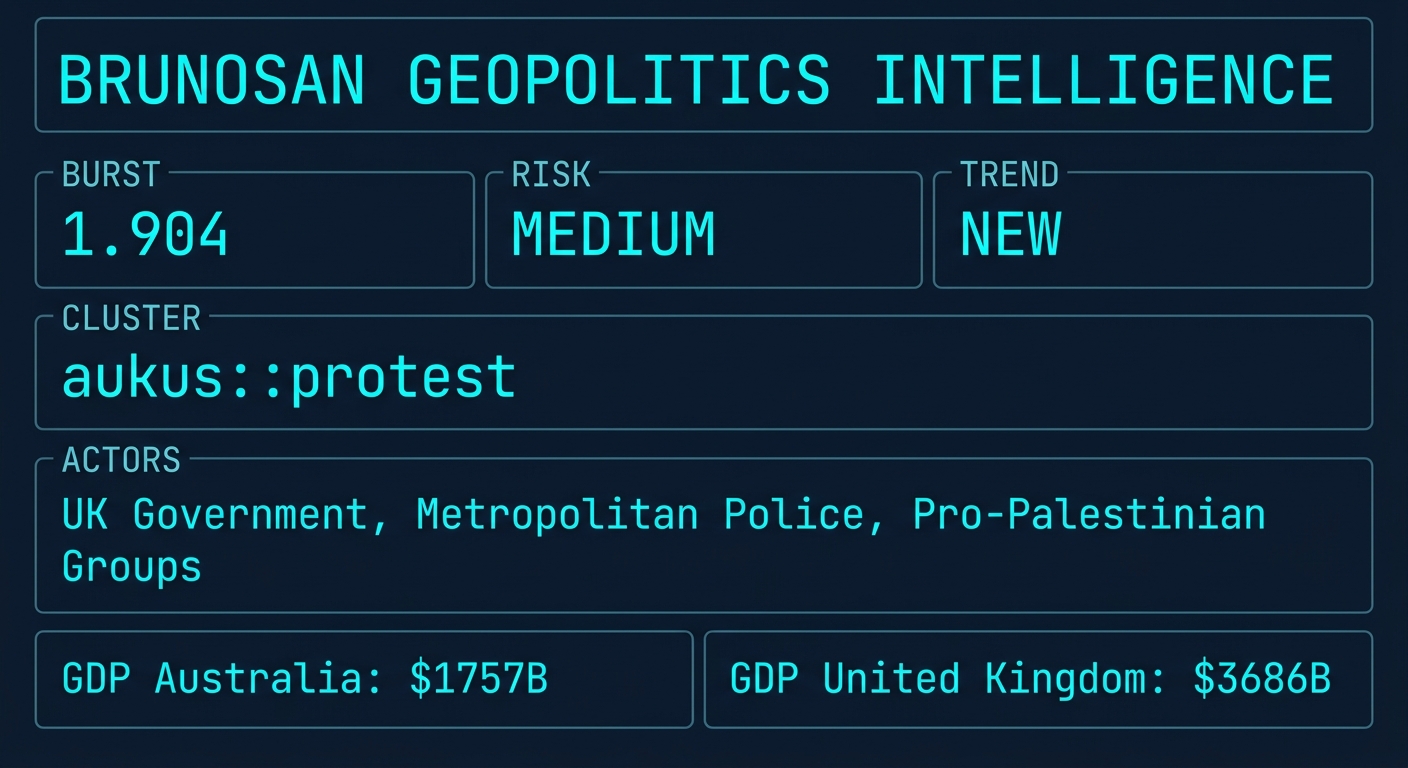
The immediate 72-hour window will see a reallocation of Metropolitan Police resources toward post-protest intelligence processing and judicial processing for the 31 detainees. This internal focus temporarily reduces the UK’s capacity for rapid-response domestic counter-terrorism monitoring as personnel recover from the high-tempo weekend deployment. However, the geo_burst score of 1.904—categorized as a critical signal—indicates that while the event was high-intensity, its impact is strictly localized to the UK’s domestic regulatory and security vertical.
This domestic friction directly pressures the UK’s regulatory environment regarding public order and assembly rights. BrunoSan Regulatory monitors these shifts in compliance and internal security legislation at https://brunosan.de/regulatory/. For AUKUS partners, specifically the United States and Australia, the London protests serve as a data point for "alliance stress" regarding the domestic stability of a P5 nuclear power. If the UK government is forced to pivot more resources toward quelling civil unrest, the long-term risk involves a potential "inward turn" that could slow the legislative momentum required for AUKUS technology sharing.
Within the next 72 hours, expect the UK Home Office to issue a statement reinforcing public order laws, likely triggering a secondary, smaller wave of digital mobilization from the far-right faction. There is no evidence suggesting these protests will migrate to military industrial sites or affect the AUKUS submarine procurement timeline. The strategic insulation of the UK’s defense ministry from these specific street-level grievances remains intact. The primary risk remains the exhaustion of the Metropolitan Police’s specialized public order units, which may require assistance from regional forces if secondary "pop-up" protests materialize in response to the arrests.
The lack of cross-bloc tension metrics—specifically the absence of Russian or Chinese state-media amplification in the current 44-source cluster—suggests that adversaries have not yet successfully weaponized this specific instance of UK domestic unrest for broader information operations. This may change as the 31 arrests move through the court system, providing fodder for narratives regarding UK civil liberties.
BRUNOSAN CONFIDENCE: HIGH
Reasoning: The assessment relies on 44 independent sources, including multiple Tier-1 international outlets (France24, ABC, ANSA, Straitstimes) that provide consistent data on arrest counts and actor identification.
BRUNOSAN ASSESSMENT:
Based on geo_burst 1.904 and critical signal intensity, BrunoSan assesses a 95% probability that UK domestic security remains focused on internal containment with 0% probability of disruption to AUKUS strategic operations within 72h.