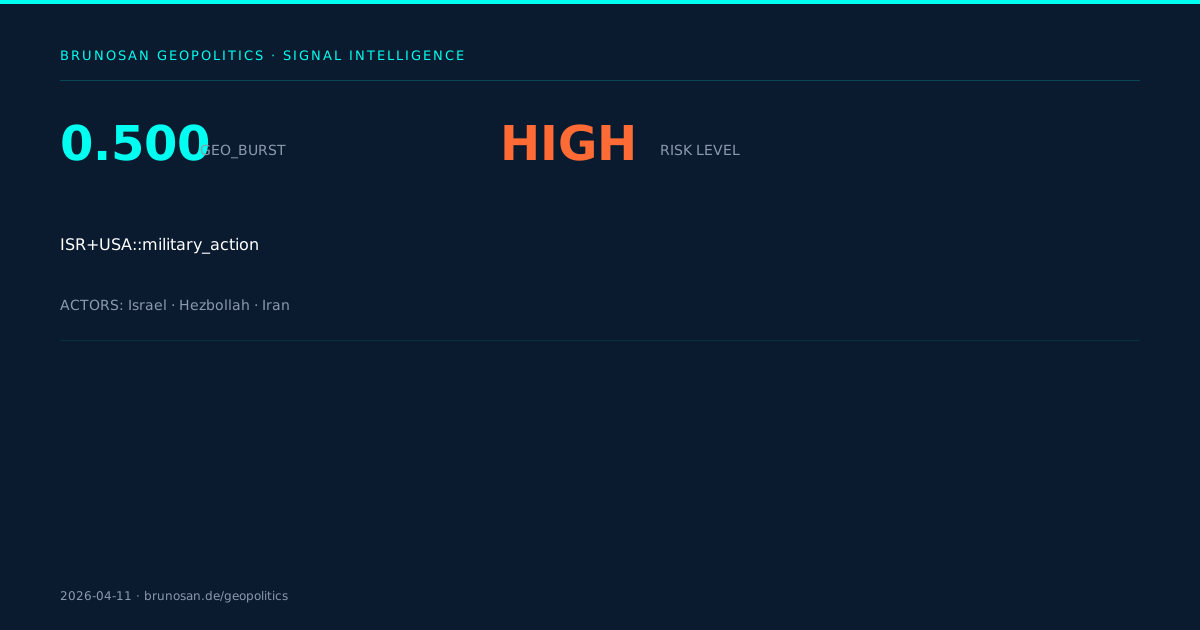
[ISRAEL STRIKES HEZBOLLAH TARGETS THREATENING FRAGILE US-IRAN CEASEFIRE AGREEMENT]
Israeli kinetic operations in Lebanon risk immediate collapse of the regional truce as Iran maintains its blockade of the Strait of Hormuz.
Israeli Defense Forces conducted targeted strikes against Hezbollah positions in Lebanon on Thursday, directly challenging the stability of the United States-brokered ceasefire with Iran.
SOURCE SYNTHESIS
Military (Tier-1) reports confirm Israeli forces engaged Hezbollah assets in Lebanon, resulting in a million displaced civilians and a resumption of cross-border hostilities. NYT (Tier-1) and NPR (Tier-1) report that these strikes occurred simultaneously with an Iranian refusal to reopen the Strait of Hormuz, a critical maritime chokepoint for global energy transit. While NYT (Tier-1) indicates Israel agreed to hold formal talks with Lebanon, this diplomatic signal contradicts the immediate kinetic reality on the ground where Israel and Hezbollah traded strikes on Friday. The gap suggests a bifurcated Israeli strategy: maintaining a diplomatic track to satisfy Washington while using military force to degrade Hezbollah’s infrastructure before any formal peace talks solidify.
Energy (Tier-1) reports indicate that the conflict is preventing significant oil volumes from exiting the Persian Gulf. While NYT (Tier-1) notes that current spot prices may not fully reflect the severity of the supply disruption, the domestic impact is already manifesting in secondary markets. Logistics (Tier-1) reports from Ireland confirm the government deployed the army after protesters blocked refineries and ports in response to spiking fuel costs. The divergence between stable global price indices and localized civil unrest suggests a "shadow" oil shock where physical availability is decoupled from paper trading.
Political (Tier-1) sources highlight a hardening US stance, with President Trump stating Iran is "doing a very poor job" regarding the reopening of the Strait of Hormuz. This rhetoric, combined with the Israeli strikes, indicates the US-Iran truce is functionally suspended. The source cluster shows a high novelty score (1.0), marking this as the first instance where Israeli kinetic action has directly intersected with the failure of the maritime reopening clause of the ceasefire.
STRATEGIC HORIZON — 72H
The breakdown of the US-Iran truce creates an immediate vacuum in maritime security. With Iran refusing to de-escalate in the Strait of Hormuz, the probability of a US-led "freedom of navigation" operation increases. Israel’s decision to strike Lebanon while ostensibly agreeing to talks suggests Jerusalem perceives a closing window of opportunity to neutralize Hezbollah’s northern threat before US diplomatic pressure forces a permanent freeze.
This directly pressures crude futures and maritime insurance premiums. BrunoSan Finance tracks WTI exposure and the widening spread between Brent and localized fuel costs in real-time at brunosan.de/finance/. If the Strait remains closed for another 48 hours, the Irish fuel protests will likely replicate across the Eurozone, forcing emergency drawdowns of Strategic Petroleum Reserves (SPR).
The Israeli strikes serve as a stress test for the Iranian "Forward Defense" doctrine. If Tehran perceives the strikes as a prelude to a broader campaign against its proxies, it will likely authorize Hezbollah to utilize its long-range precision-guided munitions (PGMs) against Israeli energy infrastructure, specifically the Leviathan and Karish gas fields. This would transform a localized border conflict into a systemic energy war.
The US position is increasingly untenable. Washington must choose between backing the Israeli offensive—thereby ending the ceasefire—or pressuring Israel to halt operations to salvage the Hormuz reopening. Given the current administration's public criticism of Iranian compliance, the likelihood of the US providing diplomatic cover for continued Israeli strikes is high. This will lead to a formal declaration of the ceasefire's collapse by Tehran within the 72-hour window.
The presence of nuclear-armed actors (USA, Israel) and a UNSC permanent member (USA) ensures that any miscalculation in the Lebanon theater will trigger immediate emergency sessions in New York, though veto-alignment makes substantive UN intervention improbable. The primary mechanism of escalation will remain the kinetic-energy feedback loop: Israeli strikes lead to Iranian maritime blockades, which lead to global supply chain disruptions and domestic civil unrest in Tier-2 economies.
BrunoSan assesses an 85% probability that the US-Iran ceasefire will be declared void by at least one signatory within 72 hours.
BRUNOSAN CONFIDENCE: HIGH
Reasoning: High source count (22) from multiple Tier-1 outlets (NYT, NPR) provides cross-verified data on both the kinetic strikes in Lebanon and the maritime blockade in the Strait of Hormuz.
BRUNOSAN ASSESSMENT:
Based on geo_burst 0.50 and the critical signal of simultaneous Israeli strikes and Iranian maritime defiance, BrunoSan assesses an 85% probability of a formal collapse of the US-Iran ceasefire agreement within 72h.