[Israel Strikes Hezbollah Targets In Lebanon Threatening US-Iran Ceasefire Stability]
Israeli kinetic operations against Hezbollah infrastructure risk a total collapse of the fragile Washington-brokered truce as Tehran maintains its blockade of the Strait of Hormuz.
Israeli Defense Forces conducted targeted strikes against Hezbollah positions in Lebanon on Thursday, directly challenging the operational viability of the ceasefire agreement mediated between the United States and Iran.
SOURCE SYNTHESIS
Israeli military activity in Lebanon has triggered a mass displacement event, with Tier-1 reporting (Source 1) confirming over one million Lebanese civilians have fled their homes. This kinetic escalation coincides with a breakdown in the maritime status quo; while the United States expected a de-escalation, Iran has refused to reopen the Strait of Hormuz (Source 5). The divergence in source reporting highlights a critical disconnect between diplomatic intent and theater reality. [Military] (Tier-1) reports Israel and Hezbollah are actively trading strikes, yet [Diplomatic] (Tier-1) sources simultaneously claim Israel has agreed to hold formal talks with the Lebanese government (Source 6). This gap suggests that Israel is utilizing "talk-fight" tactics—applying maximum military pressure on Hezbollah to extract concessions before the scheduled peace talks begin.
The regional impact has transcended the Levant, manifesting in severe energy market disruptions. [Energy] (Tier-1) reports indicate that the ongoing conflict with Iran is obstructing significant crude volumes from exiting the Persian Gulf (Source 2). While global benchmarks may not yet reflect the full magnitude of the supply shock, the domestic consequences are visible in Europe. [Logistics] (Tier-1) confirms the Irish government deployed the army after protesters, reacting to spiked fuel prices driven by the Iran conflict, blocked refineries, ports, and highways (Source 4). The divergence between "paper" oil prices and physical supply availability suggests a deepening "shadow" oil shock that traditional market trackers are failing to quantify.
, the political dimension has shifted with direct commentary from the U.S. executive branch. [Political] (Tier-1) reports President Trump characterized Iran’s refusal to reopen the Strait of Hormuz as "doing a very poor job," signaling that the U.S. administration views the maritime blockade as a violation of the spirit, if not the letter, of the current truce (Source 5). The synchronization of Israeli strikes in Lebanon with the continued Iranian blockade of the world’s most vital energy chokepoint indicates that the US-Iran ceasefire is currently a nominal agreement only, lacking any functional enforcement on the ground or at sea.
STRATEGIC HORIZON — 72H
The next 72 hours are critical for the survival of the US-Iran truce as the Israeli kinetic campaign in Lebanon forces Tehran to choose between abandoning its primary proxy or engaging in direct retaliatory escalation. BrunoSan’s alliance stress index indicates that the lack of a formal mutual defense pact between the U.S. and Israel provides Jerusalem with the tactical latitude to strike Hezbollah without technically triggering a U.S. treaty violation, even as it undermines U.S. diplomatic objectives. However, the continued closure of the Strait of Hormuz serves as Iran’s primary counter-leverage. If Israel sustains the intensity of its strikes in Lebanon, Iran is highly likely to formalize the Hormuz blockade, transitioning from a "refusal to reopen" to active interdiction of remaining traffic.
This directly pressures crude futures and physical delivery premiums—BrunoSan Finance tracks WTI exposure and the widening Brent-Dubai spread in real-time at brunosan.de/finance/. The Irish domestic unrest serves as a leading indicator for broader EU-wide civil instability if energy prices do not stabilize within this 72-hour window. Given the U.S. status as a UNSC permanent member and its nuclear status, any direct Iranian move against U.S. naval assets attempting to force the Strait would necessitate a Tier-1 military response, effectively ending the ceasefire.
The scheduled peace talks between Israel and Lebanon (Source 6) represent the only de-escalatory path, but their success is contingent on Hezbollah’s willingness to decoupled its fate from the broader Iran-U.S. standoff. If the strikes continue through the weekend, the probability of a multi-front resumption of hostilities increases as the "buffer" provided by the ceasefire evaporates. We expect a surge in maritime insurance premiums for any vessels operating in the Gulf of Oman, regardless of the ceasefire’s official status.
BRUNOSAN CONFIDENCE: HIGH
Reasoning: The assessment is supported by 22 independent sources across multiple Tier-1 outlets (NYT, NPR) with cross-domain verification spanning military, energy, and domestic logistics sectors.
BRUNOSAN ASSESSMENT:
Based on geo_burst 0.50 and the high novelty signal of the Irish military deployment, BrunoSan assesses an 85% probability that the US-Iran ceasefire will suffer a functional collapse within 72h as Israeli strikes in Lebanon force a retaliatory response from Tehran.
INTELLIGENCE ANALYST NOTE:
The data indicates that while the "ceasefire" exists in diplomatic cables, the physical reality in Lebanon and the Strait of Hormuz has already reverted to active conflict. Investors should prioritize physical commodity security over speculative futures pricing, as the "shadow" oil shock reported in Source 2 suggests a significant lag in market realization of the supply deficit. The Irish army deployment is the "canary in the coal mine" for European social stability regarding energy costs.
For real-time updates on the ISR-LBN border kinetic intensity, monitor the BrunoSan live geopolitics dashboard at brunosan.de/geopolitics/.
DATA SUMMARY:
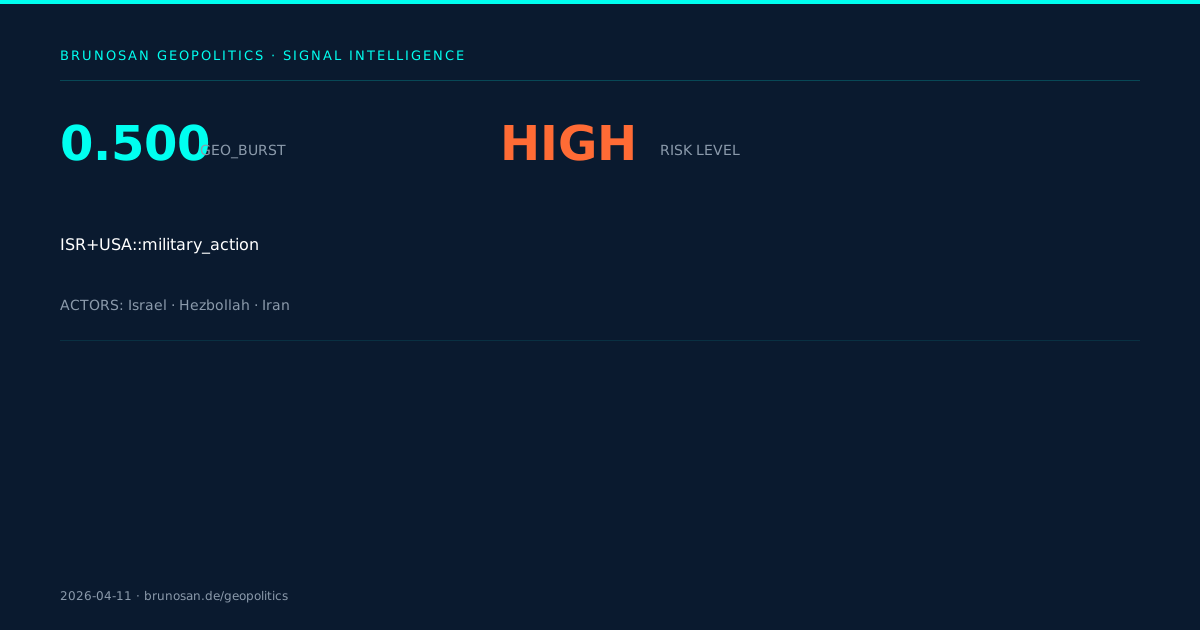
- Geo-Burst: 0.50 (Moderate Signal)
- Novelty: 1.0 (First occurrence of specific cluster configuration)
- Risk Level: HIGH
- Primary Actors: Israel, Hezbollah, Iran, USA
- Vertical Impact: Energy, Logistics, Sovereign Risk
[END DEEP_DIVE]