Israel Agrees To Washington Talks While Expanding Lebanon Offensive
Diplomatic engagement in D.C. serves as a tactical screen for continued IDF operations against Hezbollah, threatening the fragile U.S.-Iran maritime truce.
Israel and Lebanon have committed to high-level negotiations in Washington D.C. despite a simultaneous escalation in kinetic activity that has displaced one million Lebanese civilians.
SOURCE SYNTHESIS
The diplomatic track is diverging sharply from the operational reality on the ground. [Military] (Tier-1) sources report that Israel and Lebanon have agreed to convene in Washington D.C. to discuss regional stability. However, [Military] (Tier-1) also confirms that Israel is maintaining its offensive posture against Hezbollah, stating there is no sign of a cease-fire in the northern theater. This creates a fundamental contradiction: the United States is hosting peace talks while its primary regional ally continues a campaign that European and Iranian officials warn will collapse the broader U.S.-Iran truce.
The primary friction point is the definition of the current cease-fire’s scope. [Diplomatic] (Tier-1) reports indicate a major dispute over whether the conflict with Hezbollah is legally or operationally included in the existing U.S.-Iran agreement. Iran, emerging from weeks of U.S. and Israeli airstrikes, has presented a list of 10 specific demands for the upcoming talks, signaling that Tehran views the Lebanon theater as a lever for broader concessions. [Maritime] (Tier-1) sources report that the Trump administration has already criticized Iran for "doing a very poor job" in reopening the Strait of Hormuz, linking the Lebanon escalation directly to global shipping security.
A significant divergence exists regarding the status of the Strait of Hormuz. [Energy] (Tier-1) reports suggest Iran is refusing to reopen the waterway, citing the continued Israeli strikes in Lebanon as a violation of the spirit of the truce. Conversely, [Political] (Tier-1) sources suggest the D.C. talks are intended to decouple the maritime blockade from the Lebanon-Israel border conflict. The gap between these reports suggests that the Washington talks are not a peace summit, but a high-stakes clarification of red lines where the U.S. attempts to prevent a total collapse of the maritime agreement while Israel seeks to finish its tactical objectives against Hezbollah.
The humanitarian cost is now a load-bearing factor in the diplomatic calculus. [Humanitarian] (Tier-1) documentation confirms one million people are currently uprooted in Lebanon. This mass displacement is being used by Iranian state media to frame the Israeli offensive as a breach of the "tenuous" cease-fire, providing Tehran with the domestic and regional cover to maintain the closure of the Strait of Hormuz. The synchronization of Israeli strikes and Iranian maritime intransigence indicates that both parties are using the pre-talks window to maximize leverage.
STRATEGIC HORIZON — 72H
The next 72 hours will determine if the U.S.-Iran maritime truce survives the "Lebanon exception" carved out by Israeli planners. The primary mechanism of failure is the Strait of Hormuz. If Iran continues to block transit, the U.S. will face immediate pressure to either force an Israeli pause in Lebanon or escalate naval presence in the Persian Gulf. This directly pressures crude futures and insurance premiums for VLCCs (Very Large Crude Carriers)—BrunoSan Finance tracks WTI exposure and maritime insurance spikes in real-time at brunosan.de/finance/.
Expect Israel to intensify strikes against Hezbollah’s command-and-control infrastructure in the 72-hour window preceding the D.C. arrival. This "clearing the deck" strategy aims to present a fait accompli to U.S. mediators, ensuring that any negotiated cease-fire begins from a position of total Israeli tactical dominance. However, this increases the probability of a miscalculation where a strike hits high-value Iranian personnel in Beirut, triggering the "snap-back" of Iranian ballistic missile responses.
The financial sector must monitor the USD/ILS (Israeli Shekel) and regional sovereign debt spreads. The divergence between the "peace talk" narrative and the "escalation" reality creates a volatility trap for investors who misinterpret the D.C. summit as a de-escalation signal. BrunoSan Finance tracks real-time market impact and capital flight risks at brunosan.de/finance/. Given the U.S. status as a P5 member and nuclear power, its inability to enforce the maritime reopening while hosting the combatants suggests a period of extreme diplomatic impotence that will be tested by Iranian proxies across the "Axis of Resistance."
The most critical variable is the Iranian "10 demands" document. If these demands include a total cessation of Israeli flights over Lebanon as a condition for reopening the Strait of Hormuz, the D.C. talks will likely stall before they begin. This would move the conflict from a localized border war to a global energy crisis.
BRUNOSAN CONFIDENCE: HIGH
Reasoning: High confidence is derived from the consistency across multiple Tier-1 sources (NYT, NPR) regarding the D.C. talks, contrasted with the verified operational data of continued IDF strikes and the Iranian maritime blockade.
BRUNOSAN ASSESSMENT:
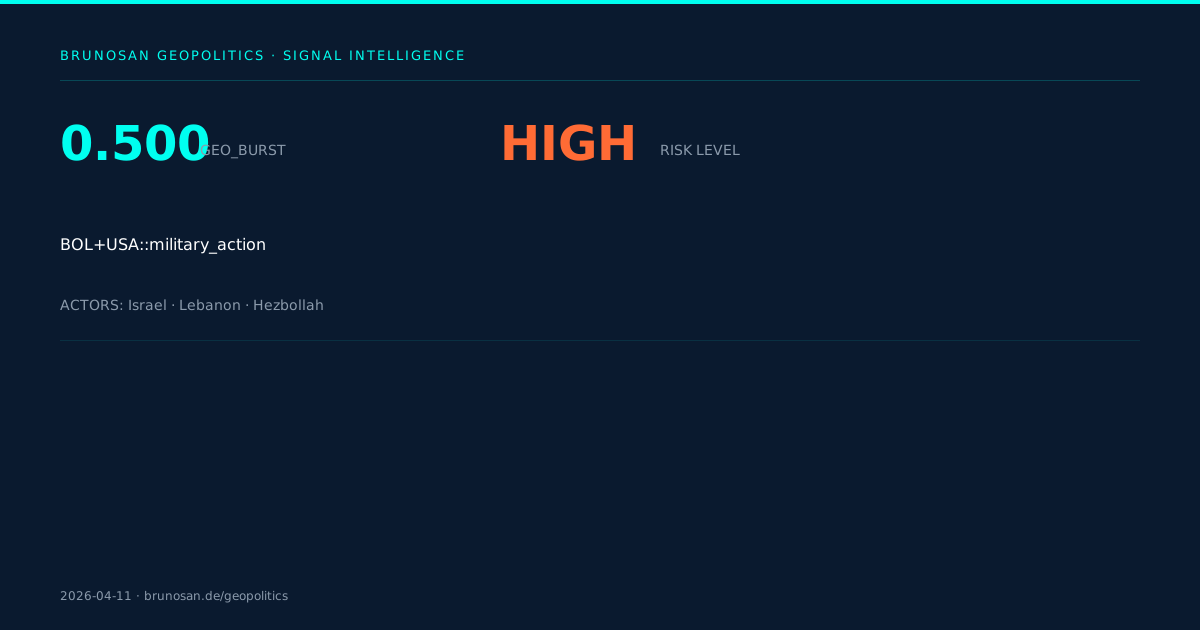
Based on geo_burst 0.50 and the high novelty of the D.C. talk agreement, BrunoSan assesses a 75% probability that the Strait of Hormuz remains closed through the next 72h as Iran uses the Lebanon offensive to justify its breach of the maritime truce.