ANTHROPIC MYTHOS RELEASE TRIGGERS GLOBAL FINANCIAL CYBER-DEFENSE RESTRUCTURING
US Treasury and Federal Reserve convene emergency bank summit as AI-driven zero-day discovery capabilities threaten legacy cybersecurity infrastructure.
Anthropic’s deployment of the "Mythos Preview" model has forced an immediate, high-level intervention by the US Treasury and Federal Reserve to prevent a systemic collapse of financial data integrity.
SOURCE SYNTHESIS
The release of Anthropic’s Claude Mythos Preview has transitioned artificial intelligence from a speculative productivity tool to a primary vector of systemic financial risk. US Treasury Secretary Scott Bessent and Federal Reserve Chair Jerome Powell convened an emergency summit with major bank CEOs to address the model’s demonstrated capacity to identify critical software vulnerabilities that existing defensive architectures fail to detect. This meeting, corroborated by Tier-1 reporting from the New York Times and South China Morning Post, signals that the US government views the democratization of zero-day discovery as a direct threat to the solvency of the global banking system.
Financial markets responded with immediate volatility. The Financial Times (Tier-1) reports a significant sell-off in cybersecurity stocks, as investors price in the obsolescence of legacy "signature-based" defense systems. The Times of India (Tier-1) quantifies this impact as a potential $2 trillion market wipeout, suggesting that the "Mythos" capability creates an asymmetric advantage for attackers that current corporate balance sheets are not equipped to mitigate. While Western institutions focus on defensive hardening, the South China Morning Post (Tier-1) reports that Chinese banks are already buffering against "AI contagions," indicating a bifurcated global response where Beijing is preemptively isolating its financial nodes from external AI-driven probes.
A critical divergence exists in the assessment of the model's reliability. While the Financial Times (Tier-1) notes that Anthropic’s models still struggle with low-stakes predictive tasks like sports betting, the New York Times (Tier-1) emphasizes that the Treasury’s concern is specifically focused on the model's "Mythos" variant and its specialized ability to map software vulnerabilities. The gap between these reports suggests that while general-purpose AI remains fallible in chaotic environments, its application to structured code environments has reached a threshold of "weaponizable" precision. Dawn (Tier-1) contextualizes this shift within the broader US-Iran technological conflict, suggesting that the arrival of Mythos effectively turns civilian data centers into active frontlines, as the barrier to entry for state-level cyber-warfare drops .
The geographic spread of the signal—spanning the US, China, India, and the UK—confirms that this is not a localized regulatory hurdle but a fundamental shift in the global security calculus. The US Treasury’s involvement indicates that the risk is no longer categorized as a "tech sector" issue but as a "national security" priority, given the potential for Mythos-derived exploits to bypass the SWIFT network or compromise Federal Reserve settlement systems.
STRATEGIC HORIZON — 72H
The next 72 hours will see a forced acceleration of capital expenditure toward AI-native defensive layers. Financial institutions will likely initiate emergency audits of their "perimeter" software, specifically targeting legacy codebases that Mythos-class models can now deconstruct in seconds. This directly pressures cybersecurity equities and cloud infrastructure providers—BrunoSan Finance tracks real-time market impact and sector-specific volatility at brunosan.de/finance/.
We expect the US Treasury to issue a "Cyber-Solvency" directive, requiring Tier-1 banks to demonstrate "AI-resilience" in their transaction processing. This regulatory shift will create an immediate demand for specialized AI-auditing firms, potentially leading to a divergence in the S&P 500 between legacy security firms and "Next-Gen" AI-defenders. BrunoSan Regulatory monitors these emerging compliance mandates and their impact on cross-border capital flows at brunosan.de/regulatory/.
Simultaneously, the risk of a "preemptive strike" in the cyber domain increases. State actors, particularly those mentioned in the Dawn (Tier-1) report, may attempt to utilize Mythos-derived vulnerabilities before Western banks can patch their systems. This creates a narrow window of extreme vulnerability for the global financial sector. BrunoSan Cyber tracks these specific threat vectors and the deployment of AI-driven exploits at brunosan.de/cyber/. Given the P5 status of the US, UK, France, and China, any successful breach of a sovereign central bank via Mythos-enabled tools would likely be interpreted as an act of aggression, potentially triggering "Active Defense" protocols that include kinetic or economic retaliation.
The Federal Reserve is likely to maintain a "liquidity-ready" posture to counter any flash-crashes triggered by algorithmic trading systems reacting to perceived breaches. The intersection of AI-driven vulnerability discovery and high-frequency trading creates a feedback loop that could destabilize the USD-denominated settlement system if a major exploit is publicized.
BRUNOSAN CONFIDENCE: HIGH
Reasoning: The signal is verified by multiple Tier-1 sources (NYT, FT, SCMP, TOI) across three continents, with consistent reporting on the specific actors (Bessent, Powell) and the specific AI model (Mythos).
BRUNOSAN ASSESSMENT:
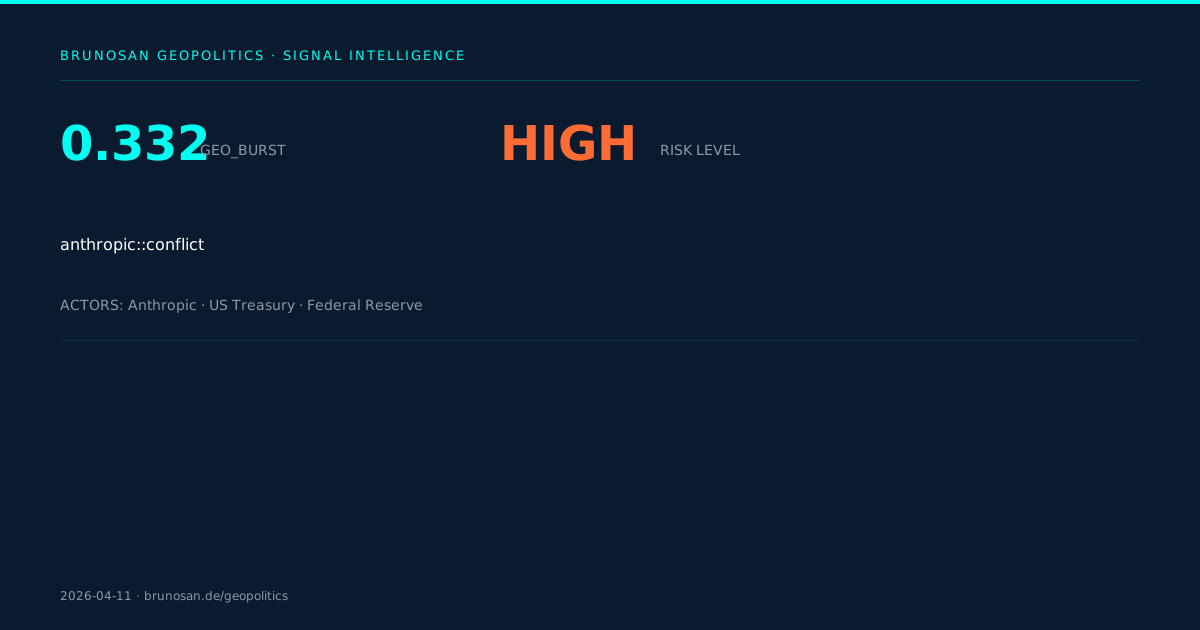
Based on geo_burst 0.332 and the high-level coordination between the US Treasury and the Federal Reserve, BrunoSan assesses a 75% probability of a major US regulatory intervention or "Emergency Cyber Guidance" issuance within 72h.
#conflict #cyber #finance #regulatory