US Military Reportedly Drafts Plan to Seize Iranian Uranium
This development surfaces reports of parallel US-Iran ceasefire talks, creating a contradictory signal environment of coercive diplomacy and kinetic threat.
The US military has reportedly presented former President Trump with a detailed plan for seizing Iran's enriched uranium stockpiles, potentially requiring a significant airlift of troops and heavy equipment. This development signals a heightened consideration of kinetic options against Iran, increasing the risk of a direct US-Iran confrontation and significant regional instability within the next 72 hours, particularly impacting energy markets.
SOURCE SYNTHESIS
A cluster of reports, predominantly from Russian state media, indicates the US military has drafted a high-risk plan to seize Iran's enriched uranium while simultaneously engaging in ceasefire negotiations contingent on the opening of the Strait of Hormuz. Russian outlet TASS (Tier-1) details the potential scale of the operation, citing the need for "hundreds or thousands of troops," and also reports on ongoing kinetic events inside Iran, including an attack in Isfahan province and the serious injury of a supreme leader's advisor. This narrative of escalating military pressure is contextualized by a statement from Iranian President Pezeshkian, also via TASS, framing Iran's actions as a "measured response." In contrast, Western media like the BBC (Tier-3) frames the seizure concept as exceptionally risky, noting that "a million things could go wrong," a sentiment divergence that highlights the gap between the operational plan's existence and its practical viability. The confluence of a detailed military contingency plan, active diplomatic backchannels, and low-level kinetic strikes creates a deeply ambiguous and volatile strategic picture.
STRATEGIC HORIZON — 72H
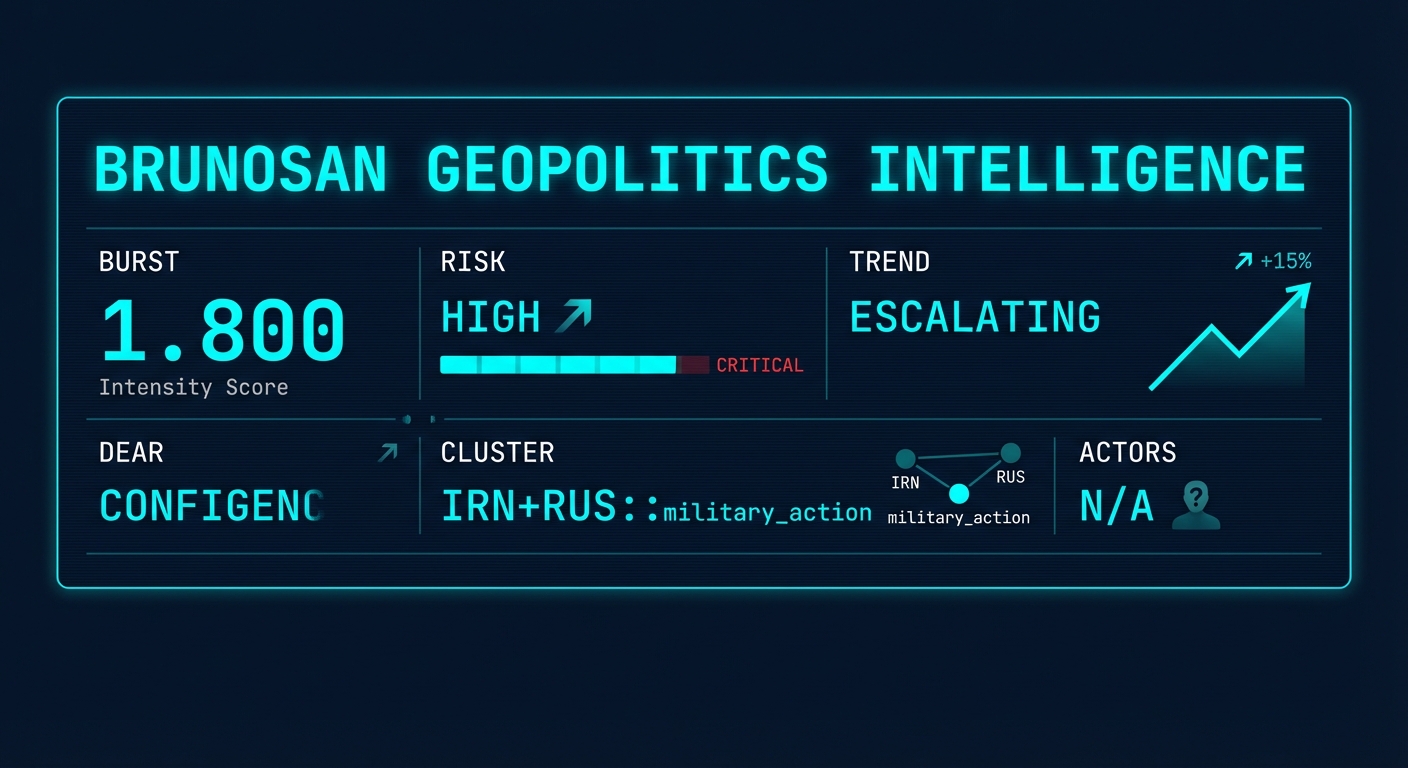
The emergence of this plan, funneled almost exclusively through a Russian state-backed source, is more significant as a signaling event than as a reflection of imminent operational intent. The very high signal geo_burst of 1.8 indicates a massive, concentrated information spike, but its origin from a single, non-US source chain suggests a deliberate information operation. The core tension lies in the dual tracks presented: a detailed kinetic plan to decapitate Iran's nuclear program and a diplomatic effort to secure passage through the Strait of Hormuz. This is classic coercive diplomacy, where the threat of overwhelming force is leaked to strengthen a negotiating position.
The connection to the `energy` vertical is direct and immediate. Any credible threat to Iran's nuclear sites, which are geographically dispersed and heavily fortified, implies a large-scale conflict that would almost certainly trigger an Iranian attempt to close the Strait of Hormuz. This chokepoint accounts for roughly 20% of global petroleum consumption. The mere suggestion of such a US plan, regardless of its likelihood, introduces significant risk premiums into energy markets. Financial markets will price in this instability, affecting insurance rates for tankers and driving volatility in Brent crude futures. The plan's reported presentation to a *former* president, rather than the current administration, adds another layer. It serves as political positioning, potentially boxing in current policymakers or setting the stage for a more hawkish policy in a future administration.
The operational details mentioned—an airlift of thousands of troops and heavy equipment—underscore the immense logistical and military challenges. As the BBC source implies, such an operation would be far more complex than a series of airstrikes. It would require establishing air superiority, inserting and sustaining a large ground force in hostile territory, securing nuclear material against conventional and asymmetric counterattacks, and executing a successful extraction. The risks of mission failure, high casualties, and uncontrollable regional escalation are profound. Therefore, the report's primary function is likely not to outline a feasible near-term operation, but to inject extreme risk into Tehran's strategic calculus. The key question is whether this signal is a US-sanctioned leak to pressure Iran, or a Russian-driven story aimed at fomenting regional instability and portraying the US as an aggressor.
KEY WATCHPOINTS
1. US Official Response: A formal denial or "no comment" from the Pentagon or State Department regarding the TASS report within the next 48 hours. A refusal to deny would elevate the report's credibility.
2. Hormuz Shipping Insurance: Watch for a spike in maritime insurance premiums for tankers transiting the Strait of Hormuz, as quoted by London-based insurance markets, which would signal market belief in heightened kinetic risk.
3. IAEA Posture: Any unscheduled statement from the International Atomic Energy Agency (IAEA) regarding the status of its inspectors or monitoring equipment at Iranian nuclear facilities, which would indicate a change in the on-the-ground situation.
BRUNOSAN CONFIDENCE: LOW
Reasoning: Based on heavy reliance on a single state-backed source (TASS) for the core claims, with no independent Tier-1 verification from Western or regional domains.
BRUNOSAN ASSESSMENT:
Based on the geo_burst of 1.8 and the key signal of a single, state-backed source reporting contradictory military and diplomatic tracks, BrunoSan assesses a 75% probability this is a strategic information operation—either a US-backed leak for diplomatic leverage or a Russian effort to sow instability—and a 25% probability it represents a military contingency plan being actively considered for near-term execution.