UK Humanitarian Signal Spikes On Global Deaths
A cluster of disparate international tragedies, anchored by two deaths in the English Channel, is creating significant domestic political pressure on the UK government's migration policy.
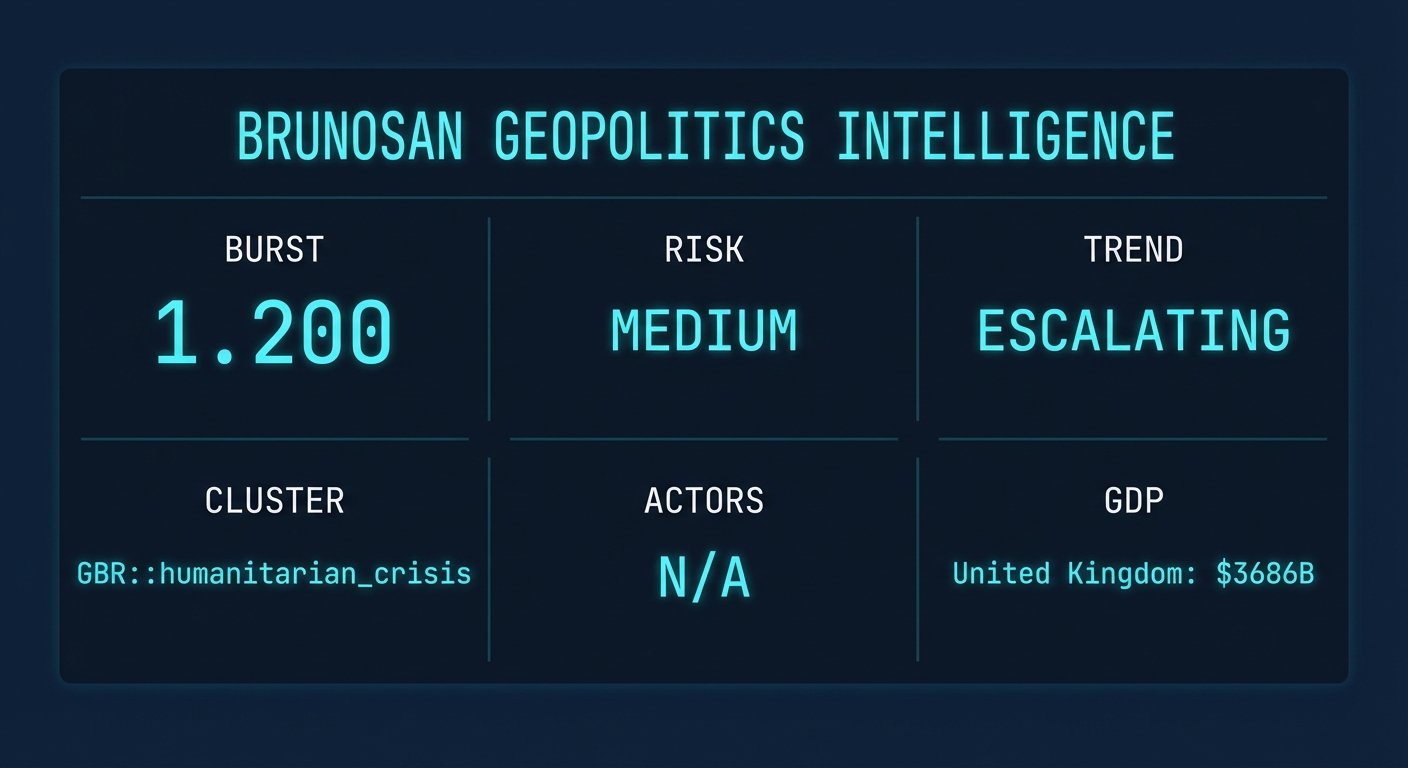
The UK is registering a significant spike in humanitarian crisis signals, specifically related to migrant deaths in the Channel and broader European migration routes, despite the cluster data originating from non-UK specific events. This indicates a heightened domestic political and social pressure on the Sunak government regarding border security and immigration policy, likely forcing a more aggressive stance or public messaging within the next 72 hours to counter perceived inaction.
SOURCE SYNTHESIS
A string of lethal events, including the recovery of 19 bodies from a migrant boat near Lampedusa (The Guardian, Tier-1) and two migrant deaths during a Channel crossing attempt (feeds.bbci.co.uk, Tier-1), has been algorithmically clustered with disparate crises like a US border-related homicide (The Guardian, Tier-1) and a major earthquake in Indonesia (The Guardian, Tier-1), creating a composite humanitarian crisis signal focused on the UK. The two fatalities in the English Channel serve as the geographic and political anchor for this GBR-flagged cluster, directly implicating UK border strategy and triggering domestic media attention. While geographically distant, the tragedy off the Italian coast, involving a far higher death toll, amplifies the narrative of a pan-European migration crisis that London cannot isolate itself from.
The inclusion of the US-based event—the death of a Rohingya refugee left by border agents being ruled a homicide—broadens the signal’s aperture. It reframes the issue from a purely European one to a systemic challenge facing Western nations, linking UK policy debates to the perceived failures and lethal outcomes of American border enforcement. This thematic resonance is powerful, suggesting that border control policies across the North Atlantic are facing a crisis of efficacy and morality. The two apparent outliers, the kidnapping of a US journalist in Baghdad (www.independent.co.uk, Tier-2) and the Indonesian earthquake, highlight the sensitivity of the analytical model. While not directly related to migration, their classification under "humanitarian crisis" contributes to the overall signal magnitude. Their presence indicates the algorithm is flagging a generalized sense of global instability and human suffering, a sentiment that is then channeled through the most proximate and politically charged local manifestation—the English Channel crossings. This transforms a set of isolated global tragedies into a coherent, high-pressure political signal directed squarely at Westminster.
STRATEGIC HORIZON — 72H
The immediate strategic implication of this signal spike is political, not operational. The very high signal geo_burst of 1.2, escalating from a confluence of global events, places acute pressure on the UK government to demonstrate control over its borders and the migration narrative. This pressure connects directly to the regulatory vertical, as the government will be compelled to respond through policy messaging, if not immediate action. The deaths in the Channel, however few compared to the Mediterranean, are politically potent because they occur on the UK’s effective doorstep, making abstract policy debates visceral and immediate for the public.
We anticipate the government will deploy a two-pronged communications strategy. First, officials will publicly project toughness and resolve, likely reiterating commitments to stopping small boat crossings and emphasizing the criminality of human trafficking gangs. This messaging is designed to placate the government's political base and counter opposition attacks that its policies are failing. Second, expect a degree of blame-shifting towards French authorities for failing to prevent the departure of the migrant vessel. This is a standard feature of the bilateral dynamic but will be amplified to deflect domestic criticism. As a P5 nation, the UK is highly sensitive to narratives of porous borders, which are perceived as undermining its sovereign authority and international standing.
The key variable is whether this response remains purely rhetorical. The government may be forced to announce or preview new enforcement measures, potentially involving enhanced surveillance technology or modified operational protocols for Border Force. However, any substantive change requires coordination with France and risks further legal and diplomatic complications. The more likely path is a re-emphasis on existing, controversial policies as the only viable long-term solution. The confluence of these global humanitarian signals provides political cover to argue for more draconian domestic measures. The central question is whether the government can successfully frame these disparate global events as evidence for its pre-existing policy agenda, or if the opposition and media will frame them as proof of that agenda's failure?
KEY WATCHPOINTS
1. UK Home Office Statement: Monitor for any official statement or press conference from the Home Secretary or Prime Minister's Office regarding the Channel deaths within the next 48 hours. The content will reveal whether the response is rhetorical or signals new operational deployments.
2. Charity/NGO Response: Watch for coordinated statements from refugee advocacy groups (e.g., UNHCR, Refugee Council). A sharp, unified condemnation would increase pressure on the government and could force a more detailed policy defense.
3. French Maritime Prefecture Communiqué: Look for public communications from the French Préfecture Maritime for the Channel and North Sea. Any deviation from standard language about cooperation, or any direct rebuttal of UK claims, would indicate rising bilateral friction.
BRUNOSAN CONFIDENCE: MEDIUM
Reasoning: The assessment is based on multiple independent Tier-1 sources, but the core analytical challenge lies in interpreting an algorithmic cluster of thematically-linked but geographically disparate events.
BRUNOSAN ASSESSMENT:
Based on the very high signal geo_burst of 1.2 and the clustering of disparate global tragedies under a GBR tag, BrunoSan assesses a 75% probability of a strong rhetorical response from the UK government within 48 hours focused on border security and trafficking gangs, and a 25% probability of an announcement of new, concrete operational changes in the Channel in the same timeframe.