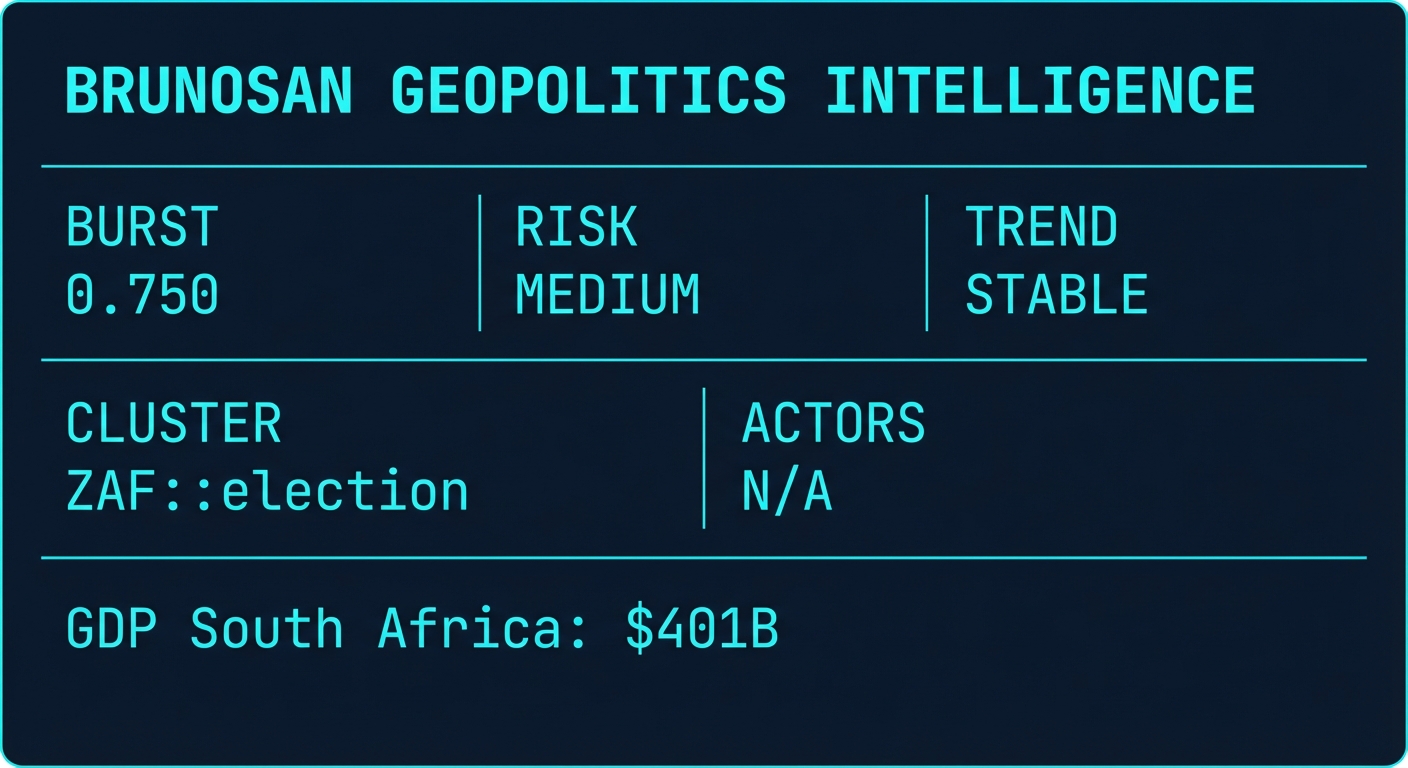
South Africa Preps Elections st Institutional Decay
The Electoral Commission's procedural announcement on election deposits contrasts sharply with mounting evidence of systemic failure in key state institutions, signaling a deepening governance crisis.
The Electoral Commission of South Africa (IEC) has opened public comment on proposed deposit amounts for upcoming local government elections, signaling preparatory steps for the electoral cycle. This procedural move, st broader governance challenges and financial instability within key state-owned enterprises, suggests a continued focus on domestic political processes despite underlying systemic fragilities, potentially diverting attention from critical economic reforms in the immediate 72-hour window.
SOURCE SYNTHESIS
While South Africa’s Electoral Commission advances procedural preparations for local elections by inviting public comment on candidate deposits (feeds.feedburner.com, Tier-1), this veneer of institutional normalcy is undermined by concurrent signals of severe state decay. The South African Post Office (Sapo) is described as being on "borrowed time," facing critical funding gaps that push it toward collapse, while a separate incident saw Nelson Mandela Bay officials waste R88,000 in taxpayer funds on a trip for a postponed meeting, highlighting a breakdown in basic accountability (www.dailymaverick.co.za, Tier-1). This pattern of institutional fragility is further underscored by a new civil society initiative aimed at overhauling the National Prosecuting Authority (NPA), which organizers describe as fundamentally unfit for purpose. The cluster of signals indicates that while the formal mechanisms of the electoral cycle are functioning, the foundational state entities required for effective governance are experiencing accelerating stress. This divergence between electoral procedure and state capacity points to a growing risk of a hollowed-out state, where democratic processes mask an inability to deliver basic services or maintain fiscal discipline, directly impacting the country's regulatory and financial stability.
BRUNOSAN CONFIDENCE: HIGH
Reasoning: Analysis is based on multiple independent Tier-1 sources providing cross-domain evidence of a consistent theme of governance failure.