Russian Economy Slows as Kremlin Projects EU Energy Pain
Official data confirms rising inflation and decelerating growth, while Moscow simultaneously message its ability to weather sanctions and exploit European energy vulnerabilities.
Russia's Economy Ministry reports annual GDP growth slowed to 1.5% in February and inflation reached 5.86% by March 30, indicating a deepening economic deceleration under Western sanctions. This sustained internal economic pressure will likely compel the Kremlin to intensify efforts to secure alternative trade routes and financial mechanisms, impacting commodity markets and regional stability over the next 72 hours.
SOURCE SYNTHESIS
Russia’s Economy Ministry has released official data confirming a significant economic slowdown, with annual GDP growth falling to 1.5% in February and annual inflation climbing to 5.86% by late March (tass.com, Tier-1). This official acknowledgement of domestic economic headwinds is occurring alongside a coordinated external messaging campaign highlighting the economic pain inflicted on Europe by sanctions and energy market volatility. A Russian envoy specifically identified Italy and Germany as suffering most from the Gulf oil shock, a narrative amplified by reports of German gas importer VNG pleading for government intervention to fill critically low storage facilities (tass.com, Tier-1). This dual-track approach—releasing controlled negative data domestically while projecting an image of strategic leverage abroad—is further complicated by a White House warning that oil prices could potentially surge to $200 per barrel, a signal of the West’s preparedness for a protracted economic conflict. As a counterpoint to the narrative of isolation, Russian state media also highlights adaptive measures, such as national airline Aeroflot compensating for lost routes to the UAE by increasing capacity to Asian markets like China and Thailand (tass.com, Tier-1). The entire information cluster originates from a single state-backed source, shaping a narrative of Russian resilience and unavoidable, self-inflicted Western economic damage.
STRATEGIC HORIZON — 72H
The Kremlin is navigating a complex economic environment defined by two opposing pressures: managing the real-world consequences of slowing growth and rising inflation internally, while maximizing its geopolitical leverage through the energy vertical externally. The data released by the Economy Ministry is not just a statistic; it is a political signal intended for both domestic and international audiences. Domestically, it sets expectations and frames a narrative of shared sacrifice in the face of foreign aggression. Internationally, it is paired with threats, both explicit and implicit, that Russia can withstand this pressure longer than Europe can withstand the associated energy price shocks.
The German gas storage situation is a critical focal point. VNG’s call for state intervention is a clear indicator that market mechanisms are failing to secure Germany’s energy supply for the coming winter. Moscow views this as a primary vector of influence. By highlighting German and Italian vulnerability, the Kremlin aims to fracture EU solidarity on sanctions policy, betting that national economic interests will eventually override bloc-level strategic commitments. This puts the German Cabinet in an immediate and difficult position: intervene and potentially distort the market further, or risk a severe energy crisis that could trigger a recession and widespread social discontent.
Simultaneously, Russia is accelerating its economic pivot to the East. The Aeroflot rerouting is a small but symbolic part of a much larger strategic reorientation of trade and finance. This pivot is Russia's primary long-term defense against Western sanctions. However, its success is contingent on the willingness of Asian partners, chiefly China and India, to absorb Russian exports and provide alternative financial infrastructure. In the next 72 hours, the primary tension will be between Russia’s need to stabilize its domestic economy and its desire to use the energy weapon against Europe before the continent can adequately diversify its supplies. The White House’s $200 oil price scenario is a direct counter-signal, communicating that the U.S. is willing to absorb significant economic pain to see its strategy through. The question is whether this resolve is matched in European capitals facing more direct and immediate consequences.
BRUNOSAN CONFIDENCE: LOW
Reasoning: All provided sources originate from a single, state-backed Russian news agency (TASS), precluding independent verification and introducing significant narrative bias.
KEY WATCHPOINTS:
1. Any unscheduled policy announcements from Russia's Central Bank regarding interest rates or capital controls within the next 7 days, which would signal a reaction to internal economic data.
2. The Brent-Urals crude oil price spread; a widening of the discount on Urals crude beyond $35/barrel would indicate increasing difficulty for Russia in placing its oil exports.
3. China's next official release of customs data; a marked increase in Russian energy import volumes would provide tangible evidence of the "pivot to Asia" strategy's effectiveness.
BRUNOSAN ASSESSMENT:
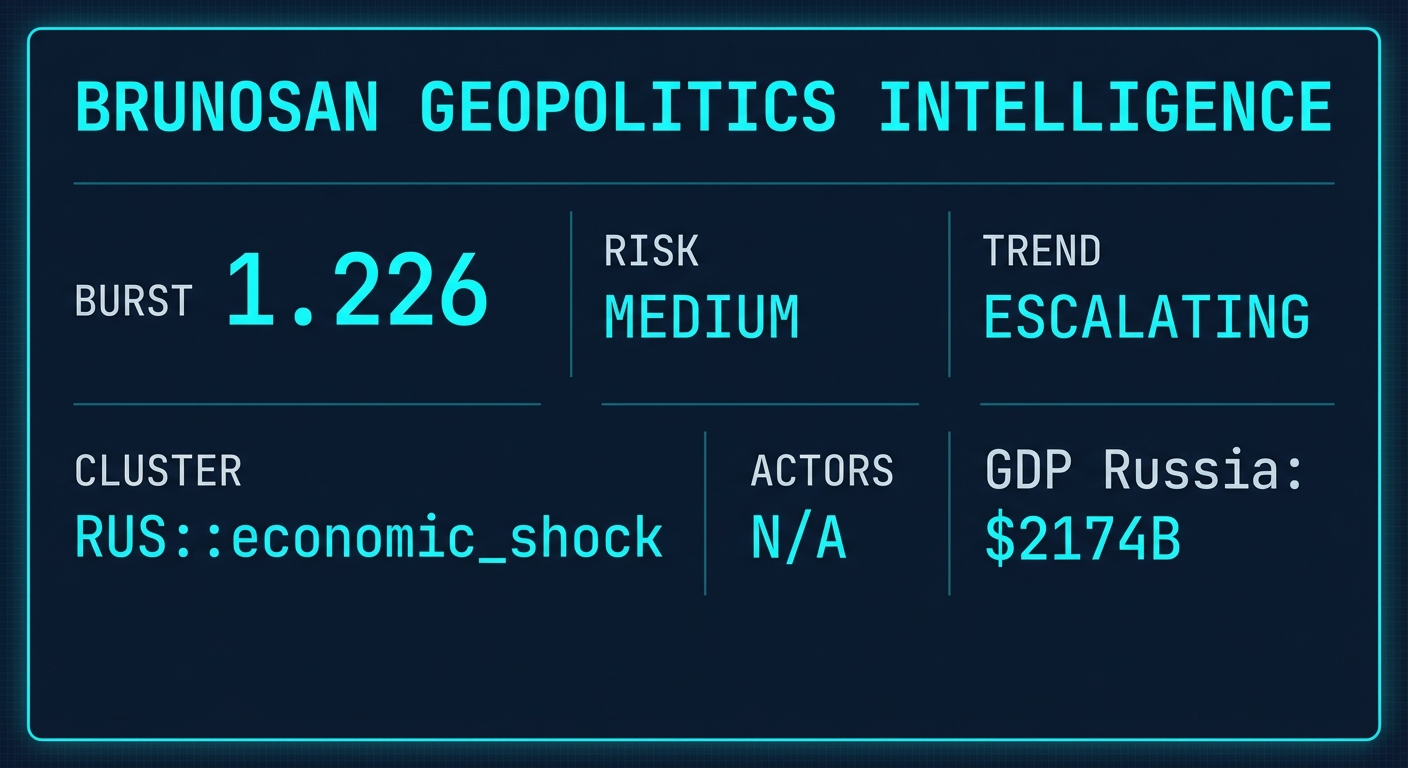
Based on the very high signal geo_burst of 1.226 and the escalating trend of economic pressure, BrunoSan assesses there is a 70% probability that Russia will escalate its information campaign targeting European energy vulnerabilities in the next 72 hours, potentially coupling it with minor, unannounced gas flow reductions to test EU resolve. We assess a 30% probability that Moscow will prioritize domestic stability, focusing on fiscal measures to counter inflation and avoiding actions that could trigger more severe Western sanctions.