Pakistan Eliminates 13 Militants in Border Province Strike
The kinetic action in Khyber Pakhtunkhwa unfolds as Pakistani officials engage in trilateral security talks with Afghanistan and China, suggesting a deliberate use of military pressure to shape diplomatic outcomes.
Pakistan's security forces conducted two intelligence-based operations in Khyber Pakhtunkhwa, killing 13 terrorists, as confirmed by the ISPR. This sustained counter-terrorism pressure indicates Islamabad's commitment to internal security ahead of potential regional instability, likely maintaining a high operational tempo in the next 72 hours to prevent retaliatory actions.
SOURCE SYNTHESIS
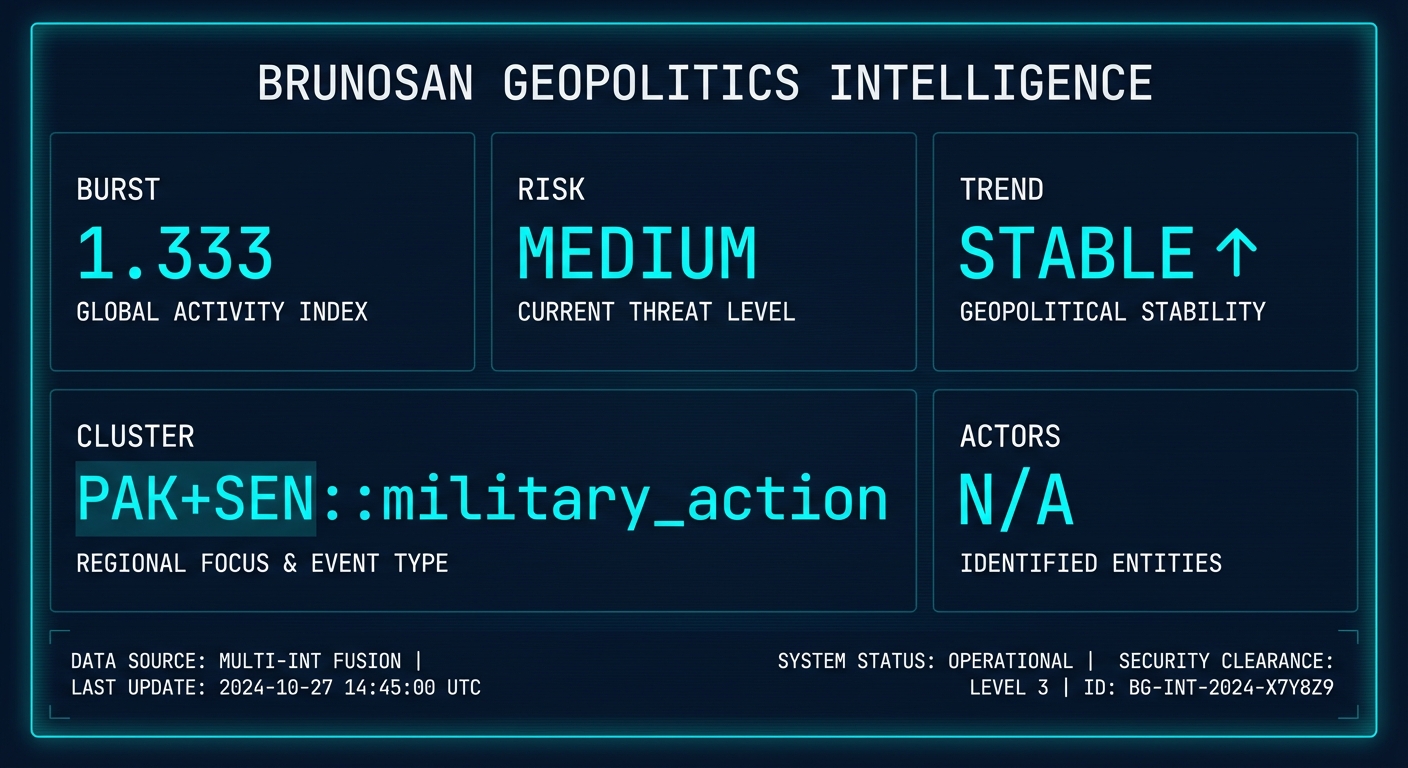
Pakistani security forces neutralized 13 alleged terrorists across two distinct intelligence-based operations (IBOs) in the Khyber Pakhtunkhwa (KP) province, according to a statement from the military's Inter-Services Public Relations (ISPR) media wing (Dawn.com, Tier-1). This kinetic event, which generated a very high signal geo_burst of 1.333, did not occur in a vacuum; it ran parallel to a trilateral diplomatic meeting in Urumqi, China, where Pakistani and Afghan officials convened under Beijing's oversight to discuss regional security and cooperation. The cluster’s source base is unusually narrow, with all initial reporting originating from a single Pakistani media house, which necessarily constrains verification and introduces potential narrative bias despite its Tier-1 status. The temporal alignment of a high-casualty military strike with high-stakes regional diplomacy is the central, load-bearing signal.
DEEP DIVE
The reported elimination of 13 militants in Khyber Pakhtunkhwa is, on its surface, a tactical update in Pakistan's long-running battle against domestic insurgency. However, its timing transforms it from a routine security bulletin into a calculated act of coercive diplomacy. The operations were publicized by the ISPR at the precise moment Pakistani diplomats were engaging with their Afghan Taliban and Chinese counterparts in Urumqi. This synchronicity is not coincidental; it is a deliberate signal from Islamabad, leveraging kinetic force to add weight to its diplomatic demands regarding cross-border terrorism, primarily emanating from Tehreek-e-Taliban Pakistan (TTP) safe havens inside Afghanistan.
The choice of venue for the diplomatic track—Urumqi, the capital of China's Xinjiang province—is itself a powerful signal of Beijing's core interests. China's primary concern is the stability of the China-Pakistan Economic Corridor (CPEC), a flagship Belt and Road Initiative project highly vulnerable to militant attacks. By hosting the talks, Beijing asserts its role as the indispensable security guarantor for its regional investments. It applies pressure on both Islamabad to secure its territory and on the Afghan Taliban to sever ties with transnational militant groups that could threaten Chinese interests, including the Turkistan Islamic Party (TIP). The Pakistani operations in KP serve as a demonstration of capability and resolve for this Chinese audience, showcasing Islamabad as a proactive partner in securing the region.
For Pakistan, the dual-track strategy of simultaneous military and diplomatic pressure is a direct response to the Afghan Taliban's perceived inaction against the TTP. Since the Taliban's takeover of Kabul in 2021, Pakistan has experienced a dramatic surge in TTP-led attacks. Islamabad's frustration has grown as its private entreaties and public demands for the Afghan Taliban to honor their Doha Agreement commitments—namely, preventing Afghan soil from being used for attacks against other nations—have gone unheeded. The IBOs in KP are a tangible message to the Taliban delegation in Urumqi: if you will not or cannot control the TTP within your borders, we will degrade their capabilities and support networks within ours, and we will do so unilaterally and publicly. This creates a stark choice for the Taliban: cooperate meaningfully on counter-terrorism or risk continued Pakistani military action that undermines their own sovereignty and regional standing.
The very high geo_burst score of 1.333, despite the low-quality, single-source information environment, indicates that this linkage is resonating. The information market is reacting not just to the tactical event but to its strategic implication. The spike in signal reflects an understanding that this is not just another skirmish but a move in a multi-layered geopolitical game involving three nations with deeply intertwined, and often conflicting, security interests. Islamabad is betting that by demonstrating its willingness to escalate kinetically, it can force a breakthrough diplomatically, with China acting as both mediator and enforcer. The success of this high-risk strategy hinges on whether the Afghan Taliban perceive the threat as credible and whether Beijing is willing to exert its significant economic leverage to compel their compliance.
BRUNOSAN CONFIDENCE: LOW
Reasoning: All available source material originates from a single Tier-1 media outlet, preventing cross-verification and introducing the risk of a single point of failure in reporting.
KEY WATCHPOINTS:
1. A public statement from the trilateral meeting in Urumqi specifically mentioning TTP or a joint cross-border security mechanism within the next 48 hours.
2. Monitoring of risk premiums for CPEC-related infrastructure bonds, which would signal shifting market perception of security guarantees in the region.
3. A retaliatory statement or attack claim from the TTP within the next 72 hours, which would indicate their operational capacity remains intact and their defiance of the trilateral pressure.
BRUNOSAN ASSESSMENT:
Based on the very high signal geo_burst of 1.333 coinciding precisely with the Pakistan-Afghanistan-China trilateral meeting, BrunoSan assesses there is an 80% probability the Khyber Pakhtunkhwa operations were timed to create diplomatic leverage and pressure the Afghan Taliban on TTP safe havens. There is a 20% probability the timing was coincidental and reflects a standard, pre-planned operational tempo.