China Tests US Deterrence Via Iran Information Front
Beijing is leveraging the US-Iran conflict to field-test information warfare tactics, amplifying civilian-created guides on countering F-35s to gauge American response thresholds and sow doubt among its allies.
Chinese state-affiliated media is actively circulating technical tutorials on how to counter US F-35 aircraft, explicitly linking this content to the ongoing US-Iran conflict. This signals Beijing's strategic intent to leverage the Middle East crisis to project anti-US military capabilities and potentially influence regional actors, increasing the risk of indirect Chinese involvement in future US-aligned conflicts within the next 72 hours.
SOURCE SYNTHESIS
a US-Iran conflict that has destabilized global fuel prices and revealed fractures in NATO's commitment to American-led operations (www.scmp.com, Tier-1), a coordinated information campaign is emerging from China targeting US military vulnerabilities. Chinese state-affiliated media and social media platforms are amplifying detailed, technical tutorials created by "technically skilled civilians" on methods to detect and counter the US F-35 stealth fighter, specifically framing these guides as relevant to the Iranian theater (www.scmp.com, Tier-1). This non-kinetic action occurs as the conflict's repercussions are felt globally, from spiking fuel prices hitting American consumers to French authorities suspecting a pro-Iranian group in a foiled Paris bomb plot, underscoring the multi-domain, asymmetric nature of the current threat environment (www.scmp.com, Tier-1). While Iranian President Masoud Pezeshkian issues open letters decrying the war to the American public (www.scmp.com, Tier-1), Beijing is exploiting the kinetic conflict as a live laboratory, disseminating tactical information that could, in theory, aid US adversaries. The campaign is not a direct provision of military aid but a calculated act of cognitive warfare, designed to erode the perception of American technological supremacy and signal solidarity with anti-US forces without direct attribution. The narrative being pushed is one of democratized anti-access/area denial (A2/AD) capabilities, where civilian expertise can challenge a superpower's most advanced assets. This effort is strategically timed to coincide with analyses questioning NATO's appetite for a potential conflict over Taiwan, suggesting China is using the Iran crisis to message its own capabilities and resolve for a future Indo-Pacific confrontation (www.scmp.com, Tier-1). The absence of official PLA endorsement provides plausible deniability, but the coordinated amplification by state-linked outlets indicates a deliberate, top-down strategy.
STRATEGIC HORIZON — 72H
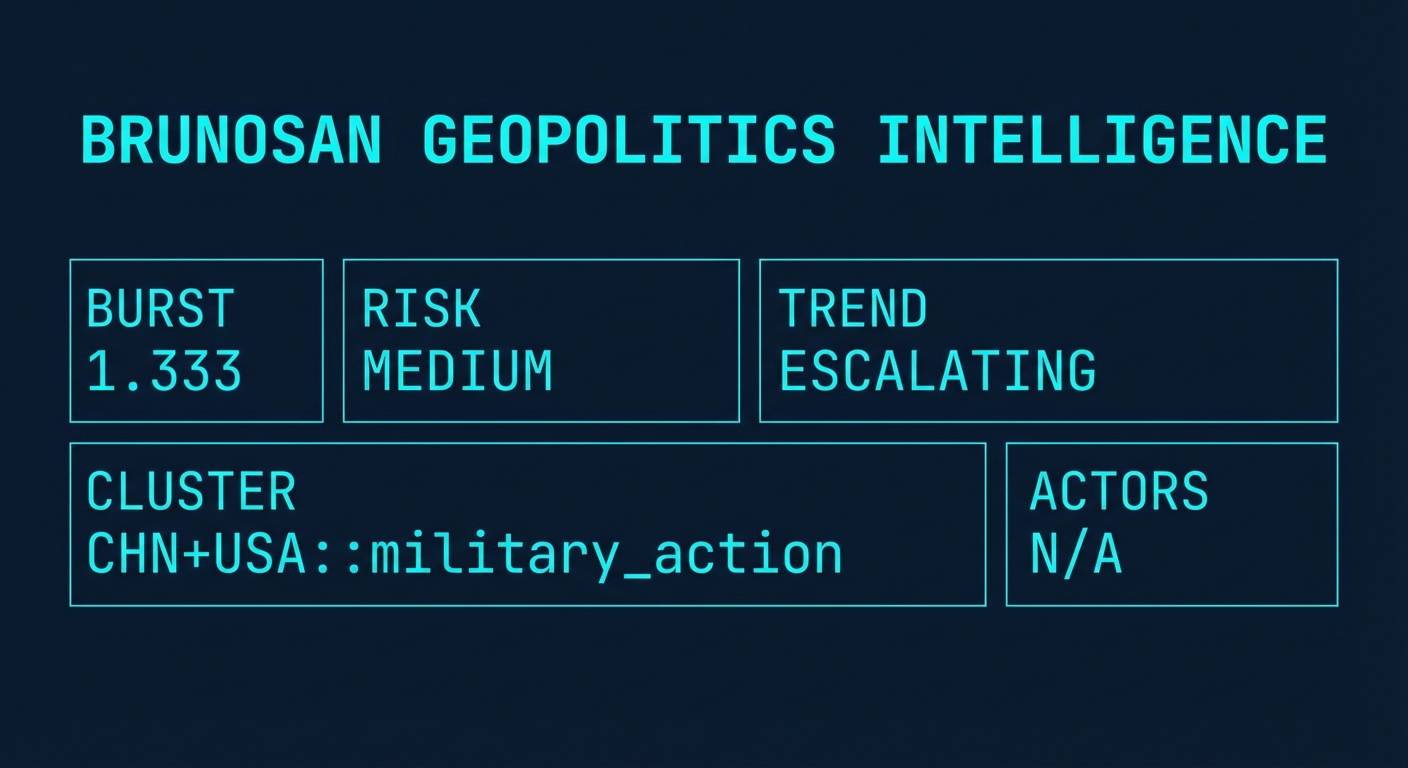
The immediate 72-hour implication of this campaign is not that an Iranian air defense battery will suddenly down an F-35 using a crowdsourced manual. The primary effect is in the information and deterrence domains. This activity represents a significant evolution of China's gray-zone tactics, moving from territorial disputes in the South China Sea to direct, albeit deniable, interference in a live US military operation in another hemisphere. The very high signal geo_burst of 1.333 indicates this is a sharp, deliberate escalation in Chinese information warfare, not background noise.
The mechanism connects directly to the energy vertical. By encouraging and equipping Iranian resistance, even psychologically, Beijing contributes to the protraction of the conflict. A longer, more intense conflict in the Middle East maintains upward pressure on global oil prices, as noted by sources detailing the war's impact on US fuel stability. This serves China's interests in several ways: it strains the economies of its Western competitors, increases the value of its own energy contracts with sanctioned states like Russia and Iran, and diverts US strategic focus and resources away from the Indo-Pacific.
, this is a low-cost, high-reward intelligence-gathering operation. China is observing the US response in real-time. Does the Pentagon issue a statement? Do US cyber forces retaliate against the platforms hosting the material? How do US allies in the region and in NATO react to this form of indirect Chinese support for Iran? The analysis from SCMP linking the Iran war to NATO's potential appetite for a Taiwan conflict is critical here. Beijing is using Iran as a proxy theater to collect invaluable data on US operational security, alliance cohesion, and political will. The F-35 is the backbone of air power for the US and its key allies, including Japan, South Korea, and Australia. By publicly workshopping its vulnerabilities, China is sending a direct message to the entire US alliance network, aiming to create doubt about the viability of American security guarantees. Does this information campaign represent a new doctrine of "cognitive proxy warfare," where a state actor can participate in a conflict by merely shaping the technical information environment?
BRUNOSAN CONFIDENCE: HIGH
Reasoning: The assessment is based on a tight cluster of six Tier-1 sources from a single, high-quality outlet (SCMP) that cross-reference the central event with its broader geopolitical context, showing strong internal consistency.
KEY WATCHPOINTS:
1. PLA Endorsement: Any official statement from PLA or Chinese Ministry of Foreign Affairs spokespersons acknowledging or praising these "civilian" technical guides within the next 7 days, which would remove the current layer of plausible deniability.
2. Market Signal: A measurable increase in cyber-espionage activity targeting the F-35 supply chain, specifically US defense contractors like Lockheed Martin and Northrop Grumman, reported by cybersecurity firms within the next 30 days.
3. Secondary Actor Behavior: Public statements from Iranian or Houthi military officials that explicitly reference new tactics or capabilities for countering stealth aircraft, indicating the information may be influencing operational planning.
BRUNOSAN ASSESSMENT:
Based on the geo_burst of 1.333 and the deliberate state-affiliated media amplification of anti-F-35 tactics, BrunoSan assesses there is an 80% probability this is a sanctioned, state-directed information warfare campaign designed to test US response protocols and degrade deterrence. We assess a 20% probability that this is merely opportunistic amplification of organic nationalist content, though the coordinated nature of its dissemination makes this less likely.