US Faces Multi-Front Diplomatic Stress Test
Pakistan and Ukraine push Washington toward high-stakes mediation with Iran and Russia, while China launches a parallel diplomatic gambit over Taiwan.
Pakistan has formally offered to facilitate direct peace talks between the United States and Iran, leveraging its diplomatic ties, while Ukraine's Zelenskyy has requested US mediation for an energy ceasefire proposal to Russia. This first-occurrence signal indicates a potential, albeit fragile, diplomatic opening for de-escalation in two critical geopolitical flashpoints, placing immediate pressure on Washington to define its engagement strategy within the next 72 hours.
SOURCE SYNTHESIS
Simultaneous but distinct diplomatic overtures are placing the United States at the center of three separate, high-stakes negotiations, with Pakistan offering to facilitate US-Iran talks, Ukraine requesting US brokerage for an energy-specific ceasefire with Russia, and China inviting Taiwan's opposition for "peace" talks. Tier-1 sources confirm Pakistan's offer to mediate, building on a previously successful role (feeds.bbci.co.uk, Tier-1), though Iran's official position, per ANSA (Tier-1), is that no direct negotiations with the US have occurred, only proposals passed through intermediaries. This channel is complicated by internal Iranian politics, with hardliners like parliamentary speaker Mohammad Bagher Ghalibaf, who is linked to the talks, maintaining a publicly hostile stance toward the US (www.vrt.be, Tier-2). Concurrently, Ukrainian President Zelenskyy has formally asked Washington to convey a proposal for an "energy ceasefire" to Moscow, a targeted de-escalation effort aimed at critical infrastructure (feeds.yle.fi, Tier-1). Compounding the pressure on Washington, China's President Xi has invited Taiwan’s opposition leader to Beijing to discuss "peace," a move widely seen as an attempt to shape the narrative and increase leverage ahead of a potential summit with the US (rss.nytimes.com, Tier-1).
STRATEGIC HORIZON — 72H
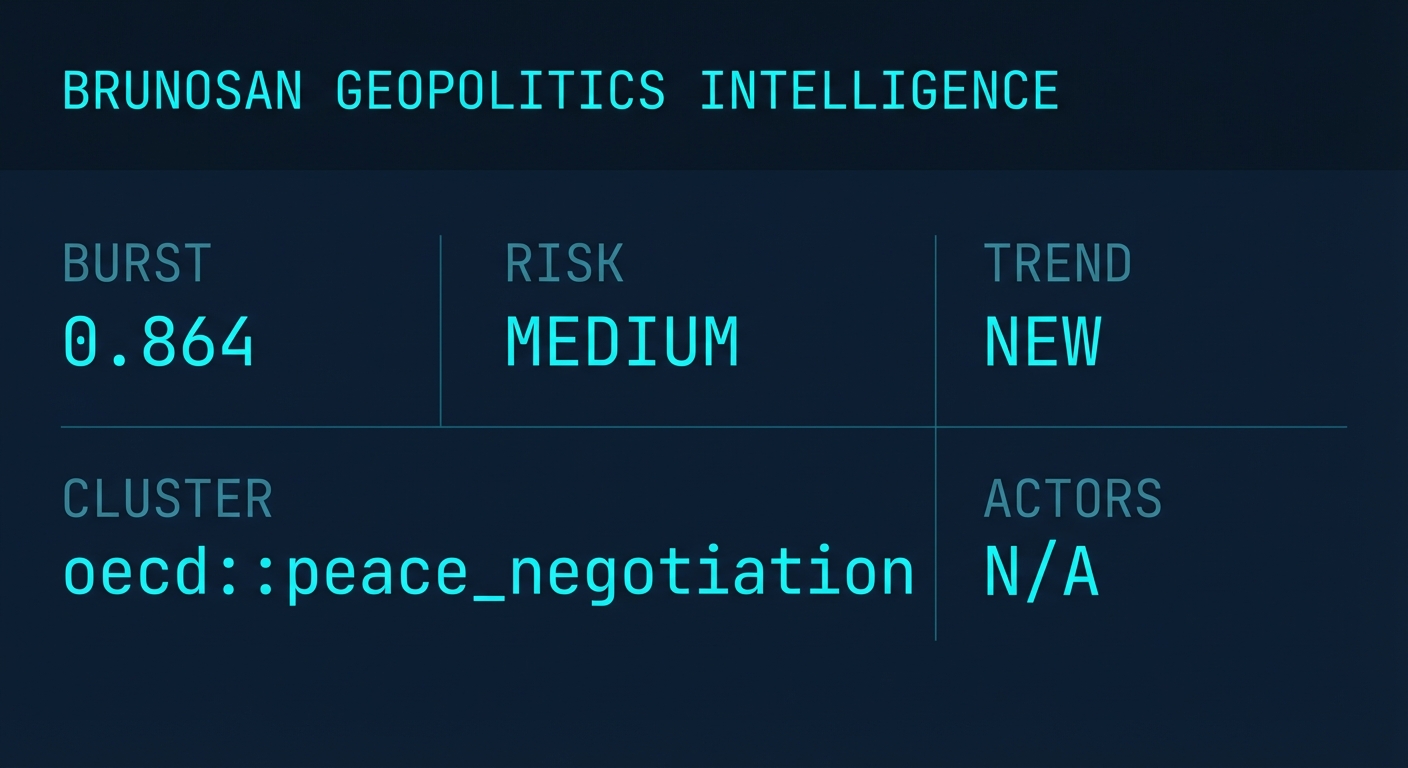
The convergence of these three mediation tracks creates an immediate and complex decision-making challenge for Washington. This is not a series of isolated events but a systemic stress test of US diplomatic capacity and strategic priorities. The geo_burst score of 0.864, near the 7-day peak for this cluster, quantifies the sudden, intense focus on negotiation signals, forcing the US to triage its response. The core challenge is that each track is booby-trapped. Engaging with Iran through Pakistan risks legitimizing a regime whose hardline elements are internally divided and publicly hostile, potentially yielding little while alienating regional allies. Refusing, however, could be portrayed as rejecting a path to de-escalation, leaving the US vulnerable to accusations of warmongering.
The connection to the energy vertical is acute and twofold. Ukraine's request for an "energy ceasefire" directly targets the cycle of attacks on power grids and fuel depots that have defined recent phases of the conflict. A US-brokered pause would have immediate implications for European energy security and market stability, potentially lowering the risk premium on natural gas futures. Conversely, the US-Iran track is inextricably linked to the security of the Strait of Hormuz, through which a significant portion of global oil supply transits. A credible de-escalation process could soothe oil markets, while a failed or rejected overture could elevate the cross-bloc tension metric, currently at a moderate 5.8/10, and trigger a spike in crude prices.
The China-Taiwan track acts as a strategic spoiler and a bandwidth trap. While ostensibly about cross-strait relations, its timing ahead of a US-China summit is a deliberate move by Beijing to frame the US as an external agitator while positioning itself as a peacemaker. It forces Washington to dedicate high-level attention and resources to managing the fallout with Taipei and regional allies, diverting focus from the Iran and Ukraine crises. The US response in the next 72 hours will be a powerful signal of its global posture. Will it attempt to engage on all three fronts, prioritizing one over the others, or issue a blanket rejection of what could be perceived as coordinated coercive diplomacy?
KEY WATCHPOINTS
1. US State Department Response: A formal public statement or high-level background briefing within 72 hours that explicitly accepts, rejects, or defers Pakistan's mediation offer for US-Iran talks.
2. Energy Market Volatility: Divergence between Brent crude and European TTF natural gas futures. A rise in Brent with stable TTF could indicate the market is pricing in a US rejection of the Iran track while remaining optimistic about the Ukraine energy ceasefire.
3. Iranian Rhetoric Shift: Official statements from the offices of the Supreme Leader or the IRGC regarding the Pakistani offer. Silence or dismissal would signal hardliner dominance and doom the initiative, while cautious acknowledgement would suggest internal debate.
BRUNOSAN CONFIDENCE: HIGH
Reasoning: Based on four Tier-1 sources (ANSA, YLE, NYT, BBC) providing consistent, cross-verified reporting on the core diplomatic overtures with only minor divergence in sentiment.
BRUNOSAN ASSESSMENT:
Based on the geo_burst of 0.864 and the direct request from a key ally, BrunoSan assesses a 70% probability the US will publicly engage with Ukraine's energy ceasefire proposal, using it as a low-risk diplomatic initiative. We assess a 35% probability of overt US acceptance of Pakistan's mediation offer, with a higher (60%) probability of utilizing the channel for discreet backchannel communication only, given the internal political risks in Tehran. The Chinese initiative is assessed as having a near-0% chance of altering US policy on Taiwan, but a 90% probability of successfully consuming US diplomatic bandwidth and shaping pre-summit narratives.