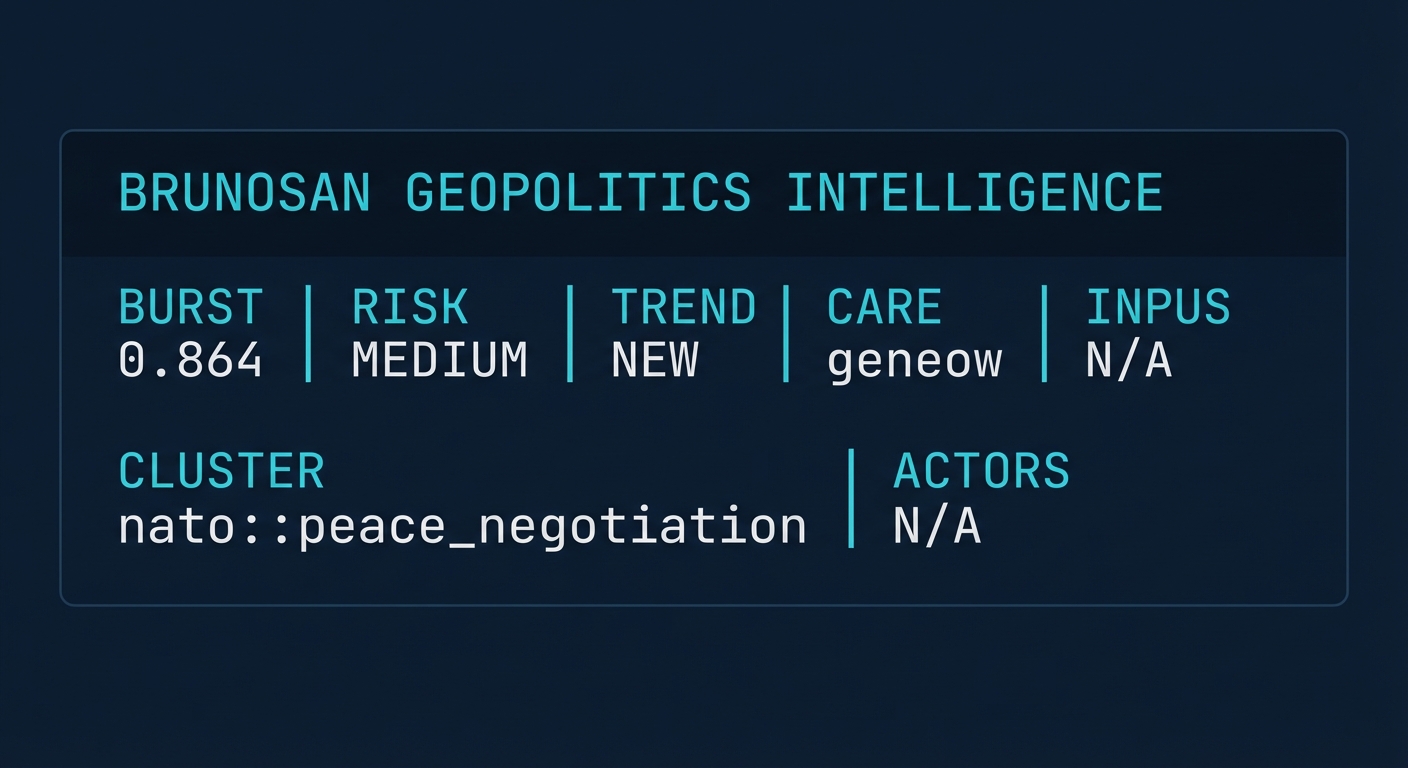
US Faces Dual Mediation Test As Parallel Peace Bids Emerge
Pakistan and Ukraine are simultaneously pushing Washington into high-stakes diplomatic roles, testing the limits of its strategic bandwidth and forcing a potential prioritization between Middle East and European crises.
Pakistan has formally offered to facilitate direct peace talks between the United States and Iran, leveraging its diplomatic ties, while Ukraine's Zelenskyy has requested US mediation for an energy ceasefire proposal to Russia. This dual-track diplomatic push, particularly Pakistan's novel role, suggests a nascent, albeit fragile, opening for de-escalation that could shift regional energy market dynamics and US foreign policy priorities within the next 72 hours.
SOURCE SYNTHESIS
Simultaneous but unconnected diplomatic overtures are pressuring the United States to engage in two separate, high-stakes negotiations: one as a principal with Iran, and another as a mediator between Ukraine and Russia. Pakistan has formally offered to facilitate US-Iran talks, a role it has successfully played for the Trump administration in the past (feeds.bbci.co.uk, Tier-1), with officials stating they are ready to proceed within days (www.luxtimes.lu, Tier-2). However, Tehran has clarified that no direct negotiations have occurred, only the exchange of "proposals" via intermediaries (www.ansa.it, Tier-1), a nuance that significantly lowers the immediate prospect of a breakthrough. This caution is amplified by the hardline, anti-US posture of key Iranian figures like parliamentary speaker Mohammad Bagher Ghalibaf, a potential interlocutor in any dialogue (www.vrt.be, Tier-2). In parallel, Ukrainian President Zelenskyy has formally asked the US to convey an "energy ceasefire" proposal to Moscow, a targeted de-escalation attempt focused on critical infrastructure (feeds.yle.fi, Tier-1). This dual-track pressure on Washington mirrors a broader global trend of using diplomatic framing to manage great power competition, as seen in China's recent invitation to Taiwan's opposition for "peace" talks ahead of a planned summit with the US (rss.nytimes.com, Tier-1).
STRATEGIC HORIZON — 72H
The convergence of these two mediation requests creates an immediate decision point for Washington, with significant implications for the energy and finance verticals. The primary challenge is not the merit of each proposal, but the strain on US diplomatic capacity and the conflicting signals that prioritizing one over the other would send. The two tracks are fundamentally different in their demands on the US: the Ukraine initiative requires Washington to act as an impartial broker, while the Iran track requires it to be a direct participant in a negotiation with a long-standing adversary.
The Ukrainian "energy ceasefire" proposal is the more contained and immediately actionable item. If the US agrees to mediate, the first signal will be a quiet diplomatic communication to Moscow. The market reaction would hinge entirely on Russia's response. An agreement, however temporary, would introduce immediate downward pressure on European natural gas futures (TTF), providing relief to EU economies. A Russian rejection, however, would be weaponized by Kyiv as proof of Moscow's intransigence, likely solidifying Western resolve and potentially triggering new sanctions targeting Russia's energy sector, re-introducing price volatility.
The Pakistan-led initiative for US-Iran talks carries far greater systemic risk and reward. The financial markets, particularly oil, are acutely sensitive to tensions in the Persian Gulf. A credible signal that the US is willing to engage—even through an intermediary—could shave the geopolitical risk premium off Brent crude prices, potentially lowering them by several dollars per barrel. Conversely, a flat rejection by the US, or a public denunciation of the offer by Iranian hardliners, would confirm the stalemate and likely add to that premium, especially if coupled with any kinetic activity near the Strait of Hormuz. The core issue is the credibility gap; Pakistan's offer is credible based on past performance, but the willingness of Iranian hardliners to genuinely negotiate is extremely low. Is this dual diplomatic pressure a coordinated effort to stretch US focus, or a coincidental convergence of crises demanding American attention?
KEY WATCHPOINTS
1. US State Department Statement (next 48 hours): Watch for a formal public statement or press briefing that addresses both the Pakistani and Ukrainian requests. A unified statement would suggest a coordinated policy, while separate, differently-worded responses would indicate prioritization of one theater over the other.
2. Brent Crude Front-Month Futures: Monitor for a price swing greater than 3% in a single trading session. A sharp drop would signal market belief in the Iran de-escalation track; a sharp rise would indicate a breakdown or rejection of the talks.
3. Russian Foreign Ministry Response: A public comment from Moscow or state-controlled media (e.g., TASS, RIA Novosti) regarding the "energy ceasefire" concept. A dismissive response closes the door, while a non-committal "we will study the proposal" opens it for US mediation.
BRUNOSAN CONFIDENCE: HIGH
Reasoning: Reporting on the core diplomatic offers is consistent across multiple Tier-1 sources (ANSA, Yle, NYT, BBC), with lower-tier sources providing corroborating context on key actors.
BRUNOSAN ASSESSMENT:
Based on the geo_burst of 0.864 and the core signal of parallel, non-alliance mediation requests targeting US diplomatic bandwidth, BrunoSan assesses a 65% probability the US will publicly welcome both initiatives but functionally prioritize the Ukraine energy ceasefire track, viewing it as a more achievable, lower-risk effort that directly supports a key ally. We assess a 25% probability of substantive US engagement on the Iran track, contingent on quiet, back-channel assurances from Tehran that contradict the public rhetoric of its hardliners. A full, public rejection of both diplomatic openings is assessed at a 10% probability, as it would cede the diplomatic initiative and project an image of inflexibility.