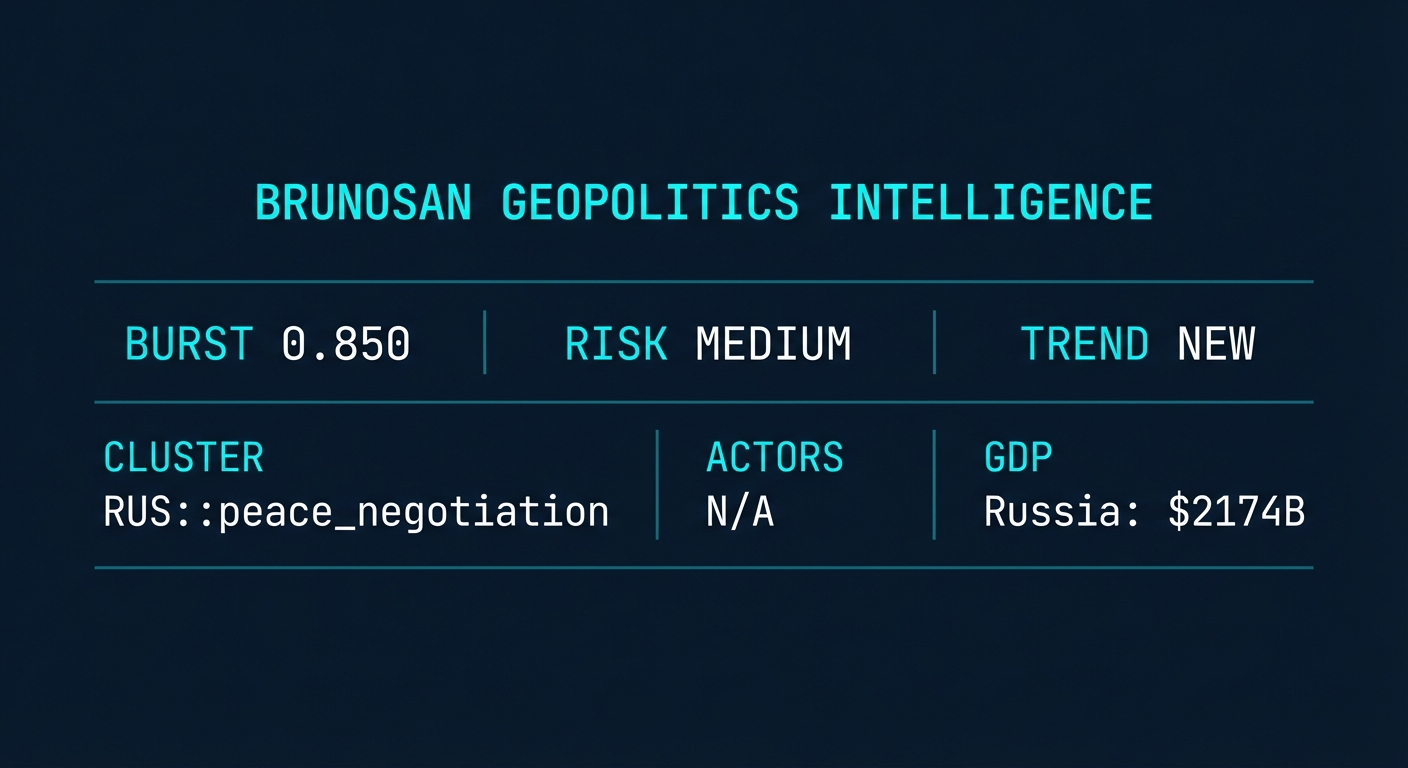
Russia Weaponizes Diplomatic Process, Pivots to Asia
While appearing to engage on Ukraine, Moscow launches a bid for influence in the India-Pakistan conflict, leveraging procedural ambiguity as a strategic tool to reshape global power dynamics.
Russia indicates that the frequency of Ukraine peace talks remains flexible, with new rounds contingent on memorandum review, while simultaneously offering to mediate the India-Pakistan conflict. This dual diplomatic posture suggests Moscow is leveraging its geopolitical position to project influence beyond the Ukraine conflict, potentially shifting regional power dynamics and creating new avenues for Russian diplomatic engagement in the next 72 hours.
SOURCE SYNTHESIS
The Kremlin is deliberately framing its engagement on Ukraine as a fluid, non-standardized process contingent on internal document reviews, while simultaneously positioning President Putin as a potential mediator in the India-Pakistan conflict at Pakistan's request (tass.com, Tier-1). This dual-track diplomatic signaling, which coincides with Russian state media's close tracking of parallel great-power negotiations such as the Iran nuclear talks (tass.com, Tier-1), points toward a coordinated strategy of using procedural ambiguity in one theater to create strategic opportunities in another. There is no divergence among the Tier-1 sources, which all reflect official Russian state positioning on these distinct but strategically linked diplomatic fronts.
STRATEGIC HORIZON — 72H
The signal cluster presents a clear picture of Russia’s evolving foreign policy doctrine under sanctions: weaponizing the diplomatic process itself. The low geo_burst score of 0.85, combined with zero signal velocity, indicates this is not a reactive, crisis-driven flurry of activity. Instead, it is a calculated, low-and-slow campaign to re-establish Russia as an indispensable global arbiter, primarily by creating and servicing diplomatic demand outside the Western sphere of influence.
Moscow’s messaging on the Ukraine talks—that frequency “can’t be strictly standardized” and new rounds depend on studying memorandums—is a masterclass in controlling the tempo of a negotiation without conceding substance. It allows Russia to project an image of engagement to non-Western audiences while creating a protracted timeline that serves its military and political objectives. This procedural slowdown in Europe is not diplomatic inertia; it is the necessary precondition for the second, more ambitious part of the strategy: a pivot to Asia.
The offer to mediate between India and Pakistan is a significant geopolitical gambit. By entertaining the request from Islamabad, Moscow is directly stepping into a space traditionally dominated by the United States and, increasingly, China. This move achieves several objectives simultaneously. It strengthens ties with Pakistan, a key regional player. It tests the limits of Russia's strategic partnership with India, which is unlikely to welcome third-party mediation. Most importantly, it broadcasts a message that Russia, despite being embroiled in a major European conflict, retains the strategic bandwidth and ambition to act as a great power in other critical theaters. This is a direct challenge to the Western narrative of a diplomatically isolated and geopolitically diminished Russia.
The connection to the `energy` vertical, highlighted by the inclusion of the Iran nuclear deal talks in this signal cluster, is critical. Russia’s economic survival is contingent on stable, high energy prices and its ability to sell its hydrocarbons on global markets. The potential return of Iranian oil to the market, pending a nuclear deal, represents a direct threat to this calculus. By positioning itself as a key dealmaker in global conflicts—from Ukraine to Kashmir to the Middle East—Russia accrues diplomatic capital. This capital can be spent in forums like OPEC+ or in backroom negotiations over sanctions enforcement to shape energy market outcomes in its favor. A Russia that is seen as essential to resolving the India-Pakistan dispute has more leverage to influence Saudi or Emirati oil production policy.
This strategy is a direct exploitation of Russia’s permanent seat on the UN Security Council (P5). While the West seeks to use institutions to isolate Russia, Moscow is asserting its P5 status not through UN resolutions, but through freelance great-power diplomacy, offering its services as a conflict mediator. It is an attempt to build a parallel diplomatic universe where its influence is not constrained by Western sanctions or condemnation. The core hypothesis this strategy tests is whether the demand for a non-Western global arbiter in the "Global South" is strong enough to offset Russia's pariah status in the West. Is Moscow successfully building a new portfolio of influence, or is it merely stretching its diplomatic and material resources dangerously thin in a high-stakes bet against sustained Western pressure?
KEY WATCHPOINTS
1. Islamabad's Follow-Up (7-10 days): Monitor for a formal, public statement from the Pakistani Prime Minister's Office or Foreign Ministry detailing the substance of the mediation request to Putin. A vague confirmation suggests a trial balloon; a detailed proposal would confirm a serious diplomatic initiative is underway.
2. Brent Crude Volatility vs. Iran Statements: Track the correlation between official Russian Foreign Ministry statements on the JCPOA (Iran nuclear deal) negotiations and short-term price volatility in Brent crude futures. A tightening correlation would indicate the market is pricing in Russia's role as a potential spoiler or facilitator.
3. China's Official Reaction: A statement from China's Ministry of Foreign Affairs regarding Russia's potential mediation role in Kashmir within the next 72 hours. Silence would suggest tacit approval or indifference, while a statement emphasizing Beijing's own role or advocating for bilateral-only solutions would signal rising Sino-Russian competition in South Asia.
BRUNOSAN CONFIDENCE: HIGH
Reasoning: The assessment is based on four consistent Tier-1 sources from the same state-backed outlet, providing a clear and unified signal of the Kremlin's official diplomatic posture.
BRUNOSAN ASSESSMENT:
Based on the sustained but sub-baseline geo_burst of 0.85 and the emergence of a new diplomatic trend signal pairing procedural ambiguity in Europe with a strategic power play in Asia, BrunoSan assesses a 75% probability that Russia is executing a deliberate strategy to use the Ukraine negotiations as a holding action to build leverage and secure new influence in the Global South, and a 25% probability that these are disconnected, opportunistic moves lacking a coherent central strategy.