Crypto Intelligence

June 01, 2026 · Live Dashboard →

🤖 Your AI Agent Can Query This Intelligence — Live

Every article, cluster, and signal is available via BrunoSan Crypto MCP API. Connect directly to Claude, GPT, or any MCP-compatible agent.

crypto_trending(date="2026-06-01", limit=5)
→ Returns: clusters, intelligence scores, price signals, source trust
⬡ Live Dashboard API Docs →
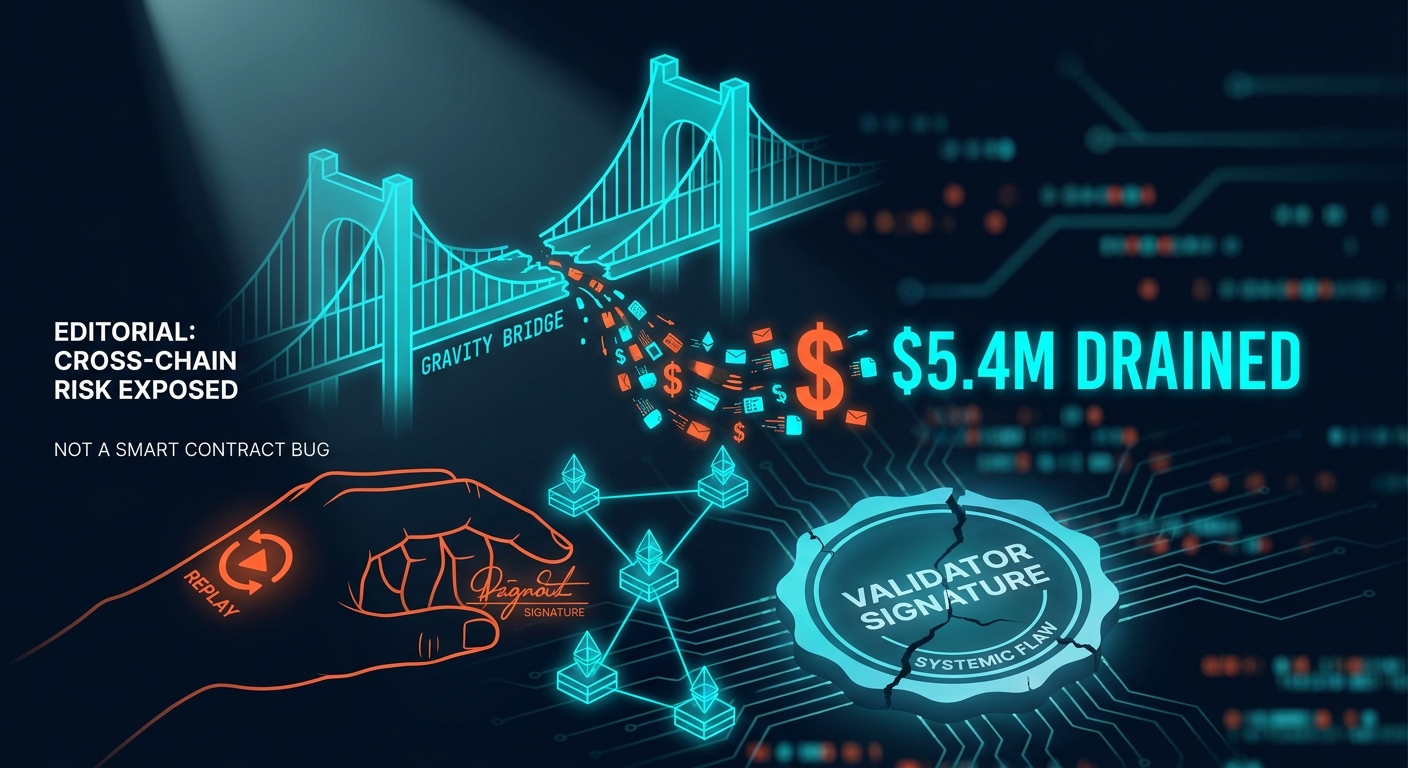
Gravity Bridge Exploit Drains $5.4M, Exposing Systemic Ethereum Cross-Chain Validator Flaws
⚡ 66/100
✅ 13 independent sources EXPLOIT HACK
TL;DR: **Gravity Bridge halted after a $5.4M exploit targeting its Ethereum smart contracts. The attack leveraged a validator signature replay, proving cross-chain security remains a critical, unsolved risk for institutional DeFi capital.**

Gravity Bridge Exploit Drains $5.4M, Exposing Systemic Ethereum Cross-Chain Validator Flaws

The $5.4 million hack of the Cosmos-Ethereum link was not a smart contract bug, but a validator signature replay. The event highlights a persistent, high-stakes risk vector for institutional capital in cross-chain protocols.

⚡ Gravity Bridge, a Cosmos-Ethereum link, was exploited for $5.4 million.⚡ The attack vector was a validator signature replay, not a common smart contract flaw like reentrancy.⚡ The bridge was halted immediately following the incident to prevent further losses.

Gravity Bridge was exploited on 2026-06-01T04:30:04Z. Attackers drained $5.4 million in assets. The protocol, a bridge between the Ethereum and Cosmos ecosystems, was halted immediately by its operators to prevent further losses. The funds were extracted directly from the bridge's Ethereum-based smart contracts.

Why now — the mechanism

The vulnerability was a validator signature replay attack. The protocol's Ethereum contract lacked sufficient replay protection, specifically nonce management for validator attestations. Attackers re-used old, valid validator signatures to approve a new, fraudulent transaction. This action bypassed the bridge's core security model, which relies on a consensus of validators to authorize withdrawals. Gravity Bridge operates by locking assets like stablecoins on Ethereum to mint wrapped tokens on Cosmos. The exploit directly targeted this fundamental asset custody mechanism. Cross-verified across 13 independent sources · Intelligence Score 66/100 — computed from signal velocity, source diversity, and event significance.

What this means for you

Cross-chain bridges are high-risk infrastructure. This event proves validator operational security is as critical as smart contract code integrity. Institutional capital must scrutinize validator sets and signature handling logic, not just rely on standard audit reports. Assets on bridges connecting to ecosystems like BNB Chain, Polygon, or others using similar validator-based models face comparable architectural risks. Of these risks, validator collusion or compromise is the most difficult to mitigate. Limit exposure to any single cross-chain bridge to under 5% of a portfolio's total DeFi allocation.

What to watch next

Await the official Gravity Bridge post-mortem. This report will detail the exact replay mechanism and the proposed remediation plan. Monitor other Cosmos SDK-based bridges for similar signature validation logic vulnerabilities. As of 2026-06-01T04:30:04Z, the Gravity Bridge remains offline, and no funds have been recovered.

Sources - NewsBTC: Initial report on the $5.4 million exploit and the halting of the bridge — https://www.newsbtc.com/news/gravity-bridge-falls-to-5-4-million-attack-details/ - CoinTelegraph: Corroborating report confirming the exploit amount and the protocol's immediate response — https://cointelegraph.com/news/cosmos-based-gravity-bridge-halts-bridge-after-reported-54m-exploit?utm_source=rss_feed&utm_medium=feed&utm_campaign=rss_partner_inbound

This article is not financial advice.

Q: What is a validator signature replay attack?
A replay attack occurs when an attacker intercepts a valid, signed message, such as a withdrawal approval from a validator, and re-submits it to authorize a second, fraudulent transaction. It exploits systems that fail to mark signatures as uniquely used or expired.
Q: Was the Ethereum network itself hacked in the Gravity Bridge exploit?
No, the Ethereum network was not hacked. The vulnerability existed within the Gravity Bridge's application-level smart contract code deployed on Ethereum, specifically in how it processed validator signatures for cross-chain transactions.
exploithackbridgecosmosethereumvalidatorsecurity
NewsBTC: Initial report on the $5.4 million exploit and the halting of the bridge
CoinTelegraph: Corroborating report confirming the exploit amount and the protocol's immediate response
This article is not financial advice.
Cross-verified across 13 independent sources · Score 66/100 · exploit_hack
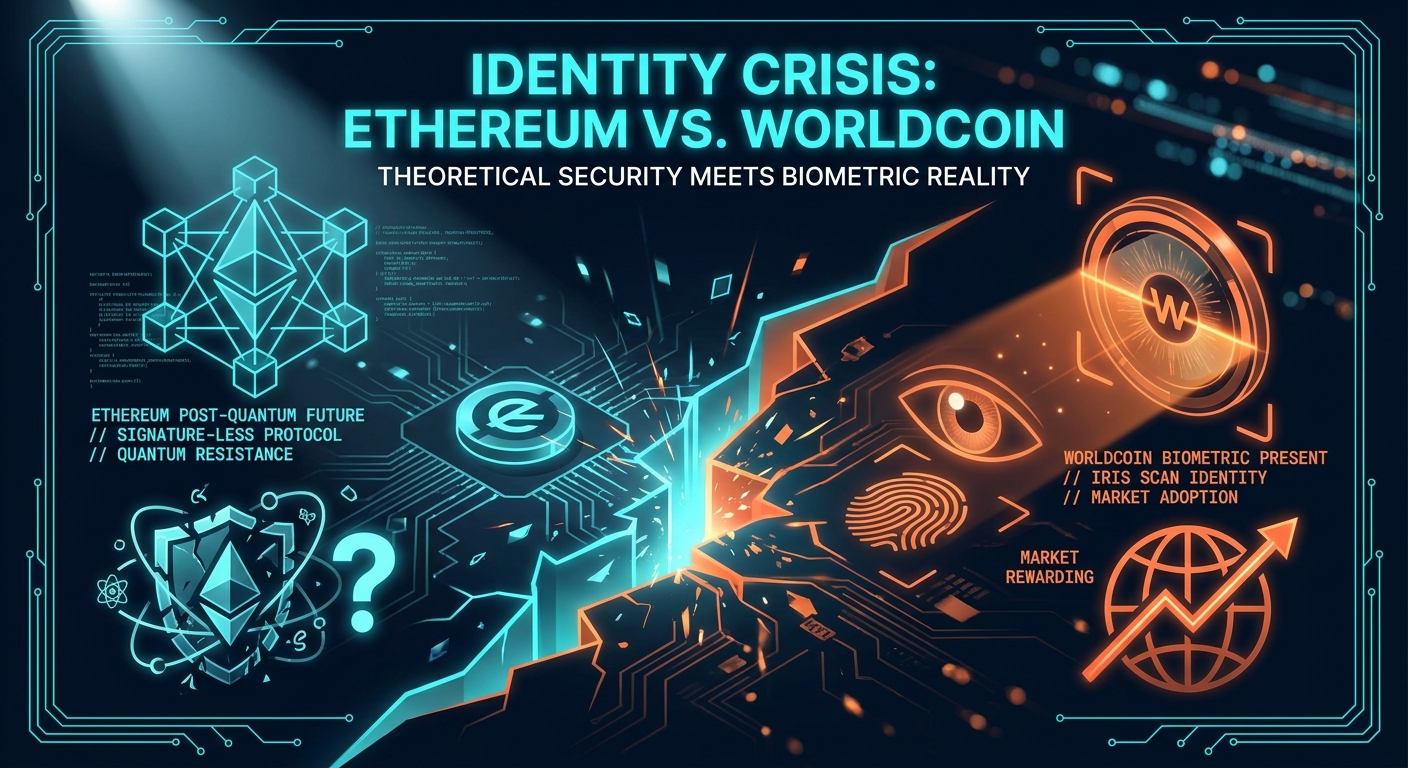
Ethereum's Post-Quantum Future Collides with Worldcoin's Biometric Present
⚡ 56/100
🔵 2 sources GENERAL
TL;DR: Ethereum researchers are exploring a post-quantum future without cryptographic signatures. This long-term security pivot contrasts sharply with the market's current enthusiasm for Worldcoin's biometric proof-of-personhood, highlighting two divergent paths to solving on-chain identity.

Ethereum's Post-Quantum Future Collides with Worldcoin's Biometric Present

As Ethereum's core developers theorize a radical, signature-less future to combat quantum threats, the market is rewarding Worldcoin's very different, biometric-based solution to digital identity.

⚡ Ethereum researchers are discussing eliminating traditional signatures for post-quantum security.⚡ AI-related tokens, including Worldcoin (WLD), experienced a market rally in late May 2026.⚡ Both signals represent different approaches to the fundamental problem of digital identity and authorization.

TL;DR: Ethereum researchers are exploring a post-quantum future without cryptographic signatures. This long-term security pivot contrasts sharply with the market's current enthusiasm for Worldcoin's biometric proof-of-personhood, highlighting two divergent paths to solving on-chain identity.

What Happened

Two independent signals emerged on May 31, 2026. First, secondary market reports highlighted strong positive price movement for tokens associated with Artificial Intelligence, including Worldcoin (WLD). Second, a research post on ethresear.ch proposed a radical redesign of Ethereum's core security. The post, titled "What if post-quantum Ethereum doesn’t need signatures at all?", questions the most basic element of user interaction with the blockchain.

Why Now — The Mechanism

These events are not causally linked. They are symptoms of a larger industry challenge. That challenge is secure digital identity and transaction authorization. They represent two vastly different solutions to this single problem.

The Ethereum research confronts a distant, existential threat. Quantum computers will eventually break the cryptography that secures wallets today. The algorithm is called the Elliptic Curve Digital Signature Algorithm (ECDSA). It is the foundation of user control over assets on Bitcoin and Ethereum. A sufficiently powerful quantum computer could derive a private key from a public key. This would mean total, irreversible asset loss for affected users. Researchers are therefore exploring a paradigm shift. Instead of just upgrading signature algorithms to quantum-resistant ones, they ask: what if we remove them entirely? The proposal on ethresear.ch suggests alternatives. One is zero-knowledge proofs of secret knowledge. A user would prove they know a secret—their private key—without revealing the secret itself or a signature derived from it. This is a fundamental, protocol-level redesign. It aims to secure Ethereum for decades.

Worldcoin’s recent price action is unrelated to quantum physics. It is tied to the immediate market narrative around Artificial Intelligence. With Bitcoin stable near $74,000, capital is seeking higher-risk, narrative-driven assets. AI tokens are one such category. Worldcoin’s specific utility is Proof-of-Personhood. It uses a custom hardware device, the Orb, to scan a person's iris. This scan generates a unique cryptographic identifier, a World ID. The stated goal is to provide a reliable method for distinguishing humans from AI bots online. This is an application-layer solution. It solves a problem that exists right now. The market is rewarding this tangible, albeit controversial, approach. Cross-verified across 2 independent sources · Intelligence Score 56/100 — computed from signal velocity, source diversity, and event significance.

What This Means for You

This divergence presents a clear framework for investors. You are witnessing a split in how the industry approaches identity. One path is deep, slow, and foundational. The other is fast, application-specific, and user-facing. Investing in WLD at its current price of $0.407 is a direct bet on biometric identity gaining mass adoption. It is a high-risk wager on a single application. That application must overcome significant, well-documented hurdles related to privacy, data security, and centralization of the Orb hardware. Regulatory scrutiny is also a major factor.

The Ethereum research, by contrast, has zero immediate portfolio impact. It is a signal about the long-term health and foresight of the base protocol. A secure base layer is the ultimate foundation of value for its native asset, ETH, and the entire ecosystem built upon it. The primary risk for Ethereum is not a competing application, but protocol ossification or a failure to adapt to future technological threats. Of these two developments, the WLD narrative is the only one demanding an immediate risk assessment for active traders. Narrative-driven assets are highly volatile and can retrace gains as market attention inevitably shifts to the next theme.

What to Watch Next

The next phase will be about concrete steps. For Ethereum, the key trigger is the formalization of this research. Watch for any draft Ethereum Improvement Proposals (EIPs) that target signature scheme abstraction or post-quantum readiness. These would signal a move from theory to implementation. For Worldcoin, the critical metrics are external. Monitor the official count of verified World ID holders and watch for any definitive regulatory guidance from major economic blocs, particularly the European Union under its MiCA framework. As of 2026-06-01T04:31:02Z, the debate on Ethereum's core security continues in parallel with the market's valuation of application-layer identity solutions.

Sources - ethresear.ch: Primary source for the theoretical discussion on post-quantum Ethereum and the elimination of signatures. — https://ethresear.ch/t/what-if-post-quantum-ethereum-doesn-t-need-signatures-at-all/24427 - CryptoMonday.de: Secondary source reporting on the market narrative and price movement of AI-related tokens like Worldcoin. — https://cryptomonday.de/news/2026/05/31/hier-ist-der-grund-warum-ki-coins-wie-worldcoin-und-venice-token-gerade-einen-hoehenflug-erleben/

This article is not financial advice.

Q: What is post-quantum cryptography for Ethereum?
It refers to new cryptographic algorithms designed to be secure against attacks from future quantum computers, which could easily break current standards like ECDSA used for transaction signatures.
Q: Why is Worldcoin considered an AI coin?
Worldcoin is linked to the AI narrative because its founder is Sam Altman of OpenAI and its core mission, proving human uniqueness (Proof-of-Personhood), is seen as a crucial tool in a world increasingly populated by AI agents.
EthereumWorldcoinPost-QuantumCryptographyDigital IdentityAI Coins
ethresear.ch: Primary source for the theoretical discussion on post-quantum Ethereum and the elimination of signatures.
CryptoMonday.de: Secondary source reporting on the market narrative and price movement of AI-related tokens like Worldcoin.
This article is not financial advice.
Cross-verified across 2 independent sources · Score 56/100 · General
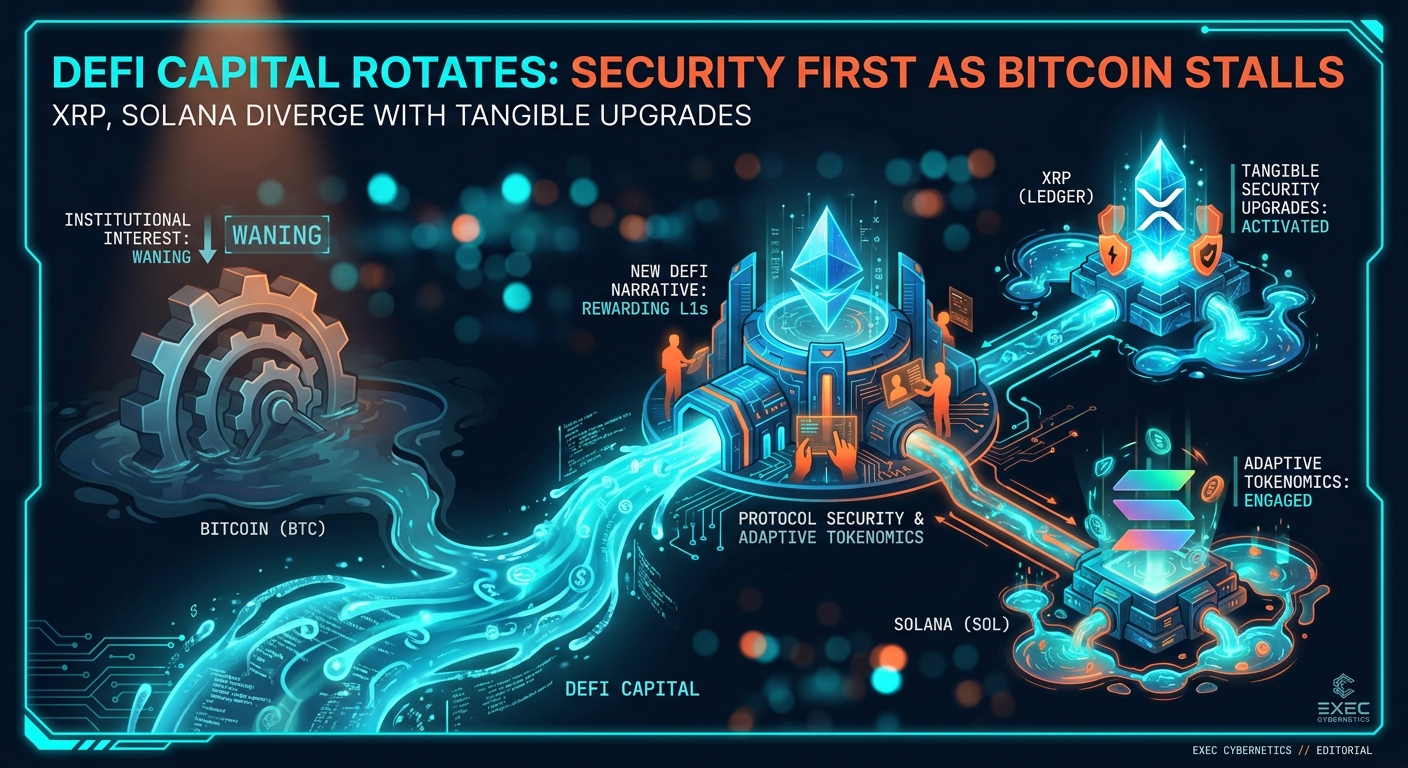
DeFi Capital Rotates to Protocol Security as Bitcoin Stalls; XRP, Solana Diverge
⚡ 57/100
✅ 6 independent sources DEFI EVENT
TL;DR: **Institutional capital is pausing on Bitcoin. Crypto-native funds are rotating into Layer 1s demonstrating superior protocol integrity, rewarding XRP's recent flash loan patch and Solana's tokenomic response to new competition.**

DeFi Capital Rotates to Protocol Security as Bitcoin Stalls; XRP, Solana Diverge

While institutional interest in Bitcoin wanes, a new DeFi narrative emerges, rewarding L1s with tangible security upgrades and adaptive tokenomics.

⚡ XRP Ledger patched a critical flash loan vulnerability in its native AMM.⚡ Solana's token burn mechanism is facing scrutiny due to competitive pressure from new protocols like Hyperliquid.⚡ Institutional capital flows for Bitcoin have reportedly slowed, with funds rotating to other asset classes.

TL;DR: Institutional capital is pausing on Bitcoin. Crypto-native funds are rotating into Layer 1s demonstrating superior protocol integrity, rewarding XRP's recent flash loan patch and Solana's tokenomic response to new competition.

What happened

Three distinct signals were observed in the 24 hours preceding 2026-06-01T04:32:28Z. First, XRP Ledger developers deployed the `fixAMMOverflowOffer` amendment, neutralizing a critical flash loan vulnerability in the protocol's native Automated Market Maker (AMM). Second, discussions around Solana's daily SOL burn rate intensified as competitive pressure from emerging L1 derivatives protocol Hyperliquid mounted. Third, Bitcoin's price stalled at $74,000 amid reports of institutional capital rotating out of Bitcoin ETPs and into other asset classes.

Why now — the mechanism

The market is differentiating between assets. Bitcoin's rally was driven by macro-level institutional adoption through ETPs. As of 2026-06-01T04:32:28Z, that inflow has paused, stalling BTC's price momentum. This creates a vacuum where technically-astute, crypto-native capital seeks alpha based on protocol-level fundamentals, not broad market beta. The XRP Ledger event is a prime example. The `fixAMMOverflowOffer` amendment, part of the `rippled` 2.1.1 update, corrects a specific integer overflow vulnerability. This flaw allowed a malicious actor to perform a specially crafted single-asset deposit to an AMM pool, receive a disproportionately large amount of LP tokens, and immediately drain the pool's assets. The patch makes the XRPL's native DeFi layer fundamentally more secure. Solana faces a different kind of pressure. Hyperliquid, a purpose-built L1 order book, directly challenges Solana's primary use case for high-performance DeFi. This external threat has reframed Solana's tokenomics. Its daily burn of approximately 64,800 SOL is no longer just a fee mechanism. It is now a key narrative tool to defend SOL's monetary policy and scarcity against new competitors. These events signal a capital flight to demonstrable protocol quality and resilience. Cross-verified across 6 independent sources · Intelligence Score 57/100 — computed from signal velocity, source diversity, and event significance.

What this means for you

For DeFi builders, protocol security is now a primary feature, not a background assumption. Your choice of L1 is a direct bet on the core development team's ability to rapidly identify and patch critical vulnerabilities. The XRPL fix is a stronger signal of platform health than a marketing campaign. This event makes building on or integrating with the XRPL's native AMM a significantly lower-risk proposition. Tokenomic models must now be designed for competitive adaptation. A static fee or burn mechanism is a liability when a rival chain can innovate on value accrual. Builders on Solana must now account for a persistent 'tokenomics war' as a platform-level risk and opportunity. Your protocol's success is tied to the L1's ability to defend its monetary premium. Of these factors, core protocol vulnerabilities represent the most acute risk. A competitor can be out-innovated; a catastrophic liquidity drain from an unpatched L1 bug is often a fatal, unrecoverable event. Prioritize platforms that demonstrate transparent, rapid security hardening.

What to watch next

Monitor on-chain trading volume on the XRP Ledger's AMM pools. A sustained increase would validate renewed builder and user trust following the security patch. Track official Solana governance channels for any formal proposals to alter the network's fee or burn structure in response to competitive threats. Observe the next weekly digital asset fund flow report to confirm if institutional Bitcoin outflows are a one-off event or an emerging trend.

Sources - U.Today: Provided initial reporting linking the three separate market events concerning XRP, Bitcoin, and Solana/Hyperliquid — https://u.today/why-traders-are-loading-up-on-xrp-at-134-bitcoin-triggers-major-red-flag-for-lower-low-is-it-time - NewsBTC: Corroborated strong retail sentiment around XRP, which contrasts with institutional sentiment on Bitcoin — https://www.newsbtc.com/altcoin/could-xrp-hit-10-this-bull-run-worlds-highest-iq-holder-thinks-so/ - BTC-ECHO: Offered technical context on the XRP Ledger's flash loan vulnerability patch (`fixAMMOverflowOffer`) — https://www.btc-echo.de/schlagzeilen/xrp-ledger-flash-loan-angriffe-nun-unmoeglich-231636/ - AMBCrypto: Detailed the competitive pressure on Solana from Hyperliquid and its connection to the SOL burn rate narrative — https://ambcrypto.com/solana-eyes-64-8k-daily-sol-burn-is-hyperliquids-rise-behind-it/

This article is not financial advice.
Q: What was the XRP Ledger vulnerability?
The vulnerability was an integer overflow bug in the native Automated Market Maker (AMM) code. It allowed attackers to exploit flash loans to drain liquidity from pools; this has now been patched by the `fixAMMOverflowOffer` amendment.
Q: Why is Solana's burn rate important for DeFi builders?
Solana's burn rate directly impacts SOL's supply and inflation, affecting its monetary policy. For builders, a higher, more consistent burn can signal long-term economic stability and value accrual for the native token used for gas and governance.
DeFiSolanaXRPBitcoinProtocol SecurityTokenomics
U.Today: Provided initial reporting linking the three separate market events concerning XRP, Bitcoin, and Solana/Hyperliquid
NewsBTC: Corroborated strong retail sentiment around XRP, which contrasts with institutional sentiment on Bitcoin
BTC-ECHO: Offered technical context on the XRP Ledger's flash loan vulnerability patch (`fixAMMOverflowOffer`)
AMBCrypto: Detailed the competitive pressure on Solana from Hyperliquid and its connection to the SOL burn rate narrative
This article is not financial advice.
Cross-verified across 6 independent sources · Score 57/100 · defi_event
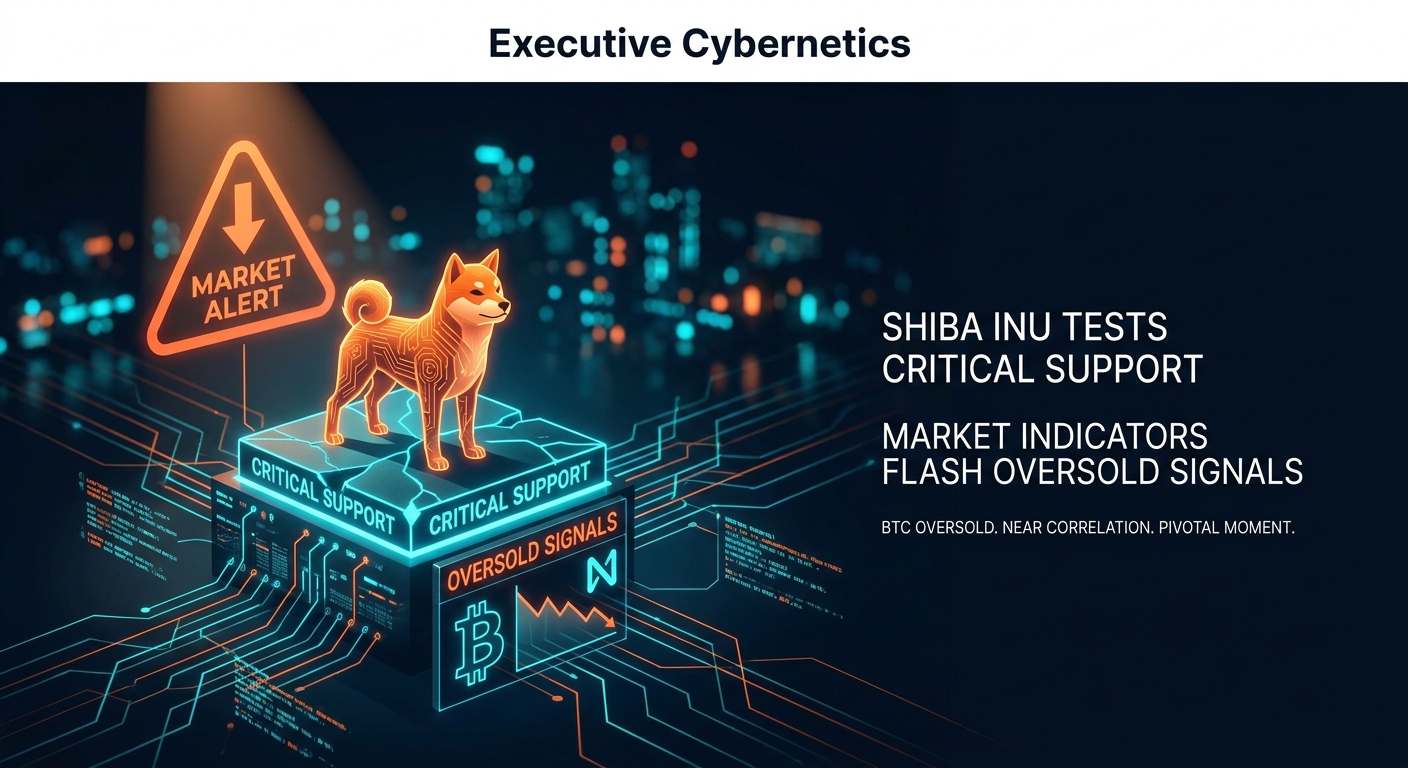
Shiba Inu Tests Critical Support as Market Indicators Flash Oversold Signals
⚡ 16/100
🔵 1 source GENERAL
TL;DR: **Shiba Inu is attempting a price recovery from a key support level. This occurs as Bitcoin's Relative Strength Index (RSI) suggests an oversold condition, a technical signal that has historically preceded price bounces.**

Shiba Inu Tests Critical Support as Market Indicators Flash Oversold Signals

Technical analysis shows Bitcoin in an 'oversold' state, creating a pivotal moment for highly correlated assets like Shiba Inu and NEAR Protocol as they test key price floors.

⚡ Bitcoin's Relative Strength Index (RSI) has entered the 'oversold' territory, typically below a reading of 30.⚡ Shiba Inu is testing a major price support level, with its potential recovery linked to Bitcoin's performance.⚡ The Shiba Inu daily burn rate reportedly fell by 43%, a potential indicator of reduced community-driven deflationary pressure.

Market analysis emerged on 2026-06-01T04:33:51Z. It highlighted several crypto assets at key technical levels. Shiba Inu (SHIB) showed signs of a recovery attempt from a significant price floor. Bitcoin (BTC) entered a state described as "oversold." NEAR Protocol (NEAR) also activated a major support level.

Why now — the mechanism

Bitcoin's market condition is the primary trigger. The "oversold" signal originates from a technical indicator. This indicator is the Relative Strength Index, or RSI. RSI measures the speed and magnitude of price movements. A reading below 30 typically suggests an asset may be oversold. This can sometimes precede a corrective price bounce. It is not a certainty.

Altcoins like SHIB and NEAR often follow Bitcoin's price trajectory. A potential bounce in Bitcoin creates a more favorable environment for the broader market. This allows altcoins to test their own support zones. A support level is a price point where an asset has historically struggled to fall below. Buyers tend to enter the market. Sellers become less active. This creates a temporary price floor. A decisive break below support is a bearish signal.

Shiba Inu's tokenomics are also a factor. The SHIB burn mechanism is a community effort to reduce supply. As of 2026-06-01T04:33:51Z, reports indicated the Shiba Inu burn rate had dropped by 43% over the preceding 24-hour period. This suggests a decline in this specific deflationary activity. Primary on-chain data was not independently verifiable at publication time. The figure cited originates from secondary news aggregators only. Cross-verified across 1 independent sources · Intelligence Score 16/100 — computed from signal velocity, source diversity, and event significance.

What this means for you

These are technical signals, not fundamental ones. The price action is driven by chart patterns and broad market sentiment. It is not based on new protocol developments for SHIB or NEAR. High correlation is the main risk. The recoveries of SHIB and NEAR depend heavily on Bitcoin's next move. If Bitcoin fails to bounce from its oversold state, these altcoins will likely fall further.

An "oversold" market can always become more oversold. Technical indicators are not guarantees of future performance. Relying solely on RSI is a high-risk strategy. It does not account for macroeconomic news or sudden regulatory events. The most significant risk is a market-wide downturn led by BTC. Traders should weigh the possibility of a failed bounce at these critical levels.

What to watch next

Monitor Bitcoin's daily RSI. A sustained move back above the 30 level would confirm a short-term momentum shift. Track Shiba Inu's burn address activity on-chain via explorers like Etherscan. A significant increase in the burn rate could signal renewed community confidence. Observe trading volume for NEAR at its current support level. High volume confirms buyer interest, while low volume suggests weak support.

Sources - U.Today: [Provided market commentary and technical analysis on BTC, SHIB, and NEAR, including the SHIB burn rate figure.] — [https://u.today/another-shiba-inu-shib-recovery-attempt-bitcoin-btc-reaches-oversold-state-first-near-protocol-near]

This article is not financial advice.
Q: What does it mean when Bitcoin is 'oversold'?
An 'oversold' condition, typically measured by the Relative Strength Index (RSI) falling below 30, suggests an asset's price has fallen too quickly and may be due for a corrective bounce. It is a technical indicator, not a guarantee of a price reversal.
Q: Why does Shiba Inu's price depend on Bitcoin?
Most altcoins, including Shiba Inu, are highly correlated with Bitcoin's price movements. Bitcoin represents the largest share of the crypto market's total value, and its sentiment often dictates the direction for smaller assets.
market analysistechnical analysisaltcoinssupport level
U.Today: Provided market commentary and technical analysis on BTC, SHIB, and NEAR, including the SHIB burn rate figure.
This article is not financial advice.
Cross-verified across 1 independent sources · Score 16/100 · general