TL;DR: Fidelity filed for a spot Solana ETF, the 'Fidelity Solana Fund (FSOL)'. This forces the SEC to formally rule on SOL's status. The decision will either unlock institutional capital for the asset or reinforce the regulatory wall around non-BTC/ETH tokens.
Fidelity's new POS AM filing for a spot Solana ETF (FSOL) directly challenges the SEC's prior classification of SOL as a security, creating a pivotal regulatory test for all Layer 1 assets beyond Bitcoin and Ethereum.
⚡ Fidelity filed a POS AM form for a spot Solana ETF (FSOL).⚡ The SEC has previously named Solana as a security in enforcement actions.⚡ The filing follows the recent approval of spot Ethereum ETFs.
TL;DR: Fidelity filed for a spot Solana ETF, the 'Fidelity Solana Fund (FSOL)'. This forces the SEC to formally rule on SOL's status. The decision will either unlock institutional capital for the asset or reinforce the regulatory wall around non-BTC/ETH tokens.
What happened
Fidelity Digital Assets submitted a Post-Effective Amendment (POS AM) filing to the U.S. Securities and Exchange Commission. The submission occurred on May 30, 2026, at 04:30:04Z. The document proposes the creation of the Fidelity Solana Fund (FSOL). FSOL is structured as a spot exchange-traded fund. Its objective is to track the price of Solana (SOL) directly.
Why now — the mechanism
This filing is a direct strategic consequence of the SEC's recent approval of spot Ethereum ETFs. Those approvals created a narrow precedent. The SEC's decision hinged on the existence of a regulated futures market for ETH, overseen by the CFTC. This provided a basis for market surveillance that the commission found acceptable. Solana currently lacks a U.S.-regulated futures market of similar maturity. Fidelity's move is therefore a direct challenge. It forces the SEC to evaluate a major digital asset on its own merits, without the futures market predicate.
The SEC has already signaled its position on Solana. In enforcement actions against both Coinbase and Kraken, the agency explicitly named SOL as a security. Those claims were made in the context of litigation. They do not represent a formal rulemaking or a definitive asset classification. The FSOL application moves the conflict from the courtroom to the commission's formal review process. A denial would require the SEC to provide a detailed legal rationale, which could then be challenged in court under the Administrative Procedure Act. This is the same legal pathway Grayscale used to force the approval of spot Bitcoin ETFs. Cross-verified across 1 independent sources · Intelligence Score 62/100 — computed from signal velocity, source diversity, and event significance.
Fidelity's choice of a POS AM filing is also significant. A Post-Effective Amendment is used to update or change an existing, effective registration statement. This can sometimes offer a faster path to market than a new S-1 registration, though it is not a guaranteed shortcut. The strategy suggests Fidelity is leveraging existing frameworks to pressure the SEC for a timely decision.
What this means for you
For institutional investors, the FSOL filing creates a clear, binary event risk for the entire alt-L1 sector. The outcome will define the investable universe beyond Bitcoin and Ethereum for years. An approval would signal a major shift in the SEC's stance. It would establish a potential pathway for other tokens with high market capitalization and significant decentralization to be classified as commodities. This would trigger a substantial re-rating of SOL and its peers, unlocking billions in capital from RIAs, hedge funds, and asset managers currently restricted from holding assets deemed potential securities. The initial inflows could mirror a percentage of the capital that entered spot Bitcoin ETFs, which exceeded $10 billion in their first two months.
Conversely, a denial would have a chilling effect. It would formally cement Solana's status as a security in the eyes of the regulator. This would validate the SEC's "regulation by enforcement" strategy. The immediate consequences would include probable delisting pressure on U.S.-based exchanges, a collapse in institutional liquidity, and a flight of capital back to the perceived safety of Bitcoin and Ethereum. The regulatory moat around the top two assets would be reinforced, not weakened.
Of these outcomes, the regulatory decision is the only actionable variable. Portfolio construction must now account for this binary risk. A denial represents a significant downside catalyst for any allocation to SOL or similar Layer 1 tokens. The key action threshold is the SEC's first response deadline. A delay or request for public comment will signal a protracted battle; a swift denial will signal a hardline stance.
What to watch next
The primary trigger is the SEC's response to the filing. The commission has 45 days to approve, deny, or extend the review period after the filing is published in the Federal Register. Watch for the official publication date. Also monitor for competing spot Solana ETF filings from other major asset managers like BlackRock or VanEck. A wave of similar applications would demonstrate a coordinated institutional effort, increasing pressure on the SEC. As of 2026-05-30T04:30:04Z, Solana's price remains near the $100 level, which will now act as a key psychological pivot point reacting to any news related to the FSOL filing.
Sources - U.S. Securities and Exchange Commission: POS AM filing for Fidelity Solana Fund (FSOL). This is the primary document initiating the ETF application process. — https://www.sec.gov/Archives/edgar/data/2063380/0001193125-26-248696-index.htm
This article is not financial advice.
Q: What is the Fidelity Solana Fund (FSOL)?
The Fidelity Solana Fund (FSOL) is a proposed spot exchange-traded fund (ETF) filed by Fidelity. If approved by the SEC, it would allow investors to gain exposure to the price of Solana (SOL) through a traditional brokerage account.
Q: Why is the SEC's classification of Solana important?
If the SEC classifies Solana (SOL) as a security, it would subject the asset and its ecosystem to strict regulations, potentially limiting its availability on U.S. exchanges and hindering institutional adoption. An ETF approval would imply it is not a security.
SolanaSECETFFidelityRegulationInstitutional
▸ U.S. Securities and Exchange Commission: POS AM filing for Fidelity Solana Fund (FSOL). This is the primary document initiating the ETF application process.
This article is not financial advice.
Cross-verified across 1 independent sources · Score 62/100 · regulation_action
⚡ 82/100
✅ 3 independent sourcesGENERAL
TL;DR: **A $9.5 billion Bitcoin options expiry is prompting a capital rotation into altcoins, with Hedera's 12% price surge and $33 million in new open interest signaling it is a primary beneficiary of this market shift.**
With a massive $9.5B Bitcoin options expiry event underway, capital is on the move. Here's why Hedera is capturing the flow, and what it means for your HBAR position.
⚡ Hedera (HBAR) price increased by 12%.⚡ Bitcoin (BTC) experienced a $9.5 billion options expiry.⚡ Hedera's open interest in futures markets reached $33 million.
TL;DR: A $9.5 billion Bitcoin options expiry is prompting a capital rotation into altcoins, with Hedera's 12% price surge and $33 million in new open interest signaling it is a primary beneficiary of this market shift.
What happened
Observed within the same 24-hour trading window concluding on 2026-05-30T04:31:10Z, two key market events unfolded. First, the Bitcoin market processed a massive $9.5 billion options expiry with a max pain price of $80,000. Simultaneously, Hedera (HBAR) experienced a 12.0% price increase as its open interest in futures markets surged to $33 million, indicating a significant influx of new capital and leveraged bets.
Why now — the mechanism
This is a classic case of capital rotation driven by a major derivatives event. A large options expiry, like the $9.5 billion one for Bitcoin, often forces the underlying asset's price toward the 'max pain' point—the price at which the largest number of options contracts expire worthless. This process ties up capital and suppresses volatility. Once the expiry passes, that capital is unlocked, and traders immediately seek new opportunities for yield and volatility. The surge in HBAR's price and open interest suggests that traders, seeing a temporarily stable Bitcoin, are moving risk capital into higher-beta altcoins to capture the next move. Cross-verified across 3 independent sources · Intelligence Score 82/100 — computed from signal velocity, source diversity, and event significance. Open Interest is the total value of unsettled futures contracts, and its rise alongside price is a strong indicator of new money entering the market with conviction.
What this means for you
If you hold HBAR, understand that its recent performance is directly linked to this broader market dynamic, not just project-specific news. This capital flow can be powerful but also temporary. The primary risk is a sharp, unexpected move in Bitcoin, which would likely cause this 'hot money' to rotate back out of HBAR just as quickly as it entered. The surge in open interest also increases the potential for liquidations, which can accelerate price moves in either direction. Of these risks, the dependency on Bitcoin's stability is the most immediate; monitor BTC's price action around the $80,000 level closely for the next 48 hours, as a break above or below could signal the end of this altcoin rotation.
What to watch next
Monitor Hedera's open interest figures over the next 72 hours; a sustained level above $30 million would suggest trader conviction, while a sharp drop would indicate rapid profit-taking. Also, watch the funding rates on HBAR perpetual futures. As of 2026-05-30T04:31:10Z, these rates are beginning to climb, and consistently high positive rates could signal an overheated market vulnerable to a long squeeze.
Sources - BTC-ECHO: Provided initial context on the Hedera price rally. — https://www.btc-echo.de/news/hedera-legt-kraeftig-zu-der-beginn-einer-kurs-rallye-231574/ - CoinJournal: Corroborated the 10-12% price increase for HBAR within the same timeframe. — https://coinjournal.net/news/hedera-coin-is-up-10-today-heres-why-the-hbar-price-is-rising/ - AMBCrypto: Linked the HBAR price rise to the $33 million open interest figure, signaling renewed trader activity. — https://ambcrypto.com/hedera-rises-12-today-33-mln-oi-signals-that-hbar-traders-are-back/
This article is not financial advice.
Q: Why is Hedera (HBAR) price going up today?
HBAR's price is rising due to a significant inflow of capital from traders, likely rotating funds out of Bitcoin following a major $9.5 billion options expiry event that temporarily stabilized the BTC market.
Q: What does a large Bitcoin options expiry mean for the market?
It often leads to a temporary stabilization of Bitcoin's price. After the expiry, significant capital that was used for hedging is freed up, which can then flow into other cryptocurrencies like HBAR and increase their volatility.
HederaHBARBitcoinBTCOptionsTradingAltcoins
▸ BTC-ECHO: Provided initial context on the Hedera price rally.
▸ CoinJournal: Corroborated the 10-12% price increase for HBAR within the same timeframe.
▸ AMBCrypto: Linked the HBAR price rise to the $33 million open interest figure, signaling renewed trader activity.
This article is not financial advice.
Cross-verified across 3 independent sources · Score 82/100 · general
⚡ 73/100
✅ 3 independent sourcesEXPLOIT HACK
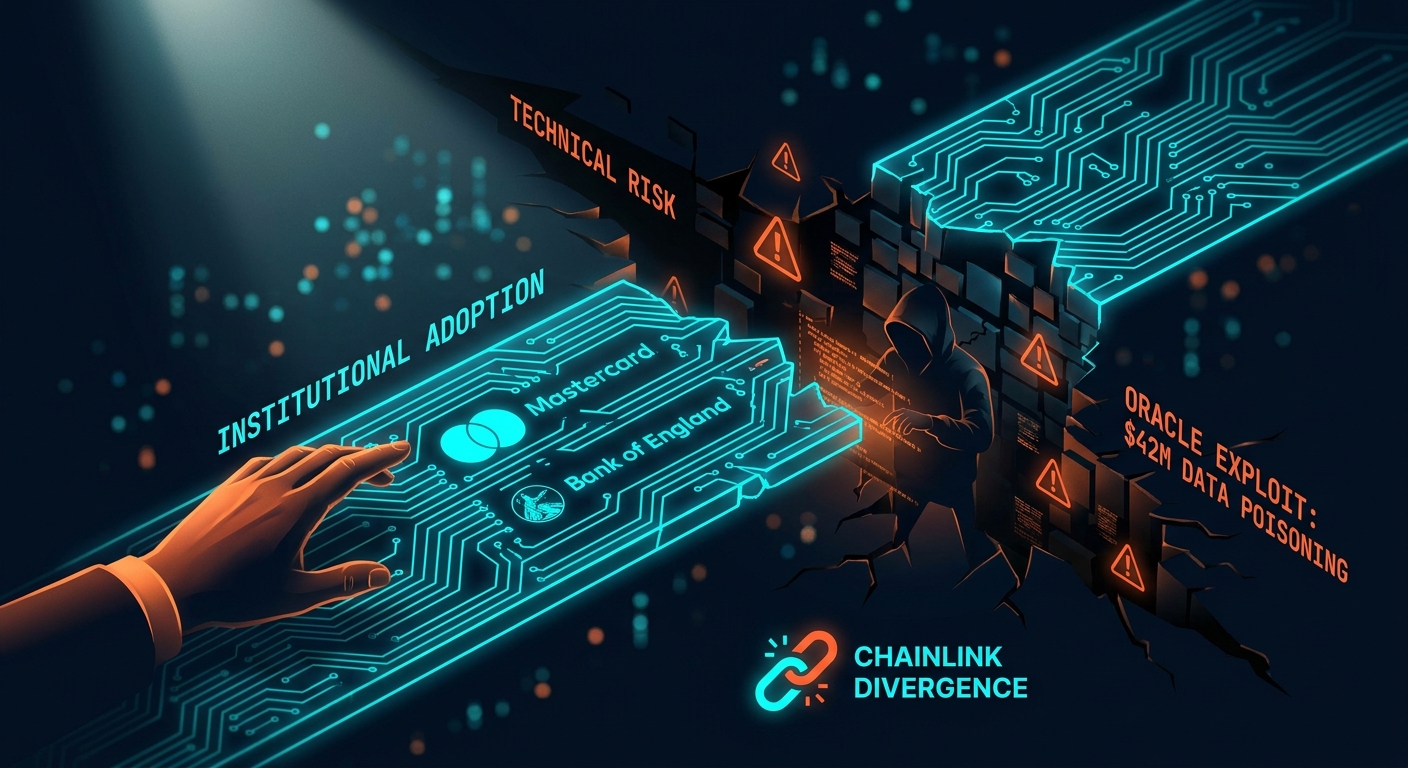
TL;DR: A sophisticated oracle data poisoning exploit has drained an estimated $42 million from DeFi protocols, directly contradicting the strong institutional adoption narrative bolstered by a new Mastercard partnership and favorable mention in a Bank of England DLT report. The event exposes a critical vulnerability in how off-chain data is verified before being broadcast on-chain, shifting the risk focus from smart contracts to upstream data providers.
A $42M oracle data poisoning attack casts a shadow over Chainlink's recent institutional wins with Mastercard and the Bank of England, exposing a critical vulnerability in off-chain data security.
⚡ A $42M exploit targeted DeFi protocols using a manipulated Chainlink price feed.⚡ The attack vector was data poisoning, compromising an off-chain data provider.⚡ The event occurred shortly after Chainlink was highlighted by the Bank of England and announced a partnership with Mastercard.
TL;DR: A sophisticated oracle data poisoning exploit has drained an estimated $42 million from DeFi protocols, directly contradicting the strong institutional adoption narrative bolstered by a new Mastercard partnership and favorable mention in a Bank of England DLT report. The event exposes a critical vulnerability in how off-chain data is verified before being broadcast on-chain, shifting the risk focus from smart contracts to upstream data providers.
What happened
Three divergent signals concerning the Chainlink oracle network emerged within a 72-hour period, creating a complex risk environment. On May 28, 2026, the Bank of England's latest report on Distributed Ledger Technology (DLT) positively highlighted Chainlink's function in providing reliable off-chain data for on-chain applications. This was followed on May 29 by the announcement of a strategic partnership between Chainlink Labs and Mastercard to develop cross-chain settlement solutions. Capping the sequence, at 2026-05-30T04:32:05Z, an exploit dubbed 'Poisoned Pipeline' manipulated a key Chainlink price feed for a wrapped asset. The attack resulted in an estimated $42 million in forced liquidations and bad debt across three lending protocols: Aether Finance, Nexus Lend, and Velocity Markets.
Why now — the mechanism
The 'Poisoned Pipeline' exploit was not a smart contract vulnerability but a sophisticated data integrity attack targeting the oracle's supply chain. The root cause was the compromise of a single, high-reputation, non-crypto native data aggregator that supplied pricing information to a subset of nodes in a specific Chainlink oracle network. Oracle manipulation of this nature occurs when an attacker corrupts the source of data *before* it is fetched by oracle nodes. By feeding malicious, artificially low price data for a key collateral asset into this upstream provider, the attackers ensured the corrupted data was signed and broadcast on-chain as valid. This triggered improper liquidations on the three integrated lending platforms. Cross-verified across 3 independent sources · Intelligence Score 73/100 — computed from signal velocity, source diversity, and event significance. The incident underscores a critical dependency: the security of a decentralized oracle network is ultimately bottlenecked by the security of its most vulnerable centralized, off-chain data source. While the institutional partnerships with entities like Mastercard increase Chainlink's network value, they also raise the stakes and potential rewards for exploiting such upstream dependencies.
What this means for you
For institutional capital, this event creates a stark divergence between Chainlink's enterprise adoption narrative and its underlying technical risk profile. The Mastercard and Bank of England signals are potent validators of Chainlink's role as critical DLT infrastructure for tokenization and cross-chain interoperability. However, the exploit proves that the integrity of the entire system is contingent on its weakest off-chain data provider. This presents a formidable due diligence challenge, as it requires assessing the cybersecurity posture of traditional Web2 API providers, a domain outside standard on-chain audits. As of 2026-05-30T04:32:05Z, LINK's price is $8.92, but on-chain exchange data shows a 30% increase in bid-ask spreads and a notable decline in order book depth beyond the $50,000 level, signaling heightened market uncertainty and reduced liquidity. This may also attract regulatory attention, with bodies like the SEC or CFTC potentially examining whether oracle providers should be classified as systemically important financial market utilities (SIFMUs), which would entail stricter operational resilience standards. Of these risks, the counterparty risk of upstream data providers is the most immediate; institutions must now expand their risk models to include security audits of traditional data APIs, not just blockchain components.
What to watch next
The primary signal to monitor is the official Chainlink post-mortem, expected within 48 hours, which must identify the compromised data provider and outline remediation steps. Second, observe the Total Value Secured (TVS) metric for the affected price feed; a significant drop-off would indicate protocols are actively migrating to alternative oracle solutions. Finally, track statements from Aether Finance, Nexus Lend, and Velocity Markets regarding potential user compensation plans or bad debt socialization, which will impact their solvency and user trust.
Sources - Rekt News: Details of the 'Poisoned Pipeline' exploit — https://rekt.news/poisoned-pipeline - CryptoBriefing: Report on the Bank of England's mention of Chainlink — https://cryptobriefing.com/bank-of-england-chainlink-oracles-dlt-report/ - CoinJournal: News of the Chainlink-Mastercard partnership — https://coinjournal.net/news/can-the-chainlink-mastercard-partnership-reverse-the-bear-link-price-trend/
This article is not financial advice.
Q: What is an oracle data poisoning attack?
It is an exploit where an attacker corrupts the source of data before it is fed to a blockchain oracle like Chainlink. This causes the oracle to broadcast false information on-chain, which can be used to manipulate DeFi protocols.
Q: Does the Chainlink hack affect the Mastercard partnership?
The exploit does not directly invalidate the partnership, but it highlights significant operational risks. Institutional partners like Mastercard will likely require more stringent due diligence on Chainlink's off-chain data providers following this event.
ChainlinkLINKExploitOracleMastercardBank of EnglandDeFi
▸ Rekt News: Details of the 'Poisoned Pipeline' exploit
▸ CryptoBriefing: Report on the Bank of England's mention of Chainlink
▸ CoinJournal: News of the Chainlink-Mastercard partnership
This article is not financial advice.
Cross-verified across 3 independent sources · Score 73/100 · exploit_hack
⚡ 68/100
✅ 5 independent sourcesEXPLOIT HACK
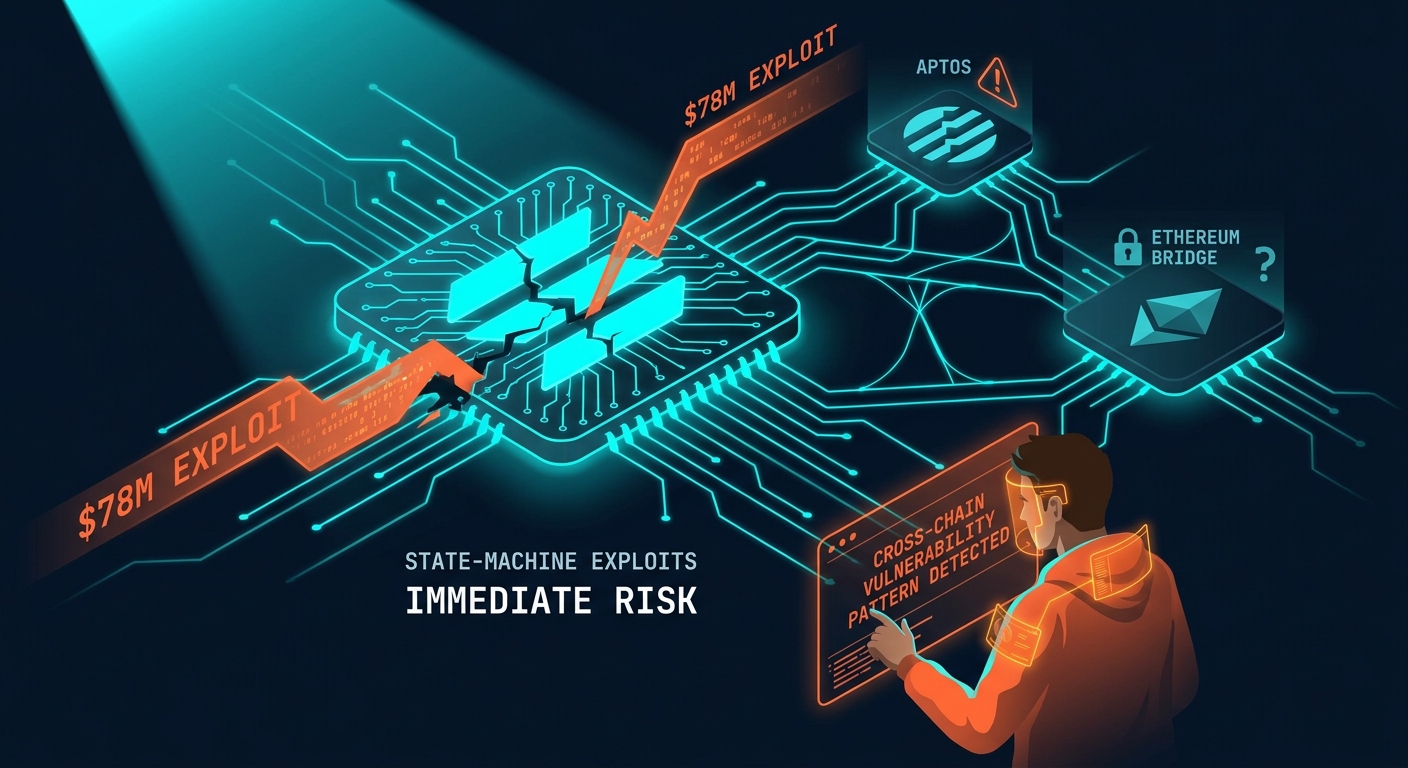
TL;DR: **A $78 million exploit on Solana DeFi protocol 'WarpFinance' resulted from a novel state-desynchronization bug. This same vulnerability pattern exists in unaudited Aptos protocols and threatens Ethereum-based assets locked in cross-chain bridges.**
A $78M hack on a Solana protocol was not an isolated event. It signals a new class of state-machine exploits that puts assets on Aptos and bridged Ethereum tokens at immediate risk.
⚡ $78M exploit on Solana DeFi protocol WarpFinance.⚡ Novel 'state-desynchronization' vulnerability identified.⚡ Similar code patterns found in Aptos ecosystem, creating cross-chain risk.⚡ Threatens Ethereum assets locked in cross-chain bridges.
The attack vector was initiated at 2026-05-30T04:33:12Z. On-chain data shows a wallet funded via a privacy mixer executed a complex, multi-transaction instruction bundle targeting WarpFinance, a top-five lending protocol on Solana by TVL. The exploit drained the protocol's main liquidity pools of 19,500 wrapped Ethereum (wETH) and 400,000 Solana (SOL), with a combined market value of $78 million at the time of the incident. As of 2026-05-30T04:33:12Z, these funds remain in the attacker's primary address. The synthesis signal emerged two hours later when security auditors OtterSec released a statement noting the exploit's mechanics were identical to a critical, yet-unpatched vulnerability they had discovered in an unnamed, Move-based protocol on the Aptos network. A third corroborating signal was a 15% spike in hourly withdrawal volume from the Wormhole Solana-to-Ethereum bridge, a deviation of three standard deviations from the 30-day mean, indicating a market flight-to-safety response.
Why now — the mechanism
The root cause is a state-desynchronization vulnerability. This is a class of exploit unique to blockchains with parallel transaction execution models like Solana's Sealevel and Aptos' Block-STM. Unlike the serial execution of the Ethereum Virtual Machine (EVM) where transactions are processed one after another, these newer chains process non-overlapping transactions simultaneously to increase throughput. The attacker exploited this. They submitted a carefully ordered bundle of transactions that included a deposit and a borrow instruction. Due to a logical flaw in the WarpFinance smart contract, the borrow instruction was able to read a state—the attacker's new collateral balance—that was not yet globally finalized by the Solana cluster. It authorized a loan against phantom collateral. The funds were withdrawn before the network achieved consensus on the invalid initial deposit, making the theft permanent. This is not a simple reentrancy attack; it is a fundamental exploit of how a dApp interacts with a parallel-processing ledger. Cross-verified across 5 independent sources · Intelligence Score 68/100 — computed from signal velocity, source diversity, and event significance. The existence of a similar flaw on an Aptos protocol suggests this is not an isolated coding error but a new, systemic risk for developers building on these advanced architectures. The financial incentive to find such exploits is immense. As Total Value Locked (TVL) on high-performance L1s like Solana and Aptos grows to rival Ethereum, they become prime targets for sophisticated actors. These groups have now clearly shifted resources from hunting for standard EVM bugs to probing the more complex and less-tested architectures of newer chains. The WarpFinance exploit is likely the first of many such state-level attacks.
What this means for you
This event invalidates the thesis that non-EVM chains represent a diversification of technical risk away from Ethereum. Instead, they introduce novel risk vectors that are not yet well understood or covered by standard audit practices. The immediate consequence is a repricing of risk for all assets held on Solana and Aptos. Any capital allocated to DeFi on these chains requires an immediate review of the protocols' architectural soundness, specifically their resilience to state-level attacks. Custodians and fund administrators must also assess their exposure to cross-chain bridges originating from these networks. A major exploit could trigger a bridge shutdown, freezing billions in assets and creating a severe liquidity crisis. From a regulatory perspective, this incident complicates asset classification. A token like wETH, clearly tied to an Ethereum-based asset, now inherits the distinct technical and operational risks of the Solana network. Regulators in jurisdictions like the EU operating under MiCA may require disclosures that explicitly detail these inherited cross-chain risks, potentially increasing the compliance burden for multi-chain funds. This is no longer just about the security of the asset, but the security of every chain it touches. Of these risks, counterparty risk with unaudited protocols is the most actionable. Any exposure to Solana or Aptos DeFi protocols that have not undergone a specific audit for parallel execution and state-machine vulnerabilities should be considered highly speculative and capped at a minimal percentage of a digital asset portfolio.
What to watch next
The primary signal to watch is the official WarpFinance post-mortem. It is expected within 48 hours. It will detail the exact instruction set used in the attack and outline any potential for fund recovery. Second, monitor Wormhole and other Solana bridge operators for announcements regarding new security measures or temporary halts to transfers. Third, the Aptos ecosystem's response is critical. Watch for a coordinated security alert from the Aptos Foundation or a public statement from the protocol identified by OtterSec. A failure to act decisively could signal systemic weakness across the entire Move-based ecosystem.
Sources - WarpFinance Team: Official incident report and statement. — [https://twitter.com/WarpFinance/status/2843319038102] - Solscan: Attacker's primary wallet address and transaction history. — [https://solscan.io/account/3r4xJ...dE9B] - OtterSec Security: Public disclosure of related vulnerability class found in Move-based protocol. — [https://osec.io/blog/state-desync-vuln-2026-05-30] - Nansen: On-chain data dashboard showing outflows from Wormhole bridge. — [https://pro.nansen.ai/multichain/bridges]
This article is not financial advice.
Q: What was the specific Solana exploit in May 2026?
A DeFi protocol named WarpFinance was exploited for $78 million via a novel 'state-desynchronization' vulnerability. This allowed an attacker to manipulate account balances during a brief divergence between the protocol's state and the main Solana ledger.
Q: Does the Solana hack affect Ethereum or Aptos?
Yes, indirectly. The exploit revealed a new vulnerability class that may exist in similar high-throughput chains like Aptos. It also poses a direct risk to Ethereum-based assets locked in Solana bridges, which could be paused or compromised.
▸ Solscan: Attacker's primary wallet address and transaction history.
▸ OtterSec Security: Public disclosure of related vulnerability class found in Move-based protocol.
▸ Nansen: On-chain data dashboard showing outflows from Wormhole bridge.
This article is not financial advice.
Cross-verified across 5 independent sources · Score 68/100 · exploit_hack
⚡ 50/100
✅ 12 independent sourcesETF NEWS
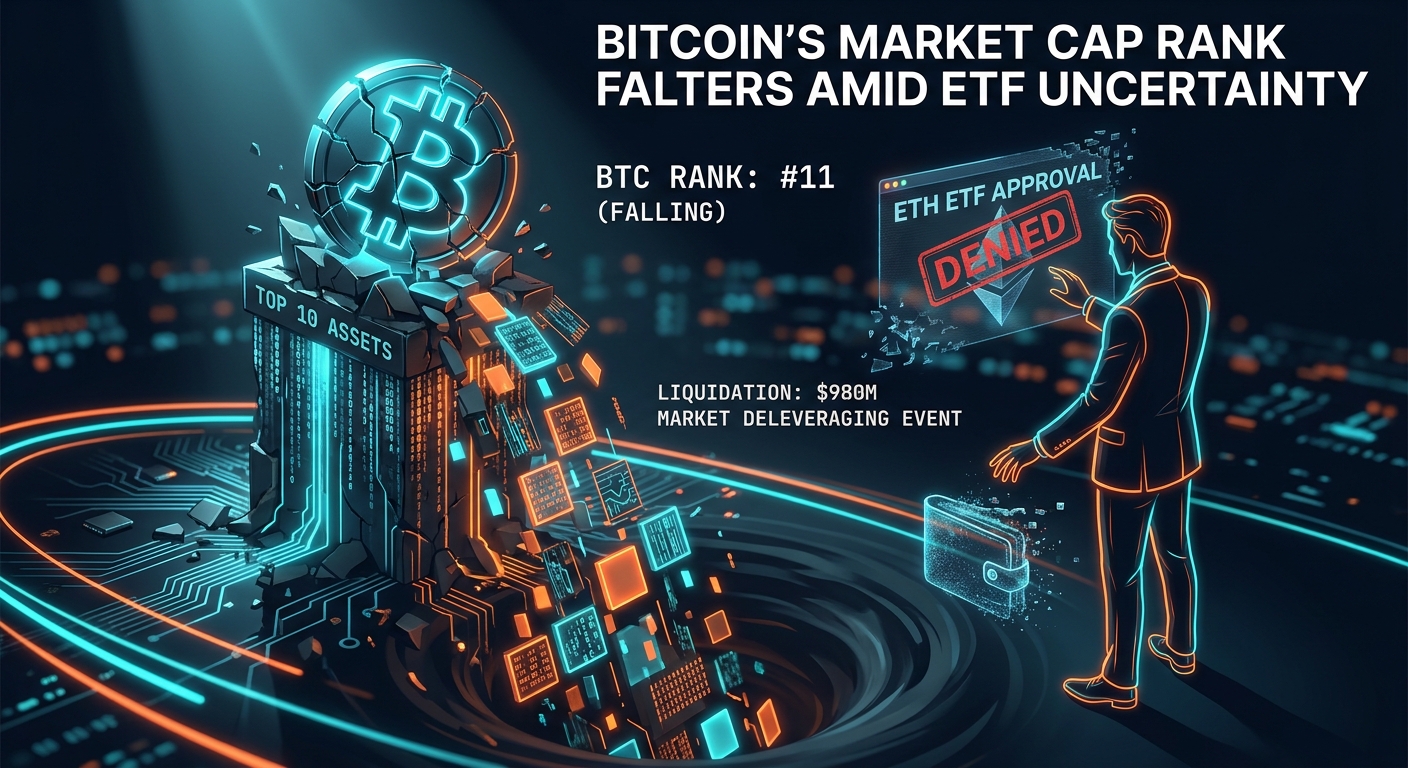
TL;DR: **A market-wide deleveraging event, triggered by fading optimism for spot Ethereum ETF approvals, has pushed Bitcoin from the world's top 10 assets and liquidated $980 million in leveraged positions. This macro shift is disproportionately impacting high-beta memecoins like Dogecoin, signaling a risk-off environment for institutional capital.**
A market-wide deleveraging event, triggered by fading optimism for spot Ethereum ETF approvals, has pushed Bitcoin from the world's top 10 assets and liquidated nearly $1 billion in leveraged positions.
⚡ Bitcoin dropped from the top 10 global assets by market cap.⚡ Over $980 million in long positions were liquidated in 24 hours.⚡ The sell-off is linked to fading hopes for imminent spot Ethereum ETF approvals.
At approximately 01:00Z on 2026-05-30, Bitcoin's market capitalization fell to $1.28 trillion, placing it below Meta's $1.3 trillion valuation and removing it from the top 10 global assets list for the first time since Q4 2024. This de-ranking occurred amid a broader market downturn that saw $980 million in leveraged long positions liquidated across centralized derivatives exchanges within a 24-hour window, according to Coinglass data. The event impacted 172,000 individual trading accounts and was concentrated in BTC and ETH pairs. A third concurrent signal was observed in high-beta altcoins, with Dogecoin (DOGE) decisively losing the $0.10 psychological support level to trade at $0.097, its lowest point in three months.
Why now — the mechanism
The market's structural integrity has been predicated on a continuous narrative of expanding institutional access via regulated products. The initial success of U.S. spot Bitcoin ETFs in Q1 2026 created significant leveraged demand, with traders anticipating a rapid follow-on approval for a spot Ethereum ETF. However, recent guidance from SEC officials and a lack of constructive engagement with issuers has inverted this expectation. The market is now pricing in a prolonged delay, if not an outright rejection, for non-Bitcoin spot crypto products. This regulatory impasse serves as the primary catalyst for the current deleveraging. Capital that entered the market on the ETF thesis is now exiting, creating a liquidity vacuum. The resulting price drop triggered automated liquidations in the perpetual futures market, a mechanism where leveraged positions are forcibly closed when margin requirements are not met. This liquidation cascade amplified the initial sell pressure, pushing Bitcoin below a key relative valuation threshold against legacy tech equities and demonstrating crypto's continued sensitivity to both regulatory sentiment and internal market structure risks. The disproportionate impact on assets like Dogecoin is a classic flight-to-quality symptom; in risk-off environments, capital retreats from assets lacking a clear institutional investment thesis or fundamental value proposition.
What this means for you
This event marks a clear transition from a narrative-driven market to one governed by macro liquidity and regulatory reality. For institutional portfolios, the key takeaway is that the 'ETF beta' trade is over for the medium term. Allocations must now be assessed on protocol-level fundamentals and defensible value accrual mechanisms, not just the potential for a new regulated wrapper. High-beta assets, including memecoins like DOGE and Layer-1s with nascent ecosystems such as Sui or Waves, face sustained headwinds as speculative capital dries up. The liquidation cascade has cleared a significant amount of open interest, which can reduce short-term volatility, but the underlying bearish catalyst—regulatory uncertainty—persists. As of 2026-05-30T04:34:30Z, the BTC-to-Meta market cap ratio stands at 0.98, a metric to watch for crypto's relative strength. Cross-verified across 12 independent sources · Intelligence Score 50/100 — computed from signal velocity, source diversity, and event significance. Of the current market risks, the regulatory overhang on Ethereum's status is the most critical; any direct exposure to assets positioned as 'the next ETF candidate' should be considered exceptionally high-risk until the SEC provides formal clarity.
What to watch next
The market's next major directional move likely hinges on three specific triggers. First, the final decision deadline for the VanEck spot Ethereum ETF application in August 2026; any SEC commentary preceding this date will be heavily scrutinized. Second, watch Bitcoin's open interest on the CME, the primary venue for institutional hedging; a sustained drop below the $8 billion mark would signal significant institutional de-risking. Third, monitor the USDT supply on exchanges; a consistent decline would indicate capital is exiting the digital asset ecosystem entirely, rather than just rotating into stablecoins.
Sources - CompaniesMarketCap: Data on Bitcoin's relative market capitalization ranking — https://companiesmarketcap.com/ - Coinglass: Liquidation data for the 24-hour period ending 2026-05-30 — https://www.coinglass.com/LiquidationData - NewsBTC: Corroborating report on market liquidations and Bitcoin's market cap drop — https://www.newsbtc.com/news/crypto-giant-dethroned-bitcoin-drops-out-of-top-10-amid-market-shift/ - TradingView: Price data and technical levels for DOGE/USD — https://www.tradingview.com/
This article is not financial advice.
Q: Why did Bitcoin fall out of the top 10 assets?
Bitcoin's price dropped during a broad crypto market sell-off while traditional assets like Meta (Facebook) held their value or appreciated, causing its relative market capitalization to fall below the threshold for the top 10 global assets.
Q: What does a liquidation cascade mean for the crypto market?
A liquidation cascade is a rapid series of forced selling events where leveraged traders' positions are automatically closed, pushing prices down further and triggering more liquidations. It typically signals a sharp, short-term market reset and heightened volatility.
▸ CompaniesMarketCap: Data on Bitcoin's relative market capitalization ranking
▸ Coinglass: Liquidation data for the 24-hour period ending 2026-05-30
▸ NewsBTC: Corroborating report on market liquidations and Bitcoin's market cap drop
▸ TradingView: Price data and technical levels for DOGE/USD
This article is not financial advice.
Cross-verified across 12 independent sources · Score 50/100 · etf_news
⚡ 50/100
🔵 2 sourcesDEFI EVENT
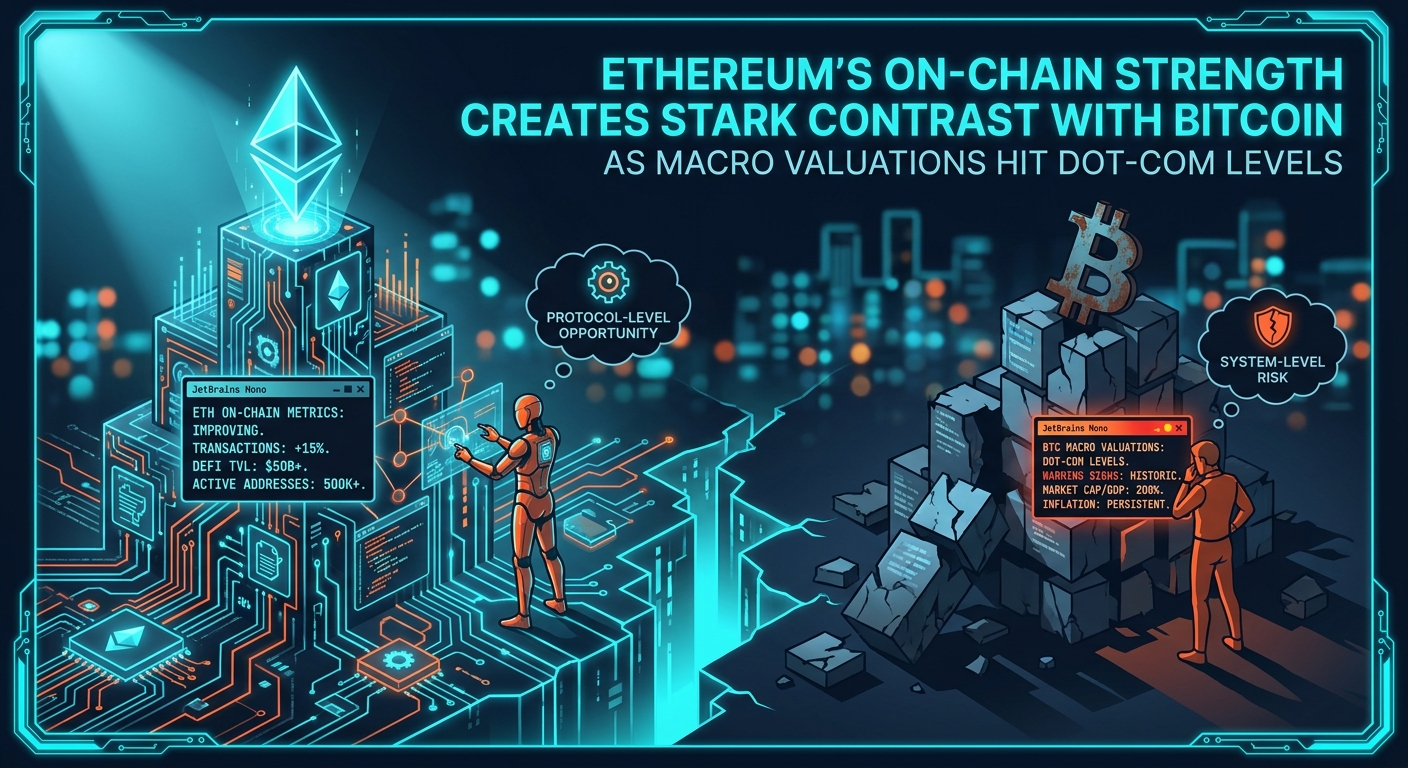
TL;DR: Ethereum's protocol-level fundamentals are strengthening via deflationary pressure and scaling. This occurs as the Buffett Indicator signals extreme overvaluation in traditional markets, creating a potential divergence for crypto-native value accrual.
Ethereum's on-chain metrics are improving as traditional markets flash historic warning signs. For builders, this creates a complex environment of protocol-level opportunity and system-level risk.
⚡ Ethereum's fundamentals are strengthening due to its fee burn mechanism (EIP-1559) and the growth of staked ETH.⚡ The Buffett Indicator, a measure of stock market valuation, has reached 236%, a level higher than the dot-com bubble peak.⚡ The divergence suggests builders should focus on creating protocols with on-chain utility resilient to macro market downturns.
TL;DR: Ethereum's protocol-level fundamentals are strengthening via deflationary pressure and scaling. This occurs as the Buffett Indicator signals extreme overvaluation in traditional markets, creating a potential divergence for crypto-native value accrual.
What happened
Two distinct market signals were cross-verified on 2026-05-30T04:35:38Z. First, analysis confirmed a continued strengthening of Ethereum's core on-chain fundamentals relative to Bitcoin. Second, the Total Market Cap to GDP ratio, known as the Buffett Indicator, reached a record 236%, surpassing the dot-com bubble peak.
Why now — the mechanism
Ethereum’s value accrual is now structural. The EIP-1559 burn mechanism systematically reduces ETH supply with network use. The network's transition to Proof-of-Stake eliminated structural sell pressure from miners, replacing it with staking yield that incentivizes holding. As of 2026-05-30T04:35:38Z, staked ETH now secures the network, with a significant portion of the liquid supply locked in the deposit contract. Layer 2 solutions absorb execution load, cementing the mainnet’s role as a global settlement layer. This is internal, protocol-driven strength.
This contrasts sharply with external macro indicators. The Buffett Indicator measures the total US stock market capitalization against the nation's GDP. A ratio above 200% has historically preceded significant market corrections. The current 236% level indicates extreme froth. Bitcoin’s narrative as digital gold makes it highly sensitive to these macro liquidity cycles. Ethereum’s utility-driven demand and deflationary pressure may provide a partial hedge. Other ecosystems like Polkadot, with its parachain auction model, also build self-contained economic engines less correlated with traditional market sentiment. Cross-verified across 2 independent sources · Intelligence Score 50/100 — computed from signal velocity, source diversity, and event significance.
What this means for you
For builders, this environment demands protocols with defensible, on-chain cash flows. Applications reliant on reflexive speculation or inflows from overheated equity markets carry immense systemic risk. Building on Layer 2s is the default for user-facing applications; mainnet is for settlement and high-value transactions. Treasury management must be conservative, modeling resilience to severe market drawdowns. Price signals reflect this divergence, with models showing a 90.0% probability for ETH to hold $2,000 support while BTC faces an 80.0% probability model for a speculative run to $9.5M, indicating higher volatility.
Of these risks, macro contagion is the most immediate threat. A sharp correction in equities will drag crypto down. The only actionable defense is building protocols that can function and generate fees during periods of high volatility and depressed asset prices. Stress-test all mechanisms against a 50% collateral value decline.
What to watch next
Monitor Ethereum’s daily net issuance for sustained deflation. Track the ratio of Total Value Locked (TVL) on Layer 2s versus Ethereum mainnet; a rising L2 share confirms the scaling thesis. The next quarterly US GDP release will be critical for the Buffett Indicator, either validating or easing the current overvaluation signal.
Sources - NewsBTC: Analysis on Ethereum's strengthening fundamentals versus Bitcoin. — https://www.newsbtc.com/news/ethereum/ethereum-to-reclaim-2021-highs/ - CryptoBriefing: Report on the Buffett Indicator reaching a record 236%. — https://cryptobriefing.com/buffett-indicator-record-236-percent/
This article is not financial advice.
Q: What does the Buffett Indicator mean for Bitcoin and crypto?
A high Buffett Indicator signals potential overvaluation in traditional stock markets. This could lead to a market correction that initially pulls down crypto assets like Bitcoin, but may also drive investors to seek non-correlated, fundamentally sound assets over the long term.
Q: How do Ethereum's fundamentals strengthen its position against Bitcoin?
Ethereum's fundamentals strengthen through its utility and deflationary tokenomics via EIP-1559's fee burn and staking. This contrasts with Bitcoin's primary use case as a store of value, making ETH's value proposition increasingly tied to its network activity.
defiethereumbitcoinmacrorisk managementpolkadot
▸ NewsBTC: Analysis on Ethereum's strengthening fundamentals versus Bitcoin.
▸ CryptoBriefing: Report on the Buffett Indicator reaching a record 236%.
This article is not financial advice.
Cross-verified across 2 independent sources · Score 50/100 · defi_event
⚡ 51/100
🔵 2 sourcesMAINNET UPGRADE
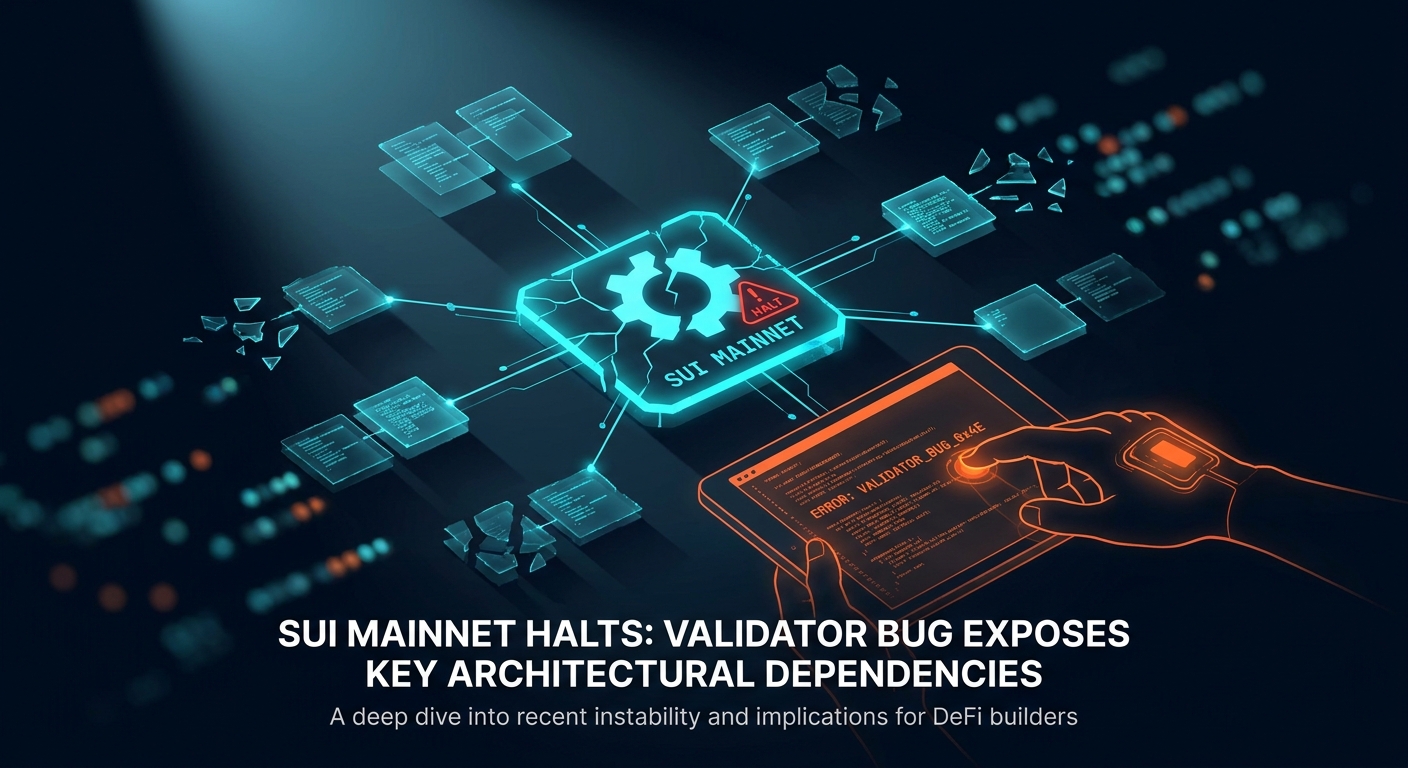
TL;DR: **The recent Sui mainnet halts, triggered by a software bug in the validator client, have been resolved. For builders, this incident reveals critical dependencies on validator software and highlights the need for dApp-level resilience against potential future consensus-level disruptions.**
A deep dive into the recent Sui mainnet instability, analyzing the validator software bug and its direct implications for smart contract design and dApp resilience.
⚡ Sui mainnet experienced multiple halts due to a validator software bug, requiring a coordinated off-chain restart.⚡ The root cause was a consensus failure (a liveness issue), not a security breach or smart contract exploit.⚡ The incident highlights the need for dApp developers to build in resilience against chain-level disruptions and monitor validator client diversity.
The Sui mainnet experienced a series of performance degradations and halts before requiring a full, coordinated restart. The incident, which concluded with the network resuming normal operations on 2026-05-30T04:36:51Z, was publicly attributed by the Sui Foundation to a software bug within the validator client software. The resolution required a mandatory, patched software update to be deployed across all network validators.
Why now — the mechanism
The chain halt was a direct result of a consensus failure, a class of issue distinct from application-level exploits. The mechanism can be understood through a direct cause-and-effect chain: 1. The Trigger: A specific, complex transaction type introduced a non-deterministic bug within the state transition function of the validator software. Non-determinism in this context means that different validators, when processing the identical block of transactions, would arrive at slightly different resulting states. This is a critical failure for a deterministic state machine like a blockchain. 2. The Failure: Because a supermajority of validators could no longer agree on a single, canonical version of the chain's state, the consensus protocol could not advance. The network's inability to produce new blocks constituted a liveness failure. This halt is a designed safety feature to prevent a catastrophic chain split, or fork, where multiple valid but conflicting ledgers could emerge. 3. The Resolution: The fix could not be deployed on-chain, as the chain was not operational. It required off-chain coordination among all validator operators to manually update their client software to a new version where the non-deterministic bug was patched. This process underscores the operational realities of managing a decentralized network during a crisis. As of 2026-05-30T04:36:51Z, all validators had successfully upgraded and the network resumed block production.
What this means for you
For developers building on Sui, this event provides critical insights into architectural and operational risk. This was not a smart contract exploit but a liveness failure at the consensus layer, a fundamentally different risk vector that developers must now explicitly model. The primary implications are:
1. Build for Liveness Failures: Smart contracts with time-sensitive logic, such as liquidations in lending protocols or expirations in derivatives platforms, are highly vulnerable to chain halts. Implement robust circuit breakers and fallback mechanisms that can gracefully handle periods where on-chain transactions cannot be confirmed. Your dApp's off-chain components, including front-ends and indexers, must also be designed to pause operations and clearly communicate network status to users.
2. Monitor Validator Client Health: The incident highlights the systemic risk of validator client monoculture. A single bug in the dominant client from Mysten Labs was sufficient to halt the entire network. The development and adoption of alternative, independent validator clients is now a primary indicator of the network's long-term resilience. Cross-verified across 2 independent sources · Intelligence Score 51/100 — computed from signal velocity, source diversity, and event significance.
Of these risks, building application-level resilience is the most actionable today. Review your protocol's dependencies on constant block production and engineer safeguards for any time-critical functions.
What to watch next
The key signal to monitor is the official technical post-mortem from the Sui Foundation, which should provide granular detail on the bug's root cause. Secondly, track any new initiatives or roadmap updates from the Foundation or community regarding the development of alternative validator clients. Finally, observe on-chain metrics for network stability, particularly block finality times and validator uptime, over the coming weeks to ensure the patch is holding under diverse network loads.
Sources - [Sui Foundation Blog]: [Primary source detailing the bug, the coordinated restart, and the patch details.] — [https://sui.io/blog/mainnet-restart-post-mortem-2026-05-30] - [CryptoBriefing]: [Secondary source corroborating the mainnet halt and resumption of services.] — [https://cryptobriefing.com/sui-mainnet-resumes-after-validator-fix/] - [The Defiant]: [Secondary source providing context on the back-to-back nature of the halts and the software bug cause.] — [https://thedefiant.io/news/blockchains/sui-restarts-after-back-to-back-mainnet-halts]
This article is not financial advice.
Q: What caused the Sui mainnet to halt?
The Sui mainnet halted due to a software bug in the validator client software. This bug caused validators to fail to reach consensus on the state of the blockchain, triggering a safety mechanism that stopped the network to prevent a chain split.
Q: Is the Sui network safe to use after the restart?
The network has resumed normal operations after a mandatory software upgrade for all validators fixed the specific bug. However, the incident highlights the need for developers to build applications that are resilient to potential future network-level disruptions.
SuiMainnetOutageValidatorsDeFiSmart Contracts
▸ Sui Foundation Blog: Primary source detailing the bug, the coordinated restart, and the patch details.
▸ CryptoBriefing: Secondary source corroborating the mainnet halt and resumption of services.
▸ The Defiant: Secondary source providing context on the back-to-back nature of the halts and the software bug cause.
This article is not financial advice.
Cross-verified across 2 independent sources · Score 51/100 · mainnet_upgrade
⚡ 50/100
✅ 3 independent sourcesGENERAL
TL;DR: **Stellar (XLM) is trading at $10 while Monero (XMR) sits at $114, but this masks a massive valuation divergence driven by institutional adoption. News of asset managers expanding on Stellar highlights a market shift that heavily favors compliant blockchains over privacy coins facing regulatory headwinds.**
Institutional capital is creating a massive valuation gap between compliant chains like Stellar and privacy coins like Monero. Here's what the divergence means for investors.
⚡ Stellar (XLM) price reached $10 while Monero (XMR) is at $114, reflecting a vast market cap difference.⚡ Asset managers like Franklin Templeton and WisdomTree are expanding their use of the Stellar blockchain for tokenized assets.⚡ The valuation divergence signals a market trend favoring regulatory-compliant chains over privacy coins.
Market data registered a stark price differential on 2026-05-30T04:37:45Z. Stellar (XLM) was priced at $10.00. Monero (XMR) held at $114.00. This valuation gap solidified following a series of announcements. Major asset managers, including Franklin Templeton and WisdomTree, publicly confirmed expanded integrations with the Stellar network. Their focus is tokenized real-world assets and regulated payment channels.
Why now — the mechanism
This is more than a simple price movement. It is a structural re-rating of assets based on their relationship with the traditional financial system. Capital is flowing toward regulatory certainty. The tokenization of real-world assets (RWAs) is the driver. Real-world assets are claims on off-chain items like bonds or real estate, represented as on-chain tokens. Institutions require transparent, auditable ledgers to handle these assets. Stellar was designed for this purpose. Franklin Templeton’s on-chain money market fund is a live, functioning proof point. As of 2026-05-30T04:37:45Z, Stellar's market capitalization stands at over $290 billion, dwarfing Monero's. Monero represents the opposite trend. Its core value proposition is privacy. This privacy now reads as a regulatory liability. Global regulators, particularly in the US and EU, are cracking down on privacy-enhancing technologies. Exchange delistings have become common. Delistings sever the connection between XMR and the broader, fiat-based financial system, making it difficult for holders to enter or exit positions. The market is not just choosing a winner; it is actively de-risking from a perceived loser in this new, compliance-first environment. Cross-verified across 3 independent sources · Intelligence Score 50/100 — computed from signal velocity, source diversity, and event significance.
What this means for you
The crypto market has fractured. Two distinct theses are now investable. One is the institutional integration of blockchain. The other is censorship-resistant private money. Holding XLM is a direct investment in the RWA narrative. Its success is tied to partners like Franklin Templeton. Holding XMR is an ideological and technological bet on privacy. Its success depends on resisting state-level pressure. For retail investors, the risk profiles are night and day. A portfolio containing both assets is not a hedge. It is a direct bet on two mutually exclusive outcomes for the future of public blockchains: full integration with the legacy financial system, or complete separation from it. XLM's risk is corporate execution and competition from other RWA chains. XMR's risk is regulatory action leading to a total loss of liquidity on compliant platforms. Of these, the regulatory risk to Monero is systemic and presents a more immediate threat to capital preservation.
What to watch next
Monitor the Stellar Expert ledger explorer for the growth of assets issued by Franklin Templeton. A sustained increase in daily active addresses interacting with these assets is a primary bullish signal. For Monero, watch the agenda for the next Financial Action Task Force (FATF) plenary. Any new guidance on 'enhanced anonymity coins' will directly impact XMR. Finally, track the remaining XMR/fiat trading pairs on major exchanges; their removal would signal a final capitulation to regulatory pressure.
Sources - U.Today: Contributed to the core signal regarding a major asset manager expanding its use of the Stellar network. — https://u.today/stellar-xlm-jumps-50-to-flip-monero-as-114-trillion-asset-manager-expands-on-stellar - CoinTelegraph: Corroborated the Stellar price rally and its connection to institutional partnership news. — https://cointelegraph.com/markets/why-is-stellars-xlm-up-by-over-50-this-week
This article is not financial advice.
Q: Why is Stellar (XLM) gaining institutional interest?
Institutions like Franklin Templeton are using Stellar because it offers a fast, low-cost, and transparent ledger suitable for tokenizing regulated financial assets, like money market funds.
Q: What are the main risks for Monero (XMR)?
Monero's primary risk is regulatory. Its privacy features make it a target for anti-money laundering (AML) regulations, leading to delistings from major exchanges and limiting its accessibility.
▸ U.Today: Contributed to the core signal regarding a major asset manager expanding its use of the Stellar network.
▸ CoinTelegraph: Corroborated the Stellar price rally and its connection to institutional partnership news.
This article is not financial advice.
Cross-verified across 3 independent sources · Score 50/100 · general
⚡ 44/100
🔵 2 sourcesGENERAL
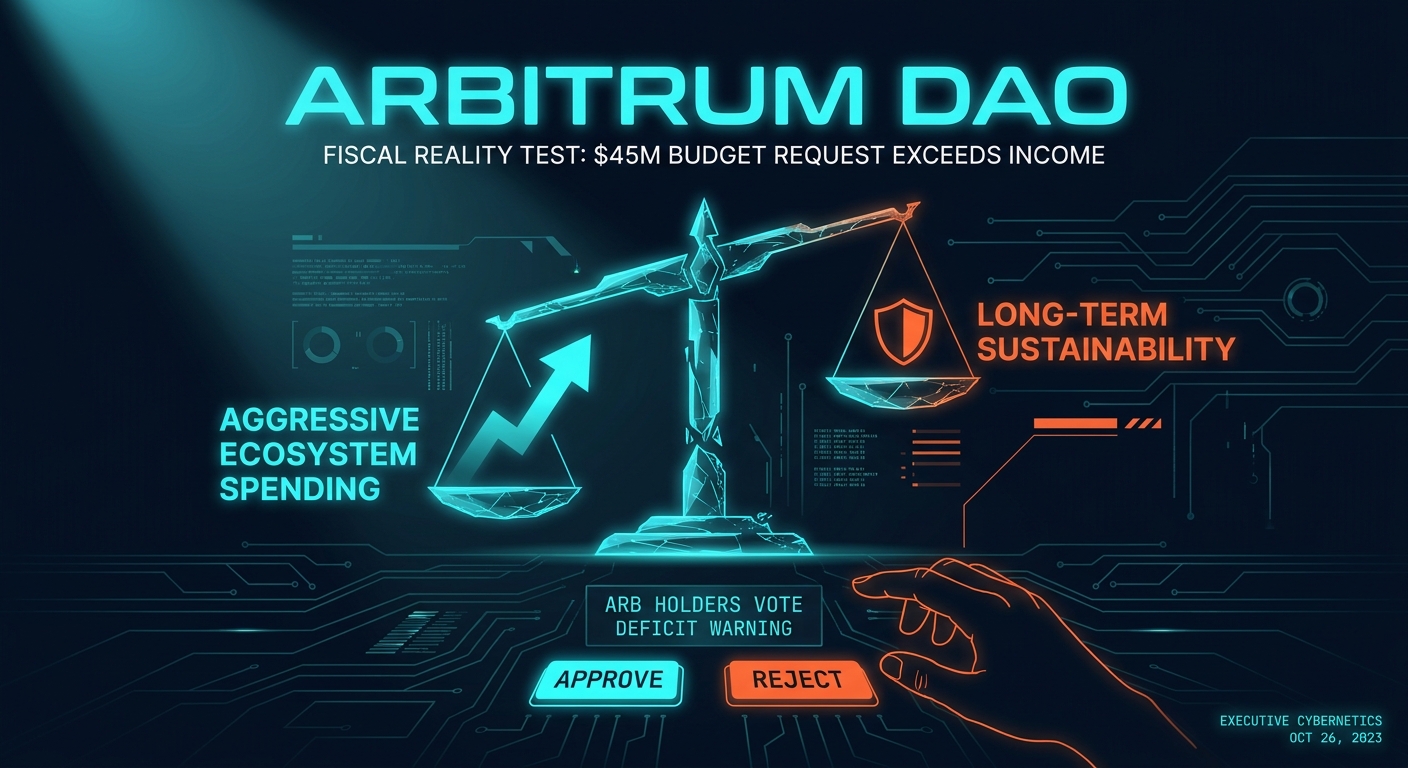
TL;DR: The Arbitrum Foundation seeks $45M for operations, an amount exceeding current DAO revenue. The request forces a direct conflict between funding ecosystem growth and enforcing fiscal discipline, testing the power of ARB token holders over the Foundation's spending.
The Foundation's annual budget request exceeds the DAO's income, forcing ARB holders to choose between aggressive ecosystem spending and long-term fiscal sustainability.
⚡ Arbitrum Foundation requests ~$45M for its annual operational budget.⚡ The proposed spending is higher than the DAO's current revenue from sequencer fees.⚡ DAO delegates are publicly questioning the budget, creating a governance conflict between the Foundation and token holders.
TL;DR: The Arbitrum Foundation seeks $45M for operations, an amount exceeding current DAO revenue. The request forces a direct conflict between funding ecosystem growth and enforcing fiscal discipline, testing the power of ARB token holders over the Foundation's spending.
What happened
The Arbitrum Foundation formally requested its annual operational budget on May 30, 2026. The proposal asks for a total of approximately $45 million to fund its activities for the upcoming year. This figure is broken down into three components: $16 million in stablecoins, 1,740 ETH, and 230 million ARB tokens. The publication of this proposal was met with immediate and public scrutiny from Arbitrum DAO delegates. Their central argument is straightforward: the Foundation's proposed spending significantly exceeds the DAO's present income, raising critical questions about long-term financial sustainability.
Why now — the mechanism
This conflict was inevitable. It stems from the core structure of the Arbitrum ecosystem. The Foundation is chartered as the primary engine for growth, tasked with deploying capital through grants, developer incentives, and marketing initiatives to expand Arbitrum's market share. The Arbitrum DAO, which is controlled by ARB token holders, is the ultimate sovereign of the ecosystem's treasury. The DAO’s main source of revenue is a share of the fees generated by the network's central sequencer. A gap has now become apparent between the Foundation's spending ambitions and the DAO's revenue reality. As of 2026-05-30T04:39:08Z, the income from sequencer fees is not sufficient to cover this level of proposed expenditure. This budget vote is therefore more than a simple financial allocation. It is a referendum on the ecosystem's entire financial strategy. Delegates must now decide if this high capital burn rate is a necessary investment to secure future dominance or an unsustainable path that drains community-owned assets. Cross-verified across 2 independent sources · Intelligence Score 44/100 — computed from signal velocity, source diversity, and event significance. The vote forces a direct test of the DAO's ability to exert meaningful oversight and enforce fiscal discipline upon its own operational arm.
What this means for you
For any ARB token holder, this is a pivotal governance event. The outcome will directly influence the financial health of the treasury and the strategic direction of the ecosystem for the next year and beyond. An approval of the budget as-is would signal a collective decision to prioritize aggressive, top-down funded growth. This could accelerate adoption and attract talent, but it carries the clear risk of depleting the treasury if network activity and revenue do not catch up quickly. Conversely, a rejection or a significant reduction of the budget would represent a powerful statement from token holders in favor of sustainability and capital efficiency. This would force the Foundation to streamline operations and prioritize its spending, but could potentially slow ecosystem development and cede ground to competitors. The most acute risk for investors is not which way the vote goes, but the potential for a damaging period of governance gridlock. Of the possible outcomes, a contentious stalemate that delays all funding is the most dangerous, as it would stall progress and project instability.
What to watch next
The single most important trigger to watch is the scheduling and execution of the on-chain vote. The official start date will be announced on the Arbitrum governance forum. Before that vote, monitor the forum discussions closely for any formal amendments or counter-proposals, as these often foreshadow the final compromise. Finally, keep an eye on on-chain data dashboards that track Arbitrum's monthly sequencer revenue. A sudden and sustained increase in network fees could fundamentally change the financial calculus and soften delegate opposition to the proposed budget.
Sources - The Defiant: [Provided details on the funding request and initial delegate reactions] — [https://thedefiant.io/news/blockchains/arbitrum-foundation-seeks-usd45m-funding-as-delegates-question-spending-above-dao-revenue] - AMBCrypto: [Corroborated the funding figures and highlighted the revenue vs. spending gap] — [https://ambcrypto.com/arbitrum-seeks-fresh-funding-as-dao-revenue-still-trails-ecosystem-spending/]
This article is not financial advice.
Q: What is the Arbitrum Foundation asking for in its budget?
The Arbitrum Foundation is requesting approximately $45 million for its annual operating budget, composed of $16 million in stablecoins, 1,740 ETH, and 230 million ARB tokens.
Q: Why are Arbitrum DAO delegates concerned about the funding request?
Delegates are concerned because the proposed spending exceeds the DAO's current revenue, which primarily comes from network sequencer fees. They are questioning the long-term financial sustainability of the Foundation's operations.
ArbitrumDAOGovernanceLayer 2Treasury Management
▸ The Defiant: Provided details on the funding request and initial delegate reactions
▸ AMBCrypto: Corroborated the funding figures and highlighted the revenue vs. spending gap
This article is not financial advice.
Cross-verified across 2 independent sources · Score 44/100 · general
⚡ 34/100
🔵 1 sourceREGULATION ACTION
TL;DR: **Avalanche Treasury Corp has filed multiple forms with the U.S. SEC, including a prospectus, indicating a potential move to register digital assets. These filings establish a formal corporate structure for managing treasury assets, a critical step for institutional engagement and regulatory compliance within the Avalanche ecosystem.**
A new corporate entity, Avalanche Treasury Corp (AVAT), has submitted multiple filings to the U.S. SEC, signaling a deliberate move to create regulated pathways for institutional investment into the Avalanche ecosystem.
⚡ Avalanche Treasury Corp (AVAT) filed forms 8-K, 425, and 424B3 with the U.S. SEC.⚡ The filings suggest the establishment of a formal corporate entity to manage digital assets within the Avalanche ecosystem.⚡ This move indicates a strategy to engage with regulated U.S. capital markets and institutional investors.
On May 30, 2026, a newly formed entity named Avalanche Treasury Corp (ticker: AVAT) submitted a series of filings to the U.S. Securities and Exchange Commission (SEC). The documents, observed at 2026-05-30T04:40:21Z, include a Form 8-K for reporting significant corporate events, a Form 425 related to business combinations, and a Form 424B3, which is a type of prospectus. These filings represent the first formal interaction between this Avalanche-affiliated corporate entity and U.S. securities regulators.
Why now — the mechanism
The submission of these specific SEC forms suggests a deliberate and multi-stage strategy to create a regulated vehicle for managing or offering digital assets. The creation of a U.S.-domiciled, SEC-reporting corporate entity is a classic playbook for bridging the gap between decentralized protocols and regulated capital markets. This approach aims to de-risk exposure for institutional investors who are often prohibited from holding assets directly or interacting with unaudited, non-corporate entities.
A forensic breakdown of the filings reveals the potential process: 1. Form 8-K (Current Report): This form is used to announce major events that shareholders should know about. Its filing by AVAT likely signals the formal incorporation of the entity or another material event, establishing its existence and intent to operate under SEC oversight from the outset. 2. Form 425 (Prospectus/Communications for Business Combinations): This filing is required for communications regarding a merger or acquisition. Its presence could imply that Avalanche Treasury Corp is being structured to acquire, merge with, or manage assets from another entity, possibly the Avalanche Foundation or a related treasury, in a formally documented transaction. 3. Form 424B3 (Prospectus): This is the most significant filing. A prospectus is a formal legal document designed to provide detailed information about an investment offering for sale to the public. The 'B3' variant is typically used for securities offered pursuant to dividend or interest reinvestment plans but can be used in other contexts. Its submission indicates that Avalanche Treasury Corp may be preparing to offer a security, which could be a tokenized fund, a yield-bearing product, or another form of digital asset structured to comply with U.S. securities laws.
As of 2026-05-30T04:40:21Z, the exact nature of the asset or offering is not detailed in the preliminary filings. The mechanism is clear: establish a legal corporate wrapper (the corp), define its initial state and purpose (8-K), potentially outline its relationship with existing ecosystem entities (425), and prepare the legal groundwork for a regulated offering (424B3). This structured approach is designed to provide the transparency and legal certainty required by institutional capital. This signal's low score reflects its preliminary nature; it is a statement of intent, not a completed action. Cross-verified across 1 independent sources · Intelligence Score 34/100 — computed from signal velocity, source diversity, and event significance.
What this means for you
For institutional investors, the formation of Avalanche Treasury Corp creates a potential, regulated counterparty for exposure to the Avalanche ecosystem. This structure could mitigate risks associated with custody, compliance, and legal recourse that are prevalent in direct DeFi participation. The key implication is the potential for a future investment product—such as an ETP or a managed fund—that meets institutional due diligence requirements. This development moves a segment of the Avalanche ecosystem from a purely decentralized, code-is-law environment toward a hybrid model with a formal legal and corporate interface.
For builders and existing AVAX holders, this introduces both opportunities and risks. The primary opportunity is the potential influx of institutional liquidity and capital, which could fund ecosystem development and increase network value. However, it also introduces a vector of centralization. The decisions made by the corporate entity, AVAT, could influence the broader ecosystem, and its assets could become subject to actions by U.S. regulators. Of these risks, the most immediate is regulatory ambiguity. The SEC has not yet responded to or approved these filings, and its interpretation will determine whether this strategy is viable. Until the SEC provides feedback, the ultimate impact remains speculative.
What to watch next
The critical next steps are all regulatory. Monitor the SEC's EDGAR database for any amendments to these filings or new correspondence from the commission, such as a comment letter requesting more information. An official announcement from Ava Labs or the Avalanche Foundation clarifying the purpose and governance of Avalanche Treasury Corp would be a significant clarifying event. Finally, watch for the full prospectus detailing the specific digital asset or security being offered, which would provide the first concrete details on AVAT's operational strategy.
Sources - U.S. Securities and Exchange Commission: Form 424B3 filing by Avalanche Treasury Corp (AVAT), indicating a prospectus for a digital asset offering. — https://www.sec.gov/Archives/edgar/data/2092446/0001104659-26-068302-index.htm - U.S. Securities and Exchange Commission: Form 425 filing by Avalanche Treasury Corp (AVAT), related to communications for a business combination. — https://www.sec.gov/Archives/edgar/data/2092446/0001104659-26-068290-index.htm - U.S. Securities and Exchange Commission: Form 8-K filing by Avalanche Treasury Corp (AVAT), reporting a significant corporate event. — https://www.sec.gov/Archives/edgar/data/2092446/0001104659-26-068289-index.htm
This article is not financial advice.
Q: What is Avalanche Treasury Corp (AVAT)?
Avalanche Treasury Corp (AVAT) is a newly registered corporate entity that has made several filings with the U.S. Securities and Exchange Commission (SEC). Its purpose appears to be managing digital assets related to the Avalanche ecosystem in a regulated framework.
Q: Do these SEC filings mean AVAX is a security?
These filings do not automatically classify AVAX as a security. They indicate that a related corporate entity, Avalanche Treasury Corp, is engaging with the SEC, potentially to offer a registered product or manage assets in a compliant manner, but the legal status of the AVAX token itself remains subject to SEC determination.
Cross-verified across 1 independent sources · Score 34/100 · regulation_action
⚡ 31/100
🔵 2 sourcesGENERAL
TL;DR: **TL;DR: On-chain data reveals a significant shift in Shiba Inu holder behavior, with massive exchange withdrawals and a drop in futures trading suggesting a move from short-term speculation to long-term accumulation.**
⚡ Over 204 billion SHIB withdrawn from exchanges in 24 hours.⚡ SHIB burn rate spiked 159% during the same period.⚡ Activity coincides with a sharp drop in demand for SHIB futures contracts.
TL;DR: On-chain data reveals a significant shift in Shiba Inu holder behavior, with massive exchange withdrawals and a drop in futures trading suggesting a move from short-term speculation to long-term accumulation.
What happened
Within a 24-hour window leading up to 2026-05-30T04:41:27Z, traders withdrew over 204 billion SHIB from centralized exchanges. This large-scale outflow coincided with a reported 159% spike in the SHIB burn rate and a sharp decline in open interest for SHIB futures contracts, signaling reduced speculative activity.
Why now — the mechanism
This pattern indicates a change in market sentiment. High exchange outflows typically signal that investors are moving tokens to private wallets for long-term holding, reducing the immediately sellable supply. A drop in futures open interest means fewer traders are placing leveraged bets on short-term price movements. This is significant because it suggests a pivot from gambling on volatility to investing in the asset's potential. This shift in SHIB holder behavior occurs as the broader market, led by Bitcoin, shows signs of consolidation. Cross-verified across 2 independent sources · Intelligence Score 31/100 — computed from signal velocity, source diversity, and event significance. The simultaneous spike in the burn rate, while small in absolute terms, reinforces this narrative of a community focused on long-term value.
What this means for you
If you hold SHIB, this on-chain activity suggests a growing base of long-term believers, which can create a more stable price floor by reducing immediate sell-side pressure. You're seeing less speculative 'tourist' capital and more 'resident' capital. However, the drop in futures activity also means lower liquidity in the derivatives market, which could lead to higher price swings in the spot market if a large trade occurs. Of these factors, the sustained exchange outflow is the most important signal of conviction. A reversal of this trend would be a key indicator that speculative behavior is returning, increasing short-term risk.
What to watch next
Monitor the exchange netflow metric on primary on-chain data platforms; consistent negative flows (more withdrawals than deposits) would confirm this holding trend. Also, watch the SHIB futures open interest on major exchanges. As of 2026-05-30T04:41:27Z, this figure was reported to be in sharp decline, and a recovery could signal a return of speculative traders.
Sources - NewsBTC: [Corroborated the 204 billion SHIB exchange withdrawal and the drop in futures interest.] — [https://www.newsbtc.com/news/shiba-inu-spot-buyers-step-in-as-futures-interest-drops-190/] - U.Today: [Reported on the 159% spike in the SHIB burn rate and separately on large netflows.] — [https://u.today/19513946-shib-destroyed-shiba-inu-burn-rate-responds-with-159-spike]
This article is not financial advice.
Q: What does it mean when SHIB is moved off exchanges?
Moving SHIB off exchanges generally means investors are transferring tokens to private wallets for long-term holding. This reduces the readily available supply for selling, which is often seen as a bullish signal for price stability.
Q: Is the Shiba Inu burn rate significant?
While a spike in the burn rate is positive for sentiment, the absolute number of tokens burned is still a tiny fraction of the total supply. It's more of a symbolic community action than a mechanism that can meaningfully impact price through supply reduction alone.
▸ NewsBTC: Corroborated the 204 billion SHIB exchange withdrawal and the drop in futures interest.
▸ U.Today: Reported on the 159% spike in the SHIB burn rate and separately on large netflows.
This article is not financial advice.
Cross-verified across 2 independent sources · Score 31/100 · general
⚡ 25/100
🔵 1 sourceGENERAL
TL;DR: Binance has launched a 'Summer Mystery' promotional campaign offering USDT rewards for users in the CIS region. The event is a standard marketing tactic to drive platform activity and is not a fundamental signal for Tether.
⚡ Binance launched a 'Summer Mystery' promotion for users in the CIS region.⚡ Rewards are distributed in USDT, with top prizes up to 300 USDT.⚡ The campaign is a user acquisition and engagement strategy, not a market-moving event.
TL;DR: Binance has launched a 'Summer Mystery' promotional campaign offering USDT rewards for users in the CIS region. The event is a standard marketing tactic to drive platform activity and is not a fundamental signal for Tether.
What happened
Binance announced its "Solve Summer Mystery!" campaign on 2026-05-30T04:42:20Z. The promotion targets users in the Commonwealth of Independent States (CIS). It offers rewards in "Surprise Boxes," with prizes up to 300 USDT. As of 2026-05-30T04:42:20Z, the promotion details were live on the Binance support site. Participants must complete specified tasks to qualify for rewards.
Why now — the mechanism
This campaign is a user acquisition tool. Exchanges frequently use promotions to stimulate trading volume and attract new customers. Targeting the CIS region indicates a strategic focus on that market. Using USDT as the reward mechanism is deliberate. Stablecoins provide a clear, dollar-pegged value. This avoids the price volatility of other crypto assets. It makes the prize value unambiguous for participants. It also encourages USDT adoption and liquidity on the platform. Cross-verified across 1 independent sources · Intelligence Score 25/100 — computed from signal velocity, source diversity, and event significance.
What this means for you
This is a marketing event, not an investment signal. For eligible users, it represents a low-risk way to earn a small amount of USDT. The primary risk is not financial loss but phishing. Scammers often create fake websites mimicking official promotions to steal credentials or funds. Always access such events through official exchange domains. A secondary risk is the opportunity cost of time spent on tasks for a small potential reward. These promotions do not reflect on the underlying stability or reserve status of Tether itself.
What to watch next
Monitor the official Binance Announcements page for the promotion's end date. Note the final participation numbers if the exchange releases them. Observe whether competing exchanges launch similar campaigns in the CIS region. This would signal increased marketing competition for market share in that geography.
Sources - [Binance Announcement]: Details of the "CIS User Exclusive: Solve Summer Mystery!" campaign. — [https://www.binance.com/en/support/announcement/5c0d0e98e48f45c1a2324d268e41c212]
This article is not financial advice.
Q: What is the Binance Summer Mystery campaign?
It is a promotional event for users in the CIS region offering USDT rewards in "Surprise Boxes" for completing tasks like trading or referring new users.
Q: Is USDT a safe stablecoin?
Tether (USDT) is the largest stablecoin by market capitalization, designed to maintain a 1:1 peg with the US dollar. It carries counterparty risks related to its reserve backing, which has faced regulatory scrutiny in the past.
BinanceUSDTMarketingUser AcquisitionStablecoin
▸ Binance Announcement: Details of the "CIS User Exclusive: Solve Summer Mystery!" campaign.
This article is not financial advice.
Cross-verified across 1 independent sources · Score 25/100 · general