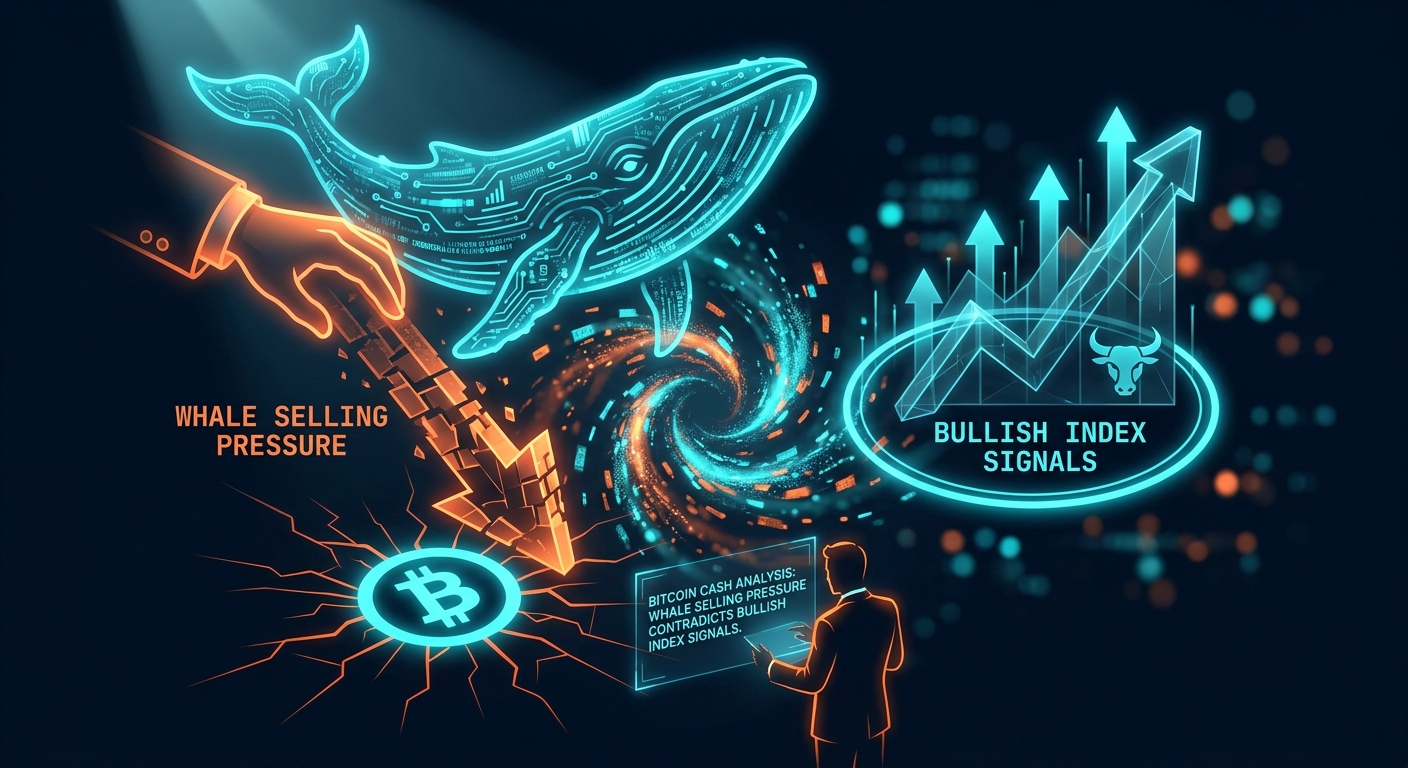
Large Bitcoin Cash holders are selling, creating significant downward price pressure. This clashes directly with the asset's inclusion in major market indices, presenting a complex and volatile picture for investors.
TL;DR: Bitcoin Cash (BCH) is sending conflicting signals: large holders are selling significant amounts, driving short-term price pressure, while its inclusion in major indices like the CoinDesk 20 reflects growing market integration. This divergence creates a high-volatility environment where retail sentiment is pitted against institutional flows.
What happened
Two contradictory signals for Bitcoin Cash emerged within the same 24-hour news cycle ending 2026-05-20T04:35:59Z. First, on-chain analysis reported by AMBCrypto indicated that large holders, or "whales," were selling significant portions of their BCH, contributing to a sharp 12% price decline toward the $380 level. Concurrently, separate performance data from CoinDesk showed BCH posting a 2.1% gain, highlighting its role as a constituent of the CoinDesk 20, a major market index designed to measure the performance of the most significant digital assets.
Why now — the mechanism
The current market dynamic for Bitcoin Cash is a direct result of two opposing forces operating on different timelines and driven by different investor types. This creates a structural conflict in its price discovery.
1. Cause: Short-Term, Concentrated Selling Pressure. The whale selling is a tactical, short-term event. With Bitcoin (BTC) establishing a strong foothold around the $120,000 mark, the entire crypto market has seen significant appreciation. Long-term holders of assets like BCH, which often moves in correlation with Bitcoin, are sitting on substantial unrealized gains. The observed selling is likely a combination of profit-taking and portfolio rebalancing by these large, early investors. Because their holdings are so concentrated, their sales create immediate, outsized downward pressure on price, as the market must absorb a large supply influx in a short period. This is a classic profit-taking cycle.
2. Effect: Long-Term, Diffuse Buying Pressure. Conversely, BCH's inclusion and performance within the CoinDesk 20 index represent a strategic, long-term structural factor. Market indices serve as benchmarks for a growing ecosystem of passive investment products, including exchange-traded funds (ETFs) and tracker funds. Inclusion means that any fund tracking this index must programmatically buy and hold BCH in proportion to its index weight. This creates a steady, non-discretionary, and price-insensitive source of demand. This process integrates BCH more deeply into the broader financial market structure, lending it a degree of legitimacy and accessibility it previously lacked. This analysis is cross-verified across 2 independent sources · Intelligence Score 43/100 — computed from signal velocity, source diversity, and event significance.
The core conflict arises because these forces are now clashing in real-time. The market is attempting to price in both the immediate, tangible bearish signal of whale exits and the more abstract, potential long-term bullish signal of structural demand. As of 2026-05-20T04:35:59Z, Bitcoin Cash is priced at approximately $380, reflecting this indecision.
What this means for you
For a retail investor, this clash of signals translates directly to heightened price volatility and significant uncertainty for Bitcoin Cash. The primary risk is becoming exit liquidity for whales; this occurs when retail investors buy into what appears to be a price dip, only to see prices fall further as large, informed sellers continue to unload their positions. The opposing risk is one of opportunity cost: missing a potential stabilization and subsequent recovery if the structural demand from index inclusion begins to absorb and outweigh the acute selling pressure.
Of these two risks, the whale activity presents the more immediate and potent threat. A handful of sellers with large holdings can overwhelm the diffuse buying from thousands of smaller market participants in the short term. Therefore, the most actionable insight is to treat the current price action with extreme caution. The downward pressure is confirmed by on-chain movements, whereas the upward pressure from index inclusion is a longer-term, less certain thesis. The risk of further downside from continued selling currently outweighs the potential for an immediate index-driven rally.
What to watch next
The resolution of this market conflict can be tracked through specific, verifiable data points. First, monitor on-chain metrics for whale wallets, specifically the number of addresses holding between 1,000 and 10,000 BCH. A stabilization or increase in this cohort would suggest the heaviest selling pressure is subsiding. Second, watch exchange net flow data for BCH; a shift from net inflows (indicating intent to sell) to net outflows (indicating intent to hold) would be a bullish signal. Finally, look for official announcements of new investment products or funds that specifically track the CoinDesk 20 index, as this would be the primary catalyst for validating the passive-buying thesis.
Sources - AMBCrypto: Provided analysis of on-chain data suggesting whale-driven selling pressure on BCH — https://ambcrypto.com/bitcoin-cash-drops-12-as-whales-sell-is-bch-headed-to-305/ - CoinDesk: Provided performance data for BCH as a constituent of the CoinDesk 20 market index — https://www.coindesk.com/coindesk-indices/2026/05/19/coindesk-20-performance-update-bitcoin-cash-bch-rises-2-1
This article is not financial advice.
This article is not financial advice.