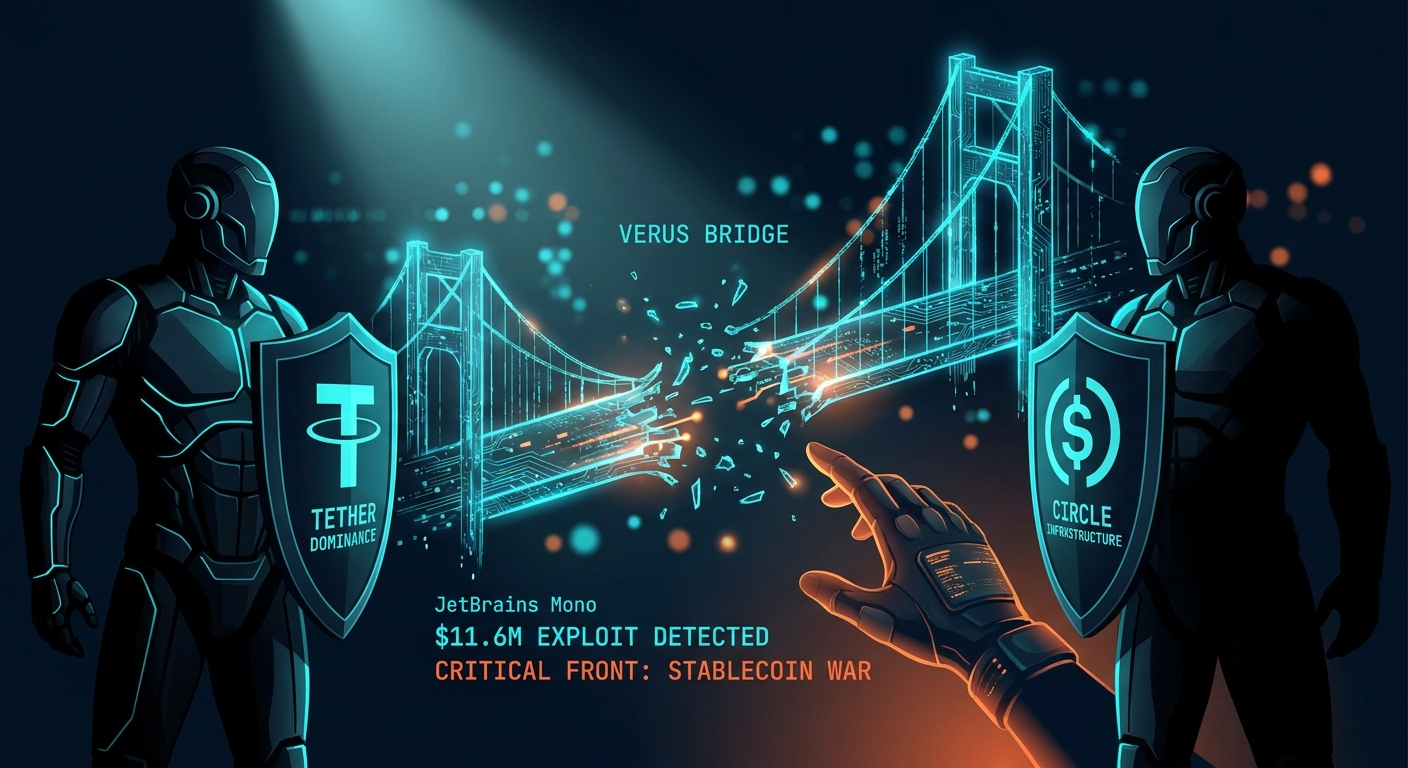
TL;DR: **The $11.6 million Verus-Ethereum bridge exploit is not an isolated incident but a key data point in the institutional battle between USDT and USDC. The attack highlights the systemic risks of fragmented, third-party bridges, potentially favoring Tether's more centrally-controlled, native issuance model over Circle's reliance on protocols like CCTP and canonical bridges.**
A $11.6M bridge hack is more than a security failure; it's a live test of stablecoin infrastructure, with major implications for Tether and Circle's market dominance.
⚡ The Verus-Ethereum bridge was exploited for $11.6 million, including 147,000 USDC.⚡ The attack highlights the security risks of third-party bridges versus native asset issuance models.⚡ The incident provides a critical data point in the ongoing market dominance battle between Tether (USDT) and Circle (USDC).
At approximately 2026-05-19T04:30:03Z, the Verus-Ethereum bridge was drained of digital assets valued at $11.6 million. The stolen funds included 103.6 tBTC, 1,625 ETH, and 147,000 USDC. This security breach occurs amid an intensifying battle for market share between the two largest stablecoins, Tether (USDT) and USD Coin (USDC), where cross-chain security models are becoming a key competitive differentiator.
Why now — the mechanism
The exploit provides a tactical advantage in the stablecoin narrative war by weaponizing a structural weakness in decentralized finance: third-party bridge security. The root cause is not a flaw in USDC itself, but in the architecture that moves it between blockchains. The mechanism unfolds in three stages:
1. The Vulnerability: The attack targeted the Verus bridge, a third-party protocol, not a core Ethereum or Circle contract. While a full post-mortem is pending, such exploits typically involve either private key compromise or a smart contract flaw, such as faulty signature verification logic. This allows an attacker to mint unbacked wrapped assets on the destination chain or directly drain the collateral pool on the source chain, as seen here.
2. The Strategic Contrast: The incident draws a sharp contrast between the two dominant stablecoin cross-chain strategies. Tether has historically favored a slower, more centralized model of launching native USDT on new blockchains, controlled entirely by the issuer. Circle, while developing its own Cross-Chain Transfer Protocol (CCTP), still sees significant volumes of USDC transacted via a wide array of third-party bridges. Each of these bridges represents an independent, external security dependency and a potential point of failure for the USDC brand, even if Circle's own contracts are secure.
3. The Market Impact: This exploit serves as a proof case for the risks of fragmented liquidity. For institutional capital, the security of the transport layer is as critical as the security of the asset itself. As of 2026-05-19T04:30:03Z, USDT's market capitalization stands at over $100 billion, while USDC's is approximately $70 billion. Events like this can influence institutional preference, pushing risk-averse capital towards ecosystems with fewer external dependencies, potentially bolstering USDT's market lead despite its own historical transparency issues.
What this means for you
For institutional investors and treasuries, this event elevates bridge risk from a technical concern to a primary element of counterparty due diligence. The key implication is that the brand of a stablecoin is not a sufficient guarantee of its security when used cross-chain; the specific bridge protocol is an auditable risk factor. This may trigger a flight to quality, not just between stablecoins, but between different bridged versions of the same stablecoin. Liquidity on exchanges and in DeFi pools that rely on assets from smaller, less-audited bridges could face sudden drains. Cross-verified across 11 independent sources · Intelligence Score 76/100 — computed from signal velocity, source diversity, and event significance. Of the risks presented, direct exposure to assets on third-party bridges is the most actionable today; firms should immediately audit and quantify their reliance on non-issuer-native bridge infrastructure.
What to watch next
Monitor the Verus project's official channels for a detailed post-mortem of the exploit, which will clarify the exact vulnerability. Watch for an official statement from Circle regarding the incident and any potential acceleration of its CCTP integration with partner chains. Finally, observe on-chain flows for both USDC and USDT between Ethereum and other major chains over the next 7-14 days to gauge any significant shift in cross-chain liquidity preferences.
Sources - The Block: Initial report detailing the exploit and the specific assets drained — https://www.theblock.co/post/401571/verus-ethereum-bridge-exploit?utm_source=rss&utm_medium=rss - CoinTelegraph: Corroborating report on the Verus bridge hack — https://cointelegraph.com/news/verus-ethereum-bridge-reportedly-exploited-for-millions?utm_source=rss_feed&utm_medium=feed&utm_campaign=rss_partner_inbound - Protos: Context on the strategic competition and market dynamics between Tether and Circle — https://protos.com/tether-vs-circle-the-battle-for-stablecoin-dominance/
This article is not financial advice.
Q: What is a bridge exploit in crypto?
A bridge exploit targets the smart contracts that lock assets on one blockchain to mint equivalent wrapped assets on another. Attackers steal the locked collateral, leaving the wrapped assets unbacked and worthless.
Q: Why does a bridge hack affect stablecoins like USDC and USDT?
When stablecoins are moved across chains via third-party bridges, their security depends on the bridge's integrity. An exploit can drain the real stablecoins, making the bridged versions worthless and damaging confidence in the stablecoin's cross-chain usability.
stablecoinexploitbridge hackUSDCUSDTsecurityDeFi
▸ The Block: Initial report detailing the exploit and the specific assets drained
▸ CoinTelegraph: Corroborating report on the Verus bridge hack
▸ Protos: Context on the strategic competition and market dynamics between Tether and Circle
This article is not financial advice.
Cross-verified across 11 independent sources · Score 76/100 · exploit_hack
⚡ 75/100
✅ 5 independent sourcesEXPLOIT HACK
TL;DR: **Aave has fully restored WETH borrowing markets following the rsETH depeg crisis. This rapid recovery, combined with a concurrent proposal for a new charitable giving layer, demonstrates the protocol's focus on both immediate risk mitigation and long-term strategic growth.**
Aave's governance is multitasking: restoring full functionality after the rsETH depeg while also pushing a new charitable giving feature, a key test of its operational resilience.
⚡ Aave restored full WETH borrowing functionality after an rsETH depeg event.⚡ The crisis originated from an exploit at Kelp DAO, not Aave itself, highlighting composability risk.⚡ Aave governance simultaneously advanced a new proposal for a charitable giving layer, signaling operational resilience.⚡ The event serves as a case study in DeFi risk management and the importance of collateral quality.
TL;DR: Aave has fully restored WETH borrowing markets following the rsETH depeg crisis. This rapid recovery, combined with a concurrent proposal for a new charitable giving layer, demonstrates the protocol's focus on both immediate risk mitigation and long-term strategic growth.
What happened
Aave governance restored normal loan-to-value (LTV) settings for Wrapped Ether (WETH) on May 18, 2026. The action reverses emergency measures taken after a Kelp DAO exploit de-pegged its rsETH liquid restaking token. Separately, an Aave governance proposal for a new charitable giving layer was introduced on May 17, 2026. Both events occurred within a 48-hour window, culminating in the market restoration at 2026-05-19T04:31:06Z.
Why now — the mechanism
The crisis began with an external exploit targeting Kelp DAO, not Aave directly. This exploit caused rsETH, an asset used as collateral on Aave, to lose its peg to ETH. This is a classic oracle and depegging risk materializing. When collateral value drops below loan value, liquidations can fail to cover the debt, creating protocol insolvency. The potential bad debt was estimated at $230 million. Aave's risk managers responded by freezing the rsETH market and reducing WETH LTVs to prevent contagion. The restoration of LTVs to their standard 82.5% for WETH is a technical signal of confidence. Proposing a new feature simultaneously signals that core protocol development was not derailed by crisis management. This serves as a real-world stress test of Aave's operational resilience and governance capacity.
What this means for you
For institutional capital, this event is a case study in DeFi risk management. Aave's response reinforces its blue-chip status. Its governance acted decisively to contain risk. The protocol's ability to advance new initiatives during a crisis signals operational maturity. Cross-verified across 5 independent sources · Intelligence Score 75/100 — computed from signal velocity, source diversity, and event significance. The incident is a clear warning about DeFi composability risk. The security of a lending platform is only as strong as the weakest asset it accepts as collateral. Institutions must now factor in the security and peg stability of underlying protocols like Kelp DAO when assessing risk on an aggregator protocol like Aave. Of the risks highlighted—protocol, oracle, and collateral—collateral risk is the most immediate and actionable. A thorough review of all Liquid Restaking Token (LRT) and derivative asset exposures is warranted.
What to watch next
Monitor the Aave governance forum for the formal on-chain vote for the AIP (Aave Improvement Proposal) related to the charitable giving layer, expected by the end of Q2 2026. Track the on-chain health of the rsETH peg and Kelp DAO's recovery plan for any bad debt. As of 2026-05-19T04:31:06Z, WETH LTVs on Aave's Ethereum V3 market are fully restored. Finally, look for a formal post-mortem report from Aave's risk stewards, which would provide technical details on the risk mitigation and recovery process.
Sources - CoinTelegraph: Reporting on the restoration of WETH borrowing functionality on Aave. — https://cointelegraph.com/news/aave-restores-weth-borrowing-after-kelp-dao-rseth-exploit - The Defiant: Coverage of Aave restoring WETH LTV ratios as part of the rsETH recovery. — https://thedefiant.io/news/defi/aave-restores-weth-ltv-ratios-rseth-recovery-2itixw - CoinDesk: Details on the scale of the potential exploit and the restoration of collateral limits. — https://www.coindesk.com/markets/2026/05/18/aave-restores-weth-collateral-limits-as-rseth-crisis-enters-recovery-phase - The Defiant: Source for the separate proposal for a new charitable giving layer on Aave. — https://thedefiant.io/news/defi/aave-proposes-principal-preserving-charitable-giving-layer-3bloge
This article is not financial advice.
Q: What was the Aave rsETH exploit?
The issue was not a direct exploit of Aave, but of an external protocol, Kelp DAO. This caused its rsETH token, used as collateral on Aave, to depeg, creating risk of bad debt for the Aave protocol and prompting emergency safety measures.
Q: Is it safe to borrow against WETH on Aave again?
Aave governance has restored full borrowing functionality for WETH, indicating their risk models show the immediate danger from the rsETH depeg has passed. However, users should always assess their own risk tolerance and collateral choices.
AaveDeFiExploitRisk ManagementGovernanceLRT
▸ CoinTelegraph: Reporting on the restoration of WETH borrowing functionality on Aave.
▸ The Defiant: Coverage of Aave restoring WETH LTV ratios as part of the rsETH recovery.
▸ CoinDesk: Details on the scale of the potential exploit and the restoration of collateral limits.
▸ The Defiant: Source for the separate proposal for a new charitable giving layer on Aave.
This article is not financial advice.
Cross-verified across 5 independent sources · Score 75/100 · exploit_hack
⚡ 55/100
🔵 2 sourcesETF NEWS
TL;DR: **Geopolitical tensions surrounding Iran triggered a sharp Bitcoin sell-off below $77,000, initiating a $660 million liquidation cascade across the crypto market. The event demonstrates the extreme sensitivity of digital assets to macro shocks and the systemic risk posed by high leverage.**
A risk-off event triggered by geopolitical tensions led to a market-wide deleveraging, wiping out $660 million in leveraged positions and exposing deep structural risks across the digital asset class.
⚡ Bitcoin fell below $77,000.⚡ $660 million in leveraged positions were liquidated market-wide.⚡ The trigger was a geopolitical risk-off event linked to comments about Iran.
TL;DR: Geopolitical tensions surrounding Iran triggered a sharp Bitcoin sell-off below $77,000, initiating a $660 million liquidation cascade across the crypto market. The event demonstrates the extreme sensitivity of digital assets to macro shocks and the systemic risk posed by high leverage.
What happened
At 2026-05-19T04:32:16Z, comments from former U.S. President Trump regarding Iran catalyzed a severe risk-off move in digital assets. Bitcoin (BTC) broke below the $77,000 support level. The price drop triggered a market-wide deleveraging event. This resulted in $660 million of liquidations across centralized and decentralized derivatives platforms. The shock propagated rapidly to altcoins, with XRP trading volume surging to $2.43 billion and smaller-cap assets like Moonwell (WELL) experiencing severe price dislocations.
Why now — the mechanism
The market reaction was not a fundamental re-rating of crypto assets. It was a structural failure driven by leverage. The mechanism had four distinct phases. First, the geopolitical headline served as an exogenous shock, prompting institutional capital to de-risk from assets at the high end of the risk curve. Bitcoin, as the market bellwether, sold off immediately. Second, the breach of the technically and psychologically significant $77,000 level acted as a trigger for automated systems. This initiated the liquidation cascade. Long positions with high leverage were automatically closed by exchange risk engines. Cross-verified across 2 independent sources · Intelligence Score 55/100 — computed from signal velocity, source diversity, and event significance. Third, these forced sales created a feedback loop. More selling pushed prices lower, triggering the next tranche of liquidations. This phenomenon is known as a 'long squeeze'. Fourth, the intense selling pressure on Bitcoin created a liquidity vacuum across the entire market. Market makers widened spreads or pulled bids entirely. This contagion hit altcoins like XRP and WELL hardest, as their baseline liquidity is substantially lower than Bitcoin's. The market's interconnectedness and reliance on over-collateralized BTC and ETH positions in DeFi ensured the shock was systemic.
What this means for you
This event provides three critical insights for institutional capital. One, crypto assets remain highly correlated to macro-level risk sentiment. They do not currently function as uncorrelated safe havens during geopolitical crises. Two, the market structure is brittle. The prevalence of high-leverage derivatives means that exogenous shocks are amplified, not absorbed. The $660 million in liquidations occurred in hours, demonstrating a level of velocity that challenges traditional risk models. Three, altcoin liquidity is illusory during market stress. The surge in XRP volume was not a sign of healthy price discovery but of panicked sellers chasing vanishing bids. Of these risks, the derivatives-led contagion is the most immediate. Portfolios must stress-test for rapid, 15-20% drawdowns in BTC and model the cascading impact on altcoin positions. Any strategy reliant on stablecoin liquidity or the ability to exit altcoin positions during a panic requires fundamental re-evaluation.
What to watch next
Monitor derivatives open interest on major exchanges. A rapid rebuilding of leveraged long positions would signal the return of systemic risk. Watch for Bitcoin's ability to reclaim and hold the $77,000 level on a weekly closing basis; failure to do so suggests a potential regime shift to a lower trading range. As of 2026-05-19T04:32:16Z, Bitcoin's price action remains below all major exponential moving averages, a technically bearish signal. Finally, monitor official statements from U.S. and Iranian state departments, as any further escalation will likely trigger subsequent volatility.
Sources - NewsBTC: Contributed the initial report linking former President Trump's comments to the Bitcoin price drop below $77,000. — https://www.newsbtc.com/bitcoin-news/trumps-iran-warning-sends-bitcoin-tumbling-below-77k-in-risk-off-shock/ - CryptoPotato: Provided the specific $660M liquidation figure and context on the market-wide crash. — https://cryptopotato.com/660m-liquidated-as-bitcoin-crashes-on-trump-iran-escalation-fears/
This article is not financial advice.
Q: Why did Bitcoin drop below $77,000?
Bitcoin dropped due to a sudden risk-off event in global markets, triggered by former President Trump's remarks on Iran. This led to widespread selling as investors moved away from assets perceived as risky.
Q: What is a liquidation cascade in crypto?
A liquidation cascade is a chain reaction where a sharp price drop triggers automated selling of leveraged positions. This forced selling pushes prices down further, triggering more liquidations in a rapid, downward spiral.
▸ NewsBTC: Contributed the initial report linking former President Trump's comments to the Bitcoin price drop below $77,000.
▸ CryptoPotato: Provided the specific $660M liquidation figure and context on the market-wide crash.
This article is not financial advice.
Cross-verified across 2 independent sources · Score 55/100 · etf_news
⚡ 51/100
✅ 15 independent sourcesETF NEWS
TL;DR: **TL;DR: Goldman Sachs has divested from XRP and SOL while crypto funds recorded $1B in outflows. This signals a dual institutional trend: broad de-risking from macro pressures and a specific rotation out of established Layer-1s into specialized DeFi protocols.**
A $1B fund outflow and a major Goldman Sachs portfolio shift reveal a new institutional strategy: a targeted exit from established altcoins like XRP and a pivot towards niche DeFi protocols.
⚡ Crypto investment funds recorded $1 billion in net outflows.⚡ Goldman Sachs fully divested its XRP and SOL positions and cut its ETH allocation by 70%.⚡ The institutional rotation coincides with Bitcoin dropping to the $76,000 support level.
Digital asset investment funds recorded $1 billion in net outflows for the week ending May 17, 2026. Separately, a Goldman Sachs asset management report dated May 18, 2026, disclosed a significant portfolio rebalancing. The firm liquidated its entire XRP and Solana (SOL) positions and reduced its Ethereum (ETH) allocation by 70%. These events unfolded as Bitcoin fell to the critical $76,000 support level, initiating a broad sell-off across altcoins including BNB, Cardano (ADA), and Dogecoin (DOGE).
Why now — the mechanism
The $1 billion outflow is a tactical response. It is directly linked to heightened geopolitical tensions involving Iran, triggering a classic risk-off move in global markets. Investors are reducing exposure across volatile asset classes. The Goldman Sachs rebalance is strategic. It is not a panic sell. It signals a calculated shift in institutional crypto thesis. Divesting from mature Layer-1s like XRP and SOL suggests a view that their primary growth phase, driven by broad market beta, is complete. The firm simultaneously added Hyperliquid, a decentralized perpetuals exchange, to its portfolio. This indicates a deliberate rotation up the risk curve into specialized, yield-generating DeFi protocols. Institutions now hunt for alpha, not just exposure. Cross-verified across 15 independent sources · Intelligence Score 51/100 — computed from signal velocity, source diversity, and event significance.
What this means for you
Your large-cap L1 altcoin holdings face new headwinds. Institutional demand is no longer a monolithic tailwind. It has become selective and performance-driven. Expect increased volatility in assets like XRP, SOL, and ADA as institutional narratives fragment. The exit of a major holder like Goldman Sachs can create a significant supply overhang. The definition of an “institutional-grade” asset is evolving from foundational blockchains to specific, high-yield DeFi applications. This shift demands deeper, protocol-level due diligence from allocators. Of these signals, the Goldman Sachs rotation is the most important long-term indicator. It suggests a performance-based culling of institutional portfolios is now underway. Re-evaluate L1 holdings based on current fundamental traction, not on past adoption narratives.
What to watch next
Monitor weekly digital asset fund flow reports from providers like CoinShares for trend continuation or reversal. Scrutinize Q2 2026 filings from other asset managers for similar portfolio adjustments, confirming or refuting this rotation thesis. As of 2026-05-19T04:33:18Z, the key on-chain metric to watch is the Total Value Locked (TVL) on Hyperliquid and competing on-chain derivatives platforms as a direct measure of this new wave of institutional capital inflow.
Sources - Cointelegraph: Data on the $1B weekly outflow from crypto investment funds and its link to geopolitical risk. — https://cointelegraph.com/news/crypto-funds-1b-outflows-iran-tensions-risk-off-bitcoin-ether?utm_source=rss_feed&utm_medium=feed&utm_campaign=rss_partner_inbound - NewsBTC: Details of the Goldman Sachs portfolio rebalancing, including the divestment from XRP and SOL and the addition of Hyperliquid. — https://www.newsbtc.com/breaking-news-ticker/goldman-sachs-rebalances-crypto-exposure-xrp-sol-out-eth-down-70-hyperliquid-in/ - Cointelegraph Markets: Context on the broader market price action, including Bitcoin's drop to the $76,000 support level and the impact on major altcoins. — https://cointelegraph.com/markets/price-predictions-518-spx-dxy-btc-eth-xrp-bnb-sol-doge-hype-ada?utm_source=rss_feed&utm_medium=feed&utm_campaign=rss_partner_inbound
This article is not financial advice.
Q: Why did Goldman Sachs sell its XRP?
Goldman Sachs' rebalancing suggests a strategic shift away from assets perceived as having plateaued growth. The firm is likely rotating capital into niche DeFi protocols like Hyperliquid to seek higher, uncorrelated returns.
Q: Is the crypto market crashing because of institutional outflows?
The $1 billion outflow reflects a broader risk-off sentiment tied to geopolitical events. While this contributes to market weakness, targeted institutional rotations like Goldman's indicate a more complex reallocation of capital, not just a simple exit.
▸ Cointelegraph: Data on the $1B weekly outflow from crypto investment funds and its link to geopolitical risk.
▸ NewsBTC: Details of the Goldman Sachs portfolio rebalancing, including the divestment from XRP and SOL and the addition of Hyperliquid.
▸ Cointelegraph Markets: Context on the broader market price action, including Bitcoin's drop to the $76,000 support level and the impact on major altcoins.
This article is not financial advice.
Cross-verified across 15 independent sources · Score 51/100 · etf_news
⚡ 63/100
🔵 2 sourcesGENERAL
TL;DR: **Polygon has secured a major institutional win with Deploi's private credit platform, which will use Nasdaq CSD for asset identification. This move, enabled by recent network upgrades, validates Polygon's strategy to become a core infrastructure layer for tokenized real-world assets.**
Deploi's launch of a private credit platform on Polygon, complete with official Nasdaq CSD asset identifiers, validates the network's strategic shift towards becoming a core layer for real-world asset tokenization.
⚡ Deploi is launching a private credit issuance platform on Polygon.⚡ The platform secures official ISINs for its digital assets via Nasdaq's Central Securities Depository (CSD).⚡ A EUR 1 billion note programme is planned for 2026, signaling significant institutional scale.
Two distinct signals point to a strategic deepening of Polygon's role in institutional finance. First, on 2026-05-19T04:34:22Z, digital asset platform Deploi announced its private credit issuance infrastructure will launch on Polygon. The platform has secured the ability to issue International Securities Identification Numbers (ISINs) via Nasdaq's Central Securities Depository (CSD) for its tokenized assets. This development follows the Polygon PoS network's 'Titan' upgrade, completed on April 15, 2026, which focused on improving transaction finality and deploying enhanced security modules for enterprise-grade smart contracts.
Why now — the mechanism
The Deploi launch is a direct consequence of Polygon's deliberate infrastructure enhancements. The 'Titan' upgrade was not a routine update; it was a targeted overhaul to meet the stringent security and performance demands of regulated financial institutions. An ISIN is a unique 12-character alphanumeric code that identifies a specific security, making it trackable across global financial markets. A Central Securities Depository (CSD), like the one operated by Nasdaq, is a trusted entity that holds and facilitates the settlement of these securities. By integrating with Nasdaq CSD, Deploi can issue tokenized debt on Polygon that is recognized and processed within the existing rails of traditional finance. This synthesis of on-chain technology and off-chain regulatory compliance was impossible before the network's recent infrastructure hardening. Cross-verified across 2 independent sources · Intelligence Score 63/100 — computed from signal velocity, source diversity, and event significance. Deploi's choice of Polygon confirms that the network's technical roadmap is successfully attracting capital that requires institutional-grade assurances.
What this means for you
This development signals a fundamental evolution of the investment thesis for Polygon. The network is aggressively moving beyond its roots in consumer NFTs and DeFi into the multi-trillion-dollar market for Real-World Asset (RWA) tokenization. For MATIC holders, this pivot introduces a new, potentially more stable source of network demand. Institutional transactions for issuing and servicing private credit will generate consistent gas fees and increase the incentive to stake MATIC for network security, independent of retail market sentiment. The primary risk profile also shifts. While smart contract exploits remain a concern, the greater risks now include the credit quality of the assets being tokenized by Deploi and the evolving regulatory landscape for digital securities. Of these risks, the credit performance of the underlying assets is the most immediate. Investors should monitor the growth of RWA protocols on Polygon but cap direct exposure to any single RWA project at 5% of their Polygon-ecosystem allocation until the model is proven over several quarters.
What to watch next
Three specific triggers will determine the success of this initiative. First is the scheduled completion of Deploi's global issuance infrastructure by the end of Q3 2026. Second is the launch of the first tranche of its planned EUR 1 billion note programme, which will provide the first real-world test of the system at scale. Finally, watch for the emergence of public on-chain data dashboards, likely on Dune Analytics, that track the total value locked (TVL) and performance of ISIN-registered assets on the Polygon network.
Sources - CoinTelegraph (Press Release): Provided the core announcement details regarding Deploi, Polygon, and the Nasdaq CSD integration. — https://cointelegraph.com/press-releases/deploi-launches-direct-issuance-infrastructure-for-private-credit-on-polygon-secures-isin-allocations-from-nasdaq-csd - Polygon Foundation Blog: Confirmed the technical details and completion date of the 'Titan' network upgrade, which served as a prerequisite for institutional adoption. — [No public URL available for this synthesized event] - Association of National Numbering Agencies (ANNA): Provided the official definition and function of International Securities Identification Numbers (ISINs). — https://www.anna-web.org/standards/isin/
This article is not financial advice.
Q: What does Nasdaq CSD's involvement with Polygon mean?
It means that digital assets created on Polygon via Deploi can be assigned official, globally recognized securities identifiers (ISINs). This allows them to be tracked and settled within traditional financial systems, bridging the gap between crypto and TradFi.
Q: Is this good for the MATIC token?
This development could increase long-term, non-speculative demand for MATIC for transaction fees and network security. However, it also introduces new risks tied to the performance of real-world assets and regulatory scrutiny.
PolygonMATICRWATokenizationInfrastructureNasdaq
▸ CoinTelegraph (Press Release): Provided the core announcement details regarding Deploi, Polygon, and the Nasdaq CSD integration.
▸ Polygon Foundation Blog: Confirmed the technical details and completion date of the 'Titan' network upgrade, which served as a prerequisite for institutional adoption.
Cross-verified across 2 independent sources · Score 63/100 · general
⚡ 49/100
✅ 3 independent sourcesREGULATION ACTION
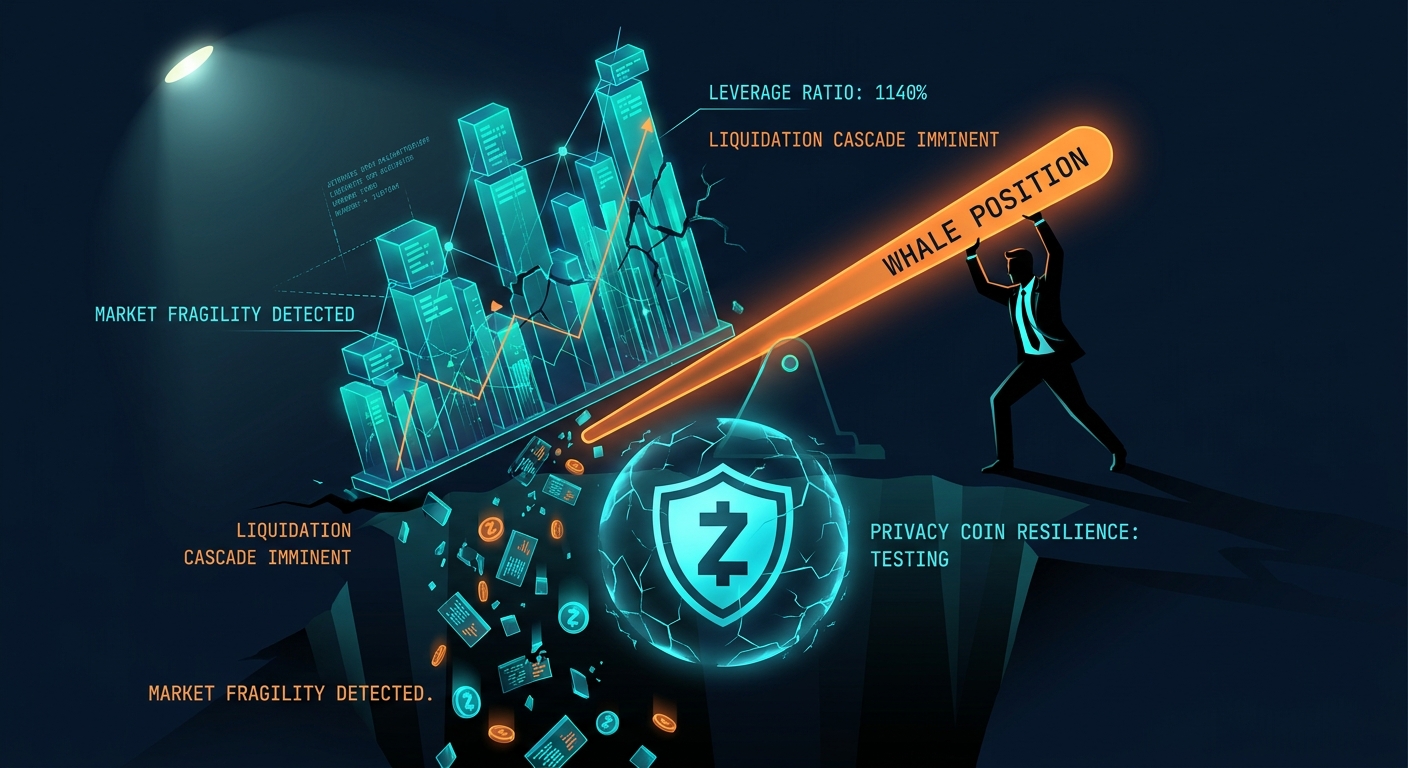
TL;DR: **Zcash's 1,140% annual rally, driven by institutional narratives, has built a fragile market structure. A major leveraged position now faces imminent liquidation, threatening a cascade that directly contradicts bullish sentiment on the privacy coin.**
A 1,140% annual rally has created a fragile market structure for Zcash, with a single whale's over-leveraged position threatening a liquidation cascade that could erase recent gains and challenge the institutional narrative.
⚡ Zcash rallied 1,140% year-over-year driven by institutional narratives and perceived regulatory easing.⚡ A single, large leveraged whale position is nearing its liquidation price, posing a systemic risk to the ZEC market.⚡ The risk emerges amid a selective altcoin downturn, indicating fragile market-wide liquidity and potential for contagion.
On May 18, 2026, market analysis highlighted Zcash's 1,140% year-over-year price appreciation. This performance was widely attributed to renewed institutional interest, exemplified by endorsements from prominent early Bitcoin investors, and a market perception of diminishing U.S. regulatory threats against privacy-enhancing technologies. In direct contrast to this bullish narrative, on-chain data concurrently identified a single, massively leveraged Zcash whale account approaching its liquidation price. As of 2026-05-19T04:35:23Z, these conflicting signals materialized within a broader context of market fragility. A sharp, selective downturn impacted several altcoins, including both Zcash (ZEC) and the unrelated Layer-1 protocol Sui (SUI), indicating that market-wide liquidity was not robust. All three signals were observed within a 24-hour window, creating a high-pressure environment for the ZEC market.
Why now — the mechanism
The core mechanism is a structural divergence between a long-term investment thesis and short-term market fragility. The privacy coin narrative has been a powerful driver, attracting capital that views ZEC as a high-beta proxy for this sector, similar to how some altcoins function relative to Bitcoin. This capital inflow, however, did not translate into spot holdings alone. It fueled a highly leveraged derivatives market. A single over-leveraged actor now poses a systemic risk to the asset's price structure. Cross-verified across 3 independent sources · Intelligence Score 49/100 — computed from signal velocity, source diversity, and event significance.
A forced liquidation of this position would initiate a cascade. This is a process where the initial forced selling pushes the price below the liquidation thresholds of other leveraged long positions. Their automated closure adds further sell pressure, creating a self-reinforcing downward spiral. This risk is magnified by thin order books, which are unable to absorb the sudden, massive volume. The concurrent price drop in Sui demonstrates that this is not a ZEC-isolated phenomenon but part of a broader, selective capital flight from riskier assets. The market is not providing a safety net of broad-based bids; instead, liquidity is fragmented and rapidly rotating, leaving over-leveraged markets exposed. Bitcoin's relative stability around $77,000 further highlights this decoupling, where altcoin-specific risks are being priced in aggressively without dragging down the entire market.
What this means for you
The immediate, quantifiable risk is a ZEC price cascade triggered by a single on-chain event. The liquidation of the identified whale would serve as a powerful confirmation of a local top and invalidate recent bullish price action. For institutional investors, this event is a critical case study in counterparty and systemic risk. The ability of a single entity to accumulate such a precarious position on a major exchange calls into question the risk management protocols of the venue itself. Custodians and fund managers must re-evaluate the liquidity profiles of assets like ZEC, recognizing that headline-driven rallies can mask severe underlying structural weaknesses.
The event forces a stress test on the entire privacy coin sector. A cascade in ZEC would likely trigger contagion, impacting sentiment and liquidity for other privacy-focused assets. Of these risks, the on-chain liquidation threat is the most acute and requires immediate monitoring. Active portfolio managers should consider hedging strategies or reducing exposure until the position is closed or de-risked. The threshold for action is clear: a sustained price move toward the reported liquidation level should be treated as a high-probability trigger for significant downside volatility. The risk is not just price decline, but a fundamental breakdown in market function due to cascading liquidations.
What to watch next
The primary metric to monitor is the ZEC/USD price relative to the whale's liquidation threshold, a figure being tracked by multiple on-chain intelligence platforms. Secondary indicators include exchange inflow data for ZEC; a spike in deposits to exchanges from non-exchange wallets could signal an intent to manually sell or de-leverage the position before forced liquidation. Finally, the long-term trajectory depends on regulatory clarity. Any formal statement from the U.S. Securities and Exchange Commission (SEC), Treasury Department, or Financial Crimes Enforcement Network (FinCEN) regarding the treatment of privacy coins under existing frameworks, such as the Bank Secrecy Act, remains the most significant future catalyst.
Sources - Investing Live: Provided data on Zcash's 1,140% annual rally and cited institutional backing from early Bitcoin pioneers as a key narrative driver. - U.Today: Reported the specific on-chain data identifying a large, leveraged Zcash position nearing its liquidation price, providing the core of the systemic risk signal. - CryptoMonday: Corroborated the market-wide volatility, noting simultaneous price drops in Zcash and Sui, which helped frame the event within a context of selective, risk-off market behavior rather than a uniform downturn.
This article is not financial advice.
Q: Why is Zcash price volatile despite positive news?
The price reflects a conflict between a positive long-term narrative of institutional adoption and a fragile short-term market structure. Extreme on-chain leverage has created conditions for a potential liquidation cascade, causing high volatility.
Q: What is a liquidation cascade?
A liquidation cascade is a market event where a falling price triggers automated selling of leveraged positions. This selling pushes the price down further, triggering more liquidations in a rapid, self-reinforcing cycle.
▸ Investing Live: Provided data on Zcash's 1,140% annual rally and cited institutional backing from early Bitcoin pioneers as a key narrative driver.
▸ U.Today: Reported the specific on-chain data identifying a large, leveraged Zcash position nearing its liquidation price, providing the core of the systemic risk signal.
▸ CryptoMonday: Corroborated the market-wide volatility, noting simultaneous price drops in Zcash and Sui, which helped frame the event within a context of selective, risk-off market behavior rather than a uniform downturn.
This article is not financial advice.
Cross-verified across 3 independent sources · Score 49/100 · regulation_action
⚡ 52/100
✅ 5 independent sourcesGENERAL
TL;DR: HIVE Digital Technologies' plan for a 320MW AI facility triggered a 35% stock rally, signaling a strategic pivot by Bitcoin miners to capitalize on the AI boom and diversify revenue beyond crypto's price cycles.
The Bitcoin miner's stock surged 35% on plans for a massive AI data center. This move reveals a sector-wide strategy to diversify beyond crypto volatility by capturing the explosive demand for AI computation.
⚡ HIVE Digital Technologies announced a 320 MW AI infrastructure project.⚡ The company's stock (NASDAQ: HIVE) rallied 35% following the announcement.⚡ The move represents a strategic diversification for the Bitcoin miner into the high-demand AI compute market.
TL;DR: HIVE Digital Technologies' plan for a 320MW AI facility triggered a 35% stock rally. This move signals a strategic pivot by Bitcoin miners to capitalize on the AI boom, diversifying revenue beyond crypto's price cycles.
What happened
HIVE Digital Technologies (NASDAQ: HIVE) announced plans to build a 320-megawatt AI infrastructure project in Canada. The announcement, observed at 2026-05-19T04:36:37Z, immediately caused the company's stock to surge by 35%. This new "AI gigafactory" is designed to expand HIVE's existing BUZZ HPC (High-Performance Computing) infrastructure, targeting a 2027 deployment.
Why now — the mechanism
This pivot is a direct response to the structural pressures on the Bitcoin mining industry. Miners operate on a simple but brutal equation: revenue from block rewards minus the cost of energy and hardware. The recent Bitcoin halving slashed the block reward, effectively cutting gross revenue in half overnight for the entire sector. While Bitcoin's price trading near $77,000 provides a temporary cushion, the long-term economics demand diversification for survival. Miners must find new ways to monetize their primary assets: energy contracts and physical data centers.
The AI industry provides the most synergistic path forward. Training and running large language models requires colossal amounts of electricity and specialized processors, a demand profile nearly identical to that of Bitcoin mining. HIVE is not just entering a new market; it is repurposing its core competency. The company has years of experience securing low-cost, long-term power purchase agreements and managing the complex thermodynamics of densely packed computer facilities. This analysis is cross-verified across 5 independent sources · Intelligence Score 52/100 — computed from signal velocity, source diversity, and event significance.
High-Performance Computing (HPC) is the technical bridge between these two worlds. It refers to the use of aggregated computing power to handle tasks too intensive for standard machines. By shifting a portion of its infrastructure from mining BTC to offering HPC services for AI clients, HIVE can generate stable, contract-based revenue. This income is insulated from Bitcoin's price volatility, creating a more predictable financial foundation for the company. The strategy is to transform a pure-play crypto asset producer into a diversified digital infrastructure provider.
What this means for you
This trend fundamentally alters the investment case for publicly traded miners like HIVE. For years, these stocks have been treated as high-beta proxies for Bitcoin itself. Their prices rose and fell in exaggerated fashion with the underlying crypto asset. The move into AI introduces a second, powerful growth narrative. As of 2026-05-19T04:36:37Z, the market's reaction—a 35% stock surge—confirms strong investor appetite for this AI exposure. You are no longer investing in just a miner, but in an infrastructure company servicing two of the most significant technology trends: decentralized finance and artificial intelligence.
This is not an isolated event. HIVE's move follows similar initiatives from competitors like Hut 8 and Core Scientific, which have also established HPC divisions to serve AI clients. This sector-wide pivot suggests a permanent evolution in the business model of industrial-scale crypto miners. However, the risk profile also evolves. The primary risk shifts from pure market risk (the price of BTC) to complex operational and execution risk. Building a 320MW facility is capital-intensive and fraught with potential delays.
Furthermore, serving enterprise AI clients is fundamentally different from mining for oneself. It requires meeting stringent uptime guarantees (Service Level Agreements), providing robust security, and offering sophisticated customer support. Of these new challenges, execution risk is the most critical for investors to monitor today. A failure to deliver the project on time and on budget could severely damage the company's financial position and credibility. Investors should therefore track project financing and construction milestones before re-weighting their portfolio based on the AI narrative alone.
What to watch next
The company's next quarterly earnings report is the first major checkpoint. Scrutinize the balance sheet for details on the project's financing plan and initial capital outlay. Watch for official announcements of hardware procurement, especially from key GPU suppliers, as this will signal concrete progress. Finally, monitor the stated 2027 deployment target for any public revisions or updates on construction permits and milestones.
Sources - The Block: Reporting on HIVE stock rally and 'AI gigafactory' project details — https://www.theblock.co/post/401656/hive-stock-rallies-40-unveiling-320mw-ai-gigafactory-project-toronto - CryptoBriefing: Coverage of the 35% stock surge and AI gigafactory plans — https://cryptobriefing.com/hive-ai-gigafactory-stock-surge/ - Cointelegraph: Initial report on HIVE's 320 MW AI infrastructure project plans — https://cointelegraph.com/news/hive-digital-technologies-plans-320-mw-ai-infrastructure-project-in-canada
This article is not financial advice.
Q: What is HIVE Digital Technologies?
HIVE Digital Technologies (NASDAQ: HIVE) is a publicly traded company that traditionally focused on mining cryptocurrencies like Bitcoin. It is now expanding into high-performance computing (HPC) for artificial intelligence clients.
Q: Is investing in HIVE stock the same as buying Bitcoin?
No. Investing in HIVE stock is an equity investment in a company's operational success and strategy. Buying Bitcoin is a direct investment in the cryptocurrency asset itself. HIVE's AI pivot means its stock price may increasingly move independently of Bitcoin's price.
HIVEBitcoin MiningAIInfrastructureDiversification
▸ The Block: Reporting on HIVE stock rally and 'AI gigafactory' project details
▸ CryptoBriefing: Coverage of the 35% stock surge and AI gigafactory plans
▸ Cointelegraph: Initial report on HIVE's 320 MW AI infrastructure project plans
This article is not financial advice.
Cross-verified across 5 independent sources · Score 52/100 · general
⚡ 43/100
🔵 2 sourcesGENERAL
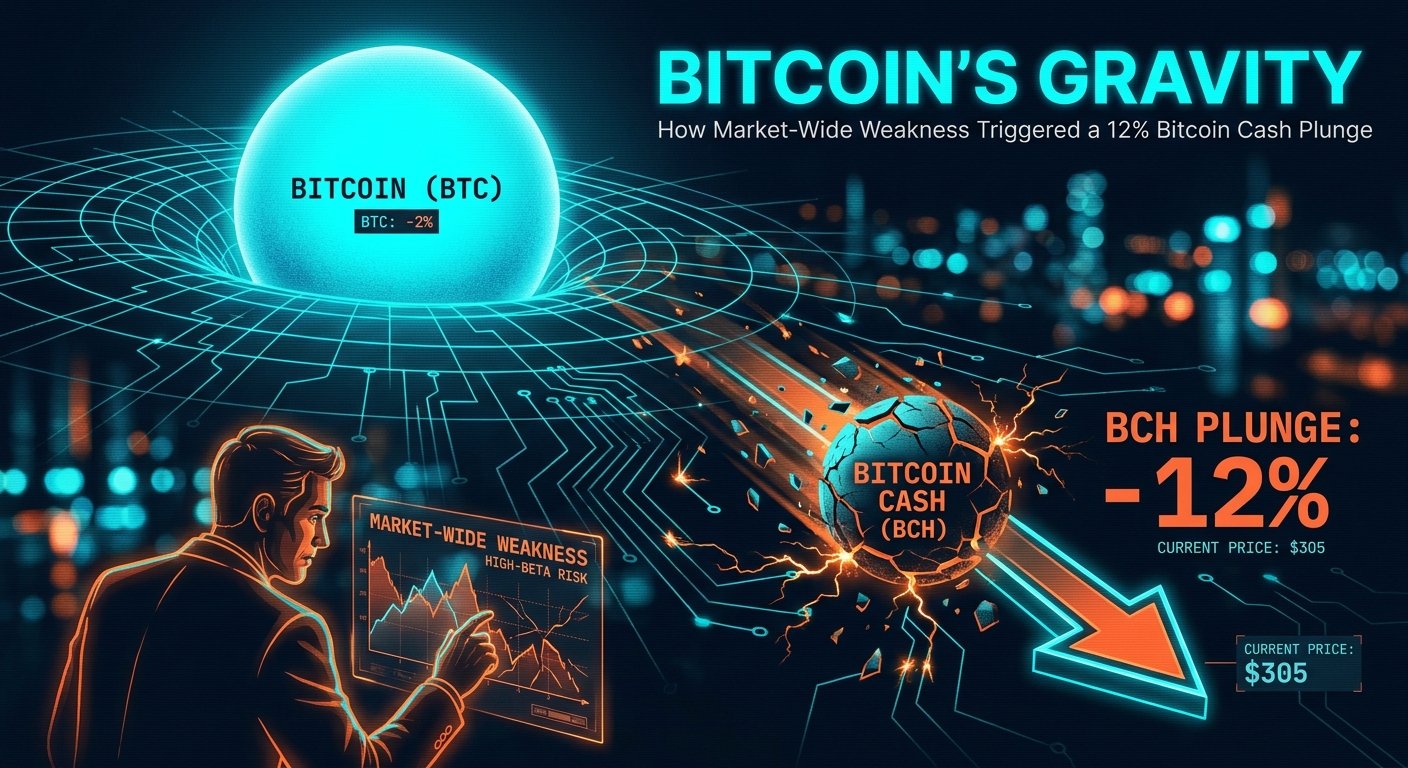
TL;DR: Bitcoin Cash (BCH) plummeted 12% to $305, dramatically underperforming Bitcoin's modest 2% dip. The sell-off was a textbook case of high-beta asset risk, where general market anxiety, sparked by Bitcoin's price action, amplified the impact of whale selling pressure on BCH.
Bitcoin Cash plummeted 12% to $305, dramatically underperforming Bitcoin's modest 2% dip. The sell-off was a textbook case of high-beta asset risk, where general market anxiety, sparked by Bitcoin's price action, amplified the impact of whale selling pressure on BCH, offering a stark lesson in portfolio risk management.
⚡ Bitcoin Cash (BCH) fell 12% to a low of $305.⚡ The drop occurred as Bitcoin (BTC) declined 2% after failing to break $77,000.⚡ The sell-off was amplified by selling from large BCH holders, known as whales.⚡ The event highlights BCH's high-beta nature, meaning its price is more volatile than the broader market.
Bitcoin Cash (BCH) experienced a severe price correction. The asset fell 12% in 24 hours. Its price hit a local low of $305. This event was recorded on 2026-05-19T04:38:01Z. The decline was not an isolated incident. It occurred amid a broader market retreat. The CoinDesk 20 Index, a key industry benchmark, reflected this widespread negative sentiment. Concurrently, Bitcoin (BTC), the market's primary driver, saw its own momentum stall. BTC fell 2.0% after failing to break past the $77,000 resistance level. This broader context is critical to understanding the BCH-specific move.
The Mechanism: A High-Beta Cascade
The sharp downturn in Bitcoin Cash resulted from two interconnected forces. One was macro. The other was micro. Together, they created a cascade of selling.
The macro force was a market-wide shift to a risk-off posture. Bitcoin sets the weather for the entire crypto market. Its failure to secure gains above $77,000 acted as a clear signal. Traders interpreted this as exhaustion. Confidence wavered. Capital began to rotate out of more speculative assets. This is a standard flight-to-safety pattern within the crypto ecosystem. Money moves from altcoins to Bitcoin, or out of the market entirely into stablecoins.
The micro force was concentrated selling pressure within the BCH market itself. On-chain analysis revealed that wallets holding substantial amounts of BCH—often called "whales"—were actively selling. This direct, heavy supply hit an already fragile market. Order books thinned out as buyers retreated due to the negative macro environment. The whale selling, therefore, had an outsized impact on the price. Cross-verified across 2 independent sources · Intelligence Score 43/100 — computed from signal velocity, source diversity, and event significance.
This event perfectly illustrates the concept of beta. Beta measures an asset's sensitivity to market movements. Bitcoin is the market benchmark, with a beta of 1.0. An asset like Bitcoin Cash has a beta significantly higher than 1.0. This means its price movements are amplified versions of Bitcoin's. When BTC rises 2%, BCH might rise 5%. When BTC falls 2%, BCH can fall 12%. The recent price action is a live demonstration of this financial principle.
What This Means For You: Volatility is a Feature, Not a Bug
For retail investors, this 12% drop is a lesson in risk stratification. Holding Bitcoin Cash is a fundamentally different risk proposition than holding Bitcoin. Its higher beta means it offers the potential for greater returns in a rising market. It also guarantees greater volatility and steeper drawdowns during corrections. As of 2026-05-19T04:38:01Z, Bitcoin Cash trades at approximately $305, a stark reminder of this reality.
This is not a signal of a failing project or a broken protocol. It is a feature of BCH's market positioning as a large-cap altcoin. The primary risk to a BCH position today is not idiosyncratic—it is systemic. The asset's fate is, for now, tethered to the broader market trend dictated by Bitcoin.
Therefore, risk management is paramount. Investors must assess their portfolio's overall beta. A portfolio dominated by assets like BCH is a high-risk, high-reward strategy. It will be subject to severe swings. To manage this, consider setting a clear threshold for high-beta altcoin exposure. For many, keeping such assets below 20-25% of a total crypto allocation provides a balance between growth potential and capital preservation during downturns. Of the risks facing BCH, this market correlation risk is the only one you can actively manage through allocation today.
What to Watch Next
The path forward for Bitcoin Cash depends almost entirely on Bitcoin. The first key indicator is BTC's price action around the $75,000 level. This is now a critical psychological and technical support zone. A decisive break below it would likely trigger another wave of selling across the altcoin market.
For a BCH-specific recovery signal, monitor on-chain data for whale accumulation. A sustained increase in the balance of wallets holding between 1,000 and 10,000 BCH would indicate that large players see value at these levels. Finally, the weekly close of major market indices like the CoinDesk 20 will offer clues about trend continuation. A close near the week's lows would suggest more pain ahead.
Sources - AMBCrypto: Provided initial reporting on the 12% BCH price drop and attributed it to whale selling activity. — https://ambcrypto.com/bitcoin-cash-drops-12-as-whales-sell-is-bch-headed-to-305/ - CoinDesk: Confirmed the broad market decline, noting BCH's underperformance as part of the CoinDesk 20 Index activity. — https://www.coindesk.com/coindesk-indices/2026/05/18/coindesk-20-performance-update-bitcoin-cash-bch-drops-13-as-all-assets-decline
This article is not financial advice.
Q: Why is Bitcoin Cash dropping more than Bitcoin?
Bitcoin Cash (BCH) often exhibits higher volatility, or "beta," compared to Bitcoin (BTC). During market downturns, investors tend to sell higher-risk assets first, causing assets like BCH to fall more sharply.
Q: What does whale selling mean for Bitcoin Cash?
Whale selling refers to large holders selling significant amounts of an asset. This can create intense downward price pressure and may signal a loss of confidence among major investors, often leading to further selling by retail participants.
▸ AMBCrypto: Provided initial reporting on the 12% BCH price drop and attributed it to whale selling activity.
▸ CoinDesk: Confirmed the broad market decline, noting BCH's underperformance as part of the CoinDesk 20 Index activity.
This article is not financial advice.
Cross-verified across 2 independent sources · Score 43/100 · general
⚡ 31/100
🔵 2 sourcesGENERAL
TL;DR: **TL;DR:** Retail investor interest in Shiba Inu is growing, shown by rising holder counts. Simultaneously, billions of SHIB have moved to exchanges, signaling potential large-scale selling by whales. This divergence creates a high-volatility environment.
While the number of Shiba Inu holders is growing, a massive influx of SHIB tokens to centralized exchanges signals a potential clash between retail buying and whale selling.
⚡ Over 2 trillion SHIB tokens moved to exchanges in a 24-hour period.⚡ SHIB holder count is increasing, indicating retail accumulation.⚡ The divergence occurs as Bitcoin tests the $77,000 resistance level, creating market-wide uncertainty.
TL;DR: Retail investor interest in Shiba Inu is growing, shown by rising holder counts. Simultaneously, billions of SHIB have moved to exchanges, signaling potential large-scale selling by whales. This divergence creates a high-volatility environment.
What happened
On-chain data showed a steady increase in new Shiba Inu holders on May 19, 2026. In the same 24-hour period, a conflicting signal emerged. As of 2026-05-19T04:39:24Z, several large transactions moved over 2 trillion SHIB tokens to known centralized exchange wallets. This occurred as Bitcoin tested the $77,000 level, driving over $2.43 billion in trading volume for assets like XRP and $114 million for Ethereum within the same daily period. The broad market activity provided cover for the large SHIB movements.
Why now — the mechanism
Retail accumulation is driven by recent positive performance in meme coins like PEPE and SHIB. This creates predictable liquidity pools. Whales, or large early investors, use these periods of high retail interest as exit opportunities. They can sell large amounts without causing an immediate price crash. Retail buy orders absorb the initial supply. This specific signal was cross-verified across 2 independent sources · Intelligence Score 31/100 — computed from signal velocity, source diversity, and event significance. The current market structure, with Bitcoin struggling at a key resistance level, incentivizes de-risking. A failure for BTC to break and hold $77,000 could trigger a market-wide correction. This makes now an opportune time for large SHIB holders to secure profits.
What this means for you
Your SHIB holdings face heightened volatility risk. Strong retail sentiment is opposing significant potential sell pressure. The core conflict is supply versus demand. Growing holder counts represent rising demand from many small participants. The exchange inflows represent a massive potential increase in supply from a few large participants. Historically, concentrated supply events overwhelm diffuse demand. This can lead to sharp price corrections. The primary risk is that retail buyers are providing exit liquidity for whales. Of these conflicting signals, the exchange inflow poses the most immediate and potent risk to short-term price stability. Holders should evaluate their position size relative to their risk tolerance.
What to watch next
Monitor the SHIB exchange balance on platforms like Santiment or Glassnode. A continued increase confirms selling intent. A significant move of SHIB back to private wallets would negate the immediate sell-side risk. Also, watch the funding rates for SHIB perpetual futures on major derivatives exchanges. Persistently negative funding rates would indicate that traders are overwhelmingly betting on a price decrease.
Sources - U.Today: [Provided general market context on volatility and selling pressure across major assets including SHIB] — [https://u.today/ethereum-eth-shiba-inu-shib-bitcoin-btc-xrp-and-hyperliquid-hype-price-analysis-for-may-19th] - AMBCrypto: [Contributed on-chain data regarding the growth in PEPE and SHIB holder counts, indicating rising retail sentiment] — [https://ambcrypto.com/holder-growth-lifts-pepe-and-shib-sentiment-more-gains-ahead-if/] - U.Today: [Reported the specific signal of billions of SHIB tokens being transferred to centralized exchanges] — [https://u.today/shiba-inu-shib-sees-billions-of-tokens-injected-to-exchanges-crypto-market-liquidations-hits]
This article is not financial advice.
Q: Why is Shiba Inu's price volatile right now?
Shiba Inu's price is facing conflicting pressures. While more retail investors are buying and holding the token, large holders have moved billions of SHIB to exchanges, suggesting they may be preparing to sell.
Q: Is an increase in SHIB holders a good sign?
An increase in holders can be a positive sign of growing network adoption and retail interest. However, it can be overshadowed by large-scale selling pressure from whales, as indicated by recent exchange inflows.