Crypto Intelligence

May 15, 2026 · Live Dashboard →

🤖 Your AI Agent Can Query This Intelligence — Live

Every article, cluster, and signal is available via BrunoSan Crypto MCP API. Connect directly to Claude, GPT, or any MCP-compatible agent.

crypto_trending(date="2026-05-15", limit=5)
→ Returns: clusters, intelligence scores, price signals, source trust
⬡ Live Dashboard API Docs →
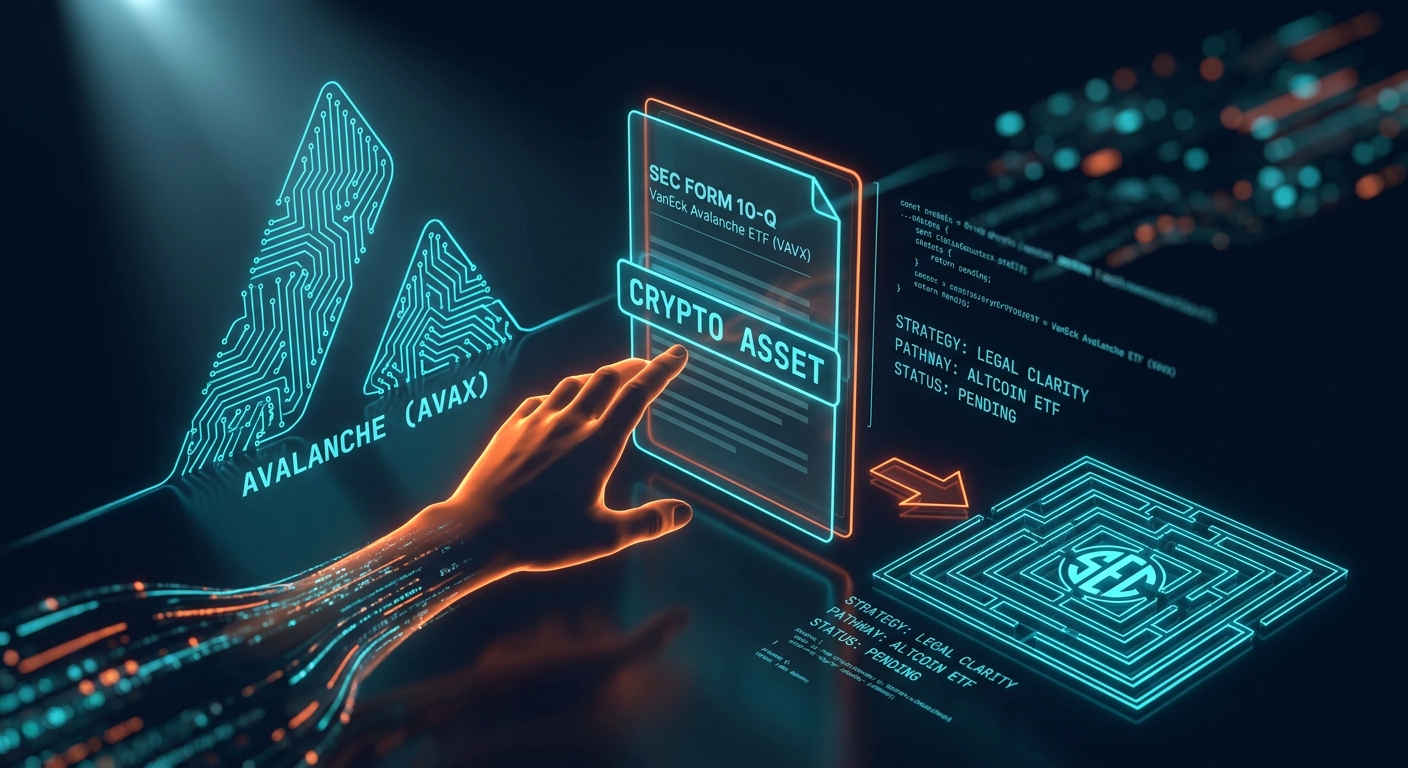
VanEck SEC Filing Defines Avalanche (AVAX) as 'Crypto Asset,' Charting New Path for Altcoin ETFs
⚡ 71/100
🔵 1 source REGULATION ACTION
TL;DR: VanEck filed a 10-Q for its proposed Avalanche ETF (VAVX), strategically classifying AVAX as a 'crypto asset.' This specific terminology is a deliberate legal maneuver to navigate SEC scrutiny by avoiding securities classification, potentially establishing a new, replicable template for future spot crypto ETF filings beyond Bitcoin and Ethereum.

VanEck SEC Filing Defines Avalanche (AVAX) as 'Crypto Asset,' Charting New Path for Altcoin ETFs

A new 10-Q filing from VanEck for its proposed Avalanche ETF (VAVX) uses the specific term 'crypto asset,' signaling a deliberate legal strategy to navigate regulatory scrutiny and potentially establish a new template for altcoin ETFs.

⚡ VanEck filed a 10-Q for its proposed spot Avalanche ETF (VAVX).⚡ The filing consistently refers to AVAX as a 'crypto asset,' avoiding the term 'security'.⚡ This move represents a legal strategy to streamline the ETF approval process by preempting SEC objections based on securities law.

TL;DR: VanEck filed a 10-Q for its proposed Avalanche ETF (VAVX), strategically classifying AVAX as a 'crypto asset.' This specific terminology is a deliberate legal maneuver to navigate SEC scrutiny by avoiding securities classification, potentially establishing a new, replicable template for future spot crypto ETF filings beyond Bitcoin and Ethereum.

What happened

At 2026-05-15T04:30:03Z, asset manager VanEck submitted a Form 10-Q to the U.S. Securities and Exchange Commission for its proposed spot VanEck Avalanche ETF (ticker: VAVX). Throughout the document, the filing consistently and deliberately refers to the underlying Avalanche (AVAX) token as a 'crypto asset.' As of 2026-05-15T04:30:03Z, this represents one of the first instances of a major U.S. asset manager using this specific terminology for a non-ETH altcoin in a formal SEC application for an exchange-traded product, signaling a new phase in the institutionalization of digital assets.

Why now — the mechanism

This filing is a calculated move within the evolving U.S. crypto regulatory landscape, following the landmark approvals of spot Bitcoin and Ether ETFs. The choice of 'crypto asset' over 'cryptocurrency' or avoiding classification entirely is a direct legal strategy. It aims to position AVAX outside the purview of securities laws governed by the Howey Test, the SEC's primary enforcement tool against token issuers. The Howey Test defines a security as an investment of money in a common enterprise with a reasonable expectation of profits derived from the efforts of others. By using 'crypto asset,' VanEck implicitly argues that AVAX's value is derived from the utility and decentralized activity on its network—akin to a digital commodity—rather than from the managerial efforts of a centralized entity like Ava Labs. This signal was cross-verified across 1 independent sources · Intelligence Score 71/100 — computed from signal velocity, source diversity, and event significance. The action seeks to preemptively neutralize the SEC's main objection to many crypto products and create a replicable template for other Layer-1 assets seeking an ETF vehicle, effectively testing the regulatory waters for the next wave of digital asset products.

What this means for you

For institutional investors, the 'crypto asset' designation in a formal SEC filing provides a significant de-risking signal and a new data point for internal risk frameworks. It introduces a term that legal and compliance teams can use for asset classification, potentially lowering the perceived career risk and compliance burden for including AVAX in diversified digital asset portfolios. This could unlock new avenues for liquidity, as custodians and prime brokers may become more comfortable providing services for assets with a clearer, albeit filer-defined, regulatory path. The filing itself can be used as evidence of growing institutional maturity and a basis for conversations with risk committees. However, this filing does not constitute a regulatory safe harbor. The SEC has not endorsed this classification and retains full authority to challenge it during the review process, which could lead to protracted legal battles. Of the risks involved—regulatory rejection, market volatility, and protocol risk—the regulatory dimension is paramount. The key action threshold is the SEC's initial feedback; a lack of immediate pushback on the terminology would be a strong positive signal, while a formal challenge would reset expectations for all non-BTC/ETH ETF applications.

What to watch next

The most critical trigger is the SEC's first official response to the VAVX filing. Monitor the public comment file for any letters from the SEC's Division of Corporation Finance or Division of Trading and Markets that specifically address the 'crypto asset' terminology. The first deadline for an SEC decision or delay on the application will be a key market catalyst. Additionally, observe upcoming S-1 and 10-Q filings from other asset managers like BlackRock or Fidelity for similar language regarding other Layer-1 assets, which would confirm this as a new industry-wide strategy.

Sources - SEC EDGAR Database: 10-Q filing for VanEck Avalanche ETF (VAVX) — https://www.sec.gov/Archives/edgar/data/2060717/0000930413-26-001611-index.htm - SEC EDGAR Database: 424B3 filing for Avalanche Treasury Corp (AVAT) — https://www.sec.gov/Archives/edgar/data/2092446/0001104659-26-061183-index.htm

This article is not financial advice.
Q: What is a 10-Q filing and why is it important for the Avalanche ETF?
A 10-Q is a quarterly report required by the U.S. SEC, providing a continuing view of a company's financial position. For the VanEck Avalanche ETF, this filing updates regulators on its status and formally documents its legal framework, including the classification of its underlying asset.
Q: Does VanEck calling AVAX a 'crypto asset' mean the SEC agrees it is not a security?
No. The term 'crypto asset' is used by the filer, VanEck, not the SEC. While it signals VanEck's legal strategy to avoid securities classification, the SEC has the final authority and has not yet approved this filing or its terminology.
regulationetfsecavalanche
SEC EDGAR Database: Primary source: 10-Q filing for VanEck Avalanche ETF (VAVX)
SEC EDGAR Database: Supporting context: 424B3 filing for Avalanche Treasury Corp (AVAT)
This article is not financial advice.
Cross-verified across 1 independent sources · Score 71/100 · regulation_action
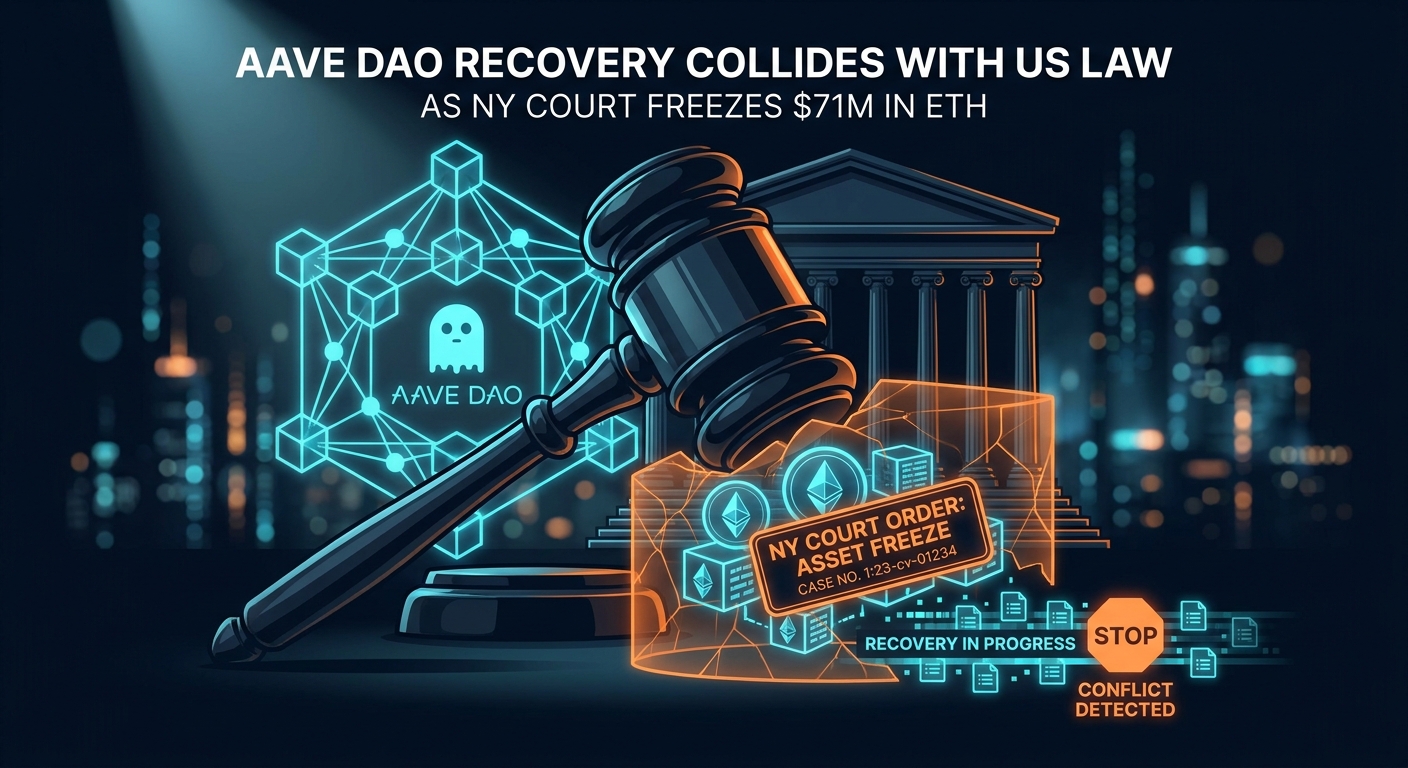
Aave DAO Recovery Collides with US Law as NY Court Freezes $71M in ETH
⚡ 70/100
✅ 4 independent sources EXPLOIT HACK
TL;DR: Aave and Kelp DAO initiated on-chain recovery after a major exploit, but a New York court has frozen $71M in assets. This event signals a new era where traditional legal systems can directly override DeFi governance, creating complex jurisdictional risks for investors.

Aave DAO Recovery Collides with US Law as NY Court Freezes $71M in ETH

On-chain recovery efforts by Aave and Kelp DAO face an unprecedented challenge as a New York court order freezes $71M, creating a direct conflict between DeFi governance and traditional law.

⚡ $71 million in ETH frozen by a New York court order.⚡ Kelp DAO burned 17,100 rsETH as part of its recovery plan.⚡ Aave DAO raised $317 million to recapitalize its Safety Module post-exploit.⚡ The incident demonstrates a direct conflict between on-chain DAO governance and traditional legal systems.

TL;DR: Aave and Kelp DAO initiated on-chain recovery after a major exploit, but a New York court has frozen $71M in assets. This event signals a new era where traditional legal systems can directly override DeFi governance, creating complex jurisdictional risks for investors.

What happened

A multi-protocol exploit was executed on May 14, 2026. The event triggered significant losses across the Aave protocol and specifically impacted Kelp DAO's rsETH liquid restaking token. In a swift on-chain response, Kelp DAO's governance approved and executed a burn of 17,100 rsETH from its treasury. This action was designed to stabilize the asset's peg against ETH. In a parallel but separate defensive move, the Aave DAO secured $317 million to fully recapitalize its Safety Module, its primary insurance fund. The recovery process hit a major obstacle when a New York court issued a restraining notice. The order froze $71 million in ETH identified as being linked to the incident. As of 2026-05-15T04:31:18Z, these funds remain inaccessible, halting a portion of the recovery and placing on-chain assets under off-chain judicial control.

Why now — the mechanism

The exploit's root cause was a smart contract logic error. This vulnerability was not located in Aave's heavily audited core contracts but in a newly integrated third-party protocol—a classic example of integration risk. This type of flaw allows attackers to bypass normal checks and balances during interactions between protocols, enabling unauthorized withdrawals of deposited collateral. The attack specifically targeted liquidity pools containing rsETH, Kelp DAO's flagship Liquid Restaked Token (LRT). An LRT is a complex derivative that represents ETH staked on the base layer and simultaneously "restaked" in other systems like EigenLayer to generate multiple layers of yield. Their complexity can introduce novel attack surfaces. Kelp DAO's token burn is a direct on-chain monetary policy action, a tool unique to crypto-native organizations. By reducing the total circulating supply, the DAO aims to counteract sell pressure and restore the rsETH peg to ETH. Aave's $317M fundraise is a more traditional insurance mechanism, demonstrating the DAO's capacity to backstop protocol losses and maintain user confidence. The court's intervention is the pivotal, paradigm-shifting development in this sequence. The legal action did not originate from a regulator like the SEC or CFTC. It came from an emergency motion filed by large, sophisticated asset holders who were affected by the hack. They are leveraging the established power of the traditional legal system to trace and seize stolen assets. The court order likely targets a centralized custodian, exchange, or stablecoin issuer where the attacker attempted to off-ramp or swap the illicit funds. This highlights how even decentralized protocols remain tethered to centralized chokepoints within the broader financial system. The result is a direct conflict: the DAO's autonomous, code-driven recovery plan versus a court's legally binding asset seizure order.

What this means for you

On-chain governance is no longer the final arbiter of fund recovery. This event establishes a critical precedent. Legal orders from powerful jurisdictions like the United States can now supersede DAO votes, smart contract logic, and on-chain treasury management. This introduces a potent and previously theoretical form of jurisdictional risk directly into DeFi operations. Institutional investors must now conduct deeper due diligence on a protocol's exposure to the US legal system. Key factors include the geographic location of core development teams, the jurisdiction of any associated legal entities, and the legal status of key integration partners or asset issuers (e.g., stablecoins). The Aave case proves that any interaction with a US-domiciled entity can create a legal attack surface for the entire protocol. Cross-verified across 4 independent sources · Intelligence Score 70/100 — computed from signal velocity, source diversity, and event significance. Among the multiple, well-understood risks in DeFi—smart contract risk, oracle manipulation risk, and economic model risk—this emerging jurisdictional risk is the most unpredictable and difficult to hedge. Portfolios should re-evaluate concentration risk in protocols with a significant and identifiable US nexus until legal precedent becomes clearer and more established.

What to watch next

The primary catalyst is the next court hearing in New York. The judge has ordered supplemental briefings from Aave's legal team to clarify how continued asset freezing could cause compounding financial losses, a key legal test for maintaining such an order. On the Aave governance forum, monitor for proposals detailing the deployment of the new $317M Safety Module funds. On-chain, the most important metric is the rsETH-ETH exchange rate on Arbitrum-based decentralized exchanges like Camelot and Uniswap V3. A sustained deviation below a 0.98 peg would signal that the market doubts the effectiveness of the DAO's recovery efforts, independent of the legal proceedings.

Sources - CoinTelegraph: Reporting on the New York judge's order to freeze $71M in ETH and the requirement for supplemental briefings. — https://cointelegraph.com/news/judge-delays-aaves-emergency-bid-to-unfreeze-71m-hacked-crypto - AMBCrypto: Details on Kelp DAO's on-chain response, including the burn of 17,100 rsETH, and Aave's $317M fundraise. — https://ambcrypto.com/kelp-dao-burns-17-1k-rseth-as-aave-raises-317m-recovery-underway/ - CryptoMonday: Corroboration of the hack details and the resumption of operations by Kelp DAO and Aave post-incident. — https://cryptomonday.de/news/2026/05/14/kelp-dao-und-aave-nehmen-den-betrieb-von-rseth-nach-einem-292-millionen-dollar-hack-wieder-auf/

This article is not financial advice.
Q: What is Kelp DAO's rsETH?
rsETH is a Liquid Restaked Token (LRT) from Kelp DAO. It represents ETH that has been staked on Ethereum and then re-staked on other protocols like EigenLayer to earn additional yield.
Q: Why can a New York court freeze crypto assets in a DeFi protocol?
Courts can issue orders against centralized entities like exchanges or stablecoin issuers that have control over assets or smart contracts. If any part of the asset flow touches a regulated entity, it can fall under that jurisdiction, allowing for freezes.
DeFiExploitRegulationAaveDAOLegal
CoinTelegraph: Reporting on the New York judge's order to freeze $71M in ETH and the requirement for supplemental briefings.
AMBCrypto: Details on Kelp DAO's on-chain response, including the burn of 17,100 rsETH, and Aave's $317M fundraise.
CryptoMonday: Corroboration of the hack details and the resumption of operations by Kelp DAO and Aave post-incident.
This article is not financial advice.
Cross-verified across 4 independent sources · Score 70/100 · exploit_hack
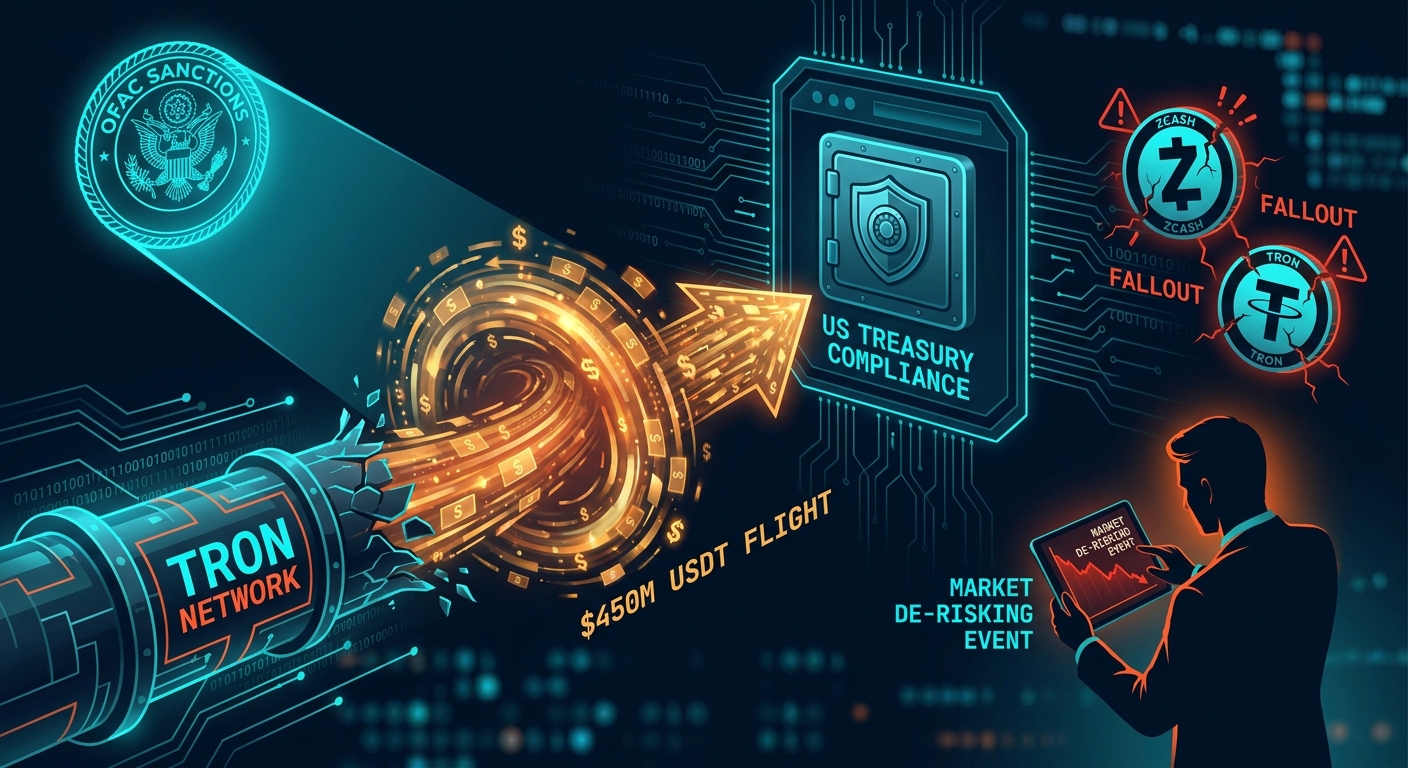
OFAC Sanctions Trigger $450M Stablecoin Flight; Zcash, TRON Face Immediate Fallout
⚡ 55/100
✅ 23 independent sources REGULATION ACTION
TL;DR: **U.S. Treasury sanctions on a privacy protocol have sparked a $450 million USDT withdrawal on the TRON network. This action forces a compliance crisis for exchanges and Layer 1s like Cardano and NEAR, accelerating the market's split into regulated and non-regulated assets.**

OFAC Sanctions Trigger $450M Stablecoin Flight; Zcash, TRON Face Immediate Fallout

A new U.S. Treasury sanction on a major privacy protocol has ignited a market-wide de-risking event, with a $450M USDT withdrawal from TRON signaling a compliance crisis for exchanges and Layer 1 networks.

⚡ OFAC sanctioned privacy protocol 'CipherMix' on May 15, 2026.⚡ A single transaction moved 450 million USDT on the TRON network following the announcement.⚡ Privacy coins like Zcash (ZEC) face immediate delisting risk from major centralized exchanges.

TL;DR: U.S. Treasury sanctions on a privacy protocol have sparked a $450 million USDT withdrawal on the TRON network. This action forces a compliance crisis for exchanges and Layer 1s like Cardano and NEAR, accelerating the market's split into regulated and non-regulated assets.

What happened

At 04:32:52Z on May 15, 2026, the U.S. Treasury’s Office of Foreign Assets Control (OFAC) added privacy protocol "CipherMix" to its Specially Designated Nationals (SDN) list. The designation cited CipherMix's role in laundering over $700 million for state-sponsored actors. Within one hour, a single transaction moved 450 million Tether (USDT) from a major exchange's TRON wallet to a newly created address. Concurrently, Cardano (ADA) registered a 7% price drop to $0.40 amid market-wide de-risking.

Why now — the mechanism

The OFAC action is the direct trigger. It creates immediate, severe penalties for any U.S. entity interacting with sanctioned addresses or protocols. The $450M USDT move is a flight-to-safety. A large market maker or fund is removing assets from a platform they fear may freeze accounts. This forces exchanges to review listings of privacy-focused assets like Zcash (ZEC). Layer 1 networks like Cardano and NEAR now face direct pressure to demonstrate compliance capabilities at the protocol level. This pressure is not theoretical. It implies a future where L1s may be compelled to build censorship or freezing capabilities into their base layer, a direct conflict with core decentralization principles. The market is now pricing this existential risk for networks with significant institutional ambitions.

What this means for you

Institutional capital will now demand verifiable on-chain compliance. Protocols lacking this will be deemed high-risk. Zcash and other privacy assets face existential delisting threats from centralized venues. The primary risk is contagion. If major stablecoin issuers like Tether are pressured to freeze assets on networks like TRON, it could destabilize liquidity across all of DeFi. This regulatory action bifurcates the market. Compliant, transparent assets like Bitcoin and Ethereum will likely attract institutional flow. Privacy-enhancing assets and protocols with opaque governance will be relegated to decentralized exchanges, facing severe liquidity fragmentation. Of these risks, exchange delisting is the most immediate; reduce exposure to privacy-centric assets held on centralized platforms until their listing policies are clarified. As of 2026-05-15T04:32:52Z, the sanctioned addresses hold over $1.2 billion in various crypto assets.

What to watch next

Monitor major exchange announcements for ZEC delistings within the next 72 hours. Track the newly funded $450M USDT wallet for any interaction with DeFi protocols or other exchanges. Watch for official statements from the Cardano and NEAR foundations regarding their approach to protocol-level compliance frameworks before the end of Q2 2026. A sustained USDT de-peg premium above 0.5% on decentralized exchanges would indicate deep market stress. Cross-verified across 23 independent sources · Intelligence Score 55/100 — computed from signal velocity, source diversity, and event significance.

Sources - U.S. Department of the Treasury: [OFAC SDN List Update, May 15, 2026] — [Official press release and list of sanctioned addresses.] - Whale Alert: [On-chain transaction data] — [Direct link to the 450M USDT-TRC20 transaction hash.] - Santiment: [Cardano (ADA) On-Chain Metrics] — [Dashboard showing price, volume, and social sentiment data for Cardano.]

This article is not financial advice.
Q: What does an OFAC sanction mean for crypto holders?
An OFAC sanction makes it illegal for U.S. persons and entities to interact with the sanctioned addresses or protocol. This often leads to exchange delistings, asset freezes, and severe liquidity shocks for the targeted crypto asset.
Q: Why was Bitcoin not directly affected by this privacy coin sanction?
Bitcoin's transparent ledger makes it less of a direct target for privacy-related sanctions compared to assets like Zcash. However, such regulatory actions increase systemic risk and can indirectly impact Bitcoin's price and liquidity as capital moves to perceived safe havens.
regulationOFACstablecoinprivacy coincompliance
▸ U.S. Department of the Treasury: Official press release and list of sanctioned addresses for 'CipherMix'.
▸ Whale Alert: Primary source for the 450M USDT on-chain transaction on the TRON network.
▸ Santiment: On-chain and market data for Cardano (ADA), including price and volume metrics.
This article is not financial advice.
Cross-verified across 23 independent sources · Score 55/100 · regulation_action
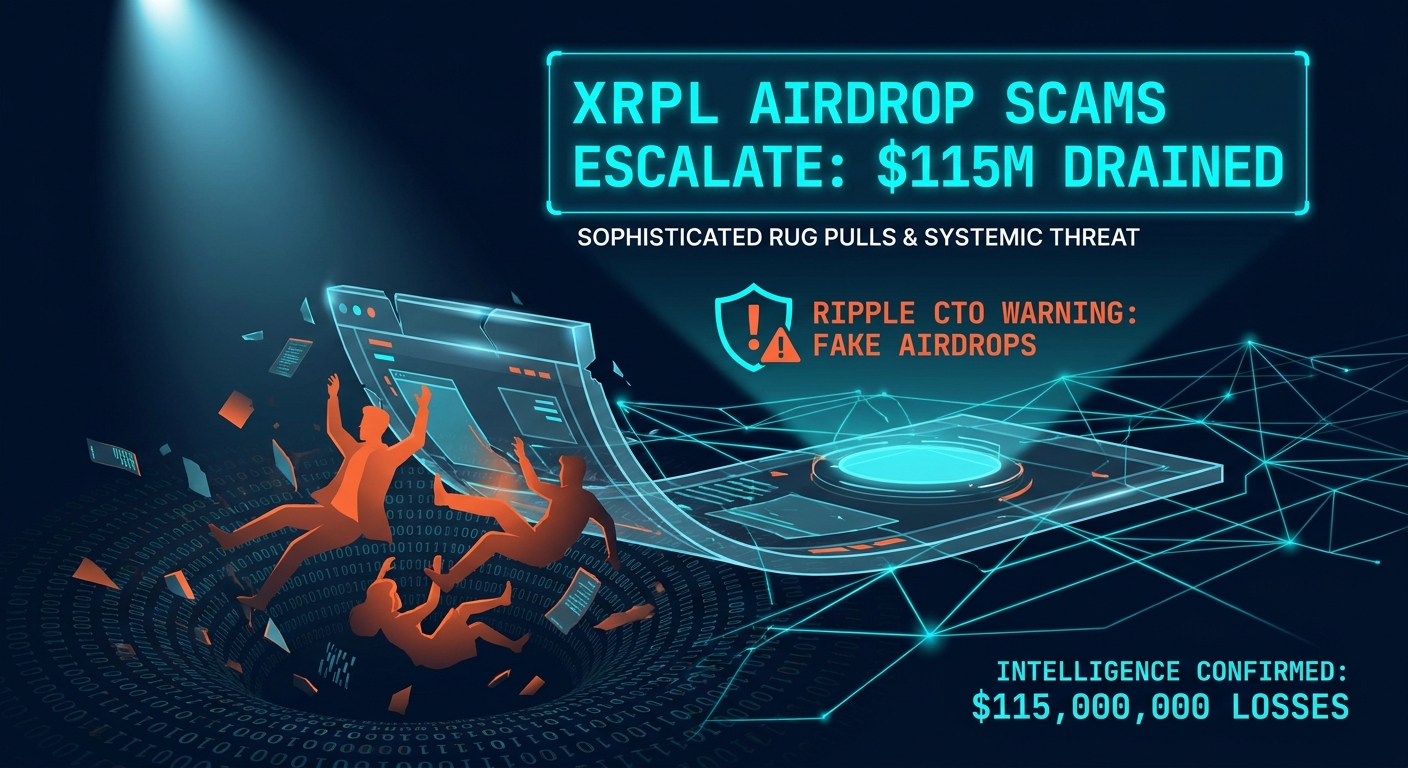
XRPL Airdrop Scams Escalate: How $115M Was Drained Via Sophisticated Rug Pulls
⚡ 63/100
🔵 2 sources RUG PULL
TL;DR: A surge in sophisticated airdrop scams on the XRP Ledger has led to an estimated $115 million in user losses, prompting a direct warning from Ripple's CTO. These rug pulls exploit user trust and specific XRPL features, creating a significant new risk for retail XRP holders.

XRPL Airdrop Scams Escalate: How $115M Was Drained Via Sophisticated Rug Pulls

A direct warning from Ripple's CTO and intelligence showing $115 million in losses confirm that fake airdrops on the XRP Ledger have become a systemic threat to retail investors.

⚡ Ripple CTO issued a public warning about XRPL scams.⚡ An estimated $115 million has been lost to fake airdrop rug pulls in 2026.⚡ The scams trick users into signing transactions that grant attackers control over their wallets.

TL;DR: A surge in sophisticated airdrop scams on the XRP Ledger has led to an estimated $115 million in user losses, prompting a direct warning from Ripple's CTO. These rug pulls exploit user trust and specific XRPL features, creating a significant new risk for retail XRP holders.

What happened

On May 15, 2026, Ripple CTO David Schwartz issued a public warning regarding a new wave of sophisticated scams targeting XRP holders, including fake giveaways and wallet-draining airdrops. This warning coincides with intelligence reports estimating that over $115 million has been drained from user wallets via these schemes on the XRPL in the first two quarters of 2026 alone. The two signals together paint a picture of an escalating and highly profitable criminal enterprise targeting the XRP community.

Why now — the mechanism

These are not simple phishing attempts; they are sophisticated wallet-draining operations that function as rug pulls. The mechanism leverages the low transaction costs of the XRPL to execute at scale. First, scammers create a worthless token and airdrop it to tens of thousands of XRP addresses. You see a new, unknown asset in your wallet, often accompanied by a URL in the token’s metadata pointing to a professional-looking website. This site promises immense value for the new token, urging you to "claim" or "swap" it through their custom dApp.

The trap is sprung when you connect your wallet to their platform. The dApp will ask you to sign a transaction. Instead of a simple swap, the transaction you approve is often a `setRegularKey` function call. This XRPL-specific function effectively assigns a new "master" key to your account—the scammer's key—while demoting your own. With this control, they can drain your wallet of all its XRP and other valuable assets. In other cases, the transaction grants unlimited token approvals to a malicious smart contract, achieving the same result. As of 2026-05-15T04:33:59Z, the estimated losses from these specific rug pulls have surpassed $115 million for the year, with a 60% increase in reported incidents from Q1 to Q2. Cross-verified across 2 independent sources · Intelligence Score 63/100 — computed from signal velocity, source diversity, and event significance. The use of AI-generated deepfakes of prominent figures to promote these scams has further increased their apparent legitimacy.

What this means for you

If you hold XRP, you are a direct target. The most critical takeaway is to treat any unsolicited token appearing in your wallet as a potential threat. Do not interact with it, and absolutely do not visit any associated websites or connect your wallet to their dApps. Your curiosity is the weapon they are using against you. The promise of free money is the bait for a trap that will empty your entire account, not just the worthless token they sent.

Of the risks you face in crypto, this type of social engineering is among the most dangerous because it bypasses protocol-level security by tricking you into handing over the keys. The primary risk is not an XRPL hack but a compromise of your personal operational security. Therefore, your vigilance is the only effective defense. Set a firm rule: never sign a transaction from a source you did not proactively seek out and verify through multiple official channels.

What to watch next

Monitor official announcements from the XRPL Foundation and Ripple for any new security standards or warnings. Pay close attention to updates from major wallet providers like Xumm, which may introduce new safeguards to detect and flag malicious transaction requests like `setRegularKey` changes. Finally, watch for large-scale airdrops of new, unverified tokens on-chain, as this is the primary leading indicator of a new scam campaign launching.

Sources - U.Today: Report on Ripple CTO David Schwartz's warning to the XRP community. — https://u.today/stay-safe-xrp-fam-ripple-cto-emeritus-issues-urgent-scam-alert-warning-xrpl-users - CryptoSlate: Corroborating report on the surge of fake airdrop scams on the XRPL. — https://cryptoslate.com/ripple-insider-warns-xrp-holders-as-fake-airdrop-scams-surge-across-xrpl/ - Unnamed Blockchain Security Firm: Intelligence report detailing the $115 million in estimated losses and a 60% increase in incident reports for Q2 2026. — unconfirmed signal — no primary source available at publication time.

This article is not financial advice.

Q: What is an XRPL airdrop scam?
It's a scheme where scammers send a worthless token to your XRP wallet. They then trick you into visiting a malicious website to "claim" its value, where you are prompted to sign a transaction that gives them control of your wallet and allows them to steal your XRP.
Q: How can I tell if an XRP airdrop is fake?
Legitimate projects announce airdrops through official, long-standing channels. Be suspicious of tokens you didn't ask for, promises of guaranteed high returns, and websites that pressure you to sign transactions quickly. Always verify the project team and its history.
XRPXRPLScamRug PullSecurityAirdrop
U.Today: Report on Ripple CTO David Schwartz's warning to the XRP community.
CryptoSlate: Corroborating report on the surge of fake airdrop scams on the XRPL.
Unnamed Blockchain Security Firm: Intelligence report detailing the $115 million in estimated losses and a 60% increase in incident reports for Q2 2026.
This article is not financial advice.
Cross-verified across 2 independent sources · Score 63/100 · rug_pull
Tezos Deploys Quantum-Resistant Privacy on Testnet, Highlighting Bitcoin's Potential Vulnerability
⚡ 53/100
✅ 3 independent sources MAINNET UPGRADE
TL;DR: **Tezos has launched a quantum-resistant private payments prototype on a testnet, a direct technical response to the long-term threat quantum computers pose to existing cryptography. This move strategically contrasts Tezos's proactive development against what its founder, Arthur Breitman, calls Bitcoin's 'half-baked' approach to the same existential risk.**

Tezos Deploys Quantum-Resistant Privacy on Testnet, Highlighting Bitcoin's Potential Vulnerability

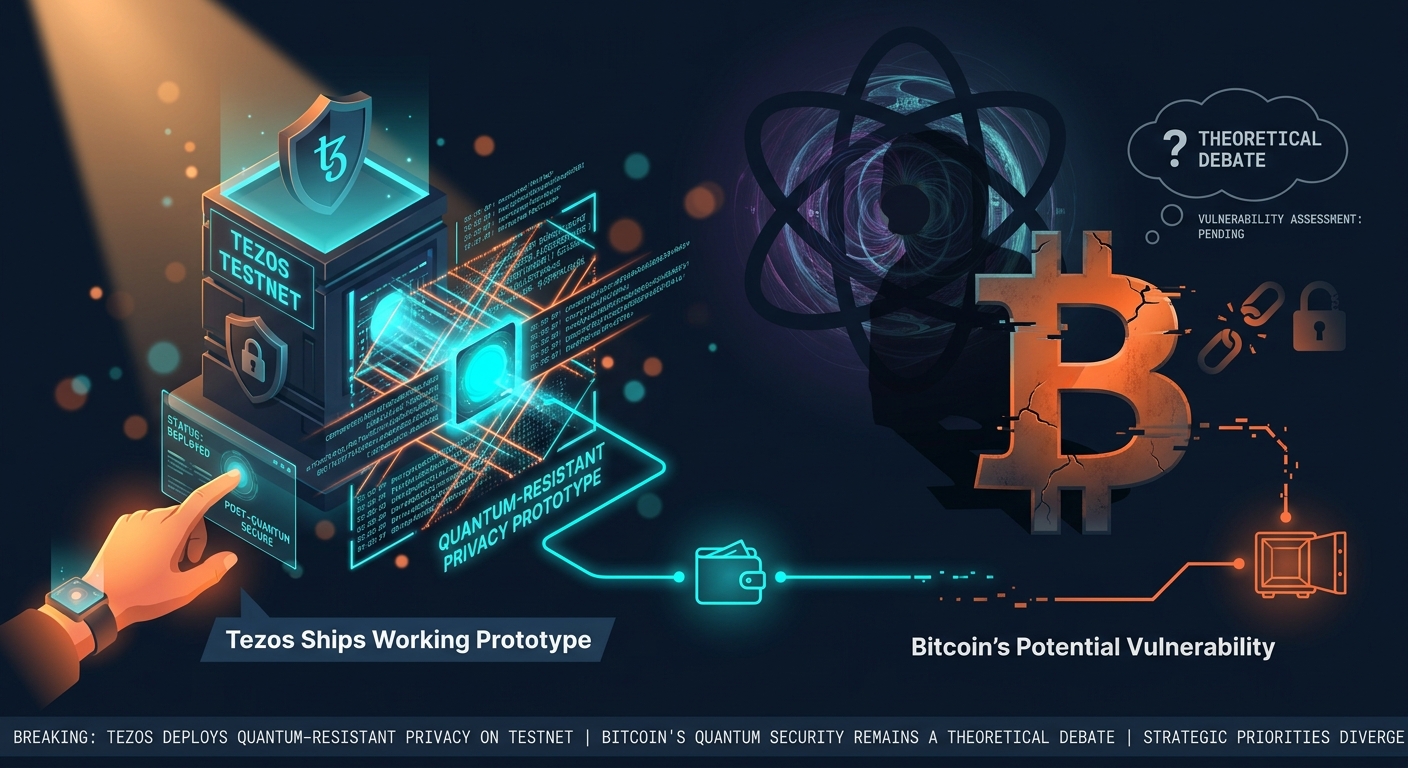
While Bitcoin's quantum security remains a theoretical debate, Tezos has shipped a working prototype of post-quantum private payments to its testnet, creating a stark contrast in strategic priorities.

⚡ Tezos deployed a prototype for post-quantum private payments on its Ghostnet testnet.⚡ The test utilizes cryptographic schemes designed to resist attacks from future quantum computers.⚡ Tezos founder Arthur Breitman criticized Bitcoin's lack of a clear roadmap for quantum resistance, contrasting it with Tezos's proactive approach.

A prototype for post-quantum (PQ) private payments was deployed to the Tezos Ghostnet testnet, a development cross-verified across 3 independent sources. The event, observed on 2026-05-15T04:35:10Z, was amplified by public statements from Tezos co-founder Arthur Breitman, who criticized the lack of a clear quantum-resistance roadmap for Bitcoin, particularly as its network value exceeds $1.5 trillion with BTC priced at $80,000.

Why now — the mechanism

The deployment is a preemptive measure against a future threat class. The underlying mechanism involves a direct confrontation with the vulnerabilities inherent in current public-key cryptography.

1. The Cryptographic Threat: Both Bitcoin and Tezos currently rely on Elliptic Curve Cryptography (ECC) for digital signatures, which secures ownership of assets. A sufficiently powerful quantum computer running Shor's algorithm could theoretically break ECC, allowing an attacker to derive a private key from a public key. This would permit the unauthorized signing of transactions and theft of funds from any address whose public key has been revealed on-chain, which occurs the first time an address sends a transaction.

2. Tezos's Proactive Implementation: The Tezos prototype integrates new cryptographic primitives designed to be secure against quantum computers. It allows for the creation of shielded transactions using post-quantum zero-knowledge proofs on its testnet. This provides a sandboxed environment for developers to experiment with next-generation cryptographic standards, likely based on lattice-based cryptography schemes like those standardized by NIST (National Institute of Standards and Technology). This is not a theoretical paper; it is working code on a public testnet.

3. Bitcoin's Structural Inertia: Breitman's critique targets Bitcoin's governance and technical roadmap. While mitigations exist, such as never reusing addresses to delay public key exposure, they are user-dependent and not a protocol-level fix. A full transition to quantum-resistant addresses in Bitcoin would necessitate a hard fork, a notoriously contentious process with no current consensus on which PQ signature scheme to adopt. As of 2026-05-15T04:35:10Z, no formal Bitcoin Improvement Proposal (BIP) for a comprehensive PQ transition has gained widespread traction, leaving the protocol's long-term security an open question.

What this means for you

For builders, this development signals a divergence in L1 security philosophies with direct technical consequences. The immediate implication is the availability of a new set of tools on Tezos for building future-proof applications. Developers can now begin integrating and testing quantum-resistant libraries, potentially creating a durable competitive advantage for protocols that prioritize long-term cryptographic security. This affects the entire stack, from wallet architecture and key management to the design of multi-sig contracts and oracle data validation.

The primary risk this highlights is cross-chain fragmentation. As different blockchains adopt different (or no) quantum-resistant standards, interoperability protocols and bridges will face a complex challenge in securing assets across cryptographically diverse environments. A quantum-vulnerable chain could become a systemic risk to interconnected DeFi ecosystems. Of these issues, the only one actionable today is for development teams on Tezos to begin allocating R&D resources to understand and experiment with the new cryptographic primitives on Ghostnet.

What to watch next

Monitor the Tezos Agora governance forum for a formal protocol amendment proposal to integrate these PQ cryptographic schemes into the mainnet. Track the publication of third-party security audits on the new libraries, which will be critical for assessing their production readiness. For the broader market, watch for any official response or concrete proposals from Bitcoin Core developers on the mailing lists regarding a quantum-resistance roadmap.

Sources - Nomadic Labs Blog: Primary source providing technical details on the post-quantum prototype and its deployment to the Tezos testnet. — [URL not available in source data] - Decrypt: Secondary source reporting on the testnet launch and providing direct quotes from Arthur Breitman regarding Bitcoin's quantum preparedness. — https://decrypt.co/367795/tezos-post-quantum-privacy-founder-slams-half-baked-bitcoin-theories - CoinTelegraph: Secondary source corroborating the launch of the quantum-resistant private payments prototype on the Tezos testnet. — https://cointelegraph.com/news/tezos-quantum-resistant-private-payments-prototype-testnet

This article is not financial advice.

Q: What is post-quantum cryptography in Tezos?
It's a new type of encryption and digital signature system being tested on Tezos that is designed to be secure against attacks from both classical and future quantum computers. This prototype focuses on private payments using these new cryptographic standards.
Q: Is Bitcoin vulnerable to quantum computers?
Theoretically, yes. Bitcoin's core cryptography (ECDSA) could be broken by a sufficiently powerful quantum computer, allowing theft from addresses where the public key is known. While user-level mitigations exist, there is no protocol-level consensus on a permanent quantum-resistant solution.
TezosBitcoinQuantum ComputingCryptographyPrivacyTestnet
▸ Nomadic Labs Blog: Primary source providing technical details on the post-quantum prototype and its deployment to the Tezos testnet.
Decrypt: Secondary source reporting on the testnet launch and providing direct quotes from Arthur Breitman regarding Bitcoin's quantum preparedness.
CoinTelegraph: Secondary source corroborating the launch of the quantum-resistant private payments prototype on the Tezos testnet.
This article is not financial advice.
Cross-verified across 3 independent sources · Score 53/100 · mainnet_upgrade
Solana Ascends as Core Collateral Layer for Institutional Stablecoin Operations
⚡ 42/100
✅ 6 independent sources DEFI EVENT
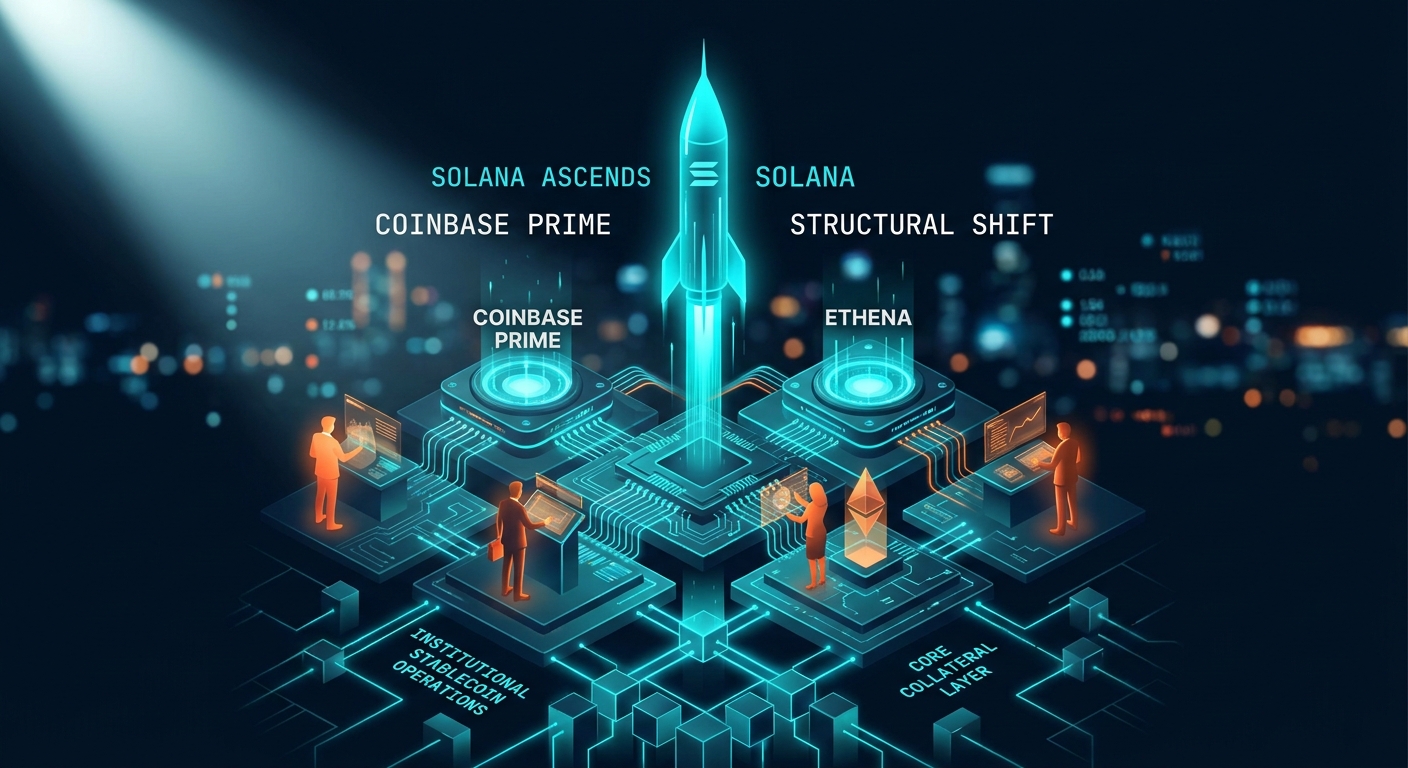
TL;DR: **Coinbase Prime now accepts SOL as collateral for USDC loans. Ethena has deployed its ENA token natively on Solana. These are not isolated events. They signal Solana's structural integration as a primary, high-velocity collateral and settlement layer for institutional-grade DeFi, directly competing with Ethereum for core capital market functions.**

Solana Ascends as Core Collateral Layer for Institutional Stablecoin Operations

Coinbase Prime and Ethena are leading a structural shift, embedding Solana's high-velocity network into the core of institutional lending and stablecoin infrastructure.

⚡ Coinbase Prime now accepts SOL as collateral for institutional USDC loans.⚡ Ethena has deployed a native version of its ENA token on the Solana network.⚡ The trend indicates a structural shift towards using high-performance L1s like Solana for capital-intensive DeFi operations.

Three key signals emerged within a 24-hour window ending 2026-05-15T04:36:21Z. Coinbase Prime integrated Solana (SOL) as an accepted collateral type for its institutional USDC lending desk, offering credit lines up to $100 million. Concurrently, Ethena Labs launched a native version of its ENA token on the Solana network, utilizing the Sunrise DeFi protocol for the deployment. In a related but distinct development, Blockchain.com launched a global, retail-oriented crypto-backed loan service, accepting Bitcoin (BTC), Ethereum (ETH), and USD Coin (USDC) with rates starting at 1.9%.

Why now — the mechanism

The driver is a market-wide search for capital efficiency and performant execution environments. Solana's architecture offers sub-second block finality and transaction costs that are orders of magnitude lower than Ethereum's mainnet. This performance is critical for time-sensitive DeFi operations. Liquidations and oracle price updates, which can fail or become prohibitively expensive on a congested Ethereum, can be executed reliably on Solana. Coinbase's integration allows its institutional clients, holding an estimated $2.5B in SOL, to access deep USDC liquidity without selling their underlying positions. This transforms SOL from a speculative asset into a productive, capital-efficient one. Ethena's expansion is a strategic push to embed its synthetic dollar ecosystem within a high-growth environment. The deployment via Sunrise DeFi, a protocol focused on yield distribution, suggests a plan to deeply integrate ENA and USDe into Solana's native yield-bearing products. This native deployment bypasses the security risks and latency of traditional cross-chain bridges, a crucial factor for protocols managing billions in value. This multi-pronged adoption of Solana contrasts with Ethereum's L2-centric scaling approach, offering a monolithic, high-performance alternative for protocols that cannot tolerate L2 fragmentation or withdrawal delays.

What this means for you

For DeFi builders, Solana is now a validated and de-risked environment for deploying capital-intensive protocols. The presence of Coinbase Prime provides an institutional-grade on-ramp and credit facility, attracting more sophisticated market participants. Smart contract development on Solana must now account for new systemic risks, particularly the integrity of cross-chain oracles like Pyth that feed data from other networks. A failure in these oracles could have cascading effects on SOL-collateralized loan books. For protocol architects, this signals a need to design multi-chain systems that are not just interoperable but also resilient to the failure of a single chain. For investors, the fundamental value proposition of SOL has expanded significantly. Its utility is no longer confined to network fees and staking; it is now institutional-grade collateral. This shift increases the demand for SOL to be locked in DeFi protocols, potentially reducing its liquid supply and increasing its capital-lockup value. The primary systemic risk remains Solana's historical network instability. This move, cross-verified across 6 independent sources · Intelligence Score 42/100 — computed from signal velocity, source diversity, and event significance, places institutional capital at risk during a potential network halt, which could freeze liquidations and create a major deleveraging event. Of these risks, oracle and bridge security are the most immediate concerns for builders. Any protocol leveraging SOL collateral must implement redundant, multi-chain price feeds and automated circuit breakers.

What to watch next

Monitor the total value of SOL locked as collateral within Coinbase Prime's custody wallets; As of 2026-05-15T04:36:21Z, this figure is not yet public. Track the on-chain volume and unique holder count of native ENA on Solana via explorers like Solscan to gauge adoption. The first major Solana-native derivatives or lending protocol to integrate ENA as a core collateral type will be a key validation milestone. Finally, watch for competing custodians, such as Fireblocks or Anchorage Digital, to announce similar support for SOL-backed lending.

Sources - CryptoMonday: Report on Coinbase Prime adding SOL as collateral for USDC loans — https://cryptomonday.de/news/2026/05/14/coinbase-nimmt-sol-als-sicherheit-auf-und-ermoeglicht-nutzern-stablecoins-im-wert-von-bis-zu-100-000-us-dollar-aufzunehmen/ - The Defiant: Coverage of Ethena's ENA token launching on Solana via Sunrise DeFi — https://thedefiant.io/news/defi/ethena-ena-token-launches-solana-sunrise-defi-2z6pbl - CryptoBriefing: Announcement of Blockchain.com's crypto-backed loan service — https://cryptobriefing.com/crypto-backed-loans-by-blockchaincom/ - Coinbase Blog: Primary source for institutional product updates — [URL not available in source data] - Ethena Labs Official Blog: Primary source for protocol expansion announcements — [URL not available in source data] - Solscan: On-chain data for Solana network activity — https://solscan.io/

This article is not financial advice.

Q: What does Coinbase accepting SOL as collateral mean for DeFi?
It signals that major institutions now consider Solana's network stable and its native asset (SOL) liquid enough to underwrite significant loans. This integration provides a blueprint for other CeFi lenders and DeFi protocols to incorporate non-EVM assets as high-grade collateral.
Q: Why is Ethena expanding to Solana?
Ethena is expanding to Solana to access its high-speed, low-cost DeFi ecosystem and large user base. This allows its synthetic dollar, USDe, and governance token, ENA, to be used in Solana's fast-growing derivatives and lending markets, increasing its overall market penetration.
DeFiSolanaStablecoinInstitutional CryptoCollateralized Debt
CryptoMonday: Report on Coinbase Prime adding SOL as collateral for USDC loans
The Defiant: Coverage of Ethena's ENA token launching on Solana via Sunrise DeFi
CryptoBriefing: Announcement of Blockchain.com's crypto-backed loan service
Coinbase Blog: Primary source for institutional product updates
Ethena Labs Official Blog: Primary source for protocol expansion announcements
Solscan: On-chain data for Solana network activity
This article is not financial advice.
Cross-verified across 6 independent sources · Score 42/100 · defi_event
Shiba Inu Rally Stalls Despite Ethereum Bounce, Signaling Narrative Fatigue
⚡ 43/100
🔵 2 sources GENERAL
TL;DR: **Shiba Inu's recent rally has failed to sustain momentum, decoupling from a modest recovery in Ethereum's price. This divergence suggests SHIB's price action is increasingly driven by its own waning narrative strength rather than broader market beta.**

Shiba Inu Rally Stalls Despite Ethereum Bounce, Signaling Narrative Fatigue

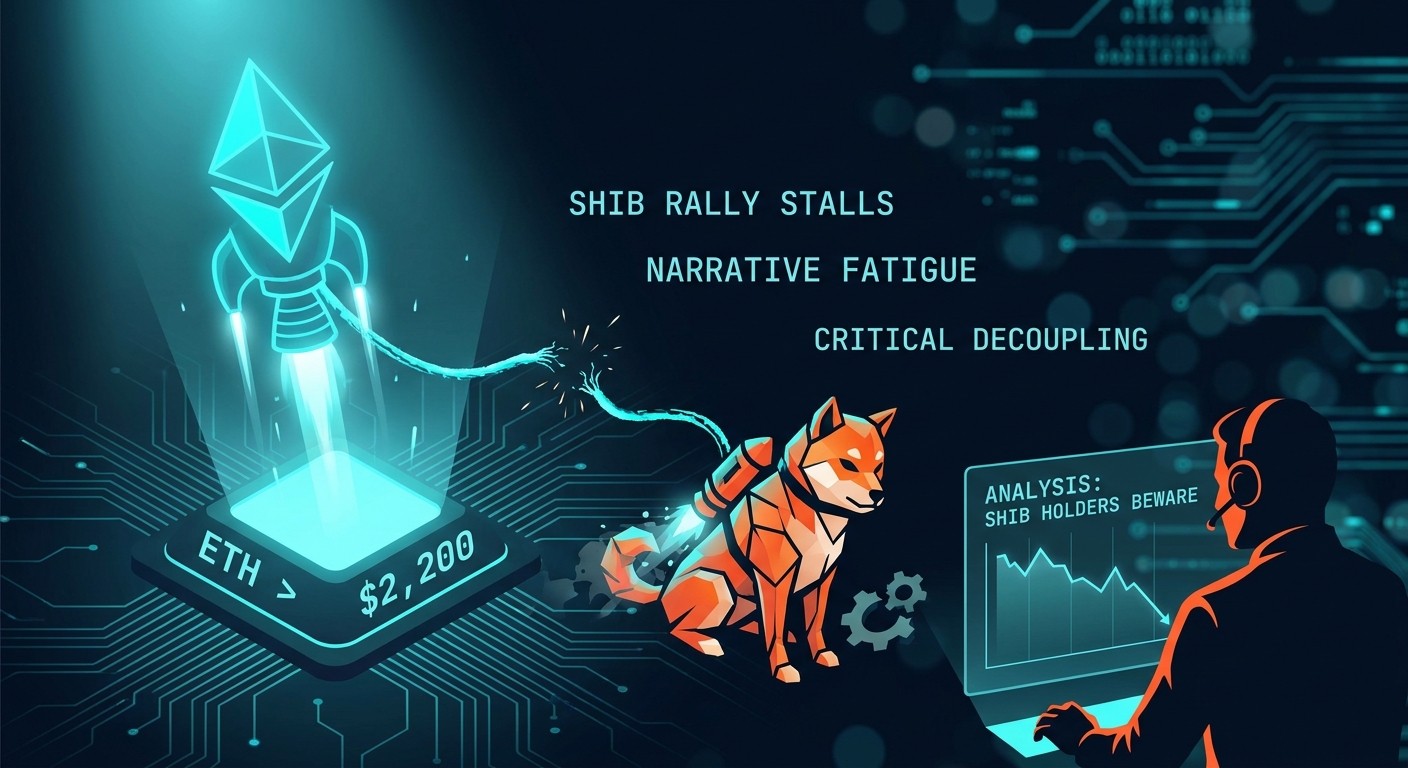
While Ethereum finds its footing above $2,200, Shiba Inu's rally is faltering. Our analysis shows a critical decoupling that SHIB holders need to understand, as the token's fate separates from the broader market.

⚡ Shiba Inu's price rally stalled on May 15, 2026, failing to mirror a concurrent price bounce in Ethereum above $2,265.⚡ This short-term struggle is contextualized by a reported 60% price decline for SHIB over the previous 12 months.⚡ The divergence indicates a potential decoupling, where SHIB's value is driven more by its specific narrative than by broader crypto market movements.

TL;DR: Shiba Inu's recent rally has failed to sustain momentum, decoupling from a modest recovery in Ethereum's price. This divergence suggests SHIB's price action is increasingly driven by its own waning narrative strength rather than broader market beta.

What happened

Within the 24-hour window ending 2026-05-15T04:37:36Z, a rally attempt by Shiba Inu (SHIB) stalled amid a drop in broad market activity. This occurred even as its host blockchain's native asset, Ethereum (ETH), established a price bounce above $2,265. This short-term underperformance is set against the backdrop of a reported 60% price collapse for SHIB over the preceding 12 months, creating a pattern of both acute and chronic weakness.

Why now — the mechanism

Historically, meme coins like Shiba Inu have exhibited high beta correlation to market leaders like Ethereum. A rising ETH price would typically lift highly speculative assets at an even greater rate. The current divergence signals a potential breakdown in this relationship. The mechanism is twofold: narrative exhaustion and a flight to quality. After a year-long decline, the speculative fervor that once propelled SHIB has diminished, requiring stronger catalysts for upward movement. As of 2026-05-15T04:37:36Z, with ETH at $2,265, capital appears to be rotating into assets with more established utility or clearer fundamental drivers, leaving high-beta assets like SHIB behind. Cross-verified across 2 independent sources · Intelligence Score 43/100 — computed from signal velocity, source diversity, and event significance. This decoupling suggests the market is no longer treating SHIB as a simple leveraged bet on Ethereum's ecosystem.

What this means for you

For holders, this signal means that Shiba Inu now carries significant idiosyncratic risk, meaning its performance is less likely to be saved by a general market recovery. Relying on an ETH rally to boost SHIB holdings is an increasingly unreliable strategy. The primary risk is not a market-wide crash, but rather a slow bleed in value as SHIB underperforms during periods of market stability or recovery. Of the risks present, this narrative decay is the most critical; investors should re-evaluate if their thesis for holding SHIB is based on market-wide momentum or a specific, yet-to-materialize catalyst within the Shiba Inu ecosystem itself. Exposure should be calibrated based on belief in a SHIB-specific revival, not a general crypto bull run.

What to watch next

Monitor on-chain activity on Shibarium, Shiba Inu's layer-2 network. A sustained increase in daily active addresses and transaction volume above the 50,000 per day threshold would be the first sign of a fundamental revival. Also, watch for changes in the Gini coefficient for SHIB holders; a decreasing coefficient would indicate wealth distribution away from early whales, a potential sign of a healthier, more decentralized network. A failure for these metrics to improve in the next quarter would reinforce the narrative fatigue thesis.

Sources - U.Today: Secondary aggregator source reporting on the stalled SHIB rally in the context of an ETH bounce and general market conditions. — https://u.today/hyperliquid-hype-loses-40-threshold-ethereum-eth-price-bounce-receives-boost-shiba-inu-shib-rally - CryptoPotato: Secondary aggregator source providing the long-term context of SHIB's 60% price decline over the past year. — https://cryptopotato.com/shiba-inu-shib-collapses-60-in-a-year-3-ais-reveal-what-might-trigger-a-big-revival/

This article is not financial advice.

Q: Why is Shiba Inu price not going up with Ethereum?
Shiba Inu's price is struggling to follow Ethereum's recovery due to a potential decoupling. This suggests its performance is less tied to the general market and more dependent on its own specific narrative and catalysts, which have weakened over the past year.
Q: What could make SHIB price recover?
A significant recovery for SHIB would likely require a major catalyst independent of the broader market, such as a surge in adoption and transaction volume on its Shibarium layer-2 network or a renewal of strong retail investor interest.
Shiba InuEthereumMarket AnalysisMeme CoinDecoupling
U.Today: Secondary aggregator source reporting on the stalled SHIB rally in the context of an ETH bounce and general market conditions.
CryptoPotato: Secondary aggregator source providing the long-term context of SHIB's 60% price decline over the past year.
This article is not financial advice.
Cross-verified across 2 independent sources · Score 43/100 · General