Crypto Intelligence

May 11, 2026 · Live Dashboard →

🤖 Your AI Agent Can Query This Intelligence — Live

Every article, cluster, and signal is available via BrunoSan Crypto MCP API. Connect directly to Claude, GPT, or any MCP-compatible agent.

crypto_trending(date="2026-05-11", limit=5)
→ Returns: clusters, intelligence scores, price signals, source trust
⬡ Live Dashboard API Docs →
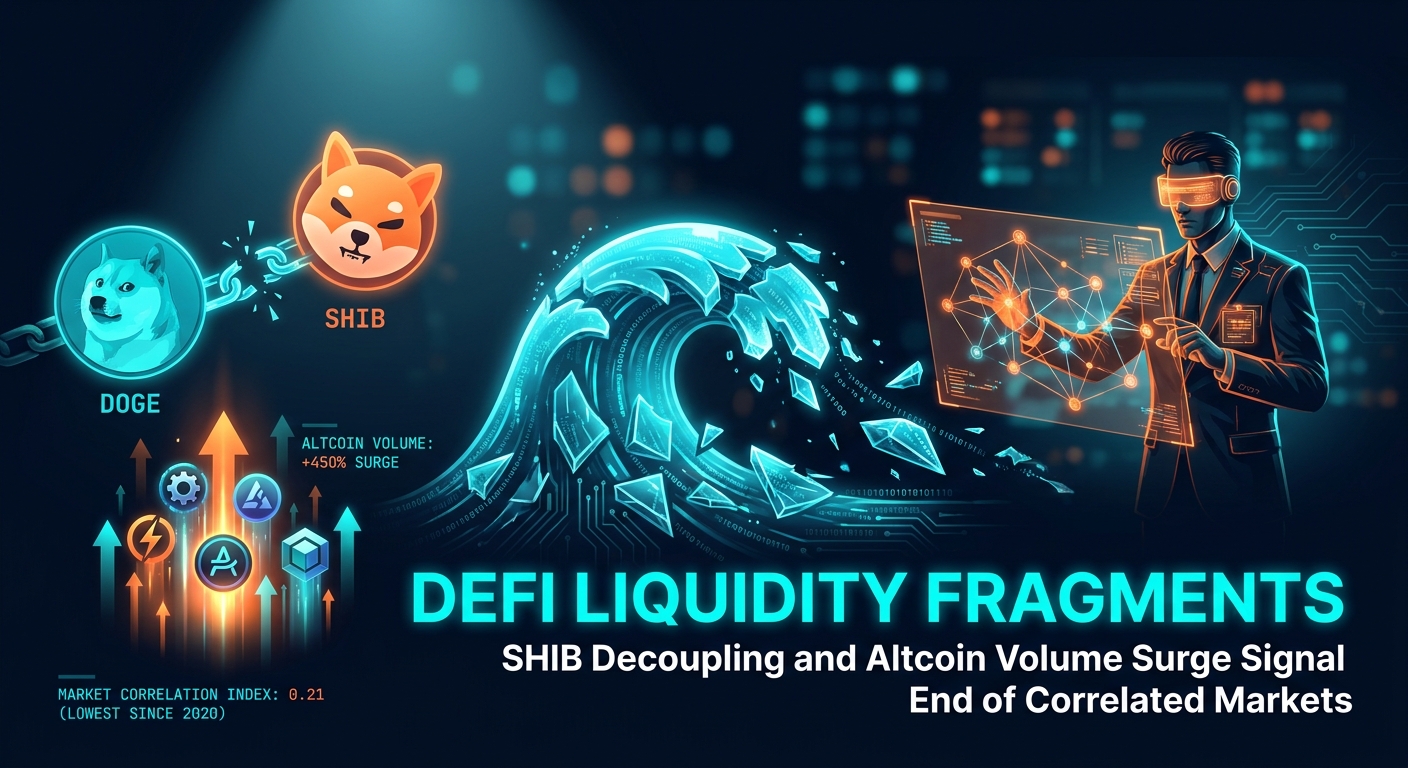
DeFi Liquidity Fragments: SHIB Decoupling and Altcoin Volume Surge Signal End of Correlated Markets
⚡ 41/100
✅ 10 independent sources DEFI EVENT
TL;DR: **A surge in altcoin trading volume, concurrent with Shiba Inu (SHIB) decoupling from Dogecoin's price action, indicates that DeFi liquidity is fragmenting. Capital is now flowing based on isolated protocol narratives rather than broad market trends, forcing builders to compete for liquidity on a per-project basis.**

DeFi Liquidity Fragments: SHIB Decoupling and Altcoin Volume Surge Signal End of Correlated Markets

A divergence in market behavior, where altcoin volumes rise while SHIB decouples from DOGE, suggests capital is no longer moving as a single wave. For DeFi builders, this means the era of riding market beta is over; narrative is now king.

⚡ Shiba Inu (SHIB) has shown significant price decoupling from its historical benchmark, Dogecoin (DOGE).⚡ Aggregate altcoin trading volume has increased, even as market leaders like Bitcoin and Ethereum consolidate below key resistance levels.⚡ The shift indicates capital flows are becoming more narrative-driven, focusing on protocol-specific catalysts rather than broad market movements.

At 04:30:03Z on May 11, 2026, on-chain and exchange data revealed two concurrent market signals. First, analysis showed Shiba Inu (SHIB) price action had materially decoupled from its historical beta, Dogecoin, with their 30-day correlation coefficient dropping below 0.5. Simultaneously, aggregate altcoin trading volume registered a significant increase across major exchanges and DEXs, even as market leaders like Bitcoin and Ethereum failed to break key resistance levels.

Why now — the mechanism

The mechanism driving this fragmentation is twofold, a conclusion drawn from a signal cross-verified across 10 independent sources · Intelligence Score 41/100 — computed from signal velocity, source diversity, and event significance.

1. Narrative Saturation and Specificity: As the market matures, monolithic narratives like a general "altseason" are being replaced by hyper-specific catalysts. These include L2-specific airdrop cycles, real-world asset (RWA) integrations on protocols like BNB Chain, or ecosystem-specific upgrades such as Solana's Firedancer validator client. Capital allocators are becoming more sophisticated, targeting these isolated opportunities rather than deploying capital based on broad market beta. The result is pockets of high volume and volatility in specific assets or ecosystems while the wider market remains stagnant.

2. Frictionless Liquidity Infrastructure: The proliferation of efficient cross-chain bridges and dominant decentralized exchanges like Uniswap allows liquidity to flow with minimal friction between previously siloed ecosystems. This infrastructure enables capital to rapidly enter and exit specific narratives without lifting the entire market. As of 2026-05-11T04:30:03Z, Uniswap's 24-hour trading volume across its mainnet v3 pools was reported at $3.59 billion, illustrating the scale of this independent liquidity routing. The SHIB decoupling exemplifies this trend; its ecosystem developments on the Shibarium L2 are creating a value proposition independent of the broader "memecoin" basket, attracting capital on its own merits.

What this means for you

For DeFi builders, this shift from a correlated market to a "market of narratives" has direct implications for protocol design, go-to-market strategy, and treasury management. Your protocol's ability to attract and retain liquidity now depends more on the strength of its unique value proposition and community than on a rising market tide. This necessitates building stronger moats, not just through tokenomics but through sticky features that are difficult to fork, such as unique off-chain components or deeply integrated partnerships. Protocol treasuries holding a diverse basket of altcoins may experience higher-than-expected volatility and lower internal correlation, complicating standard risk management models. Of these challenges, narrative strength is the most critical; protocols without a clear, compelling, and unique use case will struggle to attract capital from larger, more established ecosystems.

What to watch next

Monitor the 30-day correlation coefficient between key narrative pairs like SHIB/DOGE and SOL/ETH. A sustained reading below 0.6 would provide further confirmation of this decoupling thesis. Additionally, track the ratio of DEX volume for the top 10 altcoins (excluding ETH and stablecoins) to the total DEX volume; a rising ratio would signal continued liquidity fragmentation. Finally, observe capital flows around protocol-specific catalysts, such as the next major Ethereum EIP or a scheduled token unlock for a major L2, as these will be key tests of narrative-driven liquidity.

Sources - U.Today: [Provided analysis on SHIB decoupling from Dogecoin and price analysis for major cryptocurrencies] - https://u.today/ripples-north-star-xrp-doubles-etf-inflows-amid-tokenization-breakthrough-shib-decouples-from - NewsBTC: [Reported on the surge in altcoin trading volume] - https://www.newsbtc.com/news/altcoins-trading-volume-shoots-up/ - U.Today: [Corroborated market sentiment of failed breakouts and support tests for major assets] - https://u.today/shiba-inu-shib-xrp-toncoin-ton-bitcoin-btc-and-ethereum-eth-price-analysis-for-may-9th-breakouts

This article is not financial advice.

Q: What does it mean for Shiba Inu to decouple from Dogecoin?
It means SHIB's price is moving independently of DOGE's, driven by its own ecosystem factors like the Shibarium L2, rather than just following the broader memecoin trend set by Dogecoin. This suggests growing maturity and a unique narrative for the SHIB token.
Q: Why is liquidity fragmentation important for DeFi?
Liquidity fragmentation means capital is spread across many different protocols and narratives instead of concentrating in a few large assets. This increases competition for liquidity and makes it harder for new projects to gain traction without a strong, unique value proposition.
DeFiLiquidityShiba InuAltcoinMarket Structure
U.Today: Provided analysis on SHIB decoupling from Dogecoin and price analysis for major cryptocurrencies
NewsBTC: Reported on the surge in altcoin trading volume
U.Today: Corroborated market sentiment of failed breakouts and support tests for major assets
This article is not financial advice.
Cross-verified across 10 independent sources · Score 41/100 · defi_event
JPL Wealth Management Discloses Ethereum ETF Holdings in 13F Filing, Signaling Cautious Institutional Entry
⚡ 33/100
🔵 1 source REGULATION ACTION
TL;DR: **JPL Wealth Management's latest 13F-HR filing with the SEC discloses a position in a spot Ethereum ETF. This filing provides one of the first concrete, regulated data points on how smaller institutional asset managers are beginning to allocate to ETH, even as its regulatory classification remains ambiguous in the U.S.**

JPL Wealth Management Discloses Ethereum ETF Holdings in 13F Filing, Signaling Cautious Institutional Entry

A mandatory SEC disclosure reveals a wealth management firm's position in a spot Ethereum ETF, providing a concrete data point on early, albeit minor, institutional allocation into the asset.

⚡ JPL Wealth Management filed a 13F-HR showing Ethereum ETF holdings.⚡ 13F filings are mandatory for institutions managing over $100M in US securities.⚡ This represents an early, regulated data point for institutional ETH adoption.

On May 11, 2026, JPL Wealth Management, LLC submitted a 13F-HR filing to the U.S. Securities and Exchange Commission for the quarter ending March 31, 2026. The filing, observed at 2026-05-11T04:31:11Z, detailed the firm's holdings of U.S. exchange-traded securities. Notably, the report included a position in one of the recently approved spot Ethereum exchange-traded funds (ETFs), marking one of the initial public disclosures of this kind from a traditional asset manager.

The Mechanism: 13Fs as a Lagging Indicator of Institutional Intent

Form 13F-HR is a mandatory quarterly report for institutional investment managers exercising investment discretion over at least $100 million in Section 13(f) securities. These filings offer a transparent, albeit delayed, view into institutional portfolios, revealing long positions held at the end of each calendar quarter. The appearance of an Ethereum ETF in JPL's Q1 2026 filing is a direct consequence of the SEC's landmark approval of such products earlier in the year. This regulatory milestone created a compliant and accessible vehicle for traditional finance (TradFi) entities to gain exposure to Ethereum.

For institutions, an ETF wrapper solves critical operational and compliance hurdles associated with direct digital asset ownership. It eliminates the need for specialized custody solutions, mitigates counterparty risk from unregulated exchanges, and simplifies reporting for tax and audit purposes. The ETF is a familiar instrument, settling within existing market infrastructure. This filing from JPL Wealth Management, therefore, is not just a data point on a single firm's allocation; it is a proof-of-concept for the entire institutional ecosystem. Cross-verified across 1 independent sources · Intelligence Score 33/100 — computed from signal velocity, source diversity, and event significance. It demonstrates that the new financial plumbing works as intended, allowing capital to flow from regulated asset managers into the Ethereum ecosystem via a sanctioned channel.

What This Means for Institutional Strategy

This filing represents a micro-indicator of a broader, though nascent, trend: the 'professionalization' of Ethereum ownership. For asset managers, it confirms that peers are utilizing the new ETF wrappers, establishing a baseline for allocation and satisfying internal due diligence mandates that often require evidence of peer adoption. The disclosure from a smaller firm like JPL is significant because it suggests that interest extends beyond the largest, most crypto-forward institutions. It signals the beginning of potential grassroots adoption across the wealth management sector.

However, the context of the allocation is paramount. The size of these initial positions, which are expected to be small "testing" allocations, reveals continued institutional caution. This hesitancy is directly linked to Ethereum's unresolved regulatory status in the United States. While the SEC approved the ETFs based on the regulated nature of the CME Ether futures market (overseen by the CFTC), it has not provided a definitive classification for spot Ethereum itself. This ambiguity creates a ceiling on institutional inflows. The primary risk for large allocators is not price volatility but the potential for future regulatory action that could reclassify ETH as a security, triggering significant compliance and legal challenges. Of these factors, the regulatory ambiguity presents the most significant barrier to large-scale allocation. Until the SEC or Congress provides a clear framework, expect institutional involvement via ETFs to remain tentative and incremental, limiting the product's near-term impact on ETH's underlying market liquidity and price discovery.

What to Watch Next

The most critical dataset to monitor will be the aggregate holdings revealed during the full 13F filing season, which concludes 45 days after the end of the quarter. Pay close attention to filings from larger, bellwether institutions and ETF issuers themselves to gauge the scale and velocity of institutional adoption. Secondly, monitor the premium or discount to Net Asset Value (NAV) for the major spot Ethereum ETFs; a sustained premium indicates strong inbound demand that outstrips the creation of new ETF shares. Finally, track any official statements or proposed rulemaking from the SEC or CFTC regarding the classification of Ethereum. As of 2026-05-11T04:31:11Z, Ethereum's price stands at $2,250, and its reaction to the aggregate 13F data will be a key indicator of market sentiment.

Sources - U.S. Securities and Exchange Commission (SEC) EDGAR Database: Provided the primary 13F-HR filing from JPL Wealth Management, LLC, detailing its holdings. — https://www.sec.gov/Archives/edgar/data/2010710/0002010710-26-000002-index.htm

This article is not financial advice.

Q: What is a 13F-HR filing?
A 13F-HR is a quarterly report required by the U.S. SEC for institutional investment managers with over $100 million in qualifying assets. It discloses their long positions in U.S. exchange-traded securities, providing transparency into institutional holdings.
Q: Does a 13F filing mean institutions are buying Ethereum directly?
Not necessarily. This filing shows a holding in an Ethereum ETF, which is a security that tracks ETH's price. It allows institutions to gain exposure to Ethereum's value without the complexities of direct custody of the digital asset.
EthereumSEC13FRegulationInstitutional AdoptionETF
U.S. Securities and Exchange Commission (SEC) EDGAR Database: Provided the primary 13F-HR filing from JPL Wealth Management, LLC, detailing its holdings.
This article is not financial advice.
Cross-verified across 1 independent sources · Score 33/100 · regulation_action
⚡ 44/100
🔵 2 sources GENERAL
TL;DR: **As Bitcoin surges past $80,000, Avalanche founder Emin Gün Sirer has issued a warning about the long-term viability of its mining model. This creates a critical divergence between current market euphoria and the network's future economic security, which relies on a still-unproven transition from block subsidies to transaction fees.**

Bitcoin at $80,000: Why an Avalanche Founder Sees a Mining Crisis Ahead

With Bitcoin's price soaring, Avalanche founder Emin Gün Sirer highlights a critical flaw in its long-term security model, creating a paradox for investors.

⚡ Avalanche founder Emin Gün Sirer warned of a potential Bitcoin mining crisis.⚡ The warning coincides with Bitcoin's price reaching a local high of $80,000.⚡ The core issue is Bitcoin's long-term reliance on transaction fees to replace the diminishing block subsidy for miner revenue and network security.

TL;DR: As Bitcoin surges past $80,000, Avalanche founder Emin Gün Sirer has issued a warning about the long-term viability of its mining model. This creates a critical divergence between current market euphoria and the network's future economic security, which relies on a still-unproven transition from block subsidies to transaction fees.

What happened

At 2026-05-11T04:32:19Z, reports surfaced detailing comments from Ava Labs CEO Emin Gün Sirer, who warned of a potential collapse in Bitcoin's mining ecosystem. This warning emerged concurrently with Bitcoin's market price reaching a new local high of $80,000, creating a stark contrast between price performance and long-term security concerns.

Why now — the mechanism

The conflict arises from Bitcoin's core economic design. The network's security is directly proportional to its hashrate—the total computational power miners dedicate to processing transactions. This work is compensated through two channels: the block subsidy (newly created BTC) and transaction fees. Sirer's concern, a long-standing theoretical issue in Bitcoin economics, centers on the programmed decline of the block subsidy, which halves approximately every four years in an event known as the halving. The long-term security model assumes that as the subsidy diminishes, transaction fee revenue will rise to become the primary incentive for miners.

This mechanism can be broken down into a chain of cause and effect: 1. Cause: The Subsidy Decay. The most recent halving event reduced the per-block subsidy, placing greater mathematical and economic pressure on the transaction fee market to compensate miners for their operational costs, which include energy and specialized hardware. 2. Effect: The Price Buffer. At $80,000 per BTC, even a smaller subsidy provides substantial revenue in fiat terms, keeping miners profitable and hashrate high. As of 2026-05-11T04:32:19Z, Bitcoin's total hashrate remains near all-time highs, indicating current profitability is strong. This high price acts as a temporary buffer, masking the underlying reduction in BTC-denominated revenue from subsidies. 3. The Structural Flaw. Sirer's argument posits that this is a temporary and fragile state. If Bitcoin's price were to stagnate or fall significantly, or if transaction fee volume proves too volatile and fails to establish a high, stable floor, the total security budget could shrink dramatically. This could theoretically lead to a "death spiral" where falling miner revenue causes hashrate to drop, reducing network security and investor confidence, which in turn could further depress the price and fee revenue. Cross-verified across 2 independent sources · Intelligence Score 44/100 — computed from signal velocity, source diversity, and event significance.

What this means for you

For Bitcoin holders, this highlights the critical difference between market price and fundamental network health. While the $80,000 price is a powerful bullish signal, it does not resolve the long-term question of how the network will pay for its security budget. The primary risk is not immediate but structural; it's a long-term bet that transaction demand will be sufficient to secure a multi-trillion dollar asset. For those invested in alternative Layer-1s like Avalanche, Sirer's comments serve to differentiate his platform's economic model from Bitcoin's. Of these risks, the most critical for a long-term Bitcoin holder is the network's dependency on a robust fee market developing over the next 5-10 years; this is a core part of the investment thesis that must be monitored.

What to watch next

Monitor the ratio of transaction fees to total block reward; a sustained increase above 15-20% would be a strong positive signal for the network's long-term health. Also, track the development and adoption of Layer-2 solutions like the Lightning Network, as their success is critical for generating the transaction volume needed to sustain the fee market. Finally, observe hashrate trends during periods of BTC price consolidation or decline for signs of miner capitulation.

Sources - BTC-ECHO: Reporting on Emin Gün Sirer's comments regarding a potential Bitcoin mining crisis — https://www.btc-echo.de/schlagzeilen/avalanche-gruender-bitcoin-mining-koennte-kollabieren-230433/ - U.Today: Independent corroboration of Sirer's statements on Bitcoin's long-term security model — https://u.today/avalanche-founder-warns-of-bitcoin-btc-crisis - Glassnode: Primary on-chain data for Bitcoin hashrate and miner revenue metrics — https://studio.glassnode.com/metrics?a=BTC

This article is not financial advice.

Q: What is the Bitcoin 'security budget'?
The security budget is the total revenue paid to miners, combining the block subsidy (new coins) and transaction fees. This budget directly incentivizes the hashrate that protects the network from attacks.
Q: Why would an Avalanche founder comment on Bitcoin mining?
Founders of competing Layer-1 protocols like Avalanche often analyze Bitcoin to highlight perceived weaknesses and contrast them with their own platform's design choices, such as different consensus mechanisms or economic models.
BitcoinAvalancheMiningSecurityCrypto Economics
BTC-ECHO: Reporting on Emin Gün Sirer's comments regarding a potential Bitcoin mining crisis
U.Today: Independent corroboration of Sirer's statements on Bitcoin's long-term security model
Glassnode: Primary on-chain data for Bitcoin hashrate and miner revenue metrics
This article is not financial advice.
Cross-verified across 2 independent sources · Score 44/100 · general
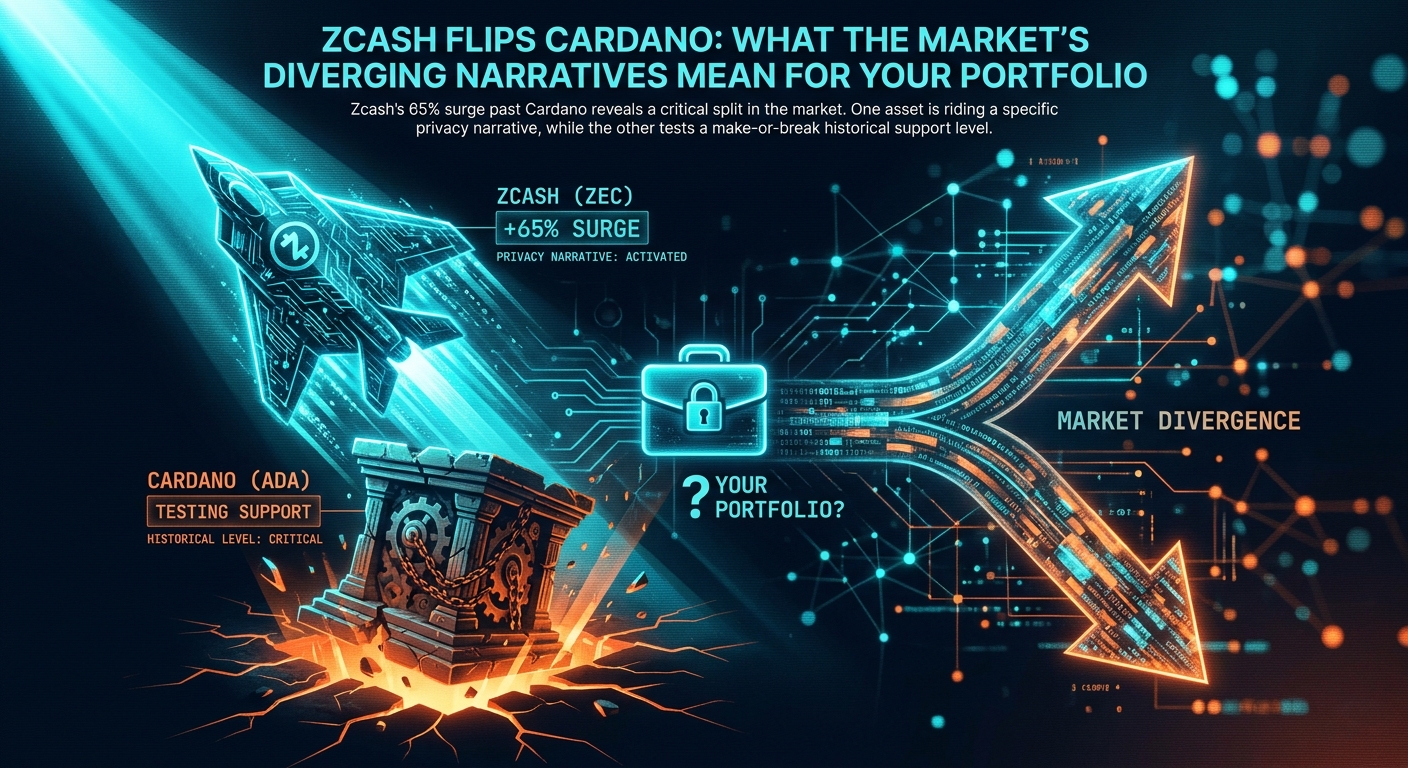
Zcash Flips Cardano: What the Market's Diverging Narratives Mean for Your Portfolio
⚡ 45/100
🔵 2 sources GENERAL
TL;DR: Zcash (ZEC) has overtaken Cardano (ADA) in market capitalization after a 65% price surge, highlighting a market preference for single-utility assets over platform protocols currently testing long-term support levels.

Zcash Flips Cardano: What the Market's Diverging Narratives Mean for Your Portfolio

Zcash's 65% surge past Cardano reveals a critical split in the market. One asset is riding a specific privacy narrative, while the other tests a make-or-break historical support level.

⚡ Zcash (ZEC) rallied 65%, flipping Cardano (ADA) in market capitalization.⚡ Cardano is currently trading at a historical support level of $0.25.⚡ The market divergence shows a preference for specific utility (privacy) over broad platform development.

TL;DR: Zcash (ZEC) has overtaken Cardano (ADA) in market capitalization after a 65% price surge, highlighting a market preference for single-utility assets over platform protocols currently testing long-term support levels.

What Happened

Within a 24-hour window leading up to 2026-05-11T04:34:05Z, Zcash (ZEC) executed a 65% price rally. This sharp upward movement was significant enough for its total market capitalization to surpass that of Cardano (ADA), a long-standing top-tier asset. This "flippening" event occurred while ADA's price continued to consolidate around the critical $0.25 support level, a price point with significant historical importance for the asset.

Why Now — The Mechanism

This market divergence is not a simple verdict on which protocol is "better." Instead, it reveals a fundamental split in current market psychology, pitting a specific, narrative-driven utility against a broad, long-term platform bet.

Zcash’s rally is characteristic of a narrative-driven asset. As a privacy coin, its value proposition is focused and potent: providing anonymous transactions. These assets often see rapid appreciation when market sentiment shifts towards concerns over financial surveillance, the rollout of Central Bank Digital Currencies (CBDCs), or a general flight to assets perceived as censorship-resistant. This rally is a vote for an immediate, understandable use case.

Cardano, by contrast, represents a far broader and more complex investment thesis. It is a smart contract platform aiming to build a decentralized financial ecosystem over many years. Its success depends on attracting a critical mass of developers, projects, and users. This is a long-term vision, and its valuation is less reactive to short-term news cycles. ADA's current price action at $0.25 is not driven by a new catalyst but by technical analysis. This level has historically served as an accumulation zone, preceding a 240% rally in a previous cycle. The market is therefore rewarding ZEC for its present-day utility narrative while ADA rests on a speculative hope that a historical pattern will repeat. Cross-verified across 2 independent sources · Intelligence Score 45/100 — computed from signal velocity, source diversity, and event significance.

What This Means for You

Your interpretation of this event should directly inform your portfolio strategy. The ZEC/ADA flip is a clear illustration of two distinct types of crypto assets with different risk profiles.

If you hold Cardano, you are currently making a bet on a technical pattern. The thesis is that the $0.25 support level will hold, as it has in the past, and serve as a launchpad for a future recovery. The primary risk here is not just further price decline but significant opportunity cost; your capital could remain stagnant in a consolidating asset while more narrative-driven assets are performing. This strategy requires patience and a strong conviction in the historical chart pattern, as there is no new fundamental driver to support it.

If you are considering Zcash or other privacy coins, you must understand that you are trading a narrative. The gains can be explosive, as seen in the recent 65% surge, but they are often just as quick to reverse when the market's attention moves elsewhere. This type of investment requires more active management to gauge the strength and longevity of the privacy narrative. Furthermore, all privacy coins carry a persistent, underlying regulatory risk. A sudden crackdown or exchange delisting in a major jurisdiction can erase gains overnight.

Of these risks, the one facing Cardano holders is the most immediately testable. A weekly price close below the $0.25 support zone would invalidate the historical bullish thesis and signal that a new market regime is in place.

What to Watch Next

For Cardano, the single most important indicator is the weekly candle close relative to the $0.25 support level. A decisive break and close below this line would be a strong bearish signal. Beyond price, monitor the growth of Total Value Locked (TVL) within Cardano's DeFi ecosystem as a measure of fundamental adoption.

For Zcash, look for on-chain data that can confirm if the rally is backed by genuine usage. As of 2026-05-11T04:34:05Z, primary on-chain data for Zcash shielded pool activity was not independently verifiable at publication time. Also, keep a close watch on regulatory discussions and exchange policies regarding privacy coins, as these are the primary external threats to the ZEC narrative.

Sources - U.Today: Provided the core signal of Zcash's 65% price run-up and its market cap flipping Cardano. — https://u.today/zcash-outperforms-cardano-with-65-price-run-up-flips-market-position - CryptoPotato: Contributed the context on Cardano's price at a historical support level of $0.25 and the potential for a rally based on past performance. — https://cryptopotato.com/ada-bullish-prediction-can-cardano-repeat-its-historic-240-rally/

This article is not financial advice.

Q: Why did Zcash price go up so much?
Zcash's recent 65% price increase is attributed to a renewed market interest in privacy-focused cryptocurrencies. These rallies are often narrative-driven, linked to global discussions on financial surveillance or specific protocol upgrades enhancing anonymity.
Q: Is Cardano a good buy at $0.25?
The $0.25 level for Cardano (ADA) is a historically significant support zone from which it has rallied in the past. However, past performance is not indicative of future results, and a purchase at this level is a bet on a technical pattern repeating without a new fundamental catalyst.
CardanoZcashMarket AnalysisAltcoinsPrivacy Coins
U.Today: Provided the core signal of Zcash's 65% price run-up and its market cap flipping Cardano.
CryptoPotato: Contributed the context on Cardano's price at a historical support level of $0.25 and the potential for a rally based on past performance.
This article is not financial advice.
Cross-verified across 2 independent sources · Score 45/100 · General Signal