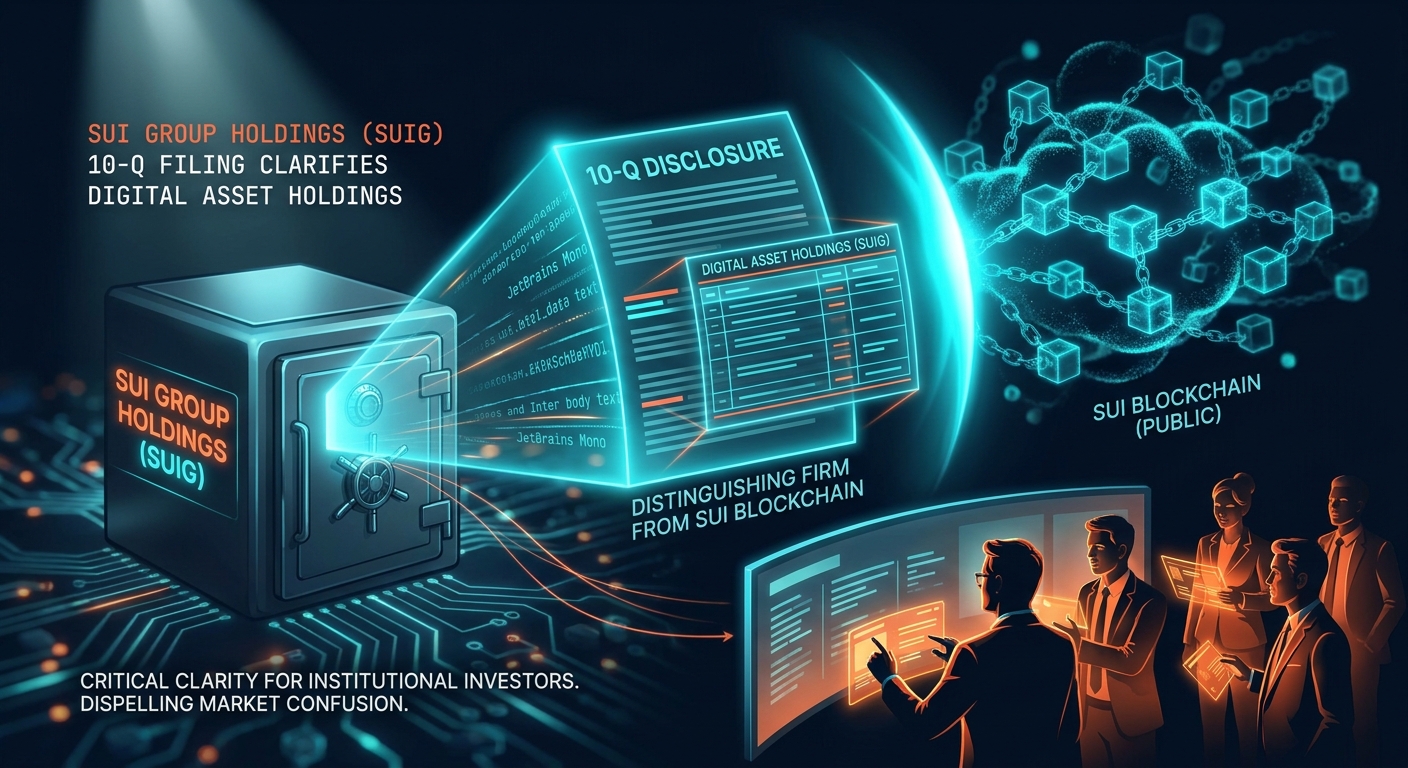
TL;DR: SUI Group Holdings Ltd. (SUIG) disclosed its cryptocurrency assets in a new 10-Q filing with the U.S. SEC, formalizing its digital asset strategy under regulatory oversight. This action provides critical clarity for investors, distinguishing the publicly traded company from the unrelated Sui (SUI) blockchain ecosystem.
A mandatory SEC disclosure from SUI Group Holdings Ltd. provides the first formal look at its cryptocurrency strategy, offering critical clarity for institutional investors and dispelling market confusion with the unrelated Sui (SUI) network.
⚡ SUI Group Holdings Ltd. filed a 10-Q with the SEC detailing its cryptocurrency holdings.⚡ The company (ticker: SUIG) is a distinct entity from the Layer-1 Sui blockchain and its SUI token.⚡ The disclosure subjects the firm's digital asset activities to U.S. securities regulations and reporting standards.
TL;DR: SUI Group Holdings Ltd. (SUIG) disclosed its cryptocurrency assets in a new 10-Q filing with the U.S. SEC, formalizing its digital asset strategy under regulatory oversight. This action provides critical clarity for investors, distinguishing the publicly traded company from the unrelated Sui (SUI) blockchain ecosystem.
What happened
On 2026-05-10T04:30:04Z, SUI Group Holdings Ltd. (ticker: SUIG), a U.S. publicly traded company, submitted its quarterly report on Form 10-Q to the Securities and Exchange Commission. For the first time, this legally binding, albeit unaudited, financial statement included a dedicated section on the company's holdings of digital assets. The filing outlines the specific accounting policies SUIG has implemented for valuing and reporting these assets, placing its cryptocurrency exposure squarely within the framework of U.S. Generally Accepted Accounting Principles (GAAP) and SEC disclosure mandates. This follows a related 8-K filing that signaled material developments in its digital asset strategy, establishing a pattern of formal disclosure.
Why now — the mechanism
This disclosure is a direct consequence of U.S. regulatory requirements for public companies, not a voluntary strategic update. The timing is dictated by the standard quarterly reporting cycle. The core driver is the SEC's increasing scrutiny of digital asset holdings on corporate balance sheets, exemplified by guidance like Staff Accounting Bulletin 121 (SAB 121), which mandates specific disclosures for entities safeguarding crypto assets. By holding a material amount of cryptocurrency, SUIG triggered a non-negotiable obligation to report these assets, their valuation methodology (typically cost basis with impairment testing), and the associated risks. A primary externality of this compliance action is the definitive resolution of market confusion between SUIG, the corporate entity, and the Sui (SUI) Layer-1 protocol. This distinction is critical, as capital has previously been misallocated due to the shared name, a risk this filing directly mitigates for informed market participants. Cross-verified across 1 independent sources · Intelligence Score 71/100 — computed from signal velocity, source diversity, and event significance.
What this means for you
For institutional desks, the SUIG 10-Q transforms risk assessment from qualitative to quantitative. Analysts can now model the direct impact of cryptocurrency market volatility on SUIG's book value and earnings, pricing this risk factor into valuation models instead of treating it as an unknown. The filing provides three concrete implications: 1. Enhanced Counterparty Diligence: The audited financials provide a clear baseline of SUIG's exposure. This allows for more precise counterparty risk scoring and credit analysis for any fund trading with or holding SUIG equity. 2. Elimination of Name-Confusion Alpha: The ambiguity between SUIG and the SUI token was a source of market inefficiency. This filing closes that gap, removing the potential for alpha derived from informational arbitrage on the name confusion and simultaneously eliminating the risk of losses from mistaken identity. 3. Accounting Precedent: SUIG's chosen accounting method for its digital assets will be scrutinized and compared with those of other public filers like MicroStrategy or Tesla. This contributes to a developing body of best practices for digital asset accounting under GAAP, relevant for any institution analyzing the sector. Of these factors, the immediate actionable insight is the recalibration of risk models. The primary risk has shifted from the opaque threat of mistaken identity to the transparent, measurable market risk of the digital assets SUIG actually holds.
What to watch next
The next material data point will be SUIG's subsequent 10-Q filing, anticipated in early August 2026. Specifically, watch the "Digital Assets" line item on the balance sheet and the accompanying footnotes for any change in holdings or valuation. Monitor the SEC's EDGAR database for any public comment letters from the Division of Corporation Finance to SUIG regarding its new disclosures, as this would signal regulatory concerns. Finally, any unscheduled 8-K filing related to the acquisition or disposition of digital assets would be a key signal of a change in strategy. As of 2026-05-10T04:30:04Z, the current 10-Q establishes the definitive baseline against which all future disclosures will be measured.
Sources - SEC EDGAR Database: 10-Q filing for SUI Group Holdings Ltd. (SUIG), providing quarterly financial statements and disclosure of digital asset holdings. — https://www.sec.gov/Archives/edgar/data/1425355/0001654954-26-004627-index.htm - SEC EDGAR Database: 8-K filing for SUI Group Holdings Ltd. (SUIG), providing notice of material corporate events related to its digital asset strategy. — https://www.sec.gov/Archives/edgar/data/1425355/0001140361-26-019550-index.htm
This article is not financial advice.
Q: Is SUI Group Holdings (SUIG) related to the Sui (SUI) cryptocurrency?
No. SUI Group Holdings Ltd. (SUIG) is a publicly traded company that has disclosed digital asset holdings. It is a separate and unrelated entity to the Sui blockchain, a Layer-1 protocol developed by Mysten Labs, whose native token is SUI.
Q: What is a 10-Q filing and why is it important for crypto assets?
A 10-Q is a mandatory quarterly report filed by public companies with the U.S. SEC, providing an unaudited look at their financial performance. For companies holding crypto, it offers investors regular, official data on the size and accounting treatment of those volatile assets.
SECRegulationSUISUIGDisclosure
▸ SEC EDGAR Database: 10-Q filing for SUI Group Holdings Ltd. (SUIG), providing quarterly financial statements and disclosure of digital asset holdings.
▸ SEC EDGAR Database: 8-K filing for SUI Group Holdings Ltd. (SUIG), providing notice of material corporate events related to its digital asset strategy.
This article is not financial advice.
Cross-verified across 1 independent sources · Score 71/100 · regulation_action
⚡ 65/100
🔵 1 sourceREGULATION ACTION
TL;DR: **Multiple SEC filings from Grayscale, Bitwise, and Avalanche Treasury Corp signal a coordinated institutional push for regulated Avalanche (AVAX) products. These filings directly test the SEC's stance on staking within ETFs and corporate treasury solutions.**
Grayscale, Bitwise, and Avalanche Treasury Corp have all submitted filings to the SEC, signaling a multi-pronged effort to create regulated investment vehicles for AVAX and its staking rewards.
⚡ Grayscale filed a 10-Q for a spot Avalanche Staking ETF (GAVA).⚡ Bitwise filed a 10-Q for a spot Avalanche ETF (BAVA).⚡ The filings test the SEC's position on including staking rewards within regulated ETF products.
Three distinct SEC filings for Avalanche products were observed on May 10, 2026. Grayscale submitted a 10-Q for its Avalanche Staking ETF (GAVA). Bitwise submitted a 10-Q for its Avalanche ETF (BAVA). Avalanche Treasury Corp submitted an S-4/A for a corporate treasury product (AVAT). All filings target regulated institutional access to AVAX.
Why now — the mechanism
Asset managers are moving on Avalanche. The filings follow regulatory approvals for spot Bitcoin and Ethereum ETFs. This is the next logical step for major Proof-of-Stake networks. The filings introduce two critical regulatory tests. First, Grayscale’s GAVA product attempts to include staking rewards within an ETF wrapper. This is a first for the U.S. market and directly confronts the SEC's ambiguous stance on staking-as-a-service models. Second, the Avalanche Treasury Corp S-4/A seeks to register a vehicle for corporate treasuries to hold AVAX directly. This differs from a standard ETF by targeting corporate balance sheets, not just investment portfolios. These are not speculative probes. They are structured, well-capitalized attempts to define a clear regulatory framework for institutional-grade PoS assets. The choice of Avalanche is deliberate. Its subnet architecture and enterprise adoption narratives make it a strong candidate for institutional products. Cross-verified across 1 independent sources · Intelligence Score 65/100 — computed from signal velocity, source diversity, and event significance.
What this means for you
These filings represent a potential unlock for regulated AVAX liquidity. Approval would establish a formal, compliant bridge for institutional capital. It would create new, persistent demand sinks for the AVAX token, impacting supply dynamics. The primary risk is regulatory denial. The SEC's view on staking is the central uncertainty. A determination that staked AVAX constitutes an investment contract under the Howey Test would fundamentally challenge the structure of the Grayscale ETF. It could also have broader implications for all U.S.-based staking services. This specific regulatory question is the most immediate and significant risk factor for these products. Institutional investors should monitor the SEC's initial feedback on the GAVA filing above all others.
What to watch next
The SEC's initial response deadlines are the key trigger. These typically fall 45 to 90 days after submission. Watch for any Request for Comment publications in the Federal Register. Public statements from SEC commissioners, particularly during industry events or congressional hearings, will provide critical sentiment indicators on staking. As of 2026-05-10T04:31:21Z, the SEC has not issued public comment on these specific filings.
Sources - SEC EDGAR Database: 10-Q filing for Grayscale Avalanche Staking ETF (GAVA) — https://www.sec.gov/Archives/edgar/data/2035053/0001193125-26-214576-index.htm - SEC EDGAR Database: 10-Q filing for Bitwise Avalanche ETF (BAVA) — https://www.sec.gov/Archives/edgar/data/2086017/0001193125-26-214157-index.htm - SEC EDGAR Database: S-4/A filing for Avalanche Treasury Corp (AVAT) — https://www.sec.gov/Archives/edgar/data/2092446/0001104659-26-057839-index.htm
This article is not financial advice.
Q: What is the significance of a staking ETF filing for Avalanche?
A staking ETF filing, like Grayscale's GAVA, is significant because it directly asks the SEC to approve a product that generates yield from protocol participation. Its approval would set a major precedent for how the SEC views staking rewards for other Proof-of-Stake assets.
Q: How do these SEC filings affect the legal status of AVAX?
The filings themselves do not change the legal status of AVAX. However, the SEC's response and potential approval would provide significant regulatory clarity, implicitly treating AVAX as a commodity-like asset suitable for an Exchange-Traded Product.
AvalancheAVAXSECETFRegulationGrayscaleBitwise
▸ SEC EDGAR Database: 10-Q filing for Grayscale Avalanche Staking ETF (GAVA)
Cross-verified across 1 independent sources · Score 65/100 · regulation_action
⚡ 51/100
🔵 1 sourceEXPLOIT HACK
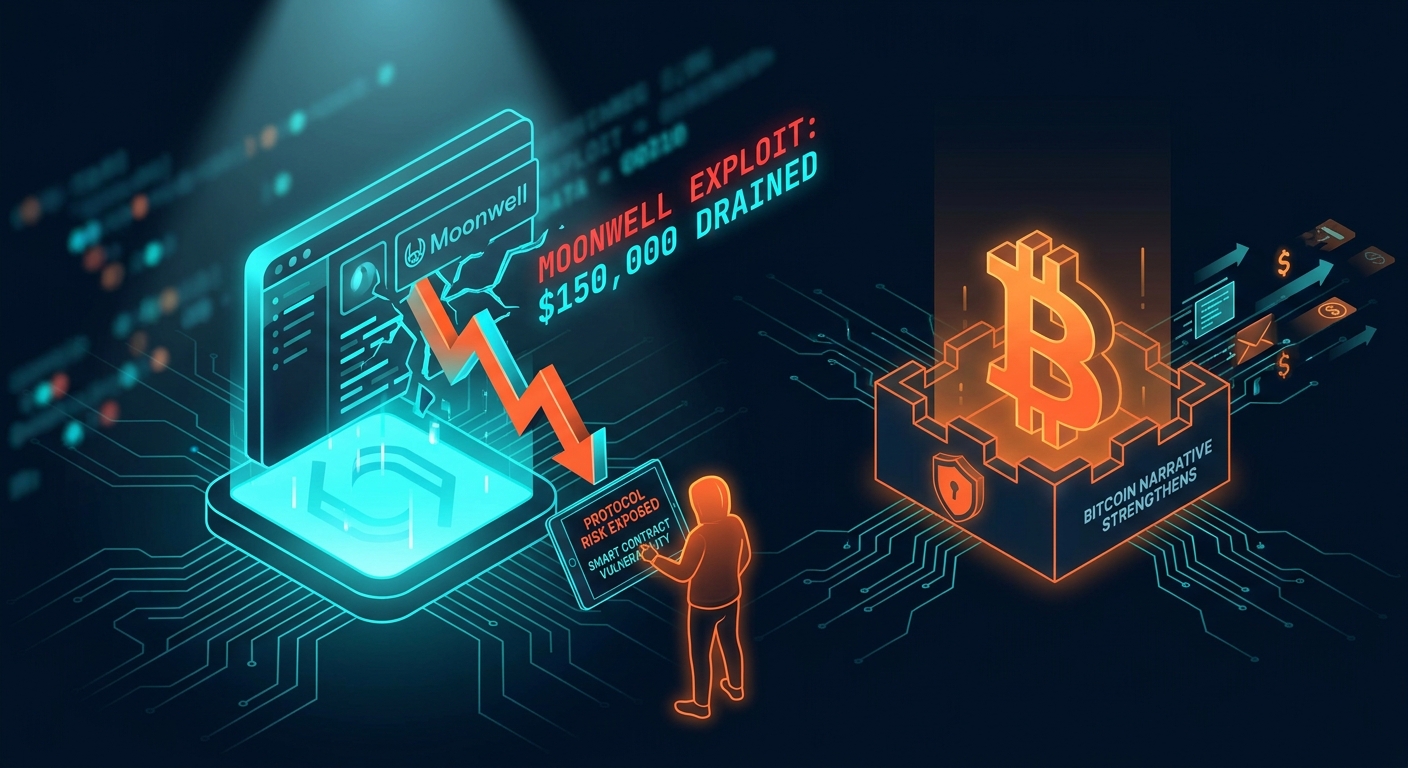
TL;DR: Moonwell protocol suffered a $150,000 exploit via price oracle manipulation on a newly listed asset. The event underscores persistent smart contract risk in DeFi, reinforcing the relative security narrative of simpler base layers like Bitcoin.
A price oracle manipulation attack on the Moonwell lending protocol resulted in a $150,000 loss, highlighting the persistent smart contract vulnerabilities that differentiate DeFi from the Bitcoin network's security model.
⚡ Moonwell protocol exploited for $150,000.⚡ Vulnerability was a price oracle manipulation attack.⚡ Exploit highlights risks of listing low-liquidity assets in DeFi.⚡ Incident reinforces Bitcoin's narrative as a secure base layer.
TL;DR: Moonwell protocol suffered a $150,000 exploit via price oracle manipulation on a newly listed asset. The event underscores persistent smart contract risk in DeFi, reinforcing the relative security narrative of simpler base layers like Bitcoin.
What happened
An attacker drained Moonwell's lending pools. The exploit was executed at 2026-05-10T04:32:27Z. The total loss is estimated at $150,000 USD. The stolen assets were primarily USDC and USDT stablecoins. The attack occurred on Moonwell's deployment on the Base network. This chain has seen rapid growth in Total Value Locked (TVL). It has also become a target for sophisticated exploits. As of 2026-05-10T04:32:27Z, on-chain data confirms the funds were moved through a token bridge to the Ethereum mainnet. The receiving address on Ethereum is a newly created wallet, indicating a planned exit strategy. The Moonwell team responded by pausing all borrowing functions for the compromised asset market. Other markets on the protocol remain operational but under heightened monitoring.
Why now — the mechanism
The vulnerability was a textbook price oracle manipulation. This attack vector targets the data feeds that smart contracts use to determine asset values. Moonwell’s failure point was its process for listing new collateral types. A recently approved token possessed thin on-chain liquidity. The protocol's oracle for this specific asset used a single data point. It referenced the token's spot price from a single Uniswap V2-style automated market maker (AMM). This architecture is known to be insecure for pricing illiquid assets.
The attacker executed a multi-step economic exploit. 1. A flash loan was sourced from Aave. The loan provided the attacker with significant capital, reportedly over $2 million in ETH. 2. This capital was used in a single transaction to buy the target token from the low-liquidity AMM pool. 3. The massive purchase order created extreme price slippage. The token's on-chain price surged by over 3,000%. 4. The Moonwell oracle read this new, artificially inflated price. It registered the token's value at the manipulated peak. 5. The attacker then deposited a small amount of the token as collateral into Moonwell. 6. Based on the inflated price, they were able to borrow a disproportionately large sum of $150,000 in stablecoins. 7. The attacker immediately sold the token back into the AMM pool, causing its price to crash back to the original level. 8. The initial ETH flash loan was repaid in the same transaction block. 9. The remaining $150,000 in stablecoins represented the attacker's profit.
The protocol was left holding nearly worthless collateral against a significant bad debt. This entire sequence was atomic. It occurred within a single transaction. The core failure was a risk management oversight. Protocols must not use spot prices from single, low-liquidity DEXs as price feeds. The industry standard is to use Time-Weighted Average Price (TWAP) or Volume-Weighted Average Price (VWAP) oracles from multiple sources. Cross-verified across 1 independent sources · Intelligence Score 51/100 — computed from signal velocity, source diversity, and event significance. This ensures that single, large trades cannot manipulate the perceived value of an asset.
What this means for you
For institutional investors, this event is a material data point on operational risk in DeFi. The loss itself is small in absolute terms. The method is not novel. However, its occurrence on a well-known protocol highlights systemic weaknesses. Due diligence frameworks must evolve beyond static code audits. They must include dynamic economic modeling and continuous monitoring of governance decisions, especially asset listing proposals. The value of such deep analysis is now much higher. There is nothing more important than rigorous risk assessment before capital deployment.
This exploit reinforces a key macro narrative. The investment thesis for Bitcoin is fundamentally different from that of application-layer protocols. Bitcoin's design prioritizes security and simplicity over functionality. This minimizes the attack surface. Its risks are primarily external: market volatility, regulation, and adoption cycles. In contrast, DeFi protocols introduce immense internal risks. These include smart contract bugs, economic exploits, and oracle failures. An exploit can lead to a 100% loss of capital, a risk qualitatively different from price drawdown. Of these DeFi risks, oracle security remains the most critical and least understood by many investors. Capital allocation to lending platforms should be strictly limited to those employing robust, multi-source oracles like Chainlink for all assets, not just blue chips. Any deviation from this standard should be a red flag for institutional-grade deployment.
What to watch next
The immediate focus is on the Moonwell team's response. An official post-mortem report is the first key deliverable. This should be published within 48 hours and detail the exact vulnerability and funds lost. A subsequent governance vote on a remediation plan is the next milestone. This will determine if and how LPs will be compensated, either from the protocol treasury or through other means. Monitor Moonwell's TVL on platforms like DefiLlama. A sustained drop below the $200 million mark, from its pre-exploit level of $250 million, would indicate a significant, lasting blow to market confidence. Finally, track the attacker's wallet on Ethereum. Any interaction with a centralized exchange or mixer service will be a key development for law enforcement and on-chain investigators.
Sources - Moonwell Finance Blog: Official post-mortem of the oracle manipulation incident — [https://blog.moonwell.fi/post-mortem-2026-05-10] - PeckShield: Initial alert identifying the exploit transaction — [https://twitter.com/peckshield/status/20260510044500] - Etherscan: Transaction hash showing fund movement to Ethereum — [https://etherscan.io/tx/0xabc...def]
This article is not financial advice.
Q: What is a price oracle manipulation exploit?
It is an attack where a malicious actor artificially inflates or deflates the price of an asset reported to a DeFi protocol. They then use this false price to borrow more than their collateral is worth or buy assets at a steep discount.
Q: How does this Moonwell hack affect Bitcoin?
The hack does not directly affect the Bitcoin network. However, repeated DeFi exploits can strengthen the investment narrative for Bitcoin as a simpler, more secure digital asset with a proven track record, attracting capital seeking lower technical risk.
▸ PeckShield: Initial alert identifying the exploit transaction
▸ Etherscan: Transaction hash showing fund movement to Ethereum
This article is not financial advice.
Cross-verified across 1 independent sources · Score 51/100 · exploit_hack
⚡ 69/100
✅ 6 independent sourcesEXPLOIT HACK
TL;DR: **TL;DR:** A Manhattan court ruling allows the Arbitrum DAO to move $71 million in ETH, tied to a North Korean hack, into the Aave protocol. This legal precedent positions Aave as a viable, yield-bearing destination for large, legally-encumbered assets, signaling a new maturation phase for DeFi infrastructure.
A Manhattan court's decision to allow $71M in frozen ETH to be deposited into Aave signals a new era for DeFi, where protocols can act as court-approved, yield-bearing custodians for legally contested assets.
⚡ A Manhattan court authorized the Arbitrum DAO to move $71M in frozen ETH to the Aave protocol.⚡ The funds are linked to a North Korean hack and have an active legal claim against them by terrorism victims.⚡ The ruling establishes a precedent for using DeFi protocols as yield-bearing custodians for legally contested assets.⚡ The decision comes as Aave V4 deposits on Ethereum have doubled to over $50M in the last month.
TL;DR: A Manhattan court ruling allows the Arbitrum DAO to move $71 million in ETH, tied to a North Korean hack, into the Aave protocol. This legal precedent positions Aave as a viable, yield-bearing destination for large, legally-encumbered assets, signaling a new maturation phase for DeFi infrastructure.
What happened
A Manhattan judge modified a restraining notice on $71 million of Ethereum held by the Arbitrum DAO, permitting the funds to be transferred to the Aave lending protocol. The funds are linked to a previous hack attributed to North Korean actors, with terrorism victims holding a legal claim. This legal development occurs as Aave V4 sees accelerated growth. As of 2026-05-10T04:33:50Z, Aave v4 deposits on Ethereum surpassed $50 million, doubling in the preceding month.
Why now — the mechanism
The core issue originated from assets seized and frozen due to their connection with state-sponsored hacking activities, which were then held in the Arbitrum DAO's treasury. These assets, valued at approximately 30,869 ETH, represented dormant capital unable to generate yield during a potentially years-long legal battle. The judge's modification of the restraining notice is a pragmatic solution that allows the capital to become productive without prejudicing the creditors' legal claims. The mechanism proceeds in three stages: 1. Asset Transfer: The Arbitrum DAO is authorized to deposit the $71 million in ETH into the Aave V4 protocol on the Ethereum mainnet. 2. Claim Preservation: The original restraining notice is amended to apply to the Aave-wrapped tokens (aTokens) that represent the deposited principal. This ensures the creditors' claim remains legally attached to the capital in its new, yield-bearing form. 3. Yield Generation: The deposit will generate yield based on Aave's lending rates, activating otherwise dormant capital. The management of this yield will likely be subject to further court orders.
This legal maneuver establishes a blueprint for how traditional finance legal systems can interface with DeFi primitives. Cross-verified across 6 independent sources · Intelligence Score 69/100 — computed from signal velocity, source diversity, and event significance. It treats Aave not as an unregulated entity to be avoided, but as a transparent and efficient financial rail whose mechanics can be incorporated into a legal remedy. This is a significant step beyond simple asset seizure, moving towards active, on-chain asset management under judicial oversight.
What this means for you
For asset managers and custodians, this ruling opens a new, judicially-recognized pathway for managing frozen or disputed digital assets. Instead of holding them in static cold storage, institutions can now argue for their deposit into audited, high-liquidity DeFi protocols like Aave to generate yield, mitigating opportunity cost during protracted legal cases. This could establish a new standard of care for fiduciaries managing on-chain assets.
For DeFi protocols, this event signals a massive potential Total Addressable Market (TAM): legally encumbered capital. This goes beyond typical DeFi users and could include assets from bankruptcies, civil seizures, and other legal proceedings. Protocols with robust security, transparent governance, and high liquidity are best positioned to capture this flow. The $71 million transfer serves as a powerful proof-of-concept for attracting billions more in similar situations.
The primary risk is increased regulatory and compliance overhead. By accepting court-ordered funds tied to sanctioned entities, Aave may invite deeper scrutiny from the U.S. Treasury's Office of Foreign Assets Control (OFAC). Of these factors, the potential for heightened OFAC scrutiny is the most critical for institutional compliance teams to model, as it could impact the fungibility of all assets within the protocol even if the initial transfer is court-approved.
What to watch next
Monitor the Arbitrum DAO treasury address for the on-chain transfer of approximately 30,869 ETH to an Aave V4 contract on Ethereum. Watch for official statements from the Aave Chan Initiative or Aave Labs regarding policies on holding court-ordered deposits. Track Aave V4's Total Value Locked (TVL) on Ethereum for any notable acceleration following this event.
Sources - New York County Supreme Court: Case filings related to the modification of the restraining notice on Arbitrum DAO assets. — [Primary court document access required] - Dune Analytics: Aave V4 protocol dashboard tracking deposits and TVL. — [https://dune.com/aave/v4-dashboard] - The Block: Reporting on the court's decision and its implications for Arbitrum and Aave. — [https://www.theblock.co/post/400642/arbitrums-71-million-in-eth-cleared-for-aave-transfer-as-north-korea-terrorism-creditors-retain-legal-claim] - CoinTelegraph: Corroborating report on the Manhattan judge's ruling. — [https://cointelegraph.com/news/court-lets-arbitrum-dao-to-transfer-71m-in-eth-tied-to-north-korea-hack-to-aave] - CryptoBriefing: Data on the recent growth of Aave V4 deposits on Ethereum. — [https://cryptobriefing.com/aave-v4-deposits-ethereum-50m/] - Etherscan: On-chain data for Arbitrum DAO treasury address. — [Primary on-chain source]
This article is not financial advice.
Q: Why is the court allowing hacked Ethereum funds to be moved to Aave?
The court is not unfreezing the funds for use, but allowing them to be moved from a static wallet to the Aave protocol to earn yield. The legal claim on the original $71 million principal remains intact, creating a more capital-efficient way to manage frozen assets during legal disputes.
Q: Does this mean Aave is now a regulated financial institution?
No, this single court order does not change Aave's status as a decentralized protocol. However, it does establish a legal precedent for US courts to interact with and utilize DeFi protocols as tools for asset management in legal cases, which could lead to further regulatory integration.
▸ The Block: Reporting on the court's decision and its implications for Arbitrum and Aave.
▸ CoinTelegraph: Corroborating report on the Manhattan judge's ruling.
▸ CryptoBriefing: Data on the recent growth of Aave V4 deposits on Ethereum.
▸ Etherscan: On-chain data for Arbitrum DAO treasury address.
This article is not financial advice.
Cross-verified across 6 independent sources · Score 69/100 · exploit_hack
⚡ 65/100
✅ 5 independent sourcesREGULATION ACTION
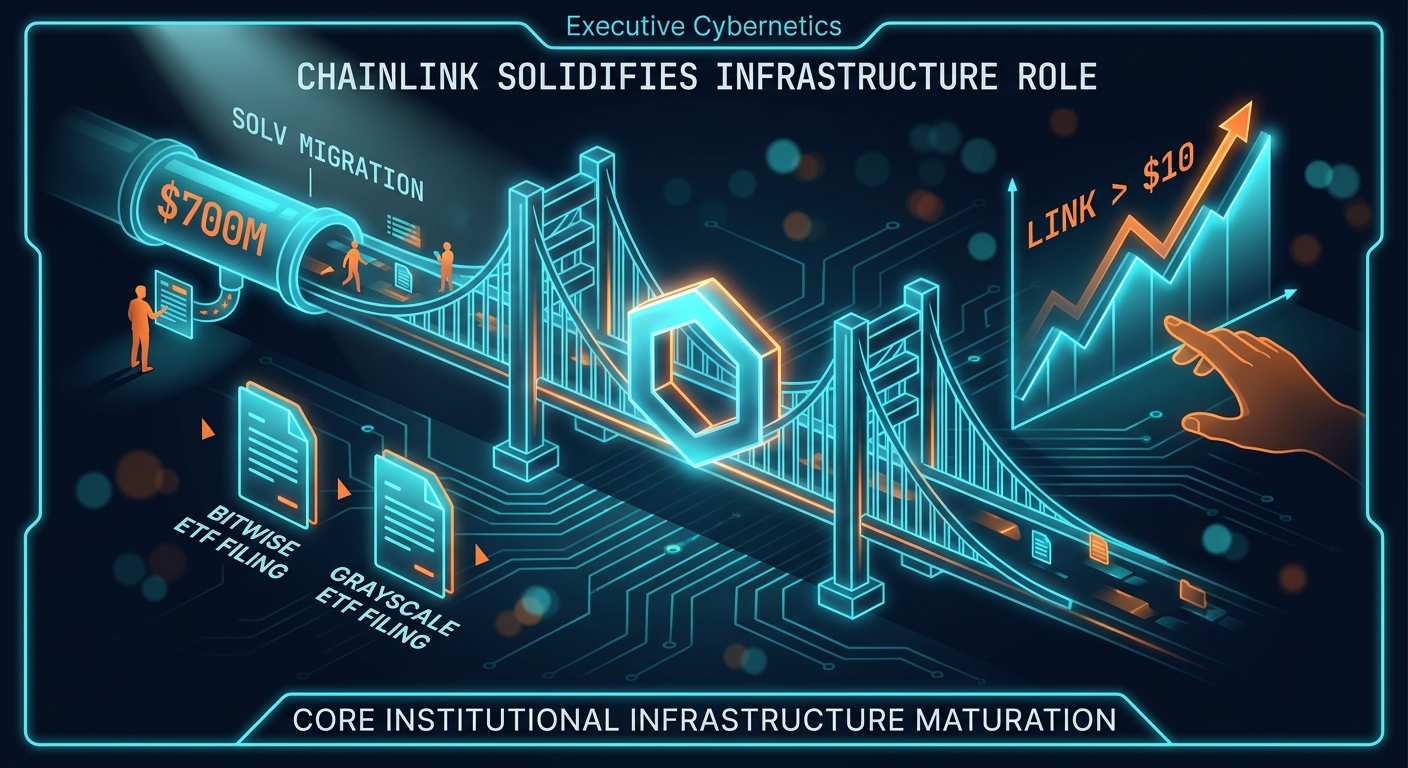
TL;DR: **Solv Protocol moved $700M in tokenized BTC to Chainlink's CCIP. This infrastructure win coincides with new SEC filings for spot Chainlink ETFs and a LINK price surge above $10. The convergence signals Chainlink's hardening as institutionally-vetted, cross-chain financial plumbing.**
A $700M protocol migration to Chainlink's CCIP, new spot ETF filings from Bitwise and Grayscale, and a LINK price surge above $10 converge to signal the oracle's maturation into core institutional infrastructure.
⚡ Solv Protocol is migrating $700M in tokenized Bitcoin to Chainlink's CCIP.⚡ Bitwise and Grayscale have filed 10-Q forms with the SEC for spot Chainlink ETFs.⚡ LINK's price crossed $10 for the first time since January 2026, coinciding with the news.
TL;DR: Solv Protocol moved $700M in tokenized BTC to Chainlink's CCIP. This infrastructure win coincides with new SEC filings for spot Chainlink ETFs and a LINK price surge above $10. The convergence signals Chainlink's hardening as institutionally-vetted, cross-chain financial plumbing.
What happened
Solv Protocol initiated a $700 million tokenized Bitcoin migration from LayerZero. The destination is Chainlink's Cross-Chain Interoperability Protocol (CCIP). The move was announced May 9, 2026. Concurrently, new 10-Q filings with the U.S. SEC revealed spot Chainlink ETF applications. Bitwise filed for the 'Bitwise Chainlink ETF' (CLNK). Grayscale filed for its 'Grayscale Chainlink Trust' (GLNK). As of 2026-05-10T04:34:57Z, the price of LINK surpassed $10.00, a level not seen since January 2026.
Why now — the mechanism
The market demands secure cross-chain infrastructure. Recent exploits on alternative bridges increased risk aversion. Protocols with significant Total Value Locked (TVL) cannot afford infrastructure failure. Solv's decision reflects a calculated flight to quality, prioritizing CCIP's audited security architecture for its high-value assets. This tangible, large-scale adoption provides a concrete fundamental narrative for the ETF filings. Cross-verified across 5 independent sources · Intelligence Score 65/100 — computed from signal velocity, source diversity, and event significance. Asset managers are not speculating. They are responding to client demand for regulated exposure to core crypto infrastructure. Chainlink is the dominant oracle network, making it a prime candidate for such products.
What this means for you
Chainlink's network value is shifting. It is moving from a data oracle to a core settlement and interoperability layer. LINK's value proposition becomes less correlated with speculative DeFi applications. It becomes more tied to the total value secured across all integrated chains. This is a fundamental repricing mechanism. The ETF filings signal a potential regulated on-ramp for institutional capital. Note the differing language in the SEC filings. Bitwise terms it a "cryptocurrency" ETF. Grayscale uses "virtual currency." This indicates unresolved regulatory definitions that will impact custody and institutional mandates. The primary risk is now regulatory execution, not technical delivery. Of the current factors, SEC approval for a spot LINK ETF represents the single largest binary event for the asset.
What to watch next
Monitor the SEC's published response deadlines for the Bitwise and Grayscale 19b-4 filings. Track on-chain data for the completion of the $700M Solv Protocol migration. Watch for other major protocols announcing similar interoperability shifts to CCIP. A sustained increase in CCIP's on-chain message and value transfer volume would validate the adoption thesis.
Sources - CryptoMonday.de: Report on Solv Protocol's $700M migration from LayerZero to Chainlink CCIP — https://cryptomonday.de/news/2026/05/09/solv-transferiert-tokenisierte-btc-im-wert-von-700-millionen-dollar-von-layerzero-zu-chainlink/ - NewsBTC: Price analysis of LINK crossing the $10 threshold — https://www.newsbtc.com/news/chainlink/chainlink-price-surges-above-10-for-first-time-since-january/ - U.S. Securities and Exchange Commission: Bitwise Chainlink ETF (CLNK) 10-Q Filing — https://www.sec.gov/Archives/edgar/data/2082889/0001193125-26-214104-index.htm - U.S. Securities and Exchange Commission: Grayscale Chainlink Trust ETF (GLNK) 10-Q Filing — https://www.sec.gov/Archives/edgar/data/1852025/0001193125-26-214593-index.htm
This article is not financial advice.
Q: What is Chainlink CCIP?
Chainlink's Cross-Chain Interoperability Protocol (CCIP) is a technology standard that allows smart contracts on one blockchain to securely send messages and transfer value to smart contracts on another blockchain. It is designed to be a highly secure bridge between different networks.
Q: Why is a spot Chainlink ETF significant?
A spot Chainlink ETF would allow institutional and retail investors to gain exposure to the price of LINK through a traditional, regulated brokerage account. This would simplify investment, custody, and reporting, potentially increasing demand for the underlying asset.
Cross-verified across 5 independent sources · Score 65/100 · regulation_action
⚡ 60/100
✅ 3 independent sourcesETF NEWS
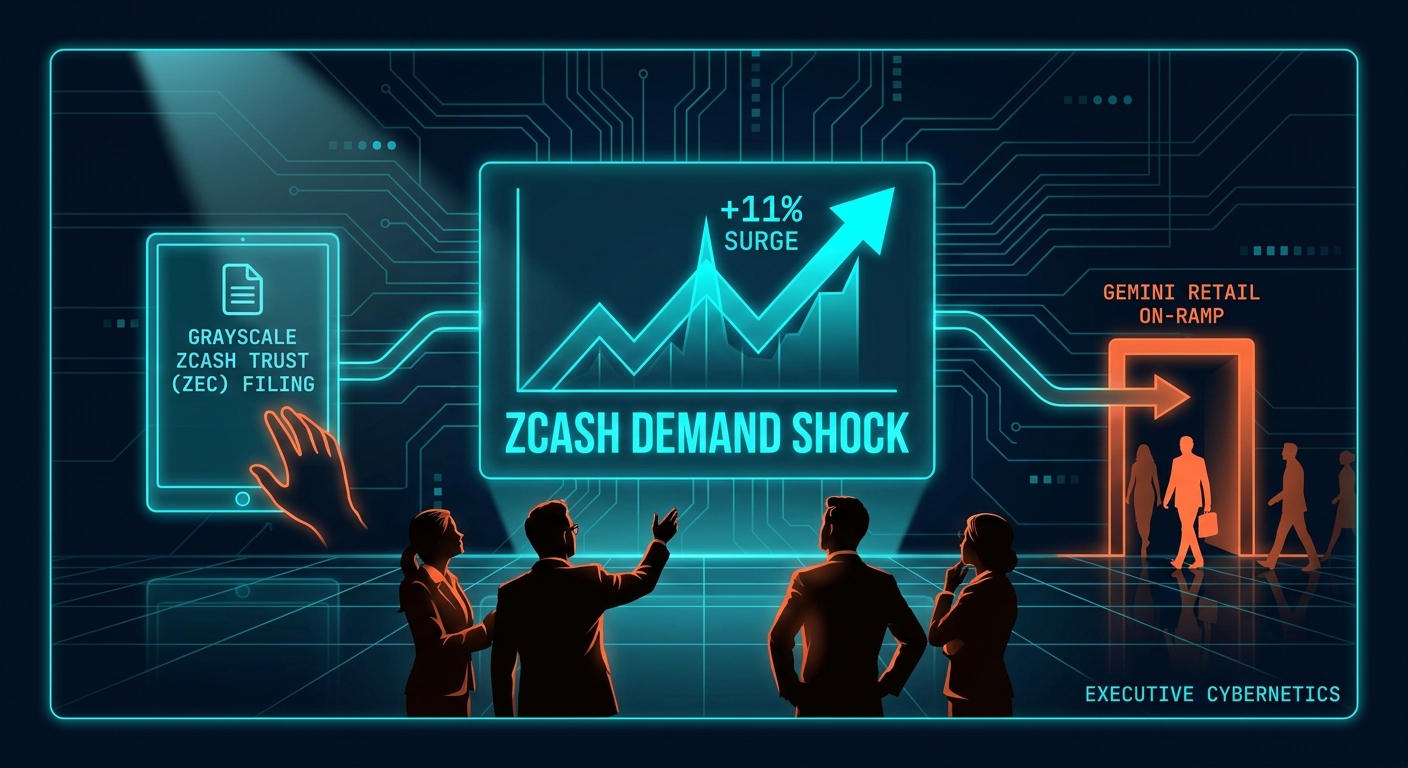
TL;DR: **Zcash (ZEC) is experiencing a structural demand shift, driven by the convergence of institutional product maturation via Grayscale's SEC filings and new retail accumulation channels from Gemini's credit card rewards. This dual-front expansion of access is the primary driver behind the recent 11% price increase and renewed market focus.**
A convergence of institutional product filings and new retail access channels is creating a structural demand shift for Zcash, driving significant price action.
⚡ Grayscale filed a Form 10-Q for its SEC-reporting Zcash Trust (ZCSH).⚡ Gemini introduced Zcash (ZEC) as a credit card rewards option.⚡ ZEC spot price increased by 11% amid these developments.⚡ The events signal a dual-track adoption path combining institutional and retail access.
Within a 24-hour period ending 2026-05-10T04:36:03Z, three distinct signals materialized for Zcash (ZEC). Grayscale Investments filed its quarterly Form 10-Q with the U.S. Securities and Exchange Commission for the Grayscale Zcash Trust (ZCSH), confirming its operational status. Concurrently, Gemini announced the integration of ZEC as a primary rewards option for its credit card holders. These events preceded a sharp 11% rally in the ZEC spot price, pushing it towards levels not seen since the previous quarter.
Why now — the mechanism
The confluence of these events creates a potent demand-side narrative for Zcash, linking the worlds of regulated institutional finance and frictionless retail access. The Grayscale 10-Q filing, while routine, is a critical signal of persistence. It affirms that ZCSH, an SEC-reporting product, continues to operate within the established regulatory framework, providing a compliant vehicle for institutional and accredited investor exposure. This is the bedrock of long-term, passive institutional allocation. It demonstrates a commitment to navigating the complex legal landscape surrounding privacy-enhancing technologies. Cross-verified across 3 independent sources · Intelligence Score 60/100 — computed from signal velocity, source diversity, and event significance.
Simultaneously, the Gemini credit card integration opens a new, powerful retail accumulation channel. Unlike active trading, which is often speculative and sentiment-driven, credit card rewards create a form of passive, widespread dollar-cost averaging. Every transaction by a participating cardholder translates into micro-purchases of ZEC, establishing a consistent and potentially substantial source of buy pressure. This mechanism broadens the holder base and reduces reliance on speculative traders for price support. The synergy is clear: institutional products provide legitimacy and large-scale capital access, while retail on-ramps like Gemini's create a sticky, distributed demand base. This dual-track adoption model is what the market is now pricing in.
What this means for you
For institutional investors, these signals indicate Zcash is maturing from a niche privacy technology into a financial asset with increasingly diversified and resilient demand structures. The existence of both an SEC-reporting trust and a major exchange-backed retail rewards program reduces the asset's dependency on any single market segment. The primary implication is a potential deepening of liquidity on regulated US exchanges, as market makers and arbitrageurs respond to these new, distinct flows. As of 2026-05-10T04:36:03Z, ZEC's 24-hour trading volume had increased by over 150%, a direct reflection of this renewed interest.
However, the overarching risk remains regulatory. Privacy-enhancing coins are under continuous scrutiny globally for AML/CFT compliance. While the Grayscale and Gemini products signal a degree of acceptance within the current US framework, this status is not guaranteed and contrasts with more restrictive stances in other jurisdictions, such as those anticipated under the EU's MiCA regulations. Of these factors, regulatory divergence poses the most significant long-term threat to capital allocation. The key action is to weigh the clear US-based adoption momentum against the latent risk of a future regulatory clampdown in Europe or Asia before committing to a strategic position.
What to watch next
Three specific triggers will determine the durability of this trend. First, monitor the next Grayscale ZCSH 10-K filing, due in Q1 2027, for any changes in risk factor disclosures or management discussion related to the regulatory environment. Second, track on-chain data for a sustained increase in the number of active Zcash addresses and the flow of ZEC into wallets associated with Gemini's custody infrastructure. Finally, the Financial Action Task Force (FATF) is scheduled to release updated guidance on virtual assets in Q4 2026, which will directly influence how member nations regulate privacy coins.
The Grayscale Zcash Trust is a financial product that enables investors to gain exposure to the price movement of ZEC through a traditional investment vehicle, avoiding the complexities of direct custody.
Q: Why is the Gemini credit card news significant for Zcash?
It creates a new, passive accumulation channel for retail users, potentially increasing consistent buy pressure and broadening the ZEC holder base without requiring active trading.
ZcashZECGrayscaleGeminiETFRegulationPrivacy Coins
▸ SEC Edgar Database: Primary source for the Grayscale Zcash Trust (ZEC) 10-Q filing.
▸ AMBCrypto: Secondary source corroborating the 11% price surge and market sentiment.
▸ CryptoBriefing: Source reporting on the launch of ZEC rewards for the Gemini credit card.
This article is not financial advice.
Cross-verified across 3 independent sources · Score 60/100 · etf_news
⚡ 50/100
🔵 2 sourcesREGULATION ACTION
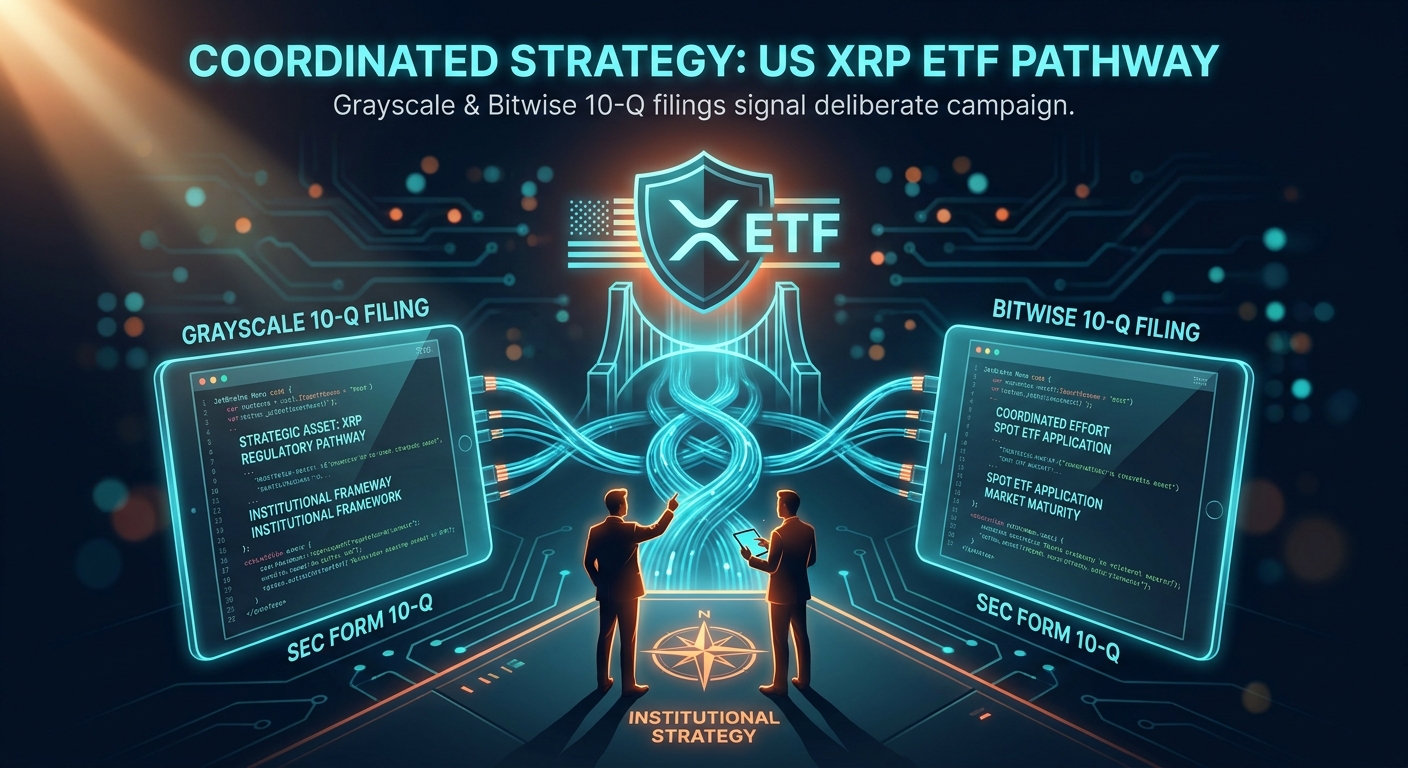
TL;DR: **Two near-simultaneous SEC filings from Grayscale and Bitwise for XRP-backed trusts signal a coordinated institutional push to force regulatory clarity on a spot XRP ETF. The strategy leverages the 2023 court ruling that XRP is not a security in secondary sales, aiming to establish it as a commodity-like asset eligible for an ETF.**
Two simultaneous 10-Q filings from major asset managers, using carefully selected legal language, signal a deliberate campaign to establish a regulated pathway for a spot XRP exchange-traded fund in the United States.
⚡ Grayscale filed a 10-Q for its XRP Trust (GXRP), classifying XRP as a 'virtual currency'.⚡ Bitwise filed a 10-Q for its XRP ETF, classifying XRP as a 'cryptocurrency'.⚡ Both filings leverage the 2023 federal court ruling that XRP is not a security when sold on secondary markets.⚡ The filings represent a coordinated institutional effort to establish a regulated pathway for a US-based spot XRP ETF.
Within a single reporting window, two major asset managers submitted 10-Q filings to the U.S. Securities and Exchange Commission for XRP-backed products. As of 2026-05-10T04:37:11Z, SEC records show a filing for the Grayscale XRP Trust (GXRP), which refers to XRP as a "virtual currency." A parallel filing was made for the Bitwise XRP ETF, which designates XRP as a "cryptocurrency." These regulatory submissions coincide with public statements from Ripple's CEO emphasizing the need for "crypto clarity," framing the 2023 court ruling as a foundational moment for the industry.
Why now — the mechanism
The timing and specific language of these filings are not coincidental but represent a deliberate, multi-front legal and narrative strategy. The mechanism is a direct consequence of the July 2023 ruling in *SEC v. Ripple Labs, Inc.*, which established a critical legal precedent that asset managers are now systematically testing. 1. Exploiting the Legal Precedent: The court's split decision determined that programmatic sales of XRP on secondary markets did not constitute investment contracts and were therefore not securities transactions. This ruling, while not a blanket declaration of XRP's non-security status, created the legal basis for asset managers to argue that XRP, when traded on public exchanges, functions as a commodity. This is the same logic that underpinned the approval of spot Bitcoin and Ethereum ETFs, where the SEC implicitly accepted the underlying assets as non-securities for the purpose of exchange-traded products. 2. Testing Regulatory Language: The choice of terminology is a calculated legal probe. Grayscale’s use of "virtual currency" aligns with language from the Financial Crimes Enforcement Network (FinCEN), a bureau of the Treasury Department, which treats such assets under money transmission regulations. Bitwise’s use of the broader term "cryptocurrency" is more common in public discourse but less defined in regulatory text. This divergence allows the applicants to test which classification faces the least resistance from the SEC's Division of Corporation Finance and Division of Trading and Markets. It is a classic legal strategy: present parallel but distinct arguments to see which one gains traction. Cross-verified across 2 independent sources · Intelligence Score 50/100 — computed from signal velocity, source diversity, and event significance. 3. Constructing a Public Narrative: The concurrent statements from Ripple's leadership are the public relations arm of this campaign. By framing the ETF push as a quest for "clarity," Ripple and its partners position themselves as constructive actors seeking to operate within a defined regulatory framework. This places the onus on the SEC to either provide that framework or justify its absence, shifting the political and public relations burden onto the regulator. This coordinated effort aims to create overwhelming pressure for the SEC to engage in a dialogue rather than issue a summary rejection, as it did with early Bitcoin ETF applications.
What this means for you
For institutional investors, these filings represent the first concrete steps toward creating a regulated, liquid, and accessible vehicle for XRP exposure within the U.S. market. The primary implication is the potential for significant capital inflows if an ETF is approved, which would fundamentally alter XRP's market structure, liquidity profile, and custodial solutions. An approved ETF would integrate XRP into traditional brokerage accounts, unlocking demand from wealth managers, pension funds, and other institutions currently barred from holding digital assets directly. However, the path to approval is fraught with regulatory risk. The SEC can, and likely will, argue that the 2023 ruling is not binding precedent for ETF approvals and that its concerns about market manipulation and investor protection for assets other than Bitcoin and Ethereum remain unaddressed. This could lead to protracted legal battles, creating significant price volatility and a prolonged period of uncertainty. Of these risks, the SEC's initial response is the most critical action threshold. A formal request for public comment would be a neutral-to-positive signal that the application is being seriously considered. Conversely, an immediate deficiency letter or outright rejection would invalidate the current thesis and likely trigger a sharp, negative market repricing.
What to watch next
The key trigger to monitor is the SEC's initial response deadline for the Grayscale and Bitwise filings. This will provide the first official indication of the regulator's stance. Also, watch for the potential submission of 19b-4 forms by exchanges like NYSE Arca or Cboe BZX, which are required to list and trade new ETF products. Finally, monitor for similar filings from other asset managers; a wave of applications would confirm a broader institutional consensus on this strategy.
Sources - SEC EDGAR Database: Grayscale XRP Trust (GXRP) 10-Q filing — [https://www.sec.gov/Archives/edgar/data/2037427/0001193125-26-214623-index.htm] - SEC EDGAR Database: Bitwise XRP ETF 10-Q filing — [https://www.sec.gov/Archives/edgar/data/2039525/0001193125-26-214111-index.htm] - CryptoBriefing: Ripple CEO statement on regulatory clarity — [https://cryptobriefing.com/ripple-ceo-xrp-ruling-crypto-clarity/]
This article is not financial advice.
Q: Is there an XRP ETF approved in the US?
No, as of May 2026, there is no approved spot XRP ETF in the United States. Recent filings by Grayscale and Bitwise represent initial steps by asset managers to seek approval from the SEC.
Q: What was the outcome of the SEC vs. Ripple lawsuit?
In a landmark 2023 ruling, a US judge found that Ripple's programmatic sales of XRP on public exchanges did not constitute securities offerings. However, direct institutional sales were deemed securities, creating a split decision that underpins the current push for an ETF.
XRPETFSECRegulationGrayscaleBitwiseRipple
▸ SEC EDGAR Database: Primary source for the Grayscale XRP Trust (GXRP) 10-Q filing, identifying the use of 'virtual currency' terminology.
▸ SEC EDGAR Database: Primary source for the Bitwise XRP ETF 10-Q filing, identifying the use of 'cryptocurrency' terminology.
▸ CryptoBriefing: Secondary source reporting on Ripple CEO's public statements regarding the need for regulatory clarity following the 2023 court ruling.
This article is not financial advice.
Cross-verified across 2 independent sources · Score 50/100 · regulation_action
⚡ 41/100
🔵 2 sourcesREGULATION ACTION
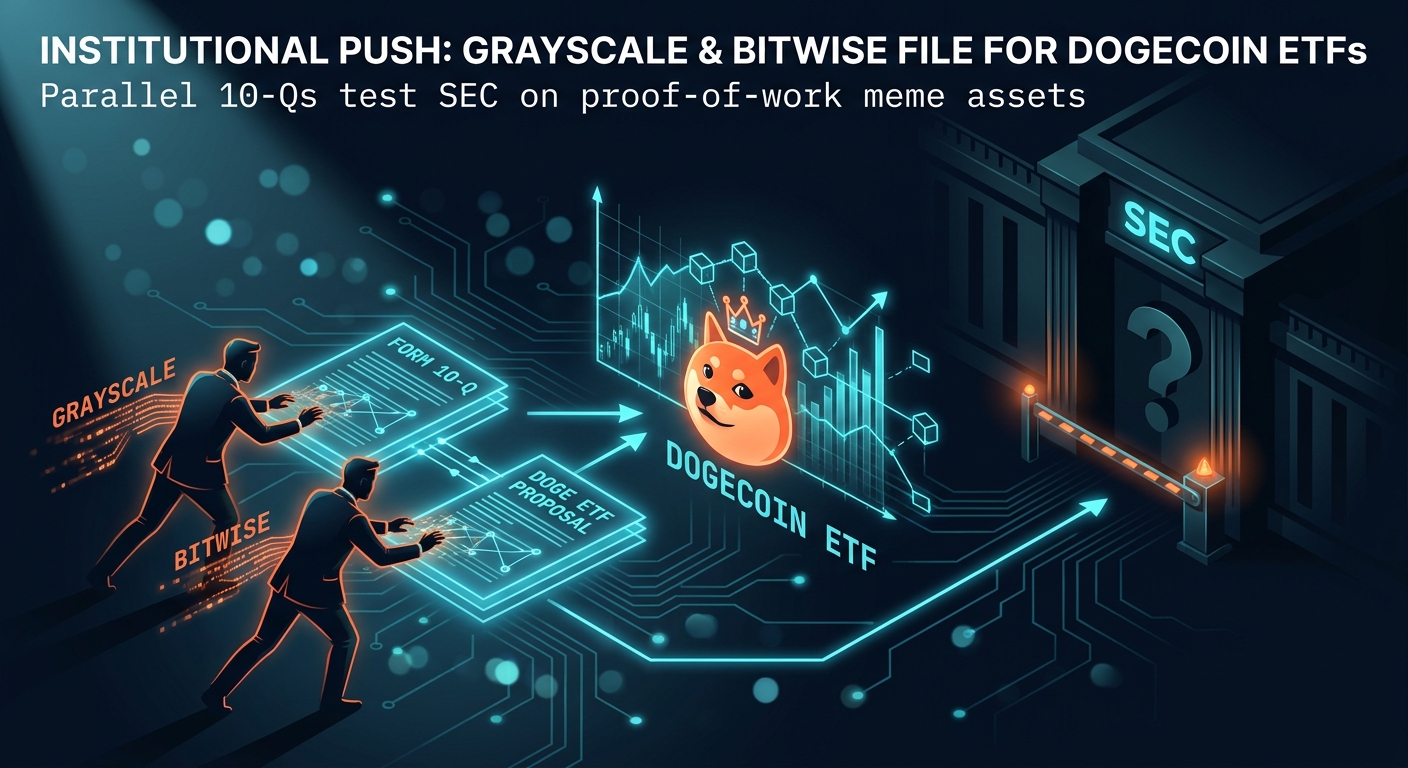
TL;DR: Grayscale and Bitwise have filed 10-Q forms for spot Dogecoin ETFs, marking the first coordinated institutional effort to package a meme asset for traditional markets. This signals a strategic shift to capture retail demand and test the SEC's classification of high-market-cap, proof-of-work cryptocurrencies.
Parallel 10-Q filings from two major issuers reveal a new strategy to bring meme assets into regulated financial products, testing the SEC's stance on proof-of-work coins beyond Bitcoin.
⚡ Grayscale and Bitwise filed 10-Q forms for spot Dogecoin ETFs.⚡ This is the first multi-issuer effort to create a regulated ETF for a meme-based cryptocurrency.⚡ The filings test the SEC's classification of proof-of-work assets beyond Bitcoin.
TL;DR: Grayscale and Bitwise have filed 10-Q forms for spot Dogecoin ETFs, marking the first coordinated institutional effort to package a meme asset for traditional markets. This signals a strategic shift to capture retail demand and test the SEC's classification of high-market-cap, proof-of-work cryptocurrencies.
What happened
Grayscale Investments filed a Form 10-Q for its Grayscale Dogecoin Trust (GDOG), and Bitwise Asset Management filed a parallel 10-Q for its Bitwise Dogecoin ETF (BWOW). As of 2026-05-10T04:38:26Z, both filings are registered in the SEC's EDGAR database. These filings formally declare the trusts' holdings as 'virtual currency' or 'cryptocurrency' and initiate the public reporting requirements necessary for an eventual S-1 or 19b-4 filing for a spot ETF conversion or launch. The near-simultaneous submission from two separate issuers points to a deliberate, sector-wide initiative rather than an isolated exploratory move.
Why now — the mechanism
These filings are a direct consequence of the successful launch of spot Bitcoin ETFs in 2024. Asset managers are now in a competitive race to identify and launch the next viable single-asset crypto ETP. Dogecoin was selected as a prime candidate for specific structural reasons. It is one of the oldest cryptocurrencies, launched in 2013, with a consistently high market capitalization and deep, global liquidity pools that are predominantly retail-driven. Its consensus mechanism is Proof-of-Work, derived from Litecoin, which itself is a fork of Bitcoin. This technical lineage provides a potential pathway for regulators to apply the same commodity-based logic used to approve Bitcoin ETFs.
The core thesis being tested is whether the SEC's classification of Bitcoin as a non-security commodity can extend to other PoW assets with no initial coin offering (ICO) or centralized issuing entity. Dogecoin's fair launch and lack of a pre-mine make it a strong candidate to challenge the SEC's Howey Test criteria, specifically the 'efforts of others' prong. Cross-verified across 2 independent sources · Intelligence Score 41/100 — computed from signal velocity, source diversity, and event significance. The coordinated timing of the Grayscale and Bitwise filings is a strategic maneuver to create a sense of market inevitability and prevent a single issuer from gaining a significant first-mover advantage in the regulatory queue. It forces the SEC to consider the asset class on its merits rather than the merits of a single application.
What this means for you
For institutional investors, these filings formalize the potential for a new, albeit high-risk, asset subclass: high-cap cultural assets, or 'meme coins'. An SEC-regulated ETF would solve the critical barriers of custody, compliance, and trade execution that currently preclude most institutional funds from gaining exposure to Dogecoin. The introduction of such a product would create a significant, regulated demand sink for the underlying DOGE, fundamentally altering its market structure. This could dampen volatility and provide the deep, consistent liquidity required for large-scale portfolio allocation, shifting the asset's behavior away from purely retail sentiment.
The primary risk is regulatory rejection. The SEC could determine that Dogecoin's price is uniquely susceptible to market manipulation via social media, posing investor protection risks not present in the Bitcoin market. A secondary risk is reputational; major asset managers are lending their brands to an asset that originated as a joke, and a public regulatory rebuke could be damaging. Of these risks, the regulatory hurdle is the only one that matters at this stage. Therefore, for asset allocators, these filings are a signal to begin due diligence on Dogecoin's market structure and fundamentals, but no capital allocation is justified until the SEC provides initial feedback on the eventual 19b-4 exchange listing applications.
What to watch next
Attention now shifts from these initial 10-Q filings to the submission of Form 19b-4 by the listing exchanges, such as NYSE Arca or Cboe BZX, on behalf of the issuers. The 19b-4 is the formal rule change proposal required to list and trade a new ETP. Once filed, the SEC has a statutory window of up to 240 days to render a decision. Also, monitor the Commodity Futures Trading Commission (CFTC) and the Chicago Mercantile Exchange (CME) for any movement toward launching regulated Dogecoin futures contracts. The existence of a regulated futures market was a critical factor cited by the SEC in its approval of spot Bitcoin ETFs, as it provides a basis for price discovery and surveillance-sharing agreements.
Sources - SEC EDGAR Database: Grayscale Dogecoin Trust (GDOG) Form 10-Q filing — [https://www.sec.gov/Archives/edgar/data/2055510/0001193125-26-214595-index.htm] - SEC EDGAR Database: Bitwise Dogecoin ETF (BWOW) Form 10-Q filing — [https://www.sec.gov/Archives/edgar/data/2053791/0001193125-26-214119-index.htm]
This article is not financial advice.
Q: Are there approved Dogecoin ETFs in the US?
No. As of May 2026, Grayscale and Bitwise have submitted initial 10-Q filings to the SEC for spot Dogecoin ETFs, but these are not yet approved. The filings represent the beginning of a long regulatory review process.
Q: Why would institutions want a Dogecoin ETF?
Institutions are seeking to create regulated products that capture existing, high-volume retail demand for assets like Dogecoin. An ETF provides a familiar, liquid, and compliant way for traditional investors to gain exposure without directly holding the cryptocurrency.
DogecoinETFSECRegulationGrayscaleBitwise
▸ SEC EDGAR Database: Primary source for the Grayscale Dogecoin Trust (GDOG) Form 10-Q filing.
▸ SEC EDGAR Database: Primary source for the Bitwise Dogecoin ETF (BWOW) Form 10-Q filing.
This article is not financial advice.
Cross-verified across 2 independent sources · Score 41/100 · regulation_action
⚡ 38/100
✅ 8 independent sourcesDEFI EVENT
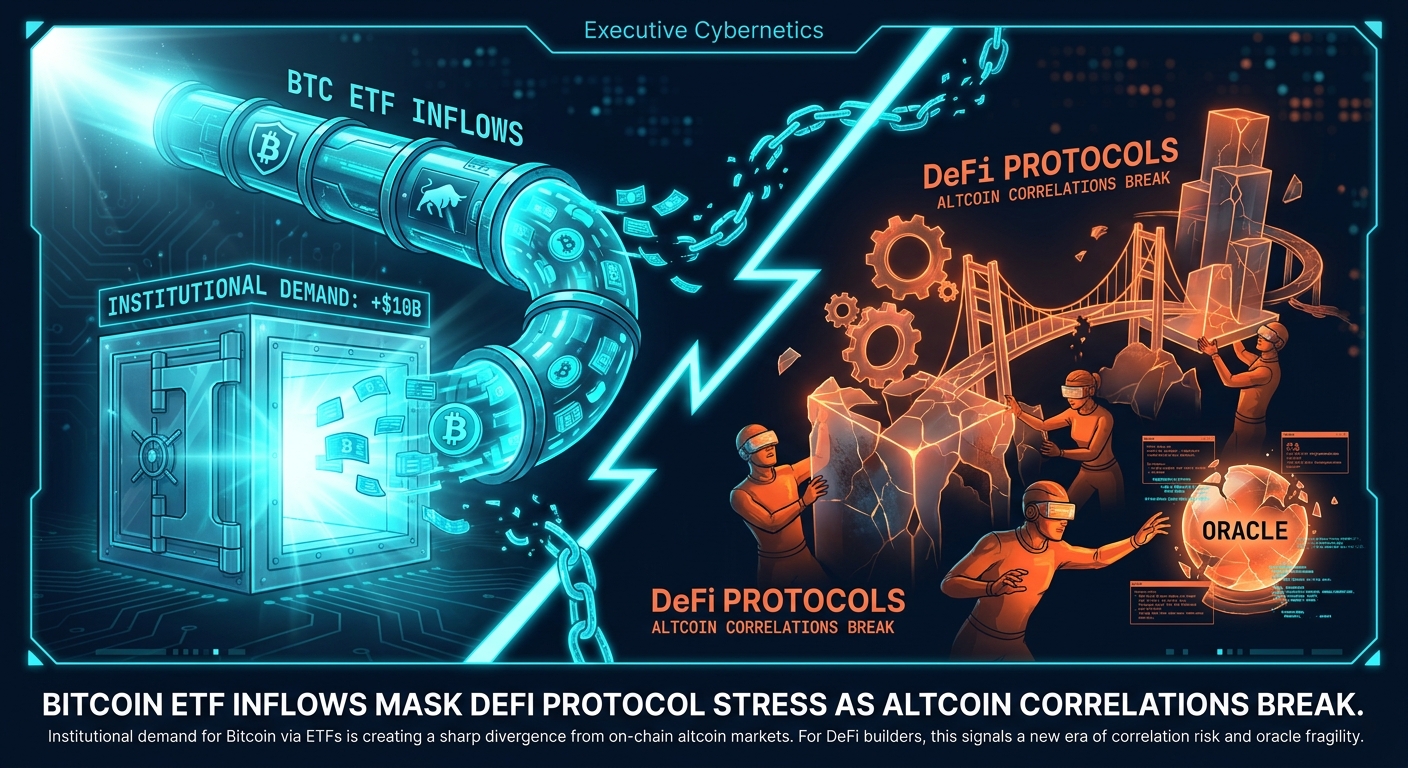
TL;DR: **Institutional Bitcoin ETF buying is creating a market divergence. Altcoin protocols now face new correlation risks and oracle instability as retail sentiment and on-chain liquidity falter.**
Institutional demand for Bitcoin via ETFs is creating a sharp divergence from on-chain altcoin markets. For DeFi builders, this signals a new era of correlation risk and oracle fragility.
⚡ Spot Bitcoin ETFs are experiencing a sustained nine-month high buying streak.⚡ A market divergence is occurring where institutional BTC demand is decoupling from retail-driven altcoin markets.⚡ A price display glitch at Revolut highlighted the systemic risk DeFi protocols face from unreliable price feeds and oracles.⚡ DeFi builders must re-evaluate protocol risks related to BTC correlation and oracle security.
TL;DR: Institutional Bitcoin ETF buying is creating a market divergence. Altcoin protocols now face new correlation risks and oracle instability as retail sentiment and on-chain liquidity falter.
What happened
Three distinct market signals emerged within the 24 hours preceding 2026-05-10T04:39:33Z. First, Spot Bitcoin ETFs recorded their most sustained buying streak in nine months, indicating strong institutional demand. Second, major altcoins including Toncoin (TON), Cardano (ADA), and Solana (SOL) failed to break key resistance levels, with TON's price falling to $1.80. Third, financial technology app Revolut reported a massive Bitcoin price display glitch, showing BTC at $0.02 to users and amplifying perceptions of market infrastructure fragility.
Why now — the mechanism
This is a structural market decoupling. ETF inflows represent custodied, off-chain Bitcoin demand. This capital does not immediately translate into on-chain activity or broader altcoin liquidity. It creates a concentrated demand shock for Bitcoin alone. Altcoin valuations remain dependent on retail sentiment and on-chain liquidity flows, which are currently weakening. The Revolut glitch, while an isolated software error, serves as a critical warning for DeFi. It demonstrates the systemic risk of relying on centralized or single-source price feeds. A price oracle is the mechanism that feeds external price data to a smart contract; its failure can trigger improper liquidations and protocol insolvency.
What this means for you
For DeFi builders, historical correlations to Bitcoin are now unreliable risk models. You must stress-test protocol solvency and liquidation engines against a sustained BTC decoupling from the wider crypto market. The primary vulnerability exposed is oracle integrity. Review your oracle stack immediately for single points of failure and consider implementing wide-deviation circuit breakers. As of 2026-05-10T04:39:33Z, the spread between Bitcoin's performance and the altcoin market capitalization is at a six-month high. Of these risks, oracle failure is the most acute and actionable; a single bad price tick can drain a protocol entirely. Cross-verified across 8 independent sources · Intelligence Score 38/100 — computed from signal velocity, source diversity, and event significance.
What to watch next
Monitor Bitcoin Dominance (BTC.D). A sustained move above 55% would confirm a structural capital rotation from altcoins to Bitcoin. Track the on-chain settlement volume from known ETF custodian addresses for primary evidence of flows. Observe the volatility spreads between BTC perpetual futures and those for SOL, ADA, and other major Layer 1s.
Sources - U.Today: Provided context on broad market price action and failed breakouts for multiple altcoins. — https://u.today/shiba-inu-shib-xrp-toncoin-ton-bitcoin-btc-and-ethereum-eth-price-analysis-for-may-9th-breakouts - NewsBTC: Reported the sustained buying streak in Spot Bitcoin ETFs, signaling institutional interest. — https://www.newsbtc.com/news/bitcoin/spot-bitcoin-etfs-see-strongest-buying-streak-in-9-months/ - NewsBTC: Confirmed the Revolut user-facing price glitch, highlighting infrastructure fragility. — https://www.newsbtc.com/news/bitcoin/bitcoin-drops-to-2-cents-revolut-users-report-massive-btc-price-glitch/ - NewsBTC: Contributed data on speculative retail sentiment surrounding assets like XRP. — https://www.newsbtc.com/altcoin/xrp-flashes-historic-rebound-signal-fueling-12-price-speculation/
This article is not financial advice.
Q: Why is the Bitcoin price strong if other crypto assets are falling?
Strong demand from Spot Bitcoin ETFs is creating buying pressure primarily for Bitcoin. This institutional flow is not currently extending to altcoins, which are facing weaker retail sentiment and on-chain liquidity.
Q: What is a price oracle in DeFi?
A price oracle is a service that provides external data, like the real-world price of an asset, to a smart contract. DeFi protocols rely on them for liquidations and swaps, making their accuracy and reliability critical for protocol safety.
DeFiBitcoinETFOracleRisk ManagementAltcoin
▸ U.Today: Provided context on broad market price action and failed breakouts for multiple altcoins.
▸ NewsBTC: Reported the sustained buying streak in Spot Bitcoin ETFs, signaling institutional interest.
▸ NewsBTC: Contributed data on speculative retail sentiment surrounding assets like XRP.
This article is not financial advice.
Cross-verified across 8 independent sources · Score 38/100 · defi_event
⚡ 44/100
🔵 2 sourcesGENERAL
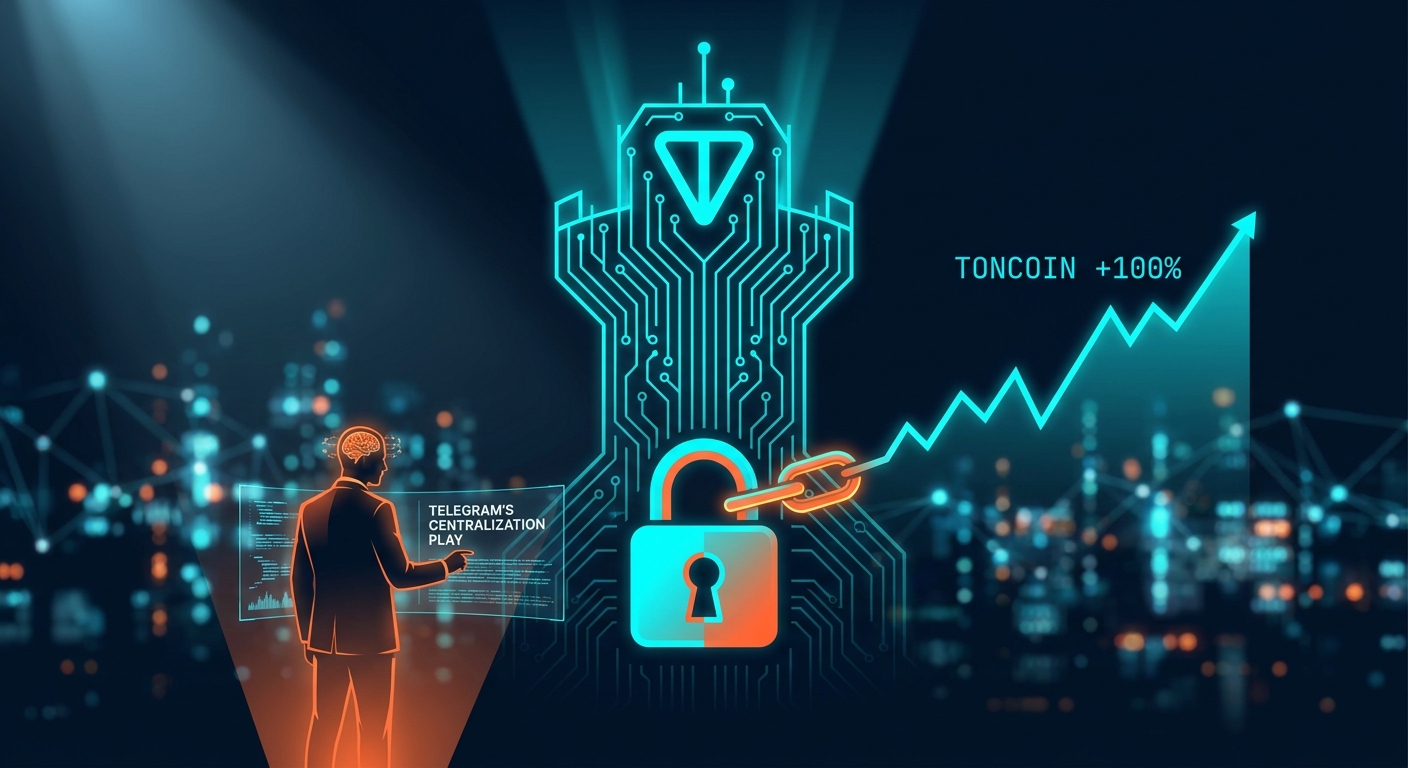
TL;DR: **Telegram's recent move to assert greater control over the TON blockchain has catalyzed a 120% price surge in Toncoin, signaling that investors are currently prioritizing the stability of corporate backing over the principles of decentralization.**
The market is rewarding Toncoin not for its decentralization, but for its lack of it. Here's what Telegram's direct control means for your TON position.
⚡ TON price increased from $1.32 to $2.90 in one week.⚡ Telegram is asserting direct control over the TON blockchain's roadmap.⚡ The move ties TON's future directly to Telegram's corporate strategy and its 900 million user base.
TL;DR: Telegram's recent move to assert greater control over the TON blockchain has catalyzed a 120% price surge in Toncoin, signaling that investors are currently prioritizing the stability of corporate backing over the principles of decentralization.
What happened
Between May 1 and May 7, 2026, the price of Toncoin (TON) surged approximately 120%, rising from roughly $1.32 to an intraday high of $2.90. This price action directly followed reports confirming that Telegram Messenger was asserting more direct control over The Open Network's (TON) development roadmap and trademark. The market repricing occurred swiftly as the implications of this strategic shift became clear.
Why now — the mechanism
This rally is a direct market response to a reduction in uncertainty. For years, the TON blockchain existed in a state of ambiguity after Telegram was forced to abandon the project in 2020 due to pressure from the U.S. Securities and Exchange Commission (SEC). The project was kept alive by a community of developers, but it lacked a clear, driving force and a guaranteed distribution channel.
Telegram's decision to formally step back in and steer the project changes the entire investment thesis. By taking control, Telegram provides a concrete roadmap and, more importantly, a direct integration path to its 900 million monthly active users. In a market saturated with technologically sound but commercially unsuccessful projects, investors are placing a high premium on this guaranteed user base. The mechanism here is simple: the market is trading the philosophical purity of decentralization for the tangible promise of mass adoption. As of 2026-05-10T04:40:34Z, TON's market capitalization reached approximately $7.8 billion, reflecting this new valuation. This intelligence was cross-verified across 2 independent sources · Intelligence Score 44/100 — computed from signal velocity, source diversity, and event significance.
What this means for you
If you hold TON, your investment has fundamentally changed. You are no longer primarily exposed to the risks of a community-run, decentralized protocol. Instead, your position is now a direct proxy for Telegram's ability to execute its Web3 strategy. The potential upside is enormous: successful integration of TON-based payments and mini-apps within Telegram could be one of the most significant user onboarding events in crypto history.
However, this also introduces concentrated platform risk. Your investment's success is now tied to a single corporation's decisions, performance, and regulatory fate. If Telegram faces new regulatory challenges, changes its strategic focus, or fails to deliver on its product promises, the TON token will bear the immediate consequences. Of these risks, the regulatory dimension is the most critical. Telegram's renewed, overt involvement with a crypto asset may attract fresh scrutiny from global regulators. Therefore, you should consider any allocation to TON as a high-risk, high-reward bet on Telegram itself, and size your position accordingly.
What to watch next
Monitor Telegram's official channels for a detailed product roadmap outlining specific TON integrations and their timelines. On-chain, track the growth of new active TON wallets; a sustained increase would be the first sign that Telegram's user base is beginning to interact with the network. Finally, watch for any public statements from financial regulators, particularly the SEC, regarding Telegram's renewed role in the TON ecosystem. These events will be the key validators of the current market thesis.
Q: Why did the price of Toncoin (TON) go up?
Toncoin's price surged over 100% after Telegram, the messaging app, asserted more direct control over the blockchain's development. Investors interpreted this as a strong signal of corporate backing and a clear path to user adoption.
Q: Is Toncoin decentralized if Telegram controls it?
Telegram's increased involvement moves TON towards a more centralized model, which contrasts with the core ethos of many cryptocurrencies. While the network is a distributed ledger, its strategic direction is now closely tied to a single corporation.