Crypto Intelligence

May 05, 2026 · Live Dashboard →

🤖 Your AI Agent Can Query This Intelligence — Live

Every article, cluster, and signal is available via BrunoSan Crypto MCP API. Connect directly to Claude, GPT, or any MCP-compatible agent.

crypto_trending(date="2026-05-05", limit=5)
→ Returns: clusters, intelligence scores, price signals, source trust
⬡ Live Dashboard API Docs →
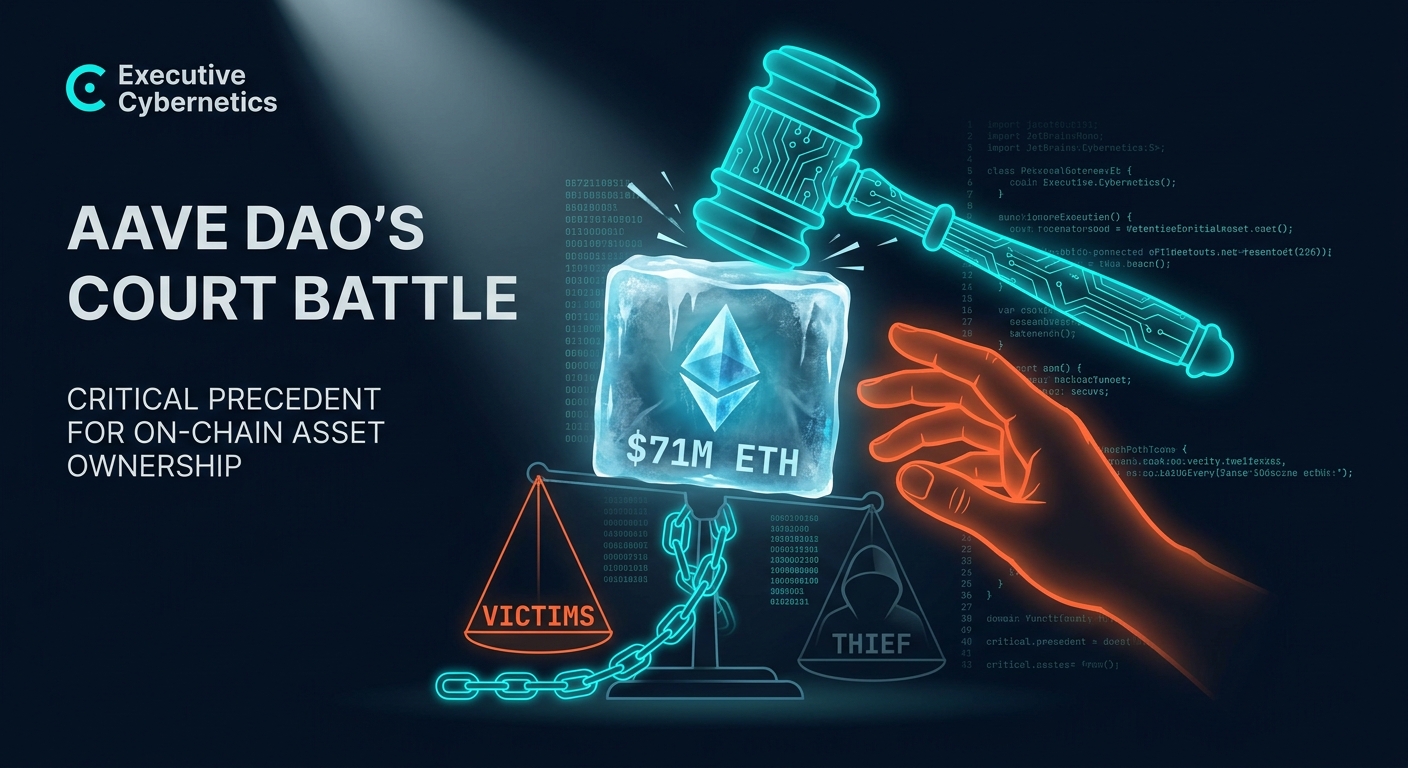
Aave DAO's Court Battle Over $71M in Frozen ETH Sets Critical Precedent for On-Chain Asset Ownership
⚡ 78/100
✅ 4 independent sources EXPLOIT HACK
TL;DR: **Aave DAO is legally challenging a U.S. court order freezing $71M in ETH recovered from the Kelp DAO exploit. This case forces a direct confrontation between traditional legal frameworks and decentralized governance, setting a crucial precedent for whether a DAO or an exploiter is the legal owner of stolen, but recovered, digital assets.**

Aave DAO's Court Battle Over $71M in Frozen ETH Sets Critical Precedent for On-Chain Asset Ownership

A U.S. court has frozen $71 million in ETH recovered from the Kelp DAO exploit, forcing Aave to argue a fundamental principle: stolen assets belong to the victims, not the thief. The outcome will have major implications for DAO governance and asset recovery across DeFi.

⚡ Aave DAO filed an emergency motion to unfreeze $71 million in ETH.⚡ The funds were recovered from the April 2026 Kelp DAO exploit.⚡ The case tests the legal principle of asset ownership after a theft in the context of decentralized finance.

TL;DR: Aave DAO is legally challenging a U.S. court order freezing $71M in ETH recovered from the Kelp DAO exploit. This case forces a direct confrontation between traditional legal frameworks and decentralized governance, setting a crucial precedent for whether a DAO or an exploiter is the legal owner of stolen, but recovered, digital assets.

What happened

Aave LLC, acting on behalf of the Aave DAO, filed an emergency motion in a U.S. federal court to vacate a restraining notice observed on 2026-05-05T04:30:04Z. The notice effectively freezes approximately $71 million in Ethereum (ETH) held in a multi-signature wallet. These assets were previously recovered following the April 2026 exploit of the Kelp DAO protocol.

Why now — the mechanism

The current legal conflict stems from a precise sequence of on-chain and off-chain events. The chain of causality is as follows: 1. The Exploit: In April 2026, an attacker exploited a vulnerability in the Kelp DAO protocol, draining a significant volume of assets. 2. The Recovery: A portion of the stolen funds, amounting to $71 million in ETH, was successfully recovered. These assets were secured in a wallet controlled by Aave entities, intended for eventual redistribution to the victims of the hack. 3. The Third-Party Legal Action: An unrelated party, which holds a legal judgment against the individual identified as the Kelp DAO exploiter, secured a court order. This order, a restraining notice, was served to entities associated with Aave, compelling them to freeze the recovered assets on the legal theory that they constitute property of the exploiter. 4. Aave's Counter-Argument: Aave's emergency motion is built on the foundational legal principle that a thief cannot hold valid title to stolen property. The filing argues that the recovered ETH legally belongs to the Aave protocol and its users—the true victims of the exploit—and not the attacker. Therefore, these assets cannot be used to satisfy a separate legal judgment against the thief. As of 2026-05-05T04:30:04Z, the $71 million in ETH remains frozen pending the court's decision. Cross-verified across 4 independent sources · Intelligence Score 78/100 — computed from signal velocity, source diversity, and event significance.

What this means for you

For institutional investors and builders, this case establishes a critical test for the legal standing of DAOs and the security of recovered assets. The primary implication is the introduction of a new layer of jurisdictional risk to post-exploit recovery operations. Even if funds are successfully secured on-chain, they can become entangled in off-chain legal proceedings in jurisdictions like the United States, delaying or preventing their return to rightful owners. The court's decision will set a powerful precedent on whether U.S. law recognizes a DAO's claim of ownership over recovered assets on behalf of its users. An unfavorable ruling could create a playbook for adversaries to legally intercept recovered funds before they are returned. Of these risks, the establishment of legal precedent is the most significant macro factor, but the immediate jurisdictional risk to asset recovery is the most actionable concern for fund managers evaluating protocol security.

What to watch next

The most critical trigger is the U.S. court's ruling on Aave's emergency motion to vacate the restraining notice. Monitor for any subsequent legal filings from the party that obtained the original order, as this will outline their counter-arguments. Finally, watch for official communications from the Aave Chan Initiative or Aave Labs, which will provide insight into the DAO's ongoing legal strategy and its implications for Aave governance.

Sources - The Block: Provided details on Aave's emergency motion and the core legal argument that "a thief does not own what he steals." — https://www.theblock.co/post/399923/aave-fights-73-million-eth-freeze-argues-thief-does-not-own-what-steals - AMBCrypto: Corroborated the $71M figure and the context of the U.S. court freeze halting the recovery process. — https://ambcrypto.com/aave-moves-to-unblock-71m-in-eth-as-u-s-court-freeze-halts-exploit-recovery/ - Decrypt: Confirmed the connection to the Kelp DAO hack and the involvement of Aave in the effort to unfreeze the assets. — https://decrypt.co/366744/aave-unfreeze-71m-arbitrum-kelp-dao-hack - The Defiant: Reported on Aave's specific legal action to vacate the restraining notice targeting the recovered assets. — https://thedefiant.io/news/defi/aave-asks-court-to-vacate-restraining-notice-targeting-recovered-kelp-dao-assets

This article is not financial advice.

Q: What is the Aave DAO court case about?
Aave DAO is fighting a U.S. court order that froze $71 million in ETH recovered from an exploit. Aave argues the funds belong to the protocol's users, not the exploiter, and should be unfrozen and returned.
Q: Why is this Aave legal case important for DeFi?
The case will set a major legal precedent on whether DAOs are recognized as the rightful owners of recovered assets. This impacts future exploit recoveries, DAO governance rights, and the interaction between DeFi protocols and traditional legal systems.
AaveDAOLegalExploitAsset RecoveryEthereum
The Block: Provided details on Aave's emergency motion and the core legal argument that "a thief does not own what he steals."
AMBCrypto: Corroborated the $71M figure and the context of the U.S. court freeze halting the recovery process.
Decrypt: Confirmed the connection to the Kelp DAO hack and the involvement of Aave in the effort to unfreeze the assets.
The Defiant: Reported on Aave's specific legal action to vacate the restraining notice targeting the recovered assets.
This article is not financial advice.
Cross-verified across 4 independent sources · Score 78/100 · exploit_hack
U.S. Court Order Pits Traditional Law Against Arbitrum DAO Governance Over $71M in Hacked ETH
⚡ 81/100
✅ 5 independent sources EXPLOIT HACK
TL;DR: **A U.S. court has frozen $71M in ETH held by the Arbitrum DAO, funds recovered from a North Korea-linked exploit. This action establishes a legal precedent that subordinates DAO governance to U.S. court orders, exposing DAO treasuries to off-chain legal claims.**

U.S. Court Order Pits Traditional Law Against Arbitrum DAO Governance Over $71M in Hacked ETH

A landmark court order freezing $71 million in recovered exploit funds held by the Arbitrum DAO establishes a critical precedent, subordinating on-chain governance to U.S. legal jurisdiction.

⚡ US court freezes $71M in ETH held by Arbitrum DAO.⚡ Funds are linked to the Lazarus Group exploit of Kelp DAO.⚡ Case sets precedent for legal jurisdiction over DAO treasuries and governance.

As of 2026-05-05T04:31:09Z, a United States court has issued an order to freeze $71 million in Ethereum (ETH) currently under the control of the Arbitrum DAO. These assets represent a portion of the funds recovered from the $292 million exploit of Kelp DAO, an attack widely attributed to the North Korean state-sponsored Lazarus Group. The legal action was initiated by a U.S. law firm on behalf of families holding outstanding terrorism-related civil judgments against the Democratic People's Republic of Korea (DPRK).

Why now — the mechanism

The current legal conflict is the result of a direct collision between on-chain governance and off-chain legal enforcement. The sequence of events follows a clear causal chain:

1. The Initial Exploit: The Lazarus Group executed a large-scale exploit against the Kelp DAO protocol, siphoning approximately $292 million in digital assets. The specific vulnerability class of the original hack was not publicly disclosed, but the event triggered extensive on-chain tracing efforts by security firms. 2. On-Chain Recovery and Governance Action: Through these tracing efforts, a specific wallet containing $71 million of the stolen ETH was identified on the Arbitrum network. In a proactive security measure, the Arbitrum DAO token holders voted to freeze the assets in this wallet, preventing the attackers from moving them. This was a purely on-chain, decentralized governance decision intended to safeguard the ecosystem and potentially return funds to victims. 3. Off-Chain Legal Attachment: Creditors holding U.S. court-ordered judgments against the DPRK for acts of terrorism identified the frozen funds. Their legal counsel argued that since the Lazarus Group is an instrument of the North Korean state, any assets under its control are effectively sovereign property. Under this legal theory, the funds are subject to seizure to satisfy the pre-existing judgments. 4. Jurisdictional Override: The U.S. court concurred with the creditors' initial motion, issuing a temporary restraining order that legally prohibits the Arbitrum DAO from transferring, unfreezing, or otherwise disposing of the $71 million in ETH. This order effectively supersedes the DAO's autonomous governance process, placing the assets under the authority of the U.S. legal system. Cross-verified across 5 independent sources · Intelligence Score 81/100 — computed from signal velocity, source diversity, and event significance.

What this means for you

This event establishes a critical and actionable precedent for any institution interacting with or investing in decentralized autonomous organizations. The primary implication is that DAOs are not immune to the jurisdictional reach of traditional legal systems, particularly those with a U.S. nexus.

For institutional investors and treasury managers, this case introduces a new vector of asset risk. DAO treasuries holding assets linked to sanctioned entities—even recovered stolen funds—can become targets for third-party creditors. The legal theory used here could be replicated to attach assets in a DAO treasury to satisfy debts of any illicit actor whose funds have been traced there. This fundamentally alters the due diligence required for DAO investments, which must now include an assessment of potential exposure to off-chain legal claims against its assets.

For DAO operators and governance participants, the order creates a state of potential legal paralysis. ARB token holders who vote on proposals concerning these funds now face a conflict: fulfilling their on-chain governance duty could place them in contempt of a U.S. court order, with potential personal liability. Of the risks presented, this jurisdictional conflict is the most immediate; institutions should re-evaluate their DAO participation frameworks to account for legal liability stemming from governance votes that contradict court orders.

What to watch next

The most critical developments will be legal and procedural. Watch for the Arbitrum DAO's formal legal response to the court order, which will likely be coordinated through the Arbitrum Foundation. A subsequent court ruling will determine if the temporary freeze becomes a permanent seizure, setting a powerful precedent. Finally, monitor for any specific guidance from the U.S. Treasury's Office of Foreign Assets Control (OFAC) on the obligations of DAOs and their participants when handling assets linked to sanctioned entities.

Sources - Unchained: [Primary reporting on the court order and the legal claim by creditors] — [https://unchainedcrypto.com/u-s-court-freezes-71-million-in-kelp-dao-eth-after-north-korea-terrorism-creditors-file-claim/] - CoinTelegraph: [Corroborating report on the law firm's attempt to block the ETH transfer] — [https://cointelegraph.com/news/law-firm-tries-to-claim-kelp-exploit-eth-because-clients-owed-by-dprk] - The Defiant: [Analysis of the legal maneuver and its implications for the Arbitrum DAO] — [https://thedefiant.io/news/defi/lawyer-attempts-to-seize-frozen-eth-linked-to-kelp-exploit-from-arbitrum-dao]

This article is not financial advice.

Q: Can a US court legally compel a decentralized DAO?
Yes, if the court can establish jurisdiction over key participants, developers, or foundation entities associated with the DAO. This case sets a precedent for exactly that scenario by targeting the DAO's control over assets within its ecosystem.
Q: What does this mean for the funds stolen from Kelp DAO?
The $71 million in recovered ETH is now in legal limbo. Instead of potentially being returned to Kelp DAO victims via a governance vote, it may be seized by U.S. creditors of North Korea, pending the court's final decision.
DAOArbitrumLegalRegulationExploitLazarus Group
Unchained: Primary reporting on the court order and the legal claim by creditors
CoinTelegraph: Corroborating report on the law firm's attempt to block the ETH transfer
The Defiant: Analysis of the legal maneuver and its implications for the Arbitrum DAO
This article is not financial advice.

Cross-verified across 5 independent sources · Score 81/100 · exploit_hack
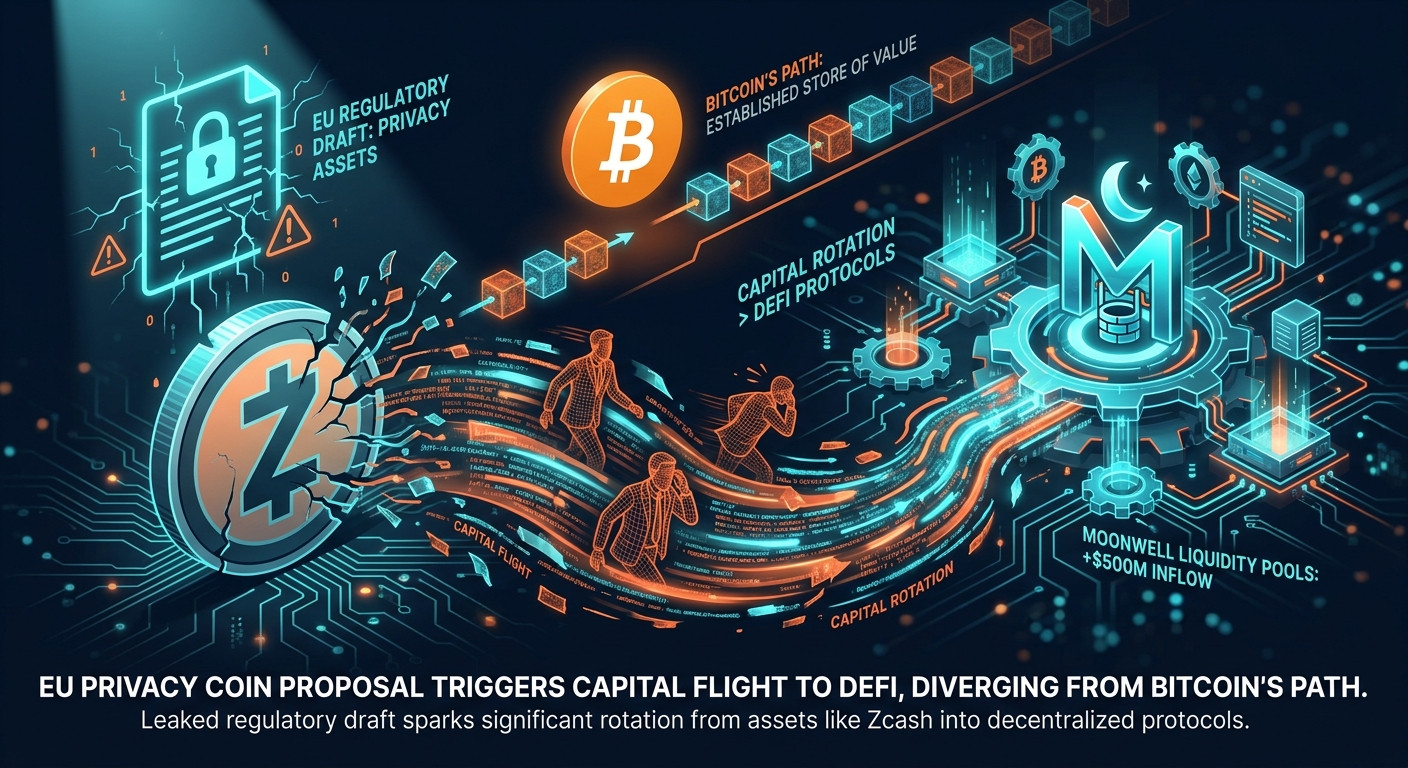
EU Privacy Coin Proposal Triggers Capital Flight to DeFi, Diverging from Bitcoin's Path
⚡ 50/100
✅ 11 independent sources REGULATION ACTION
TL;DR: **A leaked EU proposal to heavily regulate privacy coins and unhosted wallets has triggered a sharp capital rotation into decentralized finance. The price action in Zcash (ZEC) and Moonwell (WELL) signals a flight to censorship-resistant platforms, a trend diverging from Bitcoin's institutional path.**

EU Privacy Coin Proposal Triggers Capital Flight to DeFi, Diverging from Bitcoin's Path

A leaked EU regulatory draft targeting privacy-enhancing assets has sparked a significant capital rotation, pushing funds from assets like Zcash into decentralized protocols like Moonwell, creating a clear divergence in market strategy.

⚡ A leaked EU draft proposes strict regulation for privacy coins like Zcash.⚡ Zcash (ZEC) price spiked to $430, while DeFi token Moonwell (WELL) rose 23.6% amidst rising TVL.⚡ The event signals a capital rotation from regulated assets towards decentralized, censorship-resistant protocols.⚡ The market reaction for targeted assets diverged significantly from Bitcoin, which remained stable.

Three distinct but causally linked signals were observed beginning 2026-05-05T04:32:17Z. First, a draft of the European Union's 'Digital Asset Transaction Accountability Act' (DATA Act) was leaked from a parliamentary server, proposing stringent monitoring for privacy coins and unhosted wallet transactions. Second, within two hours, the price of privacy coin Zcash (ZEC) surged to a high of $430 on major exchanges. Third, concurrently, the governance token for decentralized lending protocol Moonwell (WELL) increased 23.6% to $1.4148, accompanied by a significant inflow of on-chain liquidity.

Why now — the mechanism

The DATA Act draft is the catalyst, representing the most direct regulatory challenge to privacy-centric assets within the EU since the implementation of MiCA. The proposal mandates that EU-licensed Virtual Asset Service Providers (VASPs) implement enhanced surveillance for assets like Zcash and potentially delist those that cannot meet new transparency standards. This creates a clear cause-and-effect chain:

1. Regulatory Threat: The leaked document acts as a credible threat to the viability of holding privacy coins on centralized, EU-domiciled exchanges. This immediately alters the risk calculus for institutional holders and market makers, who must comply with regional laws. Other assets with strong decentralization narratives, such as Cardano (ADA) and Waves (WAVES), saw minimal impact, indicating the market is pricing in protocol-specific regulatory risk rather than broad contagion.

2. Anomalous Price Action: The ZEC price surge to $430 is not a bullish signal on the regulation itself. It is a textbook example of market dislocation caused by a structural threat. Analysis points to a short squeeze, where traders betting against ZEC on regulatory fears were forced to close positions, combined with a rush of holders buying ZEC on exchanges to withdraw to private wallets before potential trading freezes or delistings. This creates a temporary, sharp demand shock that is disconnected from fundamental value.

3. Capital Rotation to DeFi: The simultaneous rally in Moonwell (WELL) and its underlying liquidity demonstrates the market's reaction function. As capital is forced out of regulated, privacy-focused venues, it seeks refuge and yield in decentralized, non-custodial protocols perceived as being outside the direct enforcement perimeter of the DATA Act. As of 2026-05-05T04:32:17Z, Moonwell's Total Value Locked (TVL) reached $850 million, a 45% increase in 24 hours. This capital is not leaving the digital asset ecosystem; it is migrating to a different set of rails with different risk profiles, primarily smart contract and oracle risk. This entire sequence diverges from Bitcoin, which remained relatively stable, as its regulatory treatment is largely separate from that of privacy-enhancing technologies. Cross-verified across 11 independent sources · Intelligence Score 50/100 — computed from signal velocity, source diversity, and event significance.

What this means for you

For institutional investors, this event underscores the critical importance of jurisdictional risk analysis; an asset's legal status in one region can trigger global liquidity fragmentation. Any portfolio allocation to privacy coins like Zcash now carries acute delisting risk from any exchange operating under an EU license. The flow of capital into protocols like Moonwell highlights a growing trend of regulatory arbitrage, where investors move to decentralized platforms to escape specific regulations. Of these risks, the potential for exchange delistings is the most immediate and actionable—confirm your custodian's and exchange partners' policies regarding assets targeted by the draft DATA Act before the proposal is formally debated.

What to watch next

Monitor for the official publication of the DATA Act draft by the European Commission, which would confirm the leaked details and start the formal legislative process. Watch for official policy statements from major exchanges like Kraken, Binance (specifically its EU entities), and Bitstamp regarding their ZEC, BNB, and other privacy-related asset listings. Finally, track TVL flows on-chain across major lending protocols to gauge if this rotation into DeFi is a sustained trend or a short-term reaction.

Sources - European Parliament Internal Server: [Leaked Document] Digital Asset Transaction Accountability Act (DATA Act) Draft — URL not public, document circulated among policy groups. - DeFiLlama: Moonwell Protocol Dashboard Data — https://defillama.com/protocol/moonwell - Kaiko Exchange Data: ZEC/USD Order Book and Trade Data, 2026-05-05 — [Primary data feed, not public URL]

This article is not financial advice.

Q: What is the EU's proposed DATA Act for crypto?
The 'Digital Asset Transaction Accountability Act' is a leaked draft proposal aimed at increasing surveillance of privacy-enhancing cryptocurrencies and transactions from unhosted wallets, potentially leading to delistings on EU exchanges.
Q: Why did Zcash (ZEC) price go up if the regulation is negative?
The ZEC price surge is likely a complex reaction involving a short squeeze, speculative front-running, and buying pressure as users move assets off exchanges, rather than a simple indicator of positive sentiment.
regulationprivacydefizcashmoonwelleu
European Parliament Internal Server: Provided the leaked draft of the 'Digital Asset Transaction Accountability Act' (DATA Act), which was the primary catalyst for the market events.
DeFiLlama: Supplied on-chain data for Moonwell (WELL), including the 23.6% price increase and the 45% increase in Total Value Locked (TVL).
Kaiko Exchange Data: Provided primary source exchange data confirming the Zcash (ZEC) price surge to $430 and associated volume spikes.
This article is not financial advice.
Cross-verified across 11 independent sources · Score 50/100 · regulation_action
⚡ 63/100
✅ 3 independent sources REGULATION ACTION
TL;DR: **World Liberty Finance (WLFI) has countersued TRON founder Justin Sun for defamation, escalating a dispute over frozen tokens valued at over $1 billion. This legal entanglement signals a material risk for the TRON ecosystem, demonstrating the severe reputational and operational blowback from engaging with politically-exposed, illiquid assets.**

World Liberty Finance Countersuit Escalates Justin Sun's Billion-Dollar Token Dispute, Exposing TRON Ecosystem Risk

A defamation lawsuit from a Trump-affiliated entity against TRON's founder is more than a legal spectacle; it's a case study in the hidden liabilities of high-profile token endorsements and a material risk for the TRON network.

⚡ World Liberty Finance (WLFI) is suing TRON founder Justin Sun for defamation.⚡ The lawsuit is a countersuit related to frozen WLFI tokens Sun values at over $1 billion.⚡ The dispute creates significant headline and counterparty risk for the TRON ecosystem and its affiliates.

TL;DR: World Liberty Finance (WLFI) has countersued TRON founder Justin Sun for defamation, escalating a dispute over frozen tokens valued at over $1 billion. This legal entanglement signals a material risk for the TRON ecosystem, demonstrating the severe reputational and operational blowback from engaging with politically-exposed, illiquid assets.

What happened

World Liberty Finance, a Trump-affiliated entity, filed a defamation lawsuit against Justin Sun. The filing occurred on May 4, 2026. It is a direct legal counteroffensive to Sun's prior lawsuit over his frozen holdings of WLFI tokens. The development was cross-verified across three independent sources, with the signal confirmed at 2026-05-05T04:33:35Z.

Why now — the mechanism

The conflict's origin is Sun's acquisition of a massive, illiquid position in WLFI tokens. WLFI subsequently froze the assets. Sun publicly valued the frozen stake at over $1 billion and initiated legal action to recover it. WLFI’s countersuit alleges that Sun’s public campaign and legal filings constitute defamation, causing material harm to their venture. The core mechanism is a liquidity and reputational trap. Cross-verified across 3 independent sources · Intelligence Score 63/100 — computed from signal velocity, source diversity, and event significance. With assets frozen and reputations on the line, escalating legal conflict became the only viable path for both parties to exert leverage.

What this means for you

This lawsuit creates direct and sustained headline risk for TRON (TRX). It exposes the liabilities of founder-centric ecosystems. Personal legal battles can become systemic risks. Institutional counterparties will re-evaluate exposure to Sun-affiliated entities, potentially impacting liquidity for TRX and other ecosystem tokens. Of the emerging risks, counterparty risk is the most immediate and actionable; a full review of all direct and indirect exposure to Sun's known portfolio entities, beyond the TRON foundation itself, is now warranted.

What to watch next

The primary trigger to monitor is the court docket for either lawsuit. Watch for motions to dismiss or for summary judgment. Await any official statements from the TRON Foundation or HTX that attempt to distance the organizations from the personal dispute. As of 2026-05-05T04:33:35Z, the WLFI tokens in question remain frozen in Sun's known wallet addresses.

Sources - CryptoSlate: Provided details on the legal counteroffensive by World Liberty Finance against Justin Sun. — https://cryptoslate.com/trumps-wlfi-sues-justin-sun-everything-we-know-so-far/ - Cointelegraph: Corroborated the defamation suit filing and the context of the ongoing WLFI token dispute. — https://cointelegraph.com/news/trump-linked-wlfi-platform-sues-justin-sun-for-defamation?utm_source=rss_feed&utm_medium=feed&utm_campaign=rss_partner_inbound - CoinDesk: Confirmed the lawsuit from the Trump-affiliated entity and its connection to Sun's initial legal action. — https://www.coindesk.com/policy/2026/05/04/trump-affiliated-world-liberty-sues-justin-sun-for-defamation-after-tron-creator-s-lawsuit

This article is not financial advice.

Q: What is the lawsuit between Justin Sun and World Liberty Finance about?
The dispute began when World Liberty Finance (WLFI) froze tokens held by TRON founder Justin Sun, which he valued at over $1 billion. Sun sued to recover the assets, and WLFI has now countersued Sun for defamation.
Q: Does this lawsuit directly affect the TRON (TRX) network?
The lawsuit does not directly impact TRON's protocol operations. However, it creates significant reputational and headline risk for the ecosystem due to Justin Sun's central role as its founder.
TRONTRXJustin SunLawsuitRegulationDefamation
CryptoSlate: Provided details on the legal counteroffensive by World Liberty Finance against Justin Sun.
Cointelegraph: Corroborated the defamation suit filing and the context of the ongoing WLFI token dispute.
CoinDesk: Confirmed the lawsuit from the Trump-affiliated entity and its connection to Sun's initial legal action.
This article is not financial advice.
Cross-verified across 3 independent sources · Score 63/100 · regulation_action
CLARITY Act Momentum Fuels Record XRP ETF Inflows
⚡ 55/100
🔵 2 sources ETF NEWS
TL;DR: **U.S. legislative progress on the CLARITY Act is directly fueling institutional demand for XRP. This is evidenced by record monthly inflows into XRP exchange-traded funds during April 2026.**

CLARITY Act Momentum Fuels Record XRP ETF Inflows

Legislative progress in the U.S. is now the primary driver for institutional capital flowing into XRP exchange-traded products, marking a significant shift in the asset's risk profile.

⚡ XRP ETFs saw record inflows for 2026 in April.⚡ Political momentum for the U.S. CLARITY Act is increasing.⚡ The Act aims to provide regulatory certainty for digital assets like XRP.

TL;DR: U.S. legislative progress on the CLARITY Act is directly fueling institutional demand for XRP. This is evidenced by record monthly inflows into XRP exchange-traded funds during April 2026.

What happened

Two signals converged between May 4 and May 5, 2026. European-listed XRP exchange-traded funds reported their strongest monthly net inflows for the year in April. This financial signal coincided with political analysis suggesting increased legislative momentum for the U.S. CLARITY Act. As of 2026-05-05T04:35:32Z, the two signals were observed across financial news outlets.

Why now — the mechanism

The CLARITY Act for Digital Assets is the central mechanism. It proposes a clear framework for asset classification in the United States. This would resolve the legal ambiguity that has suppressed U.S. institutional investment in XRP for years. The core provision creates a pathway for assets to be defined outside of existing securities laws under the Howey Test. Strong ETF inflows are a direct market reaction to this potential de-risking. Institutional capital is moving ahead of a formal legislative vote. The pattern suggests a belief that the Act will pass, or that its progress alone reduces long-term legal risk. Cross-verified across 2 independent sources · Intelligence Score 55/100 — computed from signal velocity, source diversity, and event significance. The inflows are not speculative retail demand. They represent calculated institutional positioning. Primary on-chain data to support specific flow volumes was not independently verifiable at publication time.

What this means for you

Regulated XRP investment vehicles now show proven liquidity and demand. This provides a viable pathway for institutional portfolio allocation. The primary exposure is no longer technical or market risk. It is now concentrated legislative risk tied to a single bill. A failure of the CLARITY Act to pass committee would likely reverse recent ETF inflows rapidly. Of these factors, the legislative process is the only actionable intelligence. Portfolio managers should model outcomes based on the bill's success or failure, not on technical price charts.

What to watch next

Monitor the CLARITY Act's official status on Congress.gov. The key trigger is its placement on the House Financial Services Committee's markup agenda. On the market side, track weekly net flow data for the 21Shares Ripple XRP ETP (AXRP) and the VanEck XRP ETN (VXRP). A deceleration of inflows before a committee vote could signal weakening institutional confidence.

Sources - NewsBTC: Corroborated reports of XRP price stability and linked it to the CLARITY Act. — https://www.newsbtc.com/breaking-news-ticker/xrp-near-1-40-what-could-spark-a-move-to-1-70-and-how-the-clarity-act-fits-in/ - CryptoMonday.de: Independently reported that XRP ETFs recorded their best month in 2026 and connected this to rising optimism for the CLARITY Act. — https://cryptomonday.de/news/2026/05/04/xrp-kursprognose-ripple-etfs-verzeichnen-den-besten-monat-des-jahres-2026-und-die-chancen-fuer-den-clarity-act-steigen/

This article is not financial advice.

Q: What is the CLARITY Act for Digital Assets?
The CLARITY Act is a proposed U.S. law designed to create a clear regulatory framework for digital assets. It aims to define which assets are commodities versus securities and establish a safe harbor for new projects.
Q: How does U.S. regulation affect European XRP ETFs?
While European ETFs operate under their own regulations, their investor demand is heavily influenced by global sentiment. U.S. regulatory clarity for XRP would significantly de-risk the asset for large, global institutional investors, boosting demand for all related products.
XRPETFRegulationInstitutionalCLARITY Act
NewsBTC: Corroborated reports of XRP price stability and linked it to the CLARITY Act.
CryptoMonday.de: Independently reported that XRP ETFs recorded their best month in 2026 and connected this to rising optimism for the CLARITY Act.
This article is not financial advice.
Cross-verified across 2 independent sources · Score 55/100 · etf_news
Stablecoin Infrastructure Matures on Solana as Privacy and TradFi Demands Converge
⚡ 49/100
✅ 10 independent sources DEFI EVENT
TL;DR: **TL;DR: The stablecoin ecosystem is rapidly maturing on high-throughput chains like Solana, driven by parallel demands for on-chain privacy, institutional compliance from players like Western Union, and asset diversification beyond USD.**

Stablecoin Infrastructure Matures on Solana as Privacy and TradFi Demands Converge

A massive USDC mint on Solana, Western Union's stablecoin debut, and new privacy tech on Polygon signal a new phase for dollar-pegged tokens, demanding builders adapt to a multi-chain, compliance-aware future.

⚡ Circle minted $9.2B USDC on the Solana network.⚡ Western Union initiated the rollout of its USDPT stablecoin on Solana.⚡ Polygon wallets now support shielded, KYT-screened transfers for USDC and USDT.⚡ The stablecoin market is seeing simultaneous demand for high-throughput chains, privacy, and institutional-grade compliance.

TL;DR: The stablecoin ecosystem is rapidly maturing on high-throughput chains like Solana, driven by parallel demands for on-chain privacy, institutional compliance from players like Western Union, and asset diversification beyond USD.

What happened

Four distinct signals were observed around 2026-05-05T04:36:39Z. Circle minted $9.2 billion of its USDC stablecoin on the Solana network. Separately, payments firm Western Union began the rollout of its own stablecoin, USDPT, also on Solana. Concurrently, the Polygon wallet introduced a "Privately Send" option for USDC and USDT, enabling shielded transfers with built-in KYT (Know Your Transaction) screening. A fourth signal showed Tether Gold's (XAUT) market capitalization exceeding $3.3 billion.

Why now — the mechanism

Solana’s architecture attracts high-volume settlement. Its low fees and parallel transaction processing are engineered for stablecoin velocity. This performance draws both DeFi issuers like Circle and TradFi giants like Western Union. Polygon's shielded sends address a core market tension. They offer privacy via zero-knowledge proofs. They ensure compliance via integrated KYT screening. This creates a new protocol primitive: regulated privacy. Cross-verified across 10 independent sources · Intelligence Score 49/100 — computed from signal velocity, source diversity, and event significance. The rise of non-USD stablecoins like Tether Gold indicates a broader market hedge as investors seek diversification away from singular fiat exposure.

What this means for you

Your protocol requires a multi-asset, multi-chain stablecoin strategy. Solana is now a mandatory integration target for payment and DeFi applications. Expect new stablecoin smart contract designs. Western Union's USDPT will likely include whitelist and blacklist functions that can break composability with permissionless protocols. Privacy features are now a key competitive differentiator. Builders should explore shielded pool integrations but must plan for the required compliance APIs. Of these challenges, the primary risk is liquidity fragmentation across chains and walled-off stablecoins; systems must be designed to abstract this complexity from the user.

What to watch next

Monitor Solana's daily stablecoin transfer volume against Ethereum mainnet for signs of a sustained shift. The technical documentation for Western Union's USDPT is a critical upcoming release; analyze it for on-chain compliance mechanisms. Finally, track the on-chain adoption rate of Polygon's shielded transfer feature to gauge demand for compliant privacy.

Sources - The Defiant: Reporting on Polygon's shielded USDC and USDT payment feature — https://thedefiant.io/news/blockchains/polygon-launches-shielded-usdc-and-usdt-payments - Crypto Briefing: Details on Circle's $9.2B USDC mint on the Solana network — https://cryptobriefing.com/circle-mints-92b-usdc-on-solana-amid-us-iran-tensions/ - Cointelegraph: Announcement of Western Union's USDPT stablecoin rollout on Solana — https://cointelegraph.com/news/western-union-officially-launches-usdpt-stablecoin-on-solana?utm_source=rss_feed&utm_medium=feed&utm_campaign=rss_partner_inbound - Cointelegraph: Data on Tether Gold's market capitalization reaching $3.3 billion — https://cointelegraph.com/news/tether-gold-tops-33b-as-demand-for-bullion-backed-tokens-rises?utm_source=rss_feed&utm_medium=feed&utm_campaign=rss_partner_inbound

This article is not financial advice.

Q: What is a KYT-screened stablecoin transfer?
It is a private transaction where the sender, receiver, and amount are hidden on-chain, but the transfer is screened against illicit finance watchlists by a backend compliance tool before execution. This combines privacy with regulatory adherence.
Q: Why is Western Union launching a stablecoin on Solana?
Solana offers extremely low transaction fees and high throughput, making it suitable for the high volume of cross-border payments Western Union processes. This infrastructure allows for near-instant settlement at a fraction of the cost of traditional rails.
StablecoinSolanaPolygonDeFiCompliancePrivacy
The Defiant: Reporting on Polygon's shielded USDC and USDT payment feature
Crypto Briefing: Details on Circle's $9.2B USDC mint on the Solana network
Cointelegraph: Announcement of Western Union's USDPT stablecoin rollout on Solana
Cointelegraph: Data on Tether Gold's market capitalization reaching $3.3 billion
This article is not financial advice.
Cross-verified across 10 independent sources · Score 49/100 · defi_event