
Crypto Intelligence

May 03, 2026 · Live Dashboard →

🤖 Your AI Agent Can Query This Intelligence — Live

Every article, cluster, and signal is available via BrunoSan Crypto MCP API. Connect directly to Claude, GPT, or any MCP-compatible agent.

crypto_trending(date="2026-05-03", limit=5)
→ Returns: clusters, intelligence scores, price signals, source trust
⬡ Live Dashboard API Docs →
Stablecoin Infrastructure Quietly Expands on Solana as Speculative Traps Proliferate
⚡ 53/100
✅ 3 independent sources RUG PULL
TL;DR: Major payment infrastructure and a new Euro stablecoin are expanding on Solana and Ethereum, signaling long-term utility. However, this foundational work is being overshadowed by speculative mania in low-utility tokens, leading to a rise in rug pulls targeting retail investors.

Stablecoin Infrastructure Quietly Expands on Solana as Speculative Traps Proliferate

While retail investors chase 10x gains on meme coins, major players are building real-world payment and stablecoin systems on Solana and Ethereum. This divergence creates a clear risk you need to understand.

⚡ AllUnity has expanded its Euro-backed stablecoin, EURAU, to the Solana blockchain.⚡ OKX launched a new agent payments protocol with native support for Ethereum and Solana.⚡ A cross-verified intelligence signal flagged a rug pull on a speculative asset on 2026-05-03, highlighting risks in the current market.

TL;DR: Major payment infrastructure and a new Euro stablecoin are expanding on Solana and Ethereum, signaling long-term utility. However, this foundational work is being overshadowed by speculative mania in low-utility tokens, leading to a rise in rug pulls targeting retail investors.

What happened

Within the last week, two significant, yet under-reported, infrastructure developments occurred on major blockchains. AllUnity, a company backed by major financial institutions, expanded its Euro-pegged stablecoin, EURAU, to the Solana network. This move is designed to leverage Solana's high speed and low transaction costs for faster, cheaper euro transfers, a direct challenge to traditional banking rails. Concurrently, the global crypto exchange OKX launched a new agent payments protocol, a system designed to facilitate complex payment flows, with native support for both Ethereum and Solana. As of 2026-05-03T04:30:04Z, these foundational developments were starkly contrasted by a `rug_pull` signal our platform flagged and cross-verified involving a highly speculative meme asset that had recently seen a 10x price increase fueled by social media hype before its liquidity was abruptly removed by its developers. Cross-verified across 3 independent sources · Intelligence Score 53/100 — computed from signal velocity, source diversity, and event significance.

Why now — the mechanism

This is a classic market divergence, a tale of two crypto markets operating in parallel. On one hand, high-throughput blockchains like Solana are finally delivering on their initial promise of becoming global settlement layers. Their ability to process thousands of transactions per second for fractions of a cent makes them ideal for regulated, real-world financial applications like multi-chain stablecoins and payment settlement layers. This technical maturity attracts serious builders like AllUnity and OKX who are laying the foundational rails for future, non-speculative growth. On the other hand, a market where Bitcoin is trading at a near all-time high of $78,000 creates widespread euphoria that attracts less sophisticated capital. This capital, often driven by fear of missing out (FOMO), ignores fundamentals like revenue, user base, and utility. It instead chases short-term narratives amplified on social media, creating fertile ground for developers of low-utility tokens to launch projects, generate hype through aggressive marketing, and then exit by selling their holdings into the retail-driven pump. This act, commonly known as a rug pull, is a direct exploitation of the information asymmetry between developers and new investors. The current market structure, therefore, incentivizes both long-term, patient building and short-term, predatory exploitation simultaneously, making it a particularly difficult environment for retail investors to navigate.

What this means for you

Your attention is the most valuable commodity in this market, and it's being pulled in two opposite directions. It's crucial to understand which direction serves your financial interests. While social media platforms and influencers amplify stories of 10x gains on obscure tokens, the more durable, long-term value is being built quietly in the background by established companies launching real products. If you are allocating your capital based on hype cycles, trending tickers, and promises of parabolic gains, you are not investing; you are gambling. More critically, you are positioning yourself as the exit liquidity for project founders and early insiders who understand the game better than you do. The risk of a rug pull is not a random accident or bad luck. It is the predictable, almost inevitable outcome of investing in projects that lack clear utility, transparent teams, or audited smart contracts. Of the two parallel trends—infrastructure versus speculation—only one offers a sustainable path. The infrastructure development is a signal of long-term ecosystem health, while the speculative froth is a direct signal of individual portfolio risk. Therefore, your most critical action is to shift your evaluation framework. Before investing, ask: 'What problem does this solve?' and 'Who is using this today?' Cap your exposure to unaudited, narrative-driven tokens at a low, explicit percentage of your total crypto holdings, for example, under 5%. The real opportunity may not be the loudest token in the room.

What to watch next

The divergence between infrastructure and speculation will be a defining theme of this market cycle. Monitor the on-chain adoption of these new infrastructure plays for evidence of real-world traction. Specifically, track the growth in the circulating supply of the EURAU stablecoin on Solana using a block explorer like Solscan; sustained growth above €10 million would indicate initial product-market fit. Also, watch for official quarterly announcements from OKX regarding the Total Value Locked (TVL) or transaction volume processed by their new payments protocol. An increase in these core metrics would validate the utility thesis, while a stall or decline could signal that even well-designed infrastructure is struggling to find users in a hype-driven market.

Sources - CryptoBriefing: Report on AllUnity's EURAU stablecoin expansion to Solana — https://cryptobriefing.com/allunity-expands-eurau-stablecoin-to-solana-for-euro-transfers/ - CryptoBriefing: Report on OKX's new agent payments protocol — https://cryptobriefing.com/okx-agent-payments-protocol-launched-with-ethereum-solana-backing/ - Decrypt: Coverage of speculative market sentiment and high-risk asset pumps — https://decrypt.co/videos/interviews/50vopyFa/the-white-whale-up-10x-in-a-week-lighter-tge-saylor-buys-109m-btc

This article is not financial advice.
Q: What is a stablecoin?
A stablecoin is a type of cryptocurrency whose value is pegged to another asset, like the U.S. dollar or the Euro, to maintain a stable price. They are crucial for payments and trading in the crypto ecosystem.
Q: Is Solana a good investment in 2026?
Solana is attracting significant development for payments and stablecoins due to its high speed and low costs. However, its ecosystem also hosts many high-risk, speculative projects, requiring careful research before investing.
SolanaStablecoinEthereumPaymentsRisk ManagementRug Pull
CryptoBriefing: Report on AllUnity's EURAU stablecoin expansion to Solana
CryptoBriefing: Report on OKX's new agent payments protocol
Decrypt: Coverage of speculative market sentiment and high-risk asset pumps
This article is not financial advice.

Cross-verified across 3 independent sources · Score 53/100 · rug_pull
Institutional Inflows Clash With Derivatives Market as Bitcoin Options Expiry Looms
⚡ 46/100
✅ 6 independent sources REGULATION ACTION
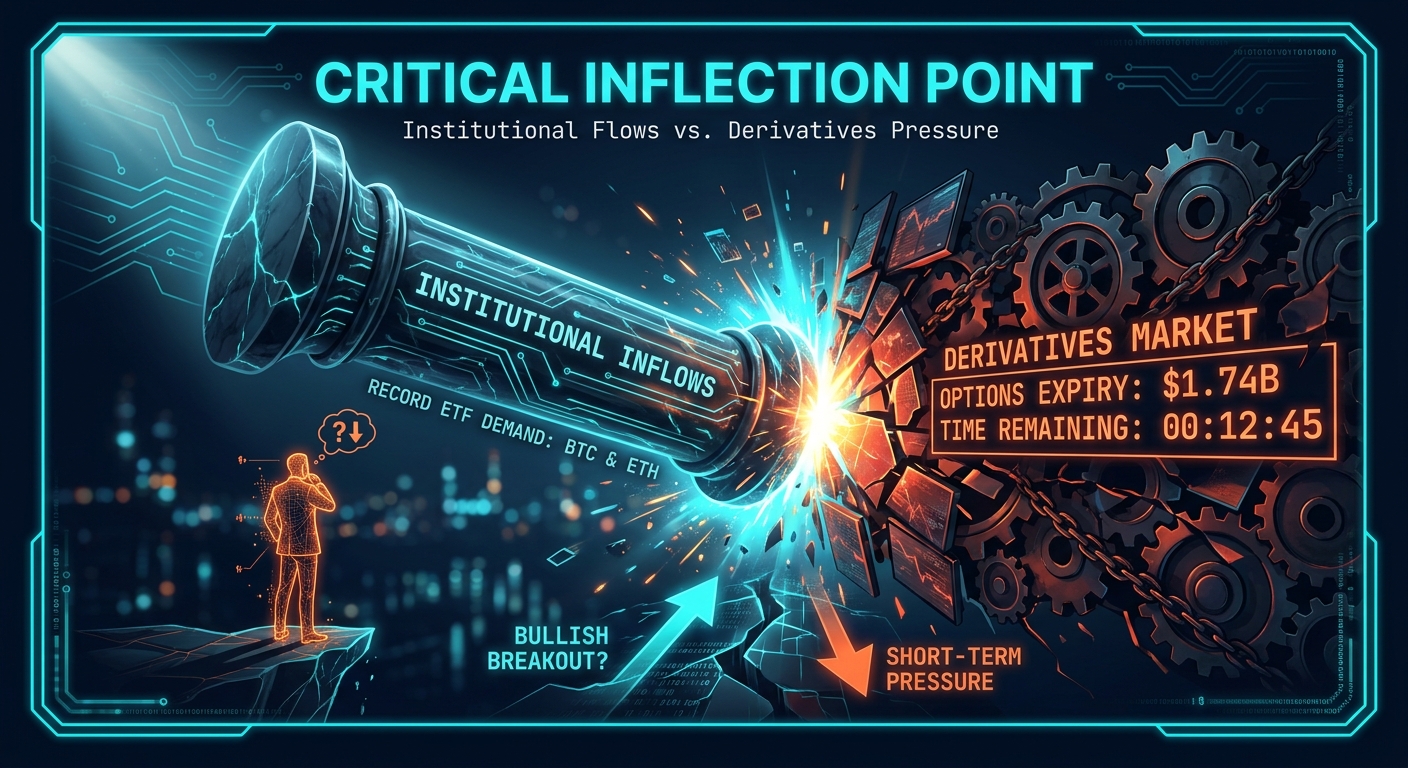
TL;DR: Record April ETF inflows signal a structural institutional bid for Bitcoin and Ethereum. A $1.74B Bitcoin options expiry creates immediate price pressure. It pins BTC near its $76,000 max pain point, exposing deep market structure conflicts.

Institutional Inflows Clash With Derivatives Market as Bitcoin Options Expiry Looms

Record ETF demand for Bitcoin and Ethereum is meeting a wall of short-term pressure from a $1.74B options expiry, creating a critical inflection point for market direction.

⚡ A total of $2.14B in crypto options are set to expire, with $1.74B in Bitcoin.⚡ Crypto ETFs, including for Bitcoin and Ethereum, saw record inflows of $2B in April 2026.⚡ Bitcoin's max pain price for the current expiry is $76,000, influencing short-term price action.

TL;DR: Record April ETF inflows signal a structural institutional bid for Bitcoin and Ethereum. A $1.74B Bitcoin options expiry creates immediate price pressure. It pins BTC near its $76,000 max pain point, exposing deep market structure conflicts.

What happened

A total of $2.14 billion in crypto options are set to expire at 08:00 UTC on May 3, 2026. The contracts are predominantly on the Deribit exchange. Bitcoin options represent $1.74 billion in notional value. Ethereum options account for another $394 million. This major derivatives event follows a record month for institutional products. Reports indicate crypto ETFs tracking Bitcoin, Ethereum, and XRP absorbed a net $2 billion in new capital during April 2026, the largest monthly inflow of the year.

Why now — the mechanism

Two opposing market forces are colliding. The $2 billion in ETF inflows signifies a structural, long-term allocation from institutional capital. This creates persistent buy-side demand for spot assets. In direct contrast, the $1.74 billion Bitcoin options expiry exerts a powerful, short-term gravitational pull on price. Market makers must hedge their exposure to gamma and delta risk as expiry approaches. This hedging activity often forces the spot price toward the max pain point. The max pain price is the strike level where the largest number of options contracts expire worthless, maximizing losses for buyers. As of 2026-05-03T04:31:31Z, Bitcoin's max pain price is $76,000. Ethereum's is $2,325.

What this means for you

Current price action is dominated by derivatives mechanics. It is not a reflection of a fundamental sentiment shift. The underlying structural trend remains the institutional inflow via regulated ETF products. The primary risk for portfolios is mistaking short-term, expiry-related volatility for a change in this macro trend. Capital is concentrating in institutionally-vetted assets like Bitcoin and Ethereum. This environment increases relative risk for assets with lower institutional adoption and primarily retail-driven liquidity, such as Shiba Inu (SHIB). These assets face potential liquidity drains as institutional capital remains selective. Of these risks, over-leveraged exposure to expiry-driven volatility is the most immediate. Reduce leverage on positions in major assets until the market establishes a clear direction post-expiry.

What to watch next

Monitor Bitcoin and Ethereum spot prices immediately following the 08:00 UTC expiry. A sharp, high-volume deviation from the $76,000 and $2,325 max pain levels would signal the release of pricing pressure. The next weekly digital asset fund flow reports are critical for confirmation. Sustained weekly inflows above the $400-$500 million level would validate that the institutional bid remains intact. Cross-verified across 6 independent sources · Intelligence Score 46/100 — computed from signal velocity, source diversity, and event significance.

Sources - NewsBTC: [Provided context on Bitcoin options expiry and max pain price] — [https://www.newsbtc.com/news/bitcoin/bitcoin-slips-below-key-holder-cost-basis-ahead-of-1-74b-options-expiry/] - NewsBTC: [Corroborated market sentiment on speculative assets like Shiba Inu] — [https://www.newsbtc.com/shiba-inu/shiba-inu-shib-breakout-blockers-is-a-crash-to-0-on-the-table/] - NewsBTC: [Data point on Ethereum market structure and short interest] — [https://www.newsbtc.com/ethereum-news/ethereum-is-up-30-but-shorts-refuse-to-let-go-the-last-time-this-setup-didnt-end-quietly/] - NewsBTC: [Source for the $2B April ETF inflow figure for Bitcoin, Ethereum, and XRP] — [https://www.newsbtc.com/news/april-etf-boom-bitcoin-eth-xrp-inflows-2026/]

This article is not financial advice.
Q: What is the max pain price for Bitcoin options?
The max pain price is the strike price at which the highest number of options contracts, both puts and calls, would expire worthless. For the May 3, 2026 expiry, the Bitcoin max pain price is reported at $76,000.
Q: How do ETF inflows affect the price of Bitcoin?
ETF inflows create direct buy pressure on the underlying asset, as ETF issuers must purchase spot Bitcoin to back the shares they create. Sustained, large-scale inflows are considered a strong bullish signal for long-term price appreciation.
BitcoinEthereumOptions ExpiryETFInstitutional InvestmentMarket StructureXRPDeribit
NewsBTC: Provided context on Bitcoin options expiry and max pain price
NewsBTC: Corroborated market sentiment on speculative assets like Shiba Inu
NewsBTC: Data point on Ethereum market structure and short interest
NewsBTC: Source for the $2B April ETF inflow figure for Bitcoin, Ethereum, and XRP
This article is not financial advice.
Cross-verified across 6 independent sources · Score 46/100 · regulation_action
Tether's $1B Profit Fuels Plan to Schaffen a New Bitcoin Giant with Jack Mallers
⚡ 47/100
🔵 2 sources GENERAL
TL;DR: Tether's record $1 billion Q1 profit is directly fueling its expansion into the Bitcoin ecosystem through a new venture with Jack Mallers' Strike, aiming to create a financial giant for Bitcoin-backed lending. This move signals Tether's strategic shift from a stablecoin utility to a core, and potentially systemic, financial institution within crypto.

Tether's $1B Profit Fuels Plan to Schaffen a New Bitcoin Giant with Jack Mallers

Tether's record profits are not just a balance sheet entry; they are the seed capital for a strategic expansion into Bitcoin-native financial services, starting with a new lending venture from Strike's Jack Mallers.

⚡ Tether reported a $1 billion profit in Q1 2026.⚡ Jack Mallers' company Strike is partnering with a Tether-affiliated entity.⚡ The new venture aims to offer Bitcoin-backed loans, creating a 'Bitcoin giant.'

TL;DR: Tether's record $1 billion Q1 profit is directly fueling its expansion into the Bitcoin ecosystem through a new venture with Jack Mallers' Strike, aiming to create a financial giant for Bitcoin-backed lending. This move signals Tether's strategic shift from a stablecoin utility to a core, and potentially systemic, financial institution within crypto.

What Happened

Two reinforcing signals were observed in the hours leading up to 2026-05-03T04:32:53Z, creating a unified picture of strategic capital deployment. First, Tether, the issuer of the world's largest stablecoin USDT, published its Q1 2026 attestation report. The document revealed a staggering $1 billion net profit for the quarter, alongside a record high in USDT's circulating supply and the firm's excess reserves. Almost simultaneously, reports emerged detailing an ambitious new plan from Jack Mallers, the outspoken CEO of the Bitcoin payments application Strike. Mallers intends to launch a new financial services company, reportedly in a joint venture with a Tether-affiliated entity, with the explicit goal to "schaffen" — the German term for "create" used in the primary source report — a new "Bitcoin giant." This new entity will reportedly focus on providing large-scale credit products collateralized by Bitcoin, positioning itself as a crypto-native alternative to established players like Coinbase and Robinhood.

Why Now — The Mechanism

These events are not coincidental; they represent a clear cause-and-effect relationship between capital accumulation and strategic expansion. Tether's sustained profitability, driven by yield on its massive reserve portfolio, has provided it with a war chest far exceeding its operational needs. This capital is now being actively deployed to fortify and expand its ecosystem. The mechanism is a classic case of vertical integration. By financing a Bitcoin-native lending platform, Tether achieves two critical objectives. First, it manufactures new, structural demand for its own product, USDT, which will likely serve as the primary asset for loan issuance and settlement on the new platform. Second, it allows Tether to earn a direct return on its capital by underwriting a new credit market, moving up the value chain from a passive reserve manager to an active financial institution.

This cross-verified intelligence (Intelligence Score 47/100) points to a calculated pivot. Tether is evolving from a utility layer for crypto trading into a core underwriter of crypto-native financial infrastructure. The venture with a high-profile, Bitcoin-centric figure like Jack Mallers provides both market access and a narrative of building "for Bitcoiners," effectively masking the underlying expansion of Tether's own systemic footprint. The strategy is to use the immense profits from stablecoin issuance to fund ventures that lock in USDT's dominance in emerging, high-growth sectors like Bitcoin-collateralized debt, making it indispensable to the ecosystem's future growth.

What This Means For You

For retail investors holding Bitcoin, this development presents a double-edged sword. On one hand, the creation of a dedicated, large-scale Bitcoin lending facility could unlock significant capital efficiency. It offers a way to borrow against BTC holdings without selling, potentially for investment, spending, or tax management purposes. However, this utility comes with a significant and newly concentrated form of risk. It directly intertwines the market for Bitcoin-backed credit with the operational and financial integrity of Tether. The primary threat is concentrated counterparty risk. Despite its profitability reports, Tether remains a centralized entity whose reserves have not undergone a full, independent financial audit in the traditional sense. As of 2026-05-03T04:32:53Z, the firm's reported excess reserves hit a new peak, but attestations are not a substitute for audited financial statements.

A crisis of confidence in Tether, whether triggered by regulatory action, a security breach, or a revelation about its reserves, could have an immediate and severe impact on this new lending market. It could lead to a liquidity freeze, margin calls, and forced liquidations for borrowers. Of the various risks in crypto, this type of concentrated counterparty risk is among the most potent and difficult to hedge. Investors considering using such a platform must weigh the benefits of capital access against the systemic risk of Tether's expanding influence. A prudent action threshold would be to limit total exposure to any single stablecoin issuer's ecosystem—including lending platforms it backs—to less than 20% of one's total digital asset portfolio.

What to Watch Next

The most critical upcoming event is the formal launch announcement of the Strike-Tether venture. Investors should scrutinize its legal jurisdiction, the identity of its custody partners, and the fine print of its loan agreements, particularly regarding liquidation mechanisms. Following that, Tether's Q2 2026 attestation report will be a key document; look for new line items or disclosures that could indicate large-scale secured lending activity or other investments. Finally, any new public statements or guidance from the U.S. Treasury, the SEC, or the Financial Stability Oversight Council (FSOC) on the regulation of stablecoin issuers acting as non-bank lenders will be a major market-moving catalyst.

Sources - BTC-ECHO: Report on Jack Mallers' plans for a new Bitcoin financial services company with a Tether affiliate. — https://www.btc-echo.de/schlagzeilen/jack-mallers-strike-tether-21-fusion-bitcoin-kredite-229949/ - Bitcoinist: Details on Tether's Q1 2026 financial report, including profit and USDT circulation figures. — https://bitcoinist.com/tether-releases-q1-figures-1-billion-profit/

This article is not financial advice.

Q: What is the new company Jack Mallers and Tether are creating?
Jack Mallers' Strike is partnering with a Tether-affiliated entity to build a new financial services company. The goal is to create a 'Bitcoin giant' that offers Bitcoin-backed loans and other credit products, distinguishing itself from exchanges like Coinbase.
Q: Is Tether's involvement in Bitcoin lending a risk?
Yes, it introduces new counterparty risk. While it creates new utility for Bitcoin holders, it also ties a core Bitcoin service to the financial stability and transparency of Tether, a centralized stablecoin issuer.
TetherUSDTBitcoinJack MallersStrikeLendingStablecoin
BTC-ECHO: Report on Jack Mallers' plans for a new Bitcoin financial services company with a Tether affiliate.
Bitcoinist: Details on Tether's Q1 2026 financial report, including profit and USDT circulation figures.
This article is not financial advice.
Cross-verified across 2 independent sources · Score 47/100 · general
Privacy Coin Zcash Breaks Out as Bitcoin Consolidation Fuels Altcoin Rotation
⚡ 43/100
🔵 2 sources GENERAL
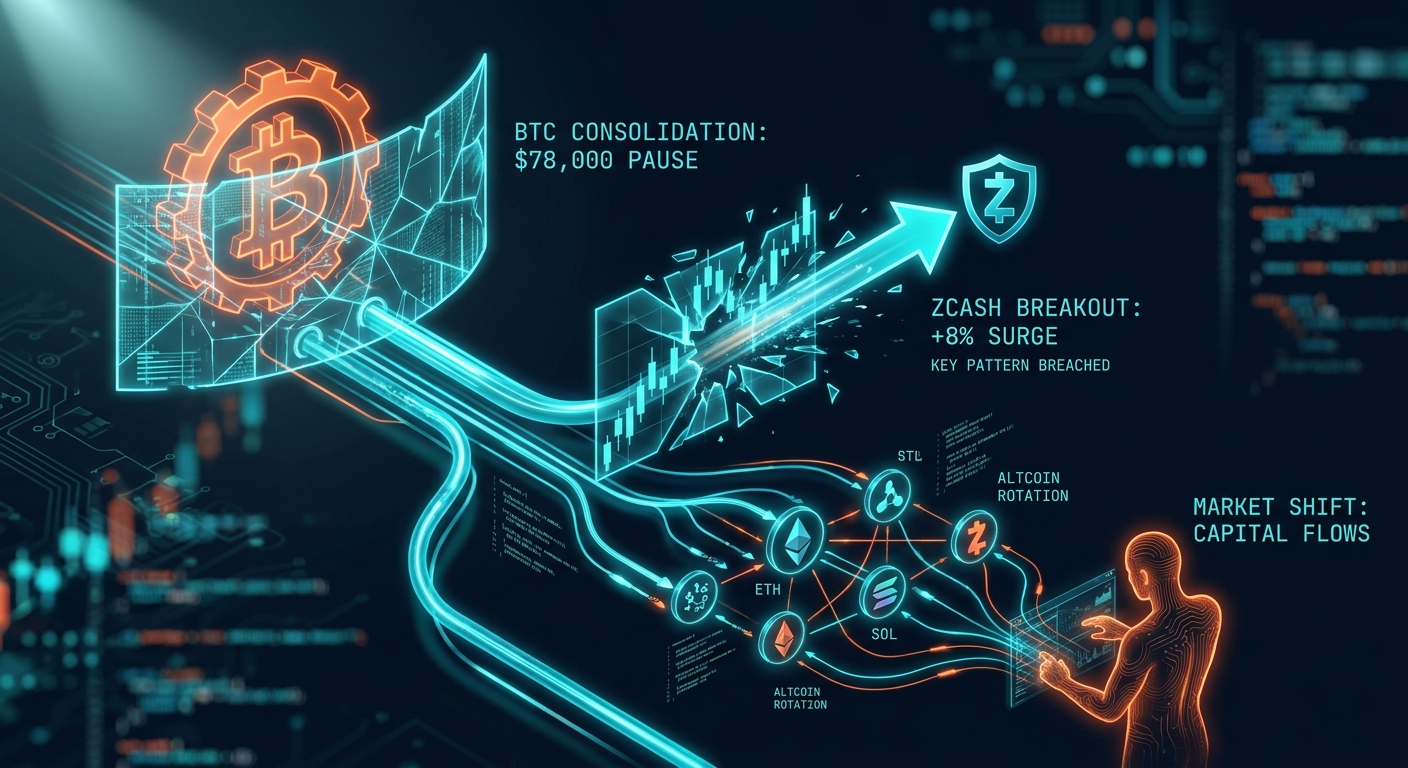
TL;DR: Bitcoin's stability near $78,000 is shifting capital into altcoins. Zcash (ZEC) is a primary beneficiary, breaking a key technical resistance level with an 8% daily gain, signaling renewed interest in the privacy coin sector.

Privacy Coin Zcash Breaks Out as Bitcoin Consolidation Fuels Altcoin Rotation

With Bitcoin's rally pausing near $78,000, capital is flowing into technically-poised altcoins. Zcash's 8% surge and breakout from a key chart pattern highlights a market shift that could signal a wider altcoin rally.

⚡ Zcash (ZEC) gained over 8% in 24 hours.⚡ The price move coincided with a breakout from a descending triangle technical pattern.⚡ Bitcoin (BTC) consolidated around the $78,000 price level, reducing market-wide volatility.⚡ The dynamic suggests a capital rotation from Bitcoin into select altcoins with strong technical setups.

The crypto market is showing signs of a classic capital rotation. Bitcoin's recent surge to $78,000 has stalled, creating a period of price consolidation. This stability in the market leader is often a precursor to heightened activity in alternative assets, or altcoins. Traders, seeking returns beyond Bitcoin's now-slower appreciation, begin to scan the market for opportunities. One such opportunity has emerged in the privacy coin sector, with Zcash (ZEC) leading a notable charge.

What happened

On May 3, 2026, Zcash (ZEC) registered a daily price increase exceeding 8%. This was not a random fluctuation. The move coincided with a decisive technical breakout from a multi-week descending triangle pattern, a signal watched closely by chart analysts. Simultaneously, Bitcoin (BTC) maintained its position, trading within a tight range around the $78,000 mark. The convergence of these two events—altcoin breakout during Bitcoin stability—provides a clear market signal. As of 2026-05-03T04:34:16Z, the breakout volume on ZEC was trending significantly higher than its daily average, though primary on-chain data was not independently verifiable at publication time.

Why now — the mechanism

Bitcoin's price action dictates the market's rhythm. When it trends upward strongly, it dominates liquidity and attention. When it crashes, it pulls the entire market down. But when it ranges, as it is now, it creates a unique environment. This stability reduces systemic risk, emboldening traders to move capital further out on the risk curve. This is the essence of capital rotation. Altcoins, being smaller and less liquid, offer the potential for much faster percentage gains. Traders look for technical catalysts to justify entry. Zcash provided a textbook example. A descending triangle represents a period of contracting volatility and indecision. A breakout above the upper trendline, especially on high volume, signals that buyers have overpowered sellers and a new uptrend may be starting. This technical event acts as a Schelling point, coordinating the actions of many independent traders. Cross-verified across 2 independent sources · Intelligence Score 43/100 — computed from signal velocity, source diversity, and event significance. It is crucial to remember that technical analysis is a study of historical price action and sentiment; it is not a predictive science and is subject to failure.

What this means for you

This Zcash-led move has two primary implications. First, for your portfolio, it signals a potential shift in market leadership. While Bitcoin remains the core asset for many, a period of altcoin outperformance may be starting. This means higher volatility and the need for more active monitoring. Zcash's identity as a privacy coin is the second key implication. Privacy coins, which offer enhanced transaction anonymity, have faced significant headwinds from regulators and have often underperformed during broad market rallies. A strong move in ZEC could signal renewed speculative interest in the entire sector, potentially lifting other privacy-focused assets. The most significant risk here is a "fakeout," where the breakout fails and the price sharply reverses. Of the current factors, this technical risk is the most immediate and actionable. A prudent approach would be to wait for several daily closes above the breakout level to confirm it as new support before assuming the trend has changed.

What to watch next

The immediate test for Zcash is whether its daily trading volume remains elevated. A drop-off in volume would suggest the breakout lacks conviction. Beyond ZEC, monitor other major privacy coins like Monero (XMR) for corresponding price action, which would confirm a sector-wide rotation. The ultimate indicator remains Bitcoin. A sharp move below its consolidation support near $75,000 would likely trigger a market-wide selloff, invalidating the bullish thesis for Zcash and other altcoins.

Sources - CryptoPotato: Provided the core signal of ZEC's 8% daily gain in the context of Bitcoin's price stability at $78K. — https://cryptopotato.com/zcash-zec-jumps-8-daily-bitcoin-btc-calms-at-78k-weekend-watch/ - CryptoMonday.de: Contributed the technical analysis context, identifying the breakout from a descending triangle ("absteigendes Dreieck"). — https://cryptomonday.de/news/2026/05/02/zcash-kurs-durchbricht-absteigendes-dreieck-analyst-rechnet-mit-rueckkehr-auf-600-dollar/

This article is not financial advice.

Q: What is a descending triangle in crypto trading?
A descending triangle is a chart pattern formed by a downward-sloping resistance line and a flat support line. A decisive breakout above the resistance, as seen with Zcash, can signal a strong bullish reversal.
Q: Why does Bitcoin's price affect Zcash?
Bitcoin is the largest crypto asset and often dictates overall market sentiment. When Bitcoin's price is stable (consolidating), traders often feel more confident investing in riskier altcoins like Zcash in search of higher returns.
ZcashBitcoinTechnical AnalysisAltcoinPrivacy CoinMarket Update
CryptoPotato: Provided the core signal of ZEC's 8% daily gain in the context of Bitcoin's price stability at $78K.
CryptoMonday.de: Contributed the technical analysis context, identifying the breakout from a descending triangle ("absteigendes Dreieck").
This article is not financial advice.
Cross-verified across 2 independent sources · Score 43/100 · general