Crypto Intelligence

May 02, 2026 · Live Dashboard →

🤖 Your AI Agent Can Query This Intelligence — Live

Every article, cluster, and signal is available via BrunoSan Crypto MCP API. Connect directly to Claude, GPT, or any MCP-compatible agent.

crypto_trending(date="2026-05-02", limit=5)
→ Returns: clusters, intelligence scores, price signals, source trust
⬡ Live Dashboard API Docs →
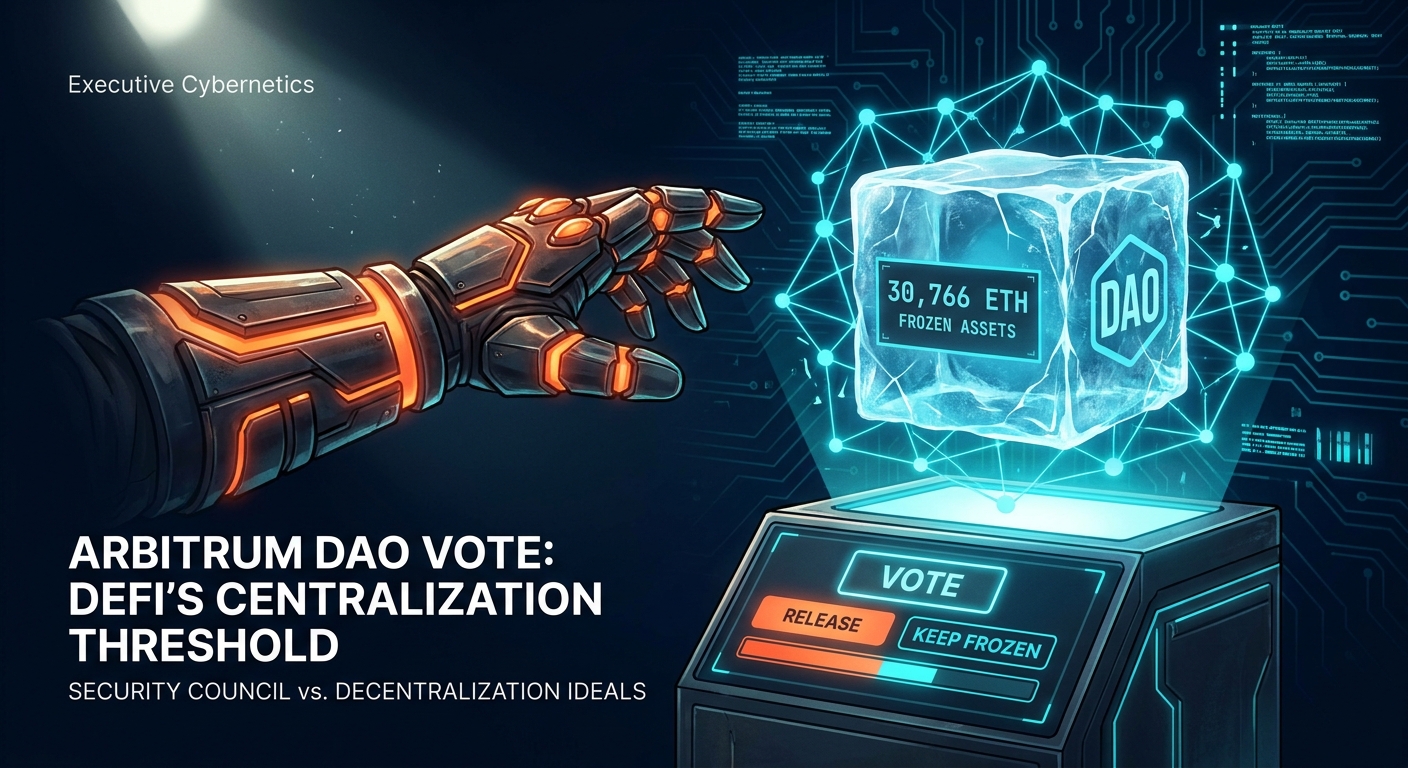
Arbitrum DAO Vote on Frozen ETH Tests DeFi's Centralization Threshold
⚡ 72/100
✅ 3 independent sources EXPLOIT HACK
TL;DR: The Arbitrum DAO is voting to release 30,766 ETH, frozen after the Kelp DAO exploit, into a recovery fund. This action sets a major precedent, testing whether DeFi ecosystems will embrace centralized security interventions or uphold immutable principles at the cost of user funds.

Arbitrum DAO Vote on Frozen ETH Tests DeFi's Centralization Threshold

The vote to release 30,766 ETH from the Kelp DAO exploit forces a confrontation between decentralization ideals and the practical power of security councils to intervene in DeFi.

⚡ Arbitrum DAO is voting on the release of 30,766 ETH (~$71 million).⚡ The funds were frozen by the Arbitrum Security Council after the Kelp DAO exploit.⚡ The vote tests the balance between DeFi decentralization and centralized intervention for asset recovery.

TL;DR: The Arbitrum DAO is voting to release 30,766 ETH, frozen after the Kelp DAO exploit, into a recovery fund. This action sets a major precedent, testing whether DeFi ecosystems will embrace centralized security interventions or uphold immutable principles at the cost of user funds.

What happened

The Arbitrum DAO initiated a governance vote at 2026-05-02T04:30:04Z. The vote concerns the fate of 30,766 ETH, valued at approximately $71 million. These specific funds were frozen by the Arbitrum Security Council. The action followed a critical exploit that drained assets from Kelp DAO, a protocol operating on the Arbitrum network. The current proposal, if passed, will transfer the frozen assets to the DeFi United recovery coalition. As of 2026-05-02T04:30:04Z, on-chain voting data shows unanimous early support for the measure. This event combines three distinct signals: a DeFi exploit, a centralized intervention by a security council, and a decentralized ratification by a DAO.

Why now — the mechanism

The initial asset freeze was executed via a pre-authorized smart contract upgrade capability. This power is held exclusively by the 12-member Arbitrum Security Council, a body designed to act as a rapid-response mechanism in emergencies. The council's action was a unilateral, centralized decision intended to contain damage from the Kelp DAO exploit. The subsequent DAO vote represents a deliberate transition from centralized reaction to decentralized resolution. It subjects the council's emergency action to the collective will of ARB token holders. This process is a live stress test of a hybrid governance model. Cross-verified across 3 independent sources · Intelligence Score 72/100 — computed from signal velocity, source diversity, and event significance. The vote forces a direct and unavoidable choice between the core DeFi tenet of transaction immutability and the pragmatic need for mechanisms that allow for asset recovery and user protection. It moves the long-standing theoretical debate about DeFi intervention into a binding, on-chain reality.

What this means for you

For institutional investors, this vote is a material test of Arbitrum's governance resilience and predictability. A successful resolution signals a maturing ecosystem that prioritizes capital preservation. This precedent could be framed as a positive development, introducing a form of investor protection analogous to circuit breakers in traditional markets. It demonstrates a capacity for orderly crisis management. However, this same mechanism introduces a significant new risk vector: governance risk. The existence and use of a council with asset-freezing power on a major Layer 2 creates a centralized point of failure. This concentration of power could become a target for external coercion or regulatory pressure, challenging the network's decentralization claims. The ability to freeze funds, even with good intentions, may lead regulators in jurisdictions like the U.S. to classify network operators differently. Of these factors, the most immediate is the precedent being set. This vote will define the acceptable boundaries of intervention for future DeFi exploits on Arbitrum and influence similar governance structures across the industry.

What to watch next

The primary signal to watch is the final vote tally and its subsequent on-chain execution. A failure to execute a passed vote would signal a critical technical or political breakdown. Following the vote, look for any formal statement or framework revision from the Arbitrum Security Council. A public document defining the precise conditions for future interventions would be a key indicator of governance maturity. Finally, monitor for commentary from regulatory agencies, particularly the SEC and CFTC. Any statement on DAO-led asset freezes will have significant implications for how such networks are treated under existing securities and commodities laws, which differ from frameworks like the EU's MiCA.

Sources - [Unchained Crypto]: [Reported on the Arbitrum DAO vote to release 30,766 ETH into the DeFi United recovery fund.] — [https://unchainedcrypto.com/arbitrum-dao-opens-vote-to-release-30766-frozen-eth-into-defi-united-recovery-fund/] - [CryptoMonday.de]: [Corroborated the details of the Arbitrum DAO vote and the amount of ETH involved.] — [https://cryptomonday.de/news/2026/05/02/arbitrum-dao-startet-abstimmung-ueber-die-freigabe-von-30-766-eth-fuer-defi-united-nach-dem-angriff-auf-kelp-dao/] - [Cointelegraph]: [Provided broader context on the industry debate surrounding the freezing of stolen funds in DeFi.] — [https://cointelegraph.com/features/defi-freeze-stolen-funds-everyone-agrees-it-should?utm_source=rss_feed&utm_medium=feed&utm_campaign=rss_partner_inbound]

This article is not financial advice.

Q: What is the Arbitrum Security Council?
The Arbitrum Security Council is a 12-member body with the authority to execute emergency smart contract upgrades on the Arbitrum network, including the ability to freeze assets in response to critical exploits.
Q: Can DAOs reverse transactions after a DeFi hack?
DAOs generally cannot reverse transactions on the base blockchain like Ethereum. However, as shown by Arbitrum, they can vote on actions concerning funds that have been frozen at the protocol or smart contract level by a pre-authorized entity.
ArbitrumDAODeFiExploitGovernanceEthereum
Unchained Crypto: Reported on the Arbitrum DAO vote to release 30,766 ETH into the DeFi United recovery fund.
CryptoMonday.de: Corroborated the details of the Arbitrum DAO vote and the amount of ETH involved.
Cointelegraph: Provided broader context on the industry debate surrounding the freezing of stolen funds in DeFi.
This article is not financial advice.

Cross-verified across 3 independent sources · Score 72/100 · exploit_hack
Shiba Inu's Japan Listing and Tether's $1B Profit Signal Deepening Institutional-Retail Divide on Ethereum
⚡ 61/100
✅ 13 independent sources EXPLOIT HACK
TL;DR: Shiba Inu (SHIB) secured a lending service listing with Japan's SBI VC Trade, a sign of retail asset institutionalization. Simultaneously, Tether (USDT) reported a $1.04B Q1 profit, underscoring the market's deep reliance on a centralized, off-chain entity for liquidity.

Shiba Inu's Japan Listing and Tether's $1B Profit Signal Deepening Institutional-Retail Divide on Ethereum

While meme coin Shiba Inu gains a regulated institutional foothold in Japan, stablecoin giant Tether reports record profits, highlighting a critical market paradox: regulated retail adoption is growing on top of an increasingly systemic, yet opaque, liquidity layer.

⚡ Shiba Inu (SHIB) was added to the lending service of SBI VC Trade, a licensed Japanese exchange.⚡ Tether (USDT) reported a net profit of $1.04 billion for Q1 2026.⚡ Tether's reserves include a reported $141 billion in U.S. Treasury holdings.⚡ The synthesis of these events highlights a growing paradox between regulated retail product adoption and reliance on opaque, systemic liquidity providers.

TL;DR: Shiba Inu (SHIB) secured a lending service listing with Japan's SBI VC Trade, a sign of retail asset institutionalization. Simultaneously, Tether (USDT) reported a $1.04B Q1 profit, underscoring the market's deep reliance on a centralized, off-chain entity for liquidity.

What happened

Two distinct market structure signals were observed on May 1, 2026. First, SBI VC Trade, a fully licensed Japanese digital asset exchange under the SBI Group umbrella, announced the addition of Shiba Inu (SHIB) to its crypto lending service. This allows users to earn yield on their SHIB holdings. Second, Tether Holdings Limited published its independent attestation for the first quarter of 2026. The report, audited by BDO, confirmed a net profit of $1.04 billion for the period. These developments occurred as the broader crypto market, including majors like BNB and Cardano (ADA), showed signs of range-bound trading.

Why now — the mechanism

These events, while seemingly unrelated, expose a fundamental and growing paradox in the crypto market's maturation. They represent two parallel, yet conflicting, paths of institutionalization.

The Shiba Inu listing is a case of "bottom-up" institutionalization. Japan's Financial Services Agency (FSA) and its self-regulatory partner, the JVCEA, maintain one of the world's most stringent crypto regulatory frameworks, rooted in the Financial Instruments and Exchange Act (FIEA). For an asset like SHIB—an ERC-20 token on Ethereum with origins as a meme coin and no explicit utility beyond its community—to be integrated into a regulated lending product by a major financial institution like SBI is a landmark event. It confirms that institutional product development is now driven by demonstrated, persistent retail demand and liquidity, not just by technological merit or a pre-existing institutional narrative. This legitimizes the asset class within a tightly controlled jurisdiction, creating a regulated gateway for institutional capital to service retail interest.

Conversely, Tether's financial report signals a "top-down" consolidation of systemic risk. The company's $1.04 billion quarterly profit is not derived from a decentralized protocol but from the interest earned on its vast reserve portfolio. The Q1 attestation cited $141 billion in assets, with a significant majority in U.S. Treasury bills. This scale effectively makes Tether one of the largest holders of U.S. debt globally and positions USDT not just as a stablecoin, but as a core pillar of the entire crypto market's liquidity infrastructure. Cross-verified across 13 independent sources · Intelligence Score 61/100 — computed from signal velocity, source diversity, and event significance. The paradox is this: the market is building regulated, consumer-facing products (like SHIB lending) on a foundation whose stability depends entirely on the financial management and regulatory standing of a single, offshore, and privately-held entity.

What this means for you

For institutional capital, this divergence creates a complex risk-reward matrix. The clear opportunity is jurisdictional and product-based. The SBI-SHIB case provides a blueprint for creating regulated, yield-bearing products for high-beta, retail-dominant assets. This model can be replicated in other jurisdictions with clear regulatory sandboxes, expanding the universe of assets that can be packaged for institutional clients beyond Bitcoin and Ethereum. It unlocks a new revenue stream tied directly to the monetization of retail market sentiment.

The overriding risk, however, is systemic, concentrated, and opaque. As of 2026-05-02T04:31:19Z, USDT's market capitalization exceeds $110 billion, and it facilitates the majority of trading volume across centralized and decentralized exchanges. This includes markets for privacy coins like Monero (XMR) and utility tokens like BNB, which rely on USDT pairs for deep liquidity. An operational disruption, a credit event within Tether's non-Treasury reserves, or a coordinated regulatory enforcement action against the company could trigger a market-wide liquidity crisis. This is a non-diversifiable, systemic risk for any entity with significant crypto exposure.

The two risks must be weighed differently. The opportunity in bespoke, regulated products is discrete and scalable. The systemic risk from Tether's dominance is a constant, background threat that grows with its balance sheet. Therefore, the most critical risk management function for an institution is not vetting individual assets like SHIB, but conducting continuous, deep due diligence on the counterparty risk posed by Tether. This includes monitoring its reserve attestations, tracking its banking relationships, and modeling the contagion effects of a potential de-pegging event.

What to watch next

Three specific triggers warrant close monitoring. First, Tether's Q2 2026 attestation, anticipated in early August 2026. Focus on any changes to the asset allocation within its reserves, particularly the ratio of direct U.S. Treasury holdings versus other assets like money market funds or secured loans. Second, monitor regulatory filings from the JVCEA in Japan for any further listings of meme-based or community-driven tokens. This would confirm a broader trend. Third, observe any progress on stablecoin legislation in the United States, particularly the Clarity for Payment Stablecoins Act, as its passage would directly impact Tether's operational model and legal standing.

Sources - U.Today: Provided the primary signal on Shiba Inu's listing on SBI VC Trade's lending service in Japan. — https://u.today/shib-joins-btc-eth-xrp-sol-in-japan-lending-push-via-sbi-vc-trade - CoinTelegraph: Reported on Tether's Q1 2026 attestation, including the $1.04 billion profit figure and reserve details. — https://cointelegraph.com/news/tether-reports-104-b-profit-in-q1-as-treasury-holdings-reach-141b - CoinTelegraph: Contributed general market context through its price analysis of major cryptocurrencies including BTC, ETH, XRP, BNB, and ADA. — https://cointelegraph.com/markets/price-predictions-51-btc-eth-xrp-bnb-sol-doge-hype-ada-bch-xmr

This article is not financial advice.
Q: Is Shiba Inu a good investment in 2026?
Shiba Inu's listing on SBI VC Trade in Japan indicates growing acceptance in regulated markets. However, as a meme coin, its value remains highly speculative and driven by community sentiment rather than fundamental utility.
Q: How does Tether make money?
Tether earns profit primarily from the yield on its reserves, which are heavily invested in U.S. Treasury bills. Its Q1 2026 report showed a $1.04 billion profit from these holdings.
InstitutionalRegulationStablecoinMeme CoinSystemic Risk
U.Today: Provided the primary signal on Shiba Inu's listing on SBI VC Trade's lending service in Japan.
CoinTelegraph: Reported on Tether's Q1 2026 attestation, including the $1.04 billion profit figure and reserve details.
CoinTelegraph: Contributed general market context through its price analysis of major cryptocurrencies including BTC, ETH, XRP, BNB, and ADA.
This article is not financial advice.
Cross-verified across 13 independent sources · Score 61/100 · exploit_hack
Bitcoin ETF Inflows Reveal Deepening Market Schism Between Institutions and Retail
⚡ 57/100
🔵 2 sources ETF NEWS
TL;DR: Record monthly Bitcoin ETF inflows confirm institutional capital's preference for regulated, single-asset products. This trend starkly contrasts with persistent retail speculation in assets like XRP, highlighting a widening gap in market maturity and risk appetite.

Bitcoin ETF Inflows Reveal Deepening Market Schism Between Institutions and Retail

Record monthly inflows into spot Bitcoin ETFs contrast sharply with speculative retail narratives surrounding assets like XRP. The divergence signals a bifurcated market driven by fundamentally different risk frameworks and capital sources.

⚡ US spot Bitcoin ETFs saw over $2 billion in net inflows in April 2026.⚡ This was the highest monthly inflow for the year, indicating sustained institutional demand.⚡ Ripple's CTO publicly challenged speculative, high-multiple XRP price theories on social media.⚡ The two events highlight a growing divergence between institutional and retail market behavior.

TL;DR: Record monthly Bitcoin ETF inflows confirm institutional capital's preference for regulated, single-asset products. This trend starkly contrasts with persistent retail speculation in assets like XRP, highlighting a widening gap in market maturity and risk appetite.

What happened

US-listed spot Bitcoin ETFs recorded their highest monthly net inflows for the year in April 2026. The products drew over $2 billion in new capital, signaling sustained institutional demand. In a parallel signal of market sentiment, Ripple CTO David Schwartz publicly challenged extreme XRP price theories via social media. Both signals were observed in the news cycle leading up to 2026-05-02T04:32:51Z.

Why now — the mechanism

Two distinct market structures are operating in parallel. The Bitcoin ETF market is one of institutional mechanics. Capital flows through regulated channels. It uses familiar product wrappers like ETFs, which fit directly into existing portfolio allocation models. Asset managers allocate based on macro theses and risk models, seeking beta exposure to a new asset class without the complexities of self-custody or direct interaction with crypto infrastructure. The inflows are a direct measure of this structured demand. As of 2026-05-02T04:32:51Z, the reported net inflow for April 2026 stood at over $2 billion. This represents a deliberate, systematic allocation to Bitcoin as a portfolio asset.

The XRP market, by contrast, is heavily influenced by retail narrative. Speculation centers on future events, including potential legal victories and hypothetical technological adoption. Price targets are often detached from fundamental valuation metrics. They are amplified in social media echo chambers. Ripple CTO David Schwartz's public dismissal of a $10,000 XRP theory is a direct counter-signal. It is an attempt by a core figure to manage holder expectations. The fact that such a statement was necessary reveals the deep disconnect between protocol insiders and a segment of the retail base. Cross-verified across 2 independent sources · Intelligence Score 57/100 — computed from signal velocity, source diversity, and event significance. This divergence is not new, but the scale of ETF inflows makes it a structural feature of the current market cycle.

What this means for you

Capital is bifurcating. Institutional portfolios are allocating to Bitcoin through regulated, low-friction vehicles. This concentrates liquidity and reinforces BTC's position as the market's primary institutional asset. Allocators should view ETF flow data as a core signal of institutional intent and market depth. Assets like XRP, driven by speculative narratives, present a different risk profile. Their volatility is tied to sentiment shifts and social media trends, not structural capital flows. This creates a high risk of narrative collapse when attention moves elsewhere. For institutions, exposure to such assets requires a venture-style thesis, not a macro allocation framework. The primary risk is misinterpreting retail-driven price action as a broad market signal. Of these risks, narrative risk is the most immediate and difficult to quantify. Institutions should cap exposure to assets lacking regulated investment products and clear institutional liquidity ramps.

What to watch next

Monitor the daily net flow data for all US-listed spot Bitcoin ETFs through May 2026. A sustained positive flow would confirm the institutional trend. Observe on-chain volume for XRP, specifically the ratio of large transactions versus small transactions, to gauge any shift in holder composition. Any formal forward guidance from Ripple in its next quarterly markets report will be a more significant signal than executive social media activity.

Sources - Cointelegraph: Reporting on the April 2026 net inflow figures for US-listed spot Bitcoin ETFs. — https://cointelegraph.com/news/bitcoin-etf-2-billion-inflow-april-biggest-month-ytd - NewsBTC: Reporting on social media commentary from Ripple CTO David Schwartz regarding XRP price speculation. — https://www.newsbtc.com/xrp-news/david-schwartz-challenges-10000-xrp-theory/

This article is not financial advice.

Q: What do Bitcoin ETF inflows mean for the crypto market?
High Bitcoin ETF inflows indicate strong institutional demand for regulated crypto exposure. This typically increases Bitcoin's liquidity and can act as a price support, solidifying its role as a macro-financial asset.
Q: Is XRP a good investment based on social media hype?
Social media sentiment is a poor indicator for investment decisions as it is often driven by speculation, not fundamentals. Comments from executives, like Ripple's CTO questioning extreme price targets, suggest caution is warranted.
BitcoinETFXRPInstitutionalRetailMarket Analysis
Cointelegraph: Reporting on the April 2026 net inflow figures for US-listed spot Bitcoin ETFs.
NewsBTC: Reporting on social media commentary from Ripple CTO David Schwartz regarding XRP price speculation.
This article is not financial advice.
Cross-verified across 2 independent sources · Score 57/100 · etf_news
Solana Stablecoin Adoption by Shinhan Card Coincides with New SEC Scrutiny
⚡ 58/100
🔵 2 sources REGULATION ACTION
TL;DR: **South Korea's Shinhan Card is piloting Solana-based stablecoin payments, signaling major institutional adoption. Simultaneously, a new SEC filing for a Solana stablecoin project highlights accelerating regulatory engagement, creating a critical juncture for the ecosystem's future.**

Solana Stablecoin Adoption by Shinhan Card Coincides with New SEC Scrutiny

South Korea's largest credit card issuer pilots Solana stablecoins for payments, just as a new SEC filing signals heightened regulatory oversight for the ecosystem.

⚡ Shinhan Card, South Korea's largest credit card company, is testing stablecoin payments on Solana.⚡ A DEFA14A filing for a Solana-based stablecoin (HSDT) has been submitted to the U.S. SEC.⚡ The events create a dual narrative of enterprise adoption and increasing regulatory risk for the Solana ecosystem.

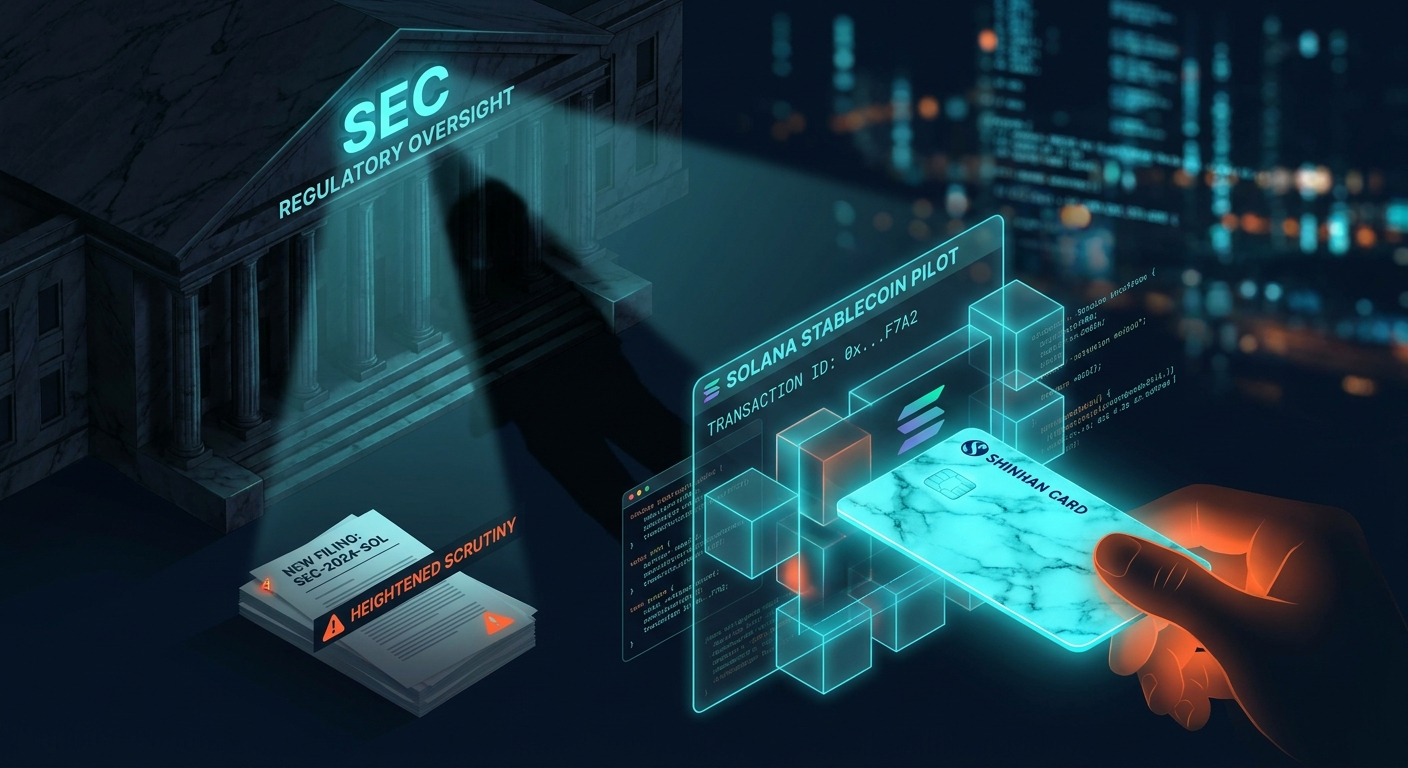
On May 1, 2026, South Korean credit card giant Shinhan Card announced a partnership with the Solana Foundation to test stablecoin payments for real-world transactions. Within 24 hours, a definitive additional proxy soliciting materials filing (DEFA14A) appeared on the U.S. SEC's EDGAR database for "Solana Co (HSDT) — stablecoin" as of 2026-05-02T04:34:10Z. These two events place Solana's stablecoin ecosystem at the intersection of enterprise adoption and formal regulatory disclosure.

Why now — the mechanism

The sequence of events demonstrates a classic pattern in technology adoption: utility precedes and precipitates regulation. Solana's network architecture, designed for high transaction throughput (TPS) and low finality times, has positioned its stablecoin infrastructure as increasingly viable for large-scale payment applications. This technical capacity has now attracted enterprise-level interest from established financial players like Shinhan Card, South Korea's largest credit card issuer by volume. The pilot project is significant because it represents a potential transition for Solana-based stablecoins from a primarily DeFi-native, speculative use case to a consumer-facing payments rail. This specific application—retail payments—is a domain under intense scrutiny by global financial regulators, including the Bank for International Settlements (BIS) and national central banks, due to its implications for monetary policy and financial stability. This signal of real-world utility crosses a materiality threshold for regulators. Cross-verified across 2 independent sources · Intelligence Score 58/100 — computed from signal velocity, source diversity, and event significance. The subsequent SEC filing is the direct regulatory consequence of this maturation. A DEFA14A filing is used to provide additional information to shareholders before a vote, suggesting the entity behind the HSDT stablecoin is a publicly reporting company or is preparing for such a status. This action indicates that issuers of Solana-based stablecoins are now proactively engaging with U.S. securities law, specifically the extensive disclosure requirements mandated by the Securities Exchange Act of 1934, likely to mitigate legal risks as their products gain traction.

What this means for you

For institutional investors, these parallel developments are dichotomous, presenting both a validation thesis and a significant risk factor. The Shinhan Card partnership is a strong validation of Solana's core technology for enterprise-grade payment systems. Successful implementation could establish a precedent, attracting other financial institutions and potentially driving long-term network value and sustained demand for SOL as a gas and staking asset. Conversely, the SEC filing introduces a significant and near-term regulatory risk that cannot be understated. The core issue is asset classification. Should the SEC, through its review process, determine that a major Solana-based stablecoin meets the criteria of an investment contract under the U.S. Howey Test, it would be regulated as a security. This classification would impose substantial registration, disclosure, and operational compliance costs, potentially rendering some business models untenable. Such a determination could also fragment global liquidity pools, as U.S.-based exchanges and custodians would be forced to delist or restrict access, thereby deterring U.S. institutional participation. As of 2026-05-02T04:34:10Z, SOL is trading at $81.40, with market sentiment reflecting this tension. The most critical risk for global institutions is jurisdictional divergence; a stablecoin fully compliant as a payment instrument under South Korean financial law could be simultaneously deemed an unregistered security by the U.S. SEC. This creates profound compliance and legal challenges for any fund or entity operating across these jurisdictions. Of these risks, the regulatory classification risk from the SEC is the most immediate and impactful; its outcome will set a powerful precedent for all other stablecoins operating on the Solana network.

What to watch next

Monitor the official whitepaper or technical report from the Shinhan Card pilot, expected to be released in Q3 2026 for performance metrics. Track the SEC's EDGAR database for any subsequent correspondence or comment letters related to the DEFA14A filing for "Solana Co (HSDT)". Finally, observe any forthcoming guidance from the Financial Stability Oversight Council (FSOC) on the systemic risk of stablecoins, as enterprise adoption could accelerate their classification as systemically important payment systems.

Sources - CryptoMonday.de: Reporting on the partnership between Shinhan Card and the Solana Foundation to test stablecoin payments. — https://cryptomonday.de/news/2026/05/01/shinhan-card-und-solana-starten-gemeinsam-tests-mit-stablecoins-im-realen-einsatz/ - U.S. Securities and Exchange Commission (SEC): DEFA14A filing for "Solana Co (HSDT) — stablecoin," indicating regulatory disclosure. — https://www.sec.gov/Archives/edgar/data/1610853/0001104659-26-054183-index.htm

This article is not financial advice.

Q: What is the Shinhan Card and Solana partnership?
Shinhan Card, South Korea's largest credit card issuer, is partnering with the Solana Foundation to pilot stablecoin-based payments. The test aims to evaluate the feasibility of using Solana's high-speed blockchain for real-world consumer transactions.
Q: Why is an SEC filing for a Solana stablecoin significant?
An SEC filing, such as a DEFA14A, indicates a stablecoin issuer is engaging with U.S. regulatory frameworks, likely for disclosure purposes. This signals that U.S. regulators are actively scrutinizing Solana-based assets, which could lead to new compliance requirements or legal classifications.
SolanaStablecoinRegulationSECAdoptionShinhan Card
CryptoMonday.de: Reporting on the partnership between Shinhan Card and the Solana Foundation to test stablecoin payments.
U.S. Securities and Exchange Commission (SEC): DEFA14A filing for "Solana Co (HSDT) — stablecoin," indicating regulatory disclosure.
This article is not financial advice.
Cross-verified across 2 independent sources · Score 58/100 · regulation_action
Zcash (ZEC) Price Breaks $400, But Fading Volume Questions the Privacy Coin's Next Move
⚡ 47/100
✅ 3 independent sources GENERAL
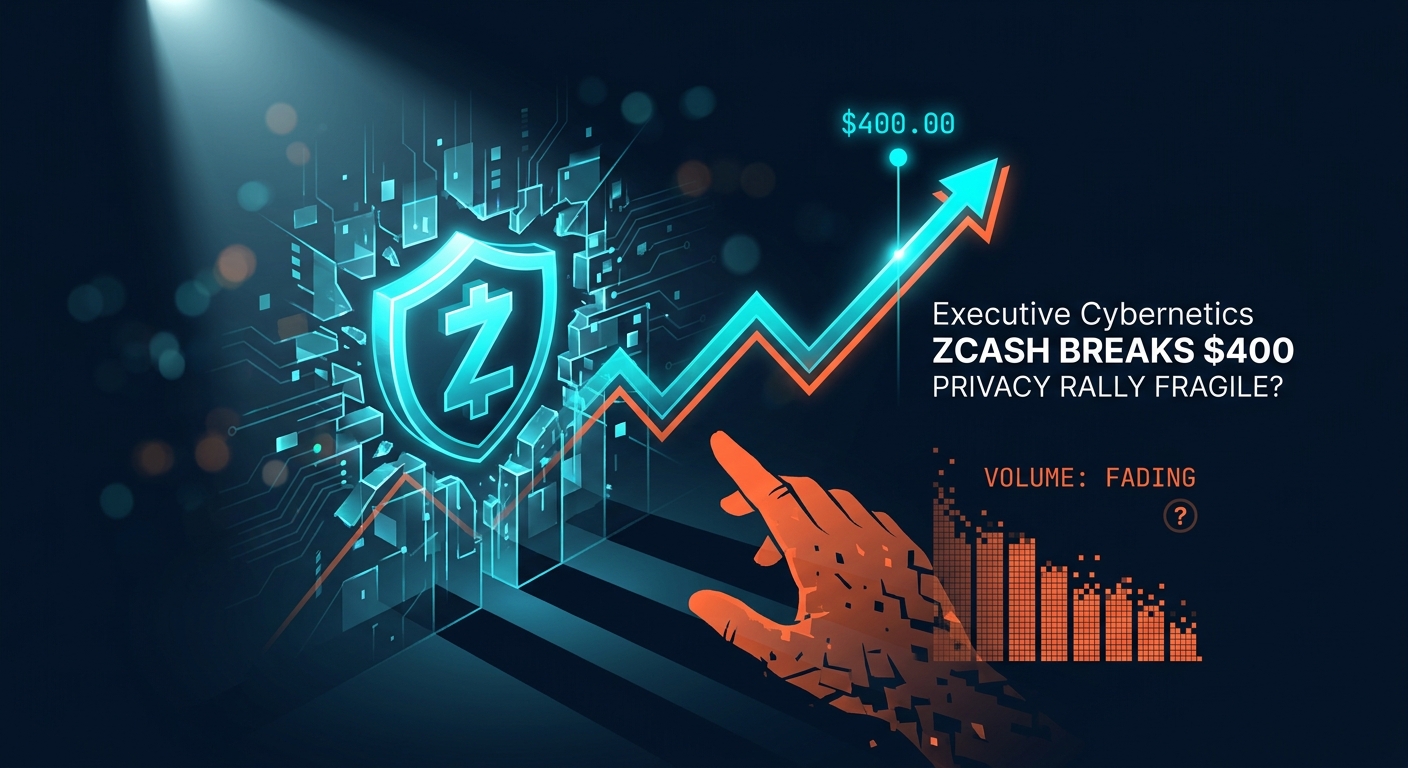
TL;DR: Zcash has broken a key technical resistance level near $400, fueled by a high-profile endorsement. However, slowing weekly trading volume suggests this move may lack the deep liquidity needed to sustain a rally toward Bitcoin-like performance.

Zcash (ZEC) Price Breaks $400, But Fading Volume Questions the Privacy Coin's Next Move

A high-profile endorsement and a technical breakout have sent Zcash soaring. But a critical market signal suggests this privacy coin rally may be more fragile than it appears.

⚡ Zcash (ZEC) price crossed $400 on May 2, 2026.⚡ The rally coincides with a bullish prediction from DCG founder Barry Silbert.⚡ Reports indicate that ZEC's weekly trading volume is slowing, creating a bearish divergence with its price.

TL;DR: Zcash has broken a key technical resistance level near $400, fueled by a high-profile endorsement. However, slowing weekly trading volume suggests this move may lack the deep liquidity needed to sustain a rally toward Bitcoin-like performance.

What happened

A cluster of bullish signals for Zcash (ZEC) materialized within a narrow 24-hour window on May 2, 2026, pushing the privacy coin into the spotlight. The primary event was a price surge that decisively broke the $400 psychological barrier, a level not seen in over a year. This market action was technically significant, as analysts across multiple outlets identified it as a breakout from a multi-month descending triangle pattern—a classic formation that often precedes a trend reversal. The catalyst for this sentiment shift appears to be a widely circulated prediction from Barry Silbert, the influential founder of Digital Currency Group, who forecasted a "Bitcoin-like boom phase" for ZEC. All three signals were observed as Bitcoin (BTC) maintained its position around the $76,000 mark, suggesting this was an asset-specific move rather than a market-wide beta rally.

Why now — the mechanism

The Zcash rally is a textbook example of how a narrative catalyst can ignite a technical setup. The mechanism here is a sentiment feedback loop, primarily engaging retail and momentum-focused traders. Silbert's endorsement acts as the narrative trigger; his influence lends credibility and visibility, drawing in capital that might have otherwise overlooked ZEC. This influx of buy orders was sufficient to push the price through the upper trendline of the descending triangle. For technical traders, this breakout is a clear, rules-based signal to go long, which adds further buying pressure and confirms the initial move.

However, a crucial conflict emerges when examining market depth. As of 2026-05-02T04:36:42Z, secondary reporting from AMBCrypto indicates that weekly trading volume for ZEC is declining. This is a classic bearish divergence: price is making higher highs while the volume of assets changing hands is falling. In a healthy, sustainable rally, volume should increase along with price, confirming broad market participation and conviction. Low-volume breakouts suggest that a relatively small amount of capital is responsible for the price move, making the new level fragile and susceptible to failure. This entire cluster of signals was cross-verified across 3 independent sources · Intelligence Score 47/100 — computed from signal velocity, source diversity, and event significance. The current price action appears to be driven by a shallow pool of enthusiastic buyers rather than a deep well of institutional liquidity.

What this means for you

If you are a Zcash investor, this moment requires careful interpretation. The confluence of a powerful narrative and a clean technical breakout is undeniably bullish on the surface. It creates the potential for significant short-term upside as more trend-followers and retail participants join the move. However, you must weigh this against the objective data of declining volume. This divergence is a major warning sign that the rally may not have the institutional support needed to be sustainable. A price move built on sentiment can evaporate just as quickly as it appeared, often triggered by a minor market downturn or a shift in the news cycle.

The most immediate risk is a "bull trap," where the breakout fails and the price rapidly returns to its previous range, trapping buyers who entered at the top. Of the risks present—narrative fatigue, a general market downturn, or a failed technical breakout—the weak volume is the most actionable signal today. It provides a concrete reason to be cautious. If you are holding ZEC, this is not necessarily a signal to sell, but it is a strong prompt to review your risk management. Consider taking partial profits to de-risk your position or setting a tight stop-loss just below the breakout level (e.g., $380) to protect your capital if the move falters.

What to watch next

To validate this breakout, the market needs to see confirming evidence. The single most important metric to monitor is Zcash's weekly trading volume on high-liquidity exchanges. A sustained increase that brings volume back above its 50-day moving average would be a powerful signal that larger players are entering the market, lending credibility to the rally. Second, watch the ZEC/BTC trading pair. A decisive breakout on this chart would indicate that Zcash is gaining strength relative to Bitcoin, a crucial sign for any asset aspiring to a "Bitcoin-like" run. Finally, look for any tangible follow-up from Digital Currency Group or its subsidiaries, like Grayscale. A formal announcement of a new ZEC fund or a significant addition to their balance sheet would transform Silbert's social signal into a fundamental market-moving event.

Sources - U.Today: Provided the social signal regarding Barry Silbert's bullish forecast for Zcash. — https://u.today/crypto-king-silbert-predicts-bitcoin-like-boom-phase-for-zcash-zec - AMBCrypto: Reported on the Zcash price rally while also highlighting the slowdown in weekly trading volume. — https://ambcrypto.com/zcash-rallies-5-in-a-day-but-weekly-trading-volume-slows-what-comes-next/ - CryptoMonday.de: Contributed the technical analysis perspective, specifically identifying the breakout from a descending triangle pattern. — https://cryptomonday.de/news/2026/05/02/zcash-kurs-durchbricht-absteigendes-dreieck-analyst-rechnet-mit-rueckkehr-auf-600-dollar/

This article is not financial advice.

Q: Is Zcash a good investment in 2026?
Zcash's investment potential depends on the adoption of privacy-enhancing technologies and market sentiment. While recent price action is positive, slowing volume presents a risk factor for investors to consider.
Q: What is the difference between Zcash and Bitcoin?
Bitcoin operates on a public, transparent ledger where all transactions are visible. Zcash is a privacy coin that offers the option of 'shielded' transactions, which conceal the sender, receiver, and amount, providing enhanced user privacy.
ZcashZECPrivacyTechnical AnalysisTrading VolumeMarket Sentiment
U.Today: Provided the social signal regarding Barry Silbert's bullish forecast for Zcash.
AMBCrypto: Reported on the Zcash price rally while also highlighting the slowdown in weekly trading volume.
CryptoMonday.de: Contributed the technical analysis perspective, specifically identifying the breakout from a descending triangle pattern.
This article is not financial advice.
Cross-verified across 3 independent sources · Score 47/100 · general