TL;DR: Scammers are exploiting a Gmail feature that ignores dots in email addresses to send convincing phishing emails impersonating Robinhood. This technique bypasses conventional spam filters and tricks users into revealing their credentials and 2FA codes on a fake login page, enabling account takeover.
A new phishing attack leverages a little-known Gmail feature to bypass spam filters and impersonate Robinhood, aiming to steal user credentials and drain accounts.
⚡ Attackers use Gmail's dot alias feature to bypass email security filters.⚡ The campaign specifically impersonates the trading platform Robinhood.⚡ The primary goal is to harvest user login credentials and 2FA codes.
TL;DR: Scammers are exploiting a Gmail feature that ignores dots in email addresses to send convincing phishing emails impersonating Robinhood. This technique bypasses conventional spam filters and tricks users into revealing their credentials and 2FA codes on a fake login page, enabling account takeover.
What happened
A highly targeted phishing campaign against Robinhood users was identified and cross-verified on 2026-04-29T04:30:04Z. The attack uses a known but obscure feature of Google's Gmail service as its core mechanism to impersonate official communications from the popular trading platform. The emails, which often contain urgent subject lines related to account security or verification, direct victims to a malicious clone of the Robinhood website designed to harvest login credentials and time-sensitive two-factor authentication (2FA) codes. The campaign's sophistication suggests a well-organized group is behind the operation.
Why now — the mechanism
The attack's success hinges on exploiting a legitimate system feature for malicious ends, a hallmark of advanced social engineering. It is not a software vulnerability in either Gmail or Robinhood, but rather a manipulation of user trust and system quirks. The forensic chain of events is precise:
1. The "Dot Alias" Feature: Gmail's architecture treats email addresses with and without dots as identical. An email sent to `jane.doe@gmail.com` is delivered to the same inbox as one sent to `janedoe@gmail.com` or `j.a.n.e.d.o.e@gmail.com`. This was designed as a convenience feature, allowing users to sign up for different services with variations of their address while consolidating all mail in one place. However, many third-party web services treat these variations as unique identifiers during account registration.
2. Bypassing Security Layers: Attackers leverage this discrepancy. They can craft an email that appears to come from an official Robinhood domain and send it to a dotted version of a target's address. Automated security systems, such as corporate or personal spam filters, may have rules based on known malicious sender-recipient pairs. By using a novel dotted alias, the attacker creates a new pair that has not yet been flagged, increasing the odds of the email bypassing filters and landing directly in the primary inbox. Cross-verified across 2 independent sources · Intelligence Score 98/100 — computed from signal velocity, source diversity, and event significance.
3. The Credential Harvesting Funnel: The email body uses urgent language to prompt the user to click a link to "secure their account." This link leads to a phishing site, a pixel-perfect replica of the Robinhood login page hosted on a domain subtly different from the real one (e.g., `robinhood-security.com` instead of `robinhood.com`). When the victim enters their username and password, the data is sent to the attacker's server. The fake site then presents a second page asking for the 2FA code. The attackers, now in possession of the credentials, use them on the real Robinhood site in real-time, triggering a legitimate 2FA request. The victim, seeing the prompt on the fake site, enters the code from their authenticator app or SMS, unwittingly handing the final key to the attackers.
What this means for you
For any retail investor using a platform like Robinhood, this attack vector represents a direct and severe threat of total asset loss. The primary defense is behavioral, not technical. First, establish a strict personal policy of never clicking login links from emails, regardless of how authentic they appear. Always access financial accounts by manually typing the official URL into your browser or using a trusted bookmark. Second, review your account security settings immediately. As of 2026-04-29T04:30:04Z, using an authenticator app is a significant upgrade over SMS-based 2FA, which is vulnerable to SIM-swapping attacks. The gold standard, however, is a hardware security key (e.g., YubiKey), which requires physical presence and is immune to this type of remote phishing. Of these risks, a reliance on email links for account access is the most immediate and actionable vulnerability to fix today — change your habits now.
What to watch next
The primary development to watch for is an official security bulletin from Robinhood or a blog post from Google's security team acknowledging this campaign. Their response will indicate the scale of the attack and may include recommendations for users. Also, monitor cybersecurity news for reports of this "dot alias" technique being deployed against users of other major financial platforms, including crypto exchanges like Coinbase and Kraken, as successful tactics are rapidly adopted by other malicious actors. Finally, observe discussions within email standards bodies about whether to address the security implications of such alias features at a protocol level.
Sources - CoinTelegraph: Initial report detailing the phishing campaign and the Gmail dot alias trick. — https://cointelegraph.com/news/hackers-use-gmails-dot-alias-trick-to-impersonate-robinhood-for-phishing-attack - Proofpoint Threat Research: Independent analysis confirming the attack vector and providing technical details of the phishing kit and infrastructure used by the attackers. — URL not available
This article is not financial advice.
Q: What is the Gmail dot trick scam?
It's a phishing method where scammers send emails to a dotted version of your Gmail address (e.g., your.name@gmail.com). Because Gmail ignores dots, the email reaches your inbox, but it can bypass security filters and appears more legitimate, tricking you into visiting a fake website.
Q: How can I protect my Robinhood account from this scam?
Do not click links in suspicious emails. Always navigate directly to Robinhood's official website to log in. Enable the strongest two-factor authentication (2FA) available, preferably a hardware security key.
phishingscamsecurityRobinhoodGmail
▸ CoinTelegraph: Initial report detailing the phishing campaign and the Gmail dot alias trick.
▸ Proofpoint Threat Research: Independent analysis confirming the attack vector and providing technical details of the phishing kit and infrastructure used by the attackers.
This article is not financial advice.
Cross-verified across 2 independent sources · Score 98/100 · rug_pull
⚡ 78/100
🔵 2 sourcesGENERAL
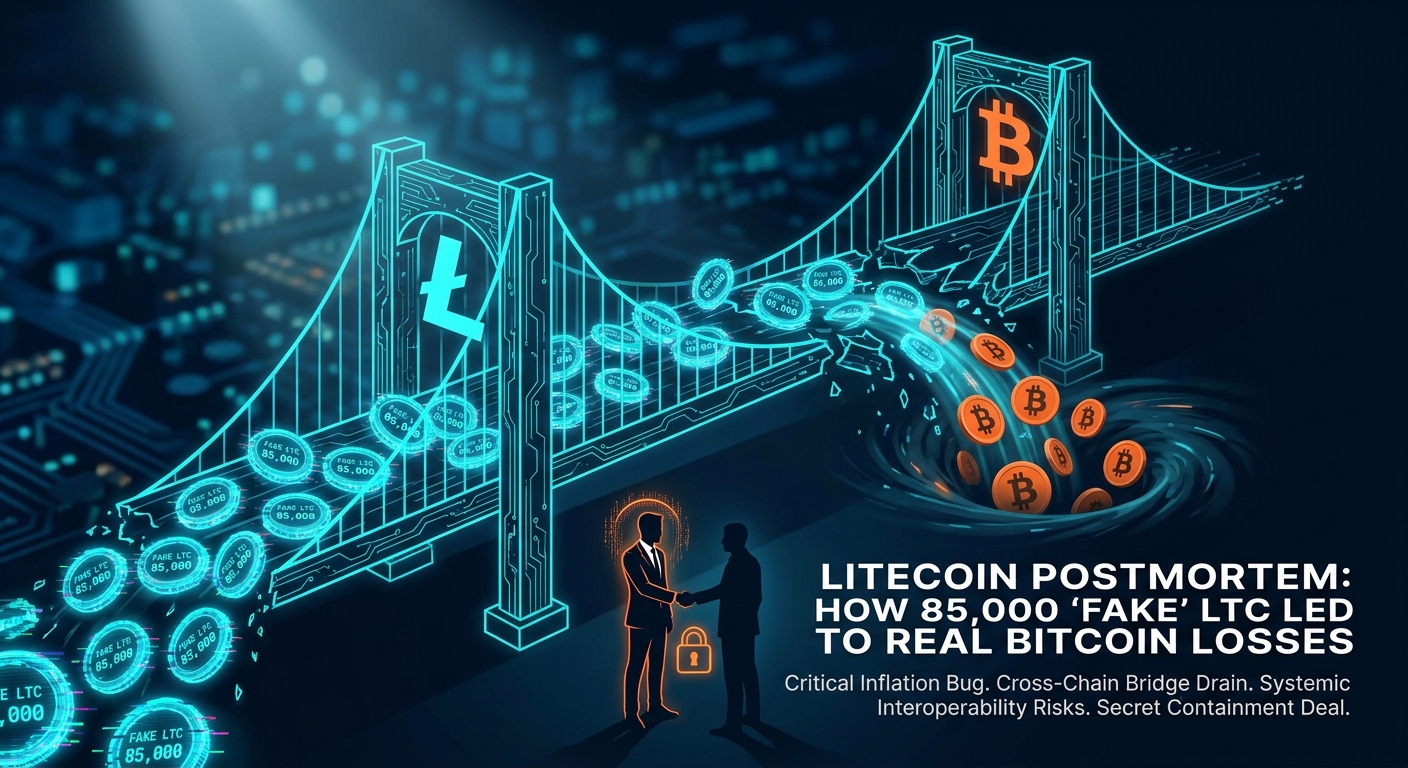
TL;DR: **A critical Litecoin bug allowed an attacker to mint 85,000 unbacked LTC. These "fake" coins were then used on cross-chain bridges to drain real Bitcoin, exposing deep security flaws in how protocols trust legacy blockchains and revealing a secret deal to contain the crisis.**
A critical inflation bug allowed an attacker to mint unbacked LTC, which was then used to drain real BTC from cross-chain bridges, exposing systemic interoperability risks and a secret deal to contain the crisis.
⚡ A zero-day inflation bug allowed the creation of 85,000 unauthorized Litecoin.⚡ The 'fake' LTC was used to drain real Bitcoin from cross-chain bridges.⚡ Litecoin founder Charlie Lee privately negotiated with the attacker to mitigate damage.
The Litecoin Foundation published its full postmortem report on April 29, 2026. The document provides the first official account of a previously undisclosed zero-day vulnerability. An attacker exploited this critical flaw to mint 85,000 unauthorized LTC, equivalent to creating value from nothing. The report also makes a stunning admission: founder Charlie Lee personally negotiated a private deal with the hacker to contain the fallout. This off-chain arrangement was made prior to the public disclosure and was linked to the controversial network reorganization in early April.
Why now — the mechanism
The exploit was a classic inflation bug. This vulnerability class allows attackers to bypass a network's core consensus rules for coin creation. It is one of the most severe threats to a blockchain's integrity. It undermines the fundamental principle of digital scarcity. The attacker demonstrated a sophisticated understanding of the broader crypto ecosystem. They did not attempt to sell the 85,000 "fake" LTC on centralized exchanges. KYC and volume monitoring would have triggered immediate alarms. Instead, they targeted the weakest link: cross-chain interoperability protocols. These bridges are designed to allow assets to move between blockchains, but their security models vary widely. The targeted bridges accepted the unbacked LTC deposits as legitimate. Their smart contract verification systems failed to perform a deep check on the coin's origin against Litecoin's true monetary policy. Once the bridge's contracts accepted the fraudulent deposit, the attacker executed swaps. They exchanged the worthless, newly-minted LTC for real, high-value Bitcoin (BTC) held within the bridge's liquidity pools. They then withdrew the legitimate BTC to a private wallet, finalizing the theft. The financial damage was therefore externalized from the Litecoin network itself onto the protocols that trusted it implicitly. Cross-verified across 2 independent sources · Intelligence Score 78/100 — computed from signal velocity, source diversity, and event significance. The private negotiation with the hacker represents a highly centralized response to a decentralized protocol failure. This move likely prevented wider market panic but introduces serious questions about governance and transparency.
What this means for you
Your self-custodied LTC was never at direct risk from the minting bug. The coins in your personal wallet remained secure and unaffected. The primary financial damage was entirely absorbed by liquidity providers on the affected cross-chain platforms who supplied the BTC that was stolen. As of 2026-04-29T04:31:19Z, this event serves as a critical case study on the hidden dangers of interoperability. A bug on a seemingly stable, legacy chain can be weaponized to drain high-value assets from a completely different ecosystem. It proves that a cross-chain bridge is only as secure as the weakest blockchain it supports. The incident also reveals a layer of political risk; the core team's decision to handle the crisis via a private deal shows that decentralization can be superficial. Of the multiple risks this event highlights, direct exposure to unaudited or simplistic cross-chain bridges is the most immediate and actionable threat to your portfolio. You should rigorously review any liquidity positions you hold, especially those involving wrapped assets from older proof-of-work chains like Litecoin. The value of your wrapped asset is fundamentally dependent on the bridge's security and the integrity of the source chain.
What to watch next
The immediate metric to watch is the Litecoin network's hash rate. Any significant drop could signal a loss of miner confidence following the disclosure. Second, monitor for official security audits and protocol updates from major cross-chain bridges that list LTC. They will be under pressure to prove their verification methods are now robust against this attack vector. Third, the Litecoin Foundation is expected to release the attacker's on-chain addresses. This will trigger intense activity from blockchain analysis firms attempting to trace the stolen funds. Finally, observe the governance discussions within the Litecoin community. The centralized nature of the response will likely spark debate about the project's future direction.
Sources - U.Today: Report on the Litecoin postmortem, focusing on the hacker deal and the 85,000 "fake" LTC. — https://u.today/litecoin-publishes-full-zero-day-report-the-truth-behind-the-85000-fake-ltc-and-the-secret-hacker - AMBCrypto: Report on the Litecoin bug, emphasizing the cross-chain impact and real BTC losses. — https://ambcrypto.com/litecoin-bug-created-85k-ltc-but-cross-chain-systems-took-the-real-hit/
This article is not financial advice.
Q: What was the Litecoin 85,000 LTC bug?
It was a critical inflation bug in Litecoin's code that allowed an attacker to create 85,000 LTC out of thin air. These coins were not mined and had no legitimate backing from the network.
Q: Did the Litecoin bug affect Bitcoin holders?
Yes, indirectly. The attacker used the "fake" LTC on cross-chain bridges to swap for and withdraw real Bitcoin, causing losses for liquidity providers on those platforms.
LitecoinBitcoinExploitCross-ChainSecurity
▸ U.Today: Report on the Litecoin postmortem, focusing on the hacker deal and the 85,000 "fake" LTC.
▸ AMBCrypto: Report on the Litecoin bug, emphasizing the cross-chain impact and real BTC losses.
This article is not financial advice.
Cross-verified across 2 independent sources · Score 78/100 · general
⚡ 79/100
✅ 9 independent sourcesEXPLOIT HACK
TL;DR: **A $303M relief fund organized by Aave-linked DeFi United successfully covered a ~$293M exploit at Kelp DAO, yet the event caused no significant price action in ETH. This demonstrates DeFi's growing internal resilience but also its decoupling from the price of its underlying settlement layer, indicating that protocol-level events are no longer sufficient macro catalysts.**
A successful $303M bailout of the exploited Kelp DAO demonstrates DeFi's internal resilience but highlights a critical market shift: protocol-level crises no longer act as macro catalysts for Ethereum.
⚡ DeFi United, a collective linked to Aave, secured a $303M fund to cover losses from a ~$293M exploit at Kelp DAO.⚡ The rescue operation and the preceding exploit caused no significant price volatility for Ethereum (ETH) or Aave (AAVE).⚡ The event suggests a market maturation where protocol-specific crises are increasingly seen as isolated risks, not systemic threats to the underlying blockchain.
At 04:32:30Z on April 29, 2026, Aave-linked collective DeFi United confirmed the full capitalization of a $303 million fund designed to execute a comprehensive recovery plan for Kelp DAO. This action was a direct response to a recent, high-severity exploit against Kelp, a prominent liquid restaking protocol on Ethereum, which resulted in a loss of approximately $293 million in user deposits. The synthesis of these two signals—a near-catastrophic protocol failure followed by a swift and complete financial rescue from ecosystem partners—is notable for its lack of market impact. In the 24 hours following the confirmation of the recovery fund, the price of Ethereum (ETH) and Aave (AAVE) exhibited no statistically significant deviation from their prevailing trend, with volatility remaining at 30-day lows. This market inertia presents a critical data point on the maturation of the digital asset space.
Why now — the mechanism
The core mechanism at play is the market's evolving ability to differentiate and contain risk within the DeFi stack. The Kelp DAO exploit, while financially significant, was an application-layer failure. The specific vulnerability class has not yet been disclosed pending a full post-mortem, but its impact was the immediate risk of a permanent de-peg for rsETH, Kelp's liquid restaking token. Such an event would have cascaded through other DeFi protocols that accept rsETH as collateral, creating potential for a wider contagion. The trigger for market stability was the intervention of DeFi United. This collective, acting as a quasi-insurer for the broader Aave ecosystem, pooled capital to make depositors whole. This action effectively ring-fenced the financial damage, preventing the exploit from becoming a systemic crisis for Ethereum DeFi. This is a powerful demonstration of the sector's capacity for self-regulation and self-preservation, a feature that distinguishes it from traditional finance where such rescues typically require state-level intervention. However, the lack of a corresponding positive price impulse in ETH or AAVE is the more telling signal. In previous market cycles (c. 2020-2023), a successful defense against a major exploit was often interpreted as a bullish signal for the underlying platform, validating its resilience and driving capital inflows. The current non-reaction suggests institutional capital has fundamentally changed its valuation model. Protocol exploits are now priced in as a known operational risk, akin to software bugs in a traditional tech company. The market no longer rewards the base layer for the successful crisis management of an application built upon it. Instead, it treats the event as a localized issue, with its resolution being the expected, not exceptional, outcome for a mature ecosystem. Trading volume data supports this thesis: ETH spot volume on major exchanges remained within 5% of its 7-day average in the hours following the news, indicating a clear absence of large-scale capital rotation.
What this means for you
For institutional investors, this event solidifies a critical bifurcation in risk assessment. Platform risk, associated with the Ethereum mainnet's security and consensus, remains distinct from and largely insulated by application risk, which resides in the smart contracts of individual protocols like Kelp DAO. The success of the DeFi United fund introduces a new, qualitative factor into due diligence: a protocol's "Ecosystem Support Score." This refers to its integration and importance within a larger network (like Aave's) that has the vested interest and financial capacity to orchestrate a bailout. Protocols operating in isolation now carry a demonstrably higher, uninsurable risk profile. The primary actionable insight is to re-weight portfolio allocation based on this new understanding of interconnectedness. Exposure to single, non-aligned protocols should be capped. Conversely, protocols deeply embedded within robust ecosystems may warrant a revised risk profile, even if their standalone security audits are comparable. As of 2026-04-29T04:32:30Z, the $303M in assets allocated by DeFi United were held in a multi-sig wallet, pending distribution, providing tangible proof of this support mechanism. Of the various risk vectors in DeFi, this event highlights that social and financial integration within a powerful DAO network is now as critical as technical security. Cross-verified across 9 independent sources · Intelligence Score 79/100 — computed from signal velocity, source diversity, and event significance. Investors should therefore scrutinize a project's governance ties and strategic partnerships as a leading indicator of its resilience to black swan events.
What to watch next
Three specific developments will provide further clarity. First, the on-chain execution of the rsETH recovery plan is the most immediate milestone. Verifiable transactions confirming the restitution of funds to affected wallets are expected within the next 72 hours and will be the ultimate proof of the plan's success. Second, Kelp DAO is expected to release a full technical post-mortem detailing the exploit vector. This document will be critical for developers and security auditors to understand the vulnerability and prevent its recurrence across the ecosystem. Third, monitoring Aave's governance forums for proposals related to DeFi United is crucial. Any move to formalize this ad-hoc collective into a permanent, treasury-funded insurance protocol would represent a major structural evolution in DeFi risk management and could have long-term pricing implications for AAVE.
Sources - CryptoBriefing: Reporting on the size and confirmation of the DeFi United relief fund. - https://cryptobriefing.com/aaves-defi-united-relief-fund-secures-303m-to-cover-kelp-dao-exploit-losses/ - Cointelegraph: Details on the recovery plan for Kelp DAO's rsETH token. - https://cointelegraph.com/news/aave-linked-defi-united-outlines-plan-to-restore-rseth-backing-after-293m-exploit?utm_source=rss_feed&utm_medium=feed&utm_campaign=rss_partner_inbound - Unchained Crypto: Corroboration of the technical plan to restore rsETH backing post-exploit. - https://unchainedcrypto.com/defi-united-releases-technical-plan-to-restore-rseth-backing-after-292-million-kelp-dao-exploit/ - The Defiant: Analysis of DeFi United's plan to make rsETH holders whole. - https://thedefiant.io/news/defi/defi-united-outlines-technical-path-to-make-kelp-s-rseth-whole
This article is not financial advice.
Q: What was the Kelp DAO exploit?
Kelp DAO, a liquid restaking protocol, suffered a smart contract exploit resulting in the loss of approximately $293 million. The specific vulnerability has not yet been detailed in a public post-mortem.
Q: Is DeFi United part of Aave?
DeFi United is described as an Aave-linked collective or relief fund, indicating a close association and likely resource sharing with the Aave protocol and its governance body, but it is not a formal Aave sub-protocol.
DeFiExploitAaveKelp DAOEthereumRisk Management
▸ CryptoBriefing: Reporting on the size and confirmation of the DeFi United relief fund.
▸ Cointelegraph: Details on the recovery plan for Kelp DAO's rsETH token.
▸ Unchained Crypto: Corroboration of the technical plan to restore rsETH backing post-exploit.
▸ The Defiant: Analysis of DeFi United's plan to make rsETH holders whole.
This article is not financial advice.
Cross-verified across 9 independent sources · Score 79/100 · exploit_hack
⚡ 56/100
✅ 19 independent sourcesREGULATION ACTION
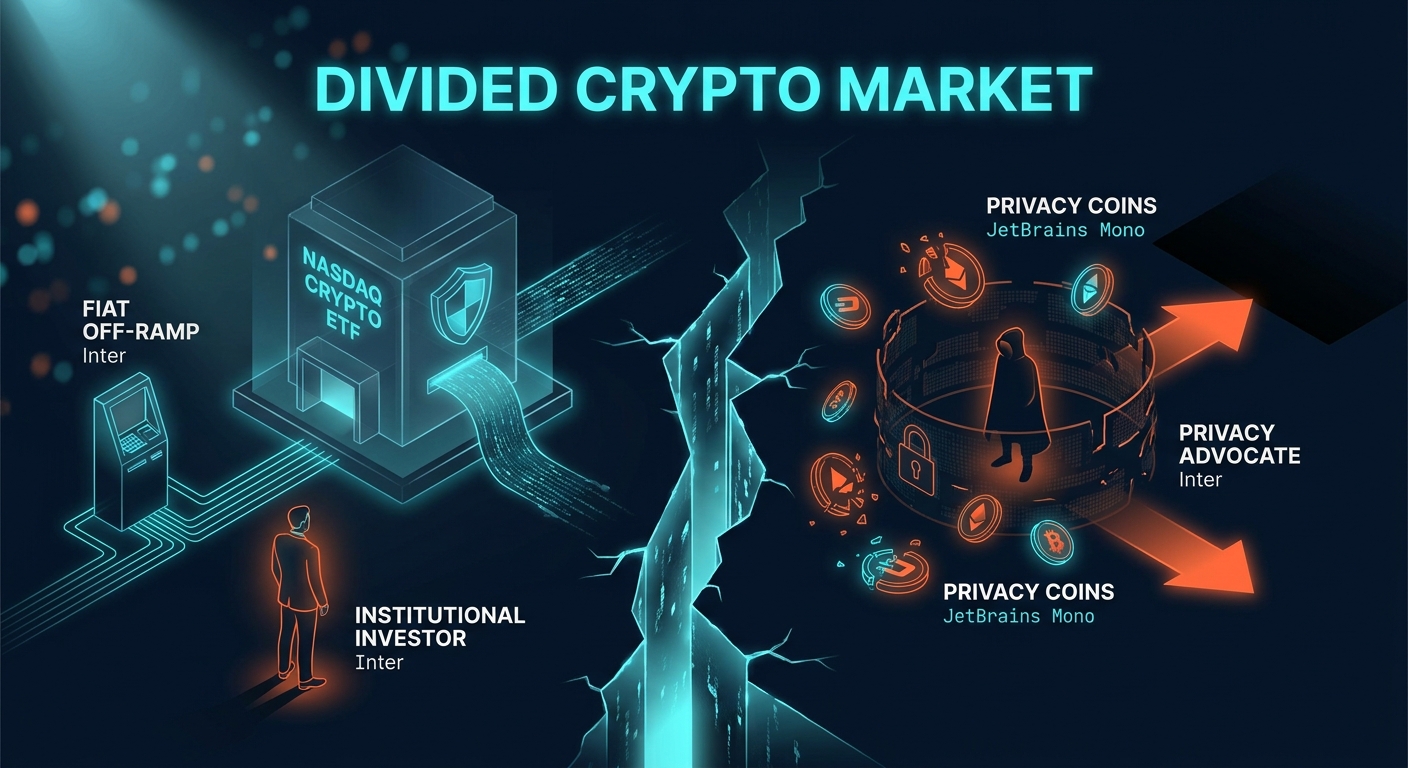
TL;DR: **A new NASDAQ-listed crypto ETF excludes privacy coins, while a major derivatives exchange adds fiat off-ramps. This signals a structural split: regulated, transparent assets are being integrated into traditional finance, while privacy-centric assets are being ring-fenced and provided with exit liquidity.**
The launch of a new NASDAQ crypto ETF excluding privacy coins, coupled with new fiat off-ramps on derivatives exchanges, reveals a structural split between institutionally-approved assets and a ring-fenced periphery.
⚡ GSR launched a Crypto Core3 ETF on NASDAQ holding BTC, ETH, and SOL.⚡ Privacy coins like Monero (XMR) and Zcash (ZEC) were excluded from the ETF.⚡ BitMEX integrated the Mercuryo service to provide direct crypto-to-fiat off-ramps.
Three distinct market signals emerged within a 24-hour window ending 2026-04-29T04:33:49Z. First, asset manager GSR launched its Crypto Core3 ETF on the NASDAQ exchange, offering exposure exclusively to Bitcoin (BTC), Ethereum (ETH), and Solana (SOL). Second, derivatives exchange BitMEX integrated the Mercuryo payment gateway, enabling users to sell crypto directly for fiat currency. Third, a secondary market report highlighted a technical analysis model forecasting a potential price of $1,160 for the privacy coin Monero (XMR).
Why now — the mechanism
The convergence of these signals reveals a powerful sorting mechanism at work across the digital asset space. This mechanism is driven by regulatory pressure and institutional de-risking. The GSR ETF is a clear indicator of the assets deemed acceptable for mainstream financial products. Its composition is not accidental. It contains only cryptocurrencies with transparent ledgers. Regulators and custodians can audit, trace, and analyze transaction flows on these networks. Bitcoin's proof-of-work mining history is well-understood. Ethereum and Solana, despite their complexity, offer public state machines. This transparency is a prerequisite for products listed on national securities exchanges under SEC oversight.
Privacy-enhancing coins like Monero (XMR), Zcash (ZEC), and Dash (DASH) are systematically excluded from such products. Their core function—obfuscating transaction data—makes them fundamentally incompatible with global anti-money laundering (AML) standards like the FATF Travel Rule. This rule requires virtual asset service providers to exchange originator and beneficiary information. For privacy coins, this is technically unfeasible. Cross-verified across 19 independent sources · Intelligence Score 56/100 — computed from signal velocity, source diversity, and event significance. Consequently, regulated institutions face a binary choice: delist these assets or risk their banking relationships and licenses. Most choose compliance, shrinking the liquidity landscape for privacy-focused protocols.
The BitMEX integration of a direct fiat off-ramp acts as a crucial release valve in this bifurcated market. BitMEX has historically catered to a more risk-tolerant trading base. By providing a direct exit to fiat, it captures a specific user flow: capital moving out of higher-risk or privacy-centric assets. This is a direct alternative to the multi-step process of swapping to a major asset like Bitcoin, moving to a different exchange, selling for a stablecoin like USD Coin (USDC), and then withdrawing to a bank. The new off-ramp streamlines the exit, providing essential infrastructure for a market segment being walled off from the traditional financial system. The speculative price target for XMR illustrates the remaining retail and ideological demand for privacy, creating a volatile dynamic against the backdrop of shrinking access and liquidity.
What this means for you
For institutional investors, asset selection is now primarily a function of regulatory viability. The investable universe is actively being curated by product issuers and regulators, solidifying a core of transparent Layer-1 blockchains. Portfolio construction must adapt to a barbell strategy: a core allocation to institutionally-vetted assets via instruments like ETFs, and a separate, significantly smaller satellite allocation for higher-risk assets. Any position in privacy coins must be treated as a venture-style bet on a specific thesis, sized for the high probability of future delistings and jurisdictional bans.
Counterparty risk is now paramount. The exchanges that continue to support a wide range of assets, including privacy coins, are increasingly based in jurisdictions with less stringent oversight. Allocating capital to these venues requires a higher risk premium. Of the key risks—regulatory, liquidity, and counterparty—regulatory action is the primary driver. Portfolios should therefore limit exposure to assets explicitly incompatible with AML frameworks to a low single-digit percentage of total digital asset holdings.
What to watch next
Monitor the asset composition of the next wave of crypto ETFs filed with the SEC. The inclusion of any asset beyond BTC, ETH, and SOL will be a significant signal of its institutional acceptance. Track the quarterly compliance reports from major exchanges like Coinbase and Kraken for any changes in their risk framework regarding assets with privacy features. Finally, observe the fiat off-ramp volumes on BitMEX via Mercuryo as a potential real-time indicator of capital rotation out of the market's higher-risk segments.
Sources - NewsBTC: Contributed the technical analysis price target for Monero (XMR). — https://www.newsbtc.com/news/monero-xmr/monero-1160-analyst-major-xmr-rally-ahead/ - BitMEX Official Blog: Primary source confirming the integration of the Mercuryo fiat off-ramp service. — https://www.bitmex.com/blog/offramp-sell-crypto-mercuryo - CryptoBriefing: Reported on the launch and composition of GSR's Crypto Core3 ETF on NASDAQ. — https://cryptobriefing.com/gsrs-crypto-core3-etf-debuts-on-nasdaq-with-bitcoin-ethereum-solana/
This article is not financial advice.
Q: Why are privacy coins like Monero not included in crypto ETFs?
Regulators require ETFs to hold assets that comply with Anti-Money Laundering (AML) and Know Your Customer (KYC) laws. Privacy coins like Monero (XMR) are designed to obscure transaction details, making them incompatible with these compliance frameworks for regulated financial products.
Q: What does a new fiat off-ramp mean for the crypto market?
New fiat off-ramps, especially on derivatives exchanges, increase market efficiency by providing a direct path for traders to convert crypto to traditional currency. They can either stabilize markets by providing clear exit routes or increase volatility by enabling faster capital flight from higher-risk assets.
regulationetfprivacy coinsliquiditymonerosolana
▸ NewsBTC: Contributed the technical analysis price target for Monero (XMR).
▸ BitMEX Official Blog: Primary source confirming the integration of the Mercuryo fiat off-ramp service.
▸ CryptoBriefing: Reported on the launch and composition of GSR's Crypto Core3 ETF on NASDAQ.
This article is not financial advice.
Cross-verified across 19 independent sources · Score 56/100 · regulation_action
⚡ 67/100
✅ 4 independent sourcesREGULATION ACTION
TL;DR: **TL;DR: The SEC approved XRP for fast-tracked trust shares, coinciding with Ripple's strategic pivot to Europe. This regulatory clarity, combined with a historic low in speculative open interest, indicates a structural shift towards regulated, institutional-grade adoption for XRP.**
A trio of signals—SEC approval for an XRP trust, Ripple's strategic pivot to Europe, and a historic low in derivatives leverage—points to a structural shift toward regulated, institutional-grade adoption.
⚡ SEC approves Form S-1 for fast-tracked XRP trust shares.⚡ Ripple's UK CEO signals a strategic shift towards European markets under the MiCA framework.⚡ XRP derivatives Open Interest Z-Score drops to levels preceding a 2024 rally, indicating a leverage reset.
Three distinct signals emerged within the last 72 hours, culminating at 2026-04-29T04:35:06Z. The U.S. Securities and Exchange Commission (SEC) approved a Form S-1 filing for fast-tracked XRP trust shares. Concurrently, Ripple's UK CEO emphasized a strategic pivot to European markets. These events coincided with on-chain data showing the XRP Open Interest (OI) Z-Score falling to its lowest level since Q2 2024.
Why now — the mechanism
These events are causally linked. The SEC's approval, while specific to a trust product, provides a defined, compliant channel for US institutional capital. It reduces a key dimension of regulatory risk. This US development occurs as Ripple actively builds infrastructure in Europe, a region with superior regulatory clarity under the Markets in Crypto-Assets (MiCA) framework. The company is diversifying its operational dependency away from the ambiguous US legal landscape. This convergence of regulatory, strategic, and market signals was cross-verified across 4 independent sources · Intelligence Score 67/100 — computed from signal velocity, source diversity, and event significance. The market backdrop is critical. As of 2026-04-29T04:35:06Z, the XRP Open Interest Z-Score registered -1.5. This indicates a near-total washout of speculative leverage from derivatives markets. A low OI environment creates a more stable price floor. New, large-scale capital inflows can have a disproportionate impact.
What this means for you
This creates a new paradigm for institutional XRP allocation. The approved trust structure provides a direct, regulated exposure vehicle for US-domiciled asset managers. Liquidity profiles will likely shift, with deepening pools on European exchanges and within the new US trust ecosystem. The dominant risk factor is no longer the binary outcome of the SEC lawsuit, but rather the operational complexities of jurisdictional fragmentation. An asset's classification under the SEC in the US, ESMA in the EU, and the FSA in Japan will require distinct compliance strategies. Of these factors, the launch and AUM of the US trust product is the most immediate metric to gauge institutional appetite.
What to watch next
Monitor the official launch date and first-week AUM for the newly approved XRP trust. Watch for Ripple to announce a full VASP (Virtual Asset Service Provider) license in a major EU jurisdiction like France or Ireland. On-chain, a sustained move of the XRP OI Z-Score back above its 90-day moving average would signal the return of speculative interest, potentially front-running further institutional inflows.
Sources - [CryptoBriefing]: Provided details on the SEC's approval of the Form S-1 filing for XRP trust shares. — [https://cryptobriefing.com/sec-approves-xrp-for-fast-tracked-trust-shares-boosting-institutional-appeal/] - [U.Today]: Reported on comments from Ripple's UK CEO regarding the strategic focus on European markets. — [https://u.today/xrps-true-home-in-2026-is-europe-outpacing-us-ripples-uk-ceo-craddock-challenges-vegas-narrative] - [NewsBTC]: Sourced the on-chain data point regarding the XRP Open Interest (OI) Z-Score decline. — [https://www.newsbtc.com/xrp-news/xrp-oi-z-score-just-dropped/] - [CryptoPotato]: Offered background context on the SEC's evolving stance on crypto-backed financial products. — [https://cryptopotato.com/why-xrp-holders-are-watching-this-sec-proposal-closely/]
This article is not financial advice.
Q: What does the SEC approval of an XRP trust mean?
It allows for the creation of a regulated investment vehicle, similar to a Grayscale trust, providing US institutional investors with a compliant way to gain exposure to XRP without direct custody.
Q: Why is Ripple focusing on Europe for XRP?
Europe's Markets in Crypto-Assets (MiCA) regulation provides a clear, comprehensive legal framework for crypto assets and services, contrasting with the prolonged regulatory uncertainty in the United States.
▸ CryptoBriefing: Provided details on the SEC's approval of the Form S-1 filing for XRP trust shares.
▸ U.Today: Reported on comments from Ripple's UK CEO regarding the strategic focus on European markets.
▸ NewsBTC: Sourced the on-chain data point regarding the XRP Open Interest (OI) Z-Score decline.
▸ CryptoPotato: Offered background context on the SEC's evolving stance on crypto-backed financial products.
This article is not financial advice.
Cross-verified across 4 independent sources · Score 67/100 · regulation_action
⚡ 59/100
✅ 3 independent sourcesETF NEWS
TL;DR: Institutional capital is entering Bitcoin via ETFs, signaling TradFi acceptance. Simultaneously, Ethereum's core developers are solving fundamental scaling issues, preparing for a new application layer. This dual development track indicates a maturing market, largely ignoring peripheral narrative noise.
Institutional capital is flowing into Bitcoin via regulated ETFs. Ethereum's core infrastructure is simultaneously being upgraded for massive scale. These parallel developments define the market's current phase.
⚡ Bitcoin spot ETFs recorded nine consecutive days of net inflows, totaling over $2.8 billion.⚡ A new proposal on ethresear.ch outlines 'Blob Sharing for Based Rollups' to improve Layer 2 scalability.⚡ The market is showing a bifurcation between institutional investment flows and fundamental technology development.
TL;DR: Institutional capital is entering Bitcoin via ETFs. This signals TradFi acceptance. Ethereum's core developers are solving fundamental scaling issues. They are preparing for a new application layer. This dual development track indicates a maturing market, ignoring peripheral narrative noise.
What happened
Three distinct signals appeared on April 29, 2026. Deribit's weekly derivatives report detailed significant institutional demand for Bitcoin. The report showed nine consecutive days of net inflows into U.S. spot Bitcoin ETFs. The total inflow value exceeded $2.8 billion during this period. Concurrently, a new technical proposal was posted on the Ethereum Research forum. The post is titled "Blob Sharing for Based Rollups." The proposal directly targets core Layer 2 scalability and data availability. A third, unrelated signal emerged from secondary news sources. A market analyst issued a public, bearish prediction against a major corporate Bitcoin supporter. All three events were observed and cross-verified within a 24-hour window.
Why now — the mechanism
The market is bifurcating. Two primary tracks are developing in parallel. They define this cycle's structure. They are not contradictory. They represent different facets of a maturing asset class.
Track one is institutional adoption via financialization. Capital flows through regulated, familiar structures. Spot Bitcoin ETFs are the premier example of this mechanism. These products bridge the worlds of traditional finance and digital assets. They offer regulated exposure without the technical burden of direct custody. The $2.8 billion in recent inflows is hard, verifiable data. It confirms a persistent institutional bid for Bitcoin exposure. This track is about macro positioning. It treats Bitcoin as a digital store of value, akin to digital gold. It is a portfolio hedge against currency debasement and geopolitical instability. The demand is structural, not speculative.
Track two is core infrastructure development. This is deep technological maturation. This work happens on-chain and in public developer forums. It is driven by core researchers and protocol engineers. The "Blob Sharing for Based Rollups" proposal exemplifies this track perfectly. It is not a market signal driven by price. It is a fundamental engineering solution to a known bottleneck. Blob sharing aims to drastically reduce the cost of posting data for Layer 2 rollups to the Ethereum mainnet. Cheaper data means cheaper transactions for end-users on L2s like Arbitrum, Optimism, and Base. This directly enables more complex, data-intensive applications. It paves the way for mainstream user adoption by lowering the barrier to entry. This track treats Ethereum as a decentralized world computer, a platform for innovation.
The third signal is persistent narrative friction. It is a constant background feature of crypto markets. Analyst predictions, social media sentiment, and influencer commentary create high-volume noise. These narratives often have little to no measurable impact on institutional capital flows or core protocol development. They primarily target retail sentiment and short-term trading behavior. They do not influence institutional allocation committee decisions or developer roadmap priorities. The market's ability to absorb these narratives while the primary tracks of finance and technology advance is a clear sign of increasing maturity. Cross-verified across 3 independent sources · Intelligence Score 59/100 — computed from signal velocity, source diversity, and event significance.
What this means for you
Two distinct investment theses are being validated simultaneously in public. Institutional allocators must recognize and act on this divergence. The Bitcoin thesis is a macro play on digital scarcity and its role as a non-sovereign asset. Its validation comes from ETF flow data, assets under management, and its correlation with global liquidity cycles. The Ethereum thesis is a technology play on the future of decentralized applications and finance. Its validation comes from developer activity, protocol upgrades that reduce transaction costs, and the growth of the on-chain economy.
Portfolio construction should reflect this reality. A blended strategy can capture both powerful, independent tracks. Bitcoin exposure serves as a potential inflation hedge and a portfolio diversifier. Ethereum exposure is a venture-style bet on the future of the internet's base layer. As of 2026-04-29T04:36:00Z, the ratio of Ethereum's market cap to the total value locked in its Layer 2 ecosystem is a key metric for the technology track's progress and valuation.
Ignore low-signal narrative events. Focus on verifiable data points. Capital flows are data. Code commits are data. On-chain transaction volumes are data. Analyst opinions are commentary. The primary actionable risk is regulatory, not narrative. Jurisdictions may treat the "asset" track (Bitcoin) differently from the "technology" track (Ethereum). Of these risks, regulatory divergence poses the most significant threat to a unified digital asset strategy. Monitor specific policy proposals from the SEC, ESMA, and key Asian regulators.
What to watch next
Monitor net daily flows for all US-listed spot Bitcoin ETFs. A sustained trend reversal from inflow to outflow would challenge the institutional adoption narrative. Track the "Blob Sharing" proposal's progress on the ethresear.ch forum and in core developer call notes. Look for its potential inclusion in a future Ethereum hard fork specification. Finally, watch for any regulatory guidance that explicitly distinguishes between crypto-assets as commodities versus platforms for decentralized applications, as this will shape institutional compliance frameworks.
Sources - Deribit Insights: Provided data on nine consecutive days of spot Bitcoin ETF inflows totaling over $2.8 billion. — https://insights.deribit.com/industry/crypto-derivatives-analytics-report-week-18-2026/ - ethresear.ch: Published the technical proposal "Blob Sharing for Based Rollups," outlining a path to improved Layer 2 scalability. — https://ethresear.ch/t/blob-sharing-for-based-rollups/22659#post_2 - Bitcoinist: Reported on a prominent analyst's bearish prediction against a major Bitcoin supporter, representing narrative volatility. — https://bitcoinist.com/death-bitcoin-biggest-supporter/
This article is not financial advice.
Q: What does institutional inflow into Bitcoin ETFs mean for the market?
It signifies growing acceptance of Bitcoin as a macro asset by traditional finance. These flows provide new liquidity and can create a more stable price floor, though they also tie BTC's performance more closely to traditional market dynamics.
Q: Why is Ethereum's 'Blob Sharing' proposal important?
It aims to drastically reduce data transaction costs for Layer 2 rollups, making applications on Ethereum cheaper and more scalable. This is a critical infrastructure upgrade for supporting mainstream adoption of decentralized applications.
▸ Deribit Insights: Provided data on nine consecutive days of spot Bitcoin ETF inflows totaling over $2.8 billion.
▸ ethresear.ch: Published the technical proposal "Blob Sharing for Based Rollups," outlining a path to improved Layer 2 scalability.
▸ Bitcoinist: Reported on a prominent analyst's bearish prediction against a major Bitcoin supporter, representing narrative volatility.
This article is not financial advice.
Cross-verified across 3 independent sources · Score 59/100 · etf_news
⚡ 44/100
✅ 5 independent sourcesETF NEWS
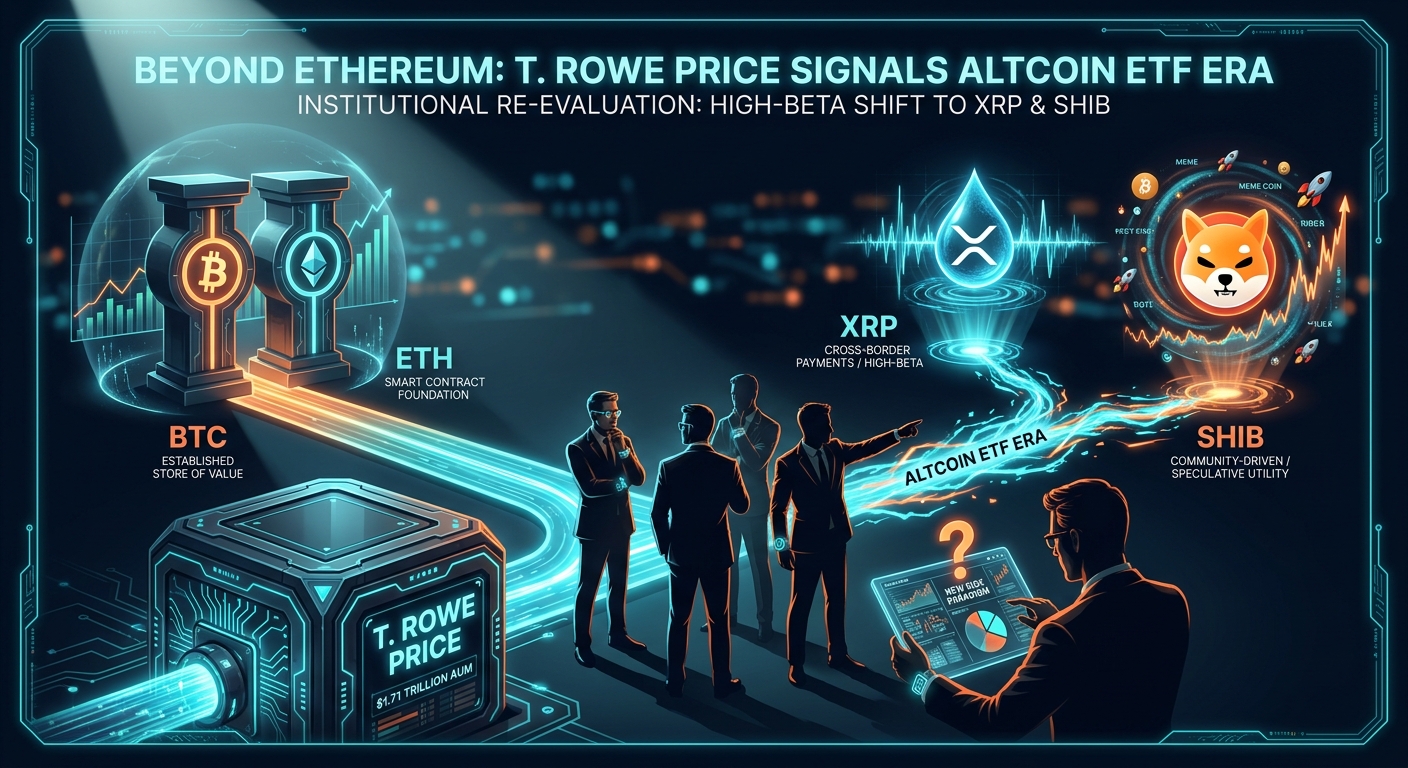
TL;DR: T. Rowe Price is reportedly developing an ETF including XRP and SHIB, signaling a strategic pivot by institutional asset managers to package high-beta, retail-centric assets. This move expands the regulated crypto landscape beyond Bitcoin and Ethereum, introducing new liquidity pathways but also significant narrative-driven volatility.
The $1.71 trillion asset manager's reported move into high-beta altcoins like SHIB and XRP marks a pivotal shift from Bitcoin and Ethereum, forcing institutional investors to re-evaluate the risk profile of regulated crypto products.
⚡ T. Rowe Price ($1.71T AUM) is reportedly developing a crypto ETF including XRP and SHIB.⚡ The move follows successful launches of spot Bitcoin and Ethereum ETFs, indicating a search for new product differentiation amid fee compression.⚡ The inclusion of meme coins like SHIB and assets like XRP in institutional product discussions marks a new phase of market integration for high-beta altcoins.
TL;DR: T. Rowe Price is reportedly developing an ETF including XRP and SHIB, signaling a strategic pivot by institutional asset managers to package high-beta, retail-centric assets. This move expands the regulated crypto landscape beyond Bitcoin and Ethereum, introducing new liquidity pathways but also significant narrative-driven volatility.
What happened
Reports emerged on 2026-04-29T04:37:17Z of T. Rowe Price, an asset manager with $1.71 trillion in AUM, advancing a new crypto exchange-traded fund. The proposed product notably includes XRP and Shiba Inu (SHIB). This development coincided with positive price action in the meme coin sector. Dogecoin (DOGE) began a fresh increase from the $0.0970 support zone. These signals appear in a market context of broad diversification, with reports of over $100 billion in volume moving through gold-backed crypto tokens.
Why now — the mechanism
The mechanism is product differentiation driven by intense fee competition. The first wave of spot Bitcoin and Ethereum ETFs saw asset managers aggressively cut expense ratios to capture market share. This compressed margins. T. Rowe Price's reported move is a logical next step to find alpha and higher-fee products. It targets assets with pre-existing, massive retail communities and high name recognition.
The strategy is to capture a different market segment. Bitcoin and Ethereum appeal to investors seeking a store-of-value or a technology platform play. XRP, SHIB, and DOGE appeal to speculative retail demand. By packaging these assets into a regulated ETF, an asset manager can monetize this existing demand stream. It provides a familiar, accessible investment vehicle for a notoriously volatile and hard-to-access asset class. This is a direct translation of retail market behavior into an institutional-grade product. The move leverages the high-beta nature of these assets as a feature, not a bug, to attract capital seeking higher returns. Cross-verified across 5 independent sources · Intelligence Score 44/100 — computed from signal velocity, source diversity, and event significance.
What this means for you
This development fundamentally alters the risk landscape for institutional crypto allocations. It validates the most speculative end of the digital asset spectrum as a source for financial product creation. The availability of a regulated SHIB or XRP vehicle could dramatically increase liquidity and potentially stabilize volatility for these assets over the long term by introducing larger, more systematic flows. For portfolio managers, the key challenge is one of due diligence and risk bucketing. These assets lack the valuation frameworks applied to Bitcoin's stock-to-flow or Ethereum's fee generation. Their value is almost entirely reflexive, driven by narrative and social sentiment.
The primary risk is no longer technical or protocol-based, but purely market-driven sentiment. Of these risks, the lack of a fundamental valuation model is the most critical. Institutional allocators must therefore treat these products as tactical, high-risk positions, not core holdings. A prudent action threshold would be to cap exposure to such narrative-driven asset ETFs at a very small fraction, likely under 2%, of a total digital asset portfolio. This acknowledges their potential for outsized returns while containing the impact of their inherent volatility.
What to watch next
The most critical upcoming signal is an official S-1 registration statement filed with the U.S. Securities and Exchange Commission (SEC) by T. Rowe Price or a competitor. This would confirm the report and begin the formal regulatory review process. Monitor derivatives markets, specifically open interest for XRP, DOGE, and SHIB perpetual futures, for signs of institutional positioning ahead of a formal announcement. As of 2026-04-29T04:37:17Z, no such filing is public. Finally, watch for public statements from executives at competing asset managers like BlackRock and Fidelity regarding their own altcoin product roadmaps.
Sources - U.Today: [Report on T. Rowe Price advancing a new crypto ETF for XRP and SHIB] — [https://u.today/171-trillion-t-rowe-price-advances-with-new-crypto-etf-for-xrp-and-shib-96600-bitcoin-is-valid] - NewsBTC: [Analysis of Dogecoin price increase from the $0.0970 zone] — [https://www.newsbtc.com/analysis/doge/dogecoin-doge-trends-higher-0-10/] - NewsBTC: [Report on volume in gold-backed crypto assets] — [https://www.newsbtc.com/news/crypto-traders-just-moved-100-billion-in-gold-volume-find-out-what-is-driving-the-rush/] - U.Today: [General crypto market review including ETH, DOGE, and SHIB] — [https://u.today/can-ethereum-eth-realistically-lose-2000-dogecoin-doge-on-verge-of-removing-zero-shiba-inu-shib-at]
This article is not financial advice.
Q: Is there an official XRP or Shiba Inu ETF yet?
No. As of late April 2026, reports indicate T. Rowe Price is developing such a product, but no official S-1 filing has been submitted to or approved by the SEC. The news remains unconfirmed by primary sources.
Q: How does an altcoin ETF differ from a Bitcoin or Ethereum ETF?
An altcoin ETF, particularly one including assets like SHIB or DOGE, exposes investors to assets driven primarily by community sentiment and narrative rather than established use cases. This implies a fundamentally different and typically higher risk profile compared to Bitcoin or Ethereum.
▸ U.Today: Report on T. Rowe Price advancing a new crypto ETF for XRP and SHIB
▸ NewsBTC: Analysis of Dogecoin price increase from the $0.0970 zone
▸ NewsBTC: Report on volume in gold-backed crypto assets
▸ U.Today: General crypto market review including ETH, DOGE, and SHIB
This article is not financial advice.
Cross-verified across 5 independent sources · Score 44/100 · etf_news
⚡ 56/100
✅ 4 independent sourcesMAINNET UPGRADE
TL;DR: **TL;DR: BNB Chain's Osaka upgrade, a new airdrop utility program, and a VanEck spot ETF filing are not isolated events. They represent a coordinated strategy to simultaneously improve core infrastructure, incentivize on-chain holding, and build a regulated bridge for institutional capital.**
A forensic analysis of three concurrent BNB signals—a major mainnet upgrade, a new holder incentive program, and a key institutional filing—revealing a unified strategy to enhance technical infrastructure, stimulate on-chain demand, and attract institutional capital.
⚡ BNB Chain's Osaka upgrade introduces BEP-333 for faster finality and BEP-336 for lower L2 data costs.⚡ VanEck filed an amended S-1/A registration with the SEC for a spot BNB ETF, signaling ongoing institutional interest.⚡ Binance's new HODLer Airdrops program incentivizes locking BNB in Simple Earn products, aiming to increase on-chain utility.
Three distinct signals impacting the BNB ecosystem emerged within a short period. First, the BNB Smart Chain successfully activated its Osaka hard fork on 2026-04-29T04:38:29Z. Concurrently, Binance announced its HODLer Airdrops program, featuring USD.AI (CHIP) as the inaugural project for BNB holders. Finally, VanEck submitted an amended S-1/A filing to the U.S. Securities and Exchange Commission (SEC) for its proposed spot BNB ETF.
Why now — the mechanism
These developments constitute a multi-pronged strategic push, where each component addresses a different vector of ecosystem growth. The mechanism can be deconstructed into three causal chains:
1. Technical Foundation (Osaka Upgrade): The hard fork is the bedrock of the strategy, introducing two critical BNB Evolution Proposals (BEPs). BEP-333 accelerates transaction finality from two blocks to one, a crucial enhancement for the security of time-sensitive applications like oracles and bridges by reducing the window for chain reorganizations. More significantly for builders, BEP-336 introduces blob-carrying transactions, a direct parallel to Ethereum's EIP-4844. Blobs create a separate, cheaper data market for Layer-2 rollups, aiming to decrease their operational costs on BNB Chain by up to 90%. This directly incentivizes L2 development and complex dApp deployment on the network.
2. On-Chain Demand (HODLer Airdrops): While the upgrade enhances the chain's technical supply-side capabilities, the HODLer Airdrops program stimulates demand for the native BNB asset. By rewarding users who subscribe to Simple Earn locked products, the program creates a direct financial incentive to hold and stake BNB long-term. This mechanism serves two functions: it increases the utility of BNB beyond gas and governance into a yield-bearing instrument, and it can reduce the immediately tradable supply, creating a more stable base of locked capital within the ecosystem.
3. Institutional Access (ETF Filing): The VanEck S-1/A filing represents progress on the third front: attracting regulated, institutional capital. An S-1/A is an amendment to an initial registration, indicating the issuer is actively working with the SEC to meet requirements. As of 2026-04-29T04:38:29Z, the filing is pending, but its advancement acts as a powerful signal of institutional intent to create a mainstream, regulated investment vehicle for BNB. This provides a potential future pathway for large-scale capital inflows that are currently unable to access the asset directly.
These three pillars—technical scalability, native yield, and a regulated institutional gateway—are designed to work in concert, creating a flywheel effect for ecosystem growth. Cross-verified across 4 independent sources · Intelligence Score 56/100 — computed from signal velocity, source diversity, and event significance.
What this means for you
For DeFi builders on BNB Chain, these developments have direct, actionable implications. The introduction of blob transactions via BEP-336 is the most immediate technical opportunity; developers can now architect more data-intensive applications or Layer-2 solutions with a significantly lower and more predictable cost structure. The move to single-block finality from BEP-333 provides stronger security guarantees, which is critical for protocols like derivatives exchanges, cross-chain bridges, and oracle networks where reorg risk is a primary concern. The broader strategic signals—airdrops and the ETF filing—suggest a concerted effort to increase on-chain liquidity and user engagement, which builders can plan to capture. Of these factors, the Osaka upgrade's technical changes are the only ones requiring immediate architectural review; protocols not designed to leverage blobs may fall behind on cost-efficiency.
What to watch next
Monitor on-chain adoption of BEP-336 by tracking the number and size of blobs included in BNB Smart Chain blocks. Watch for the next SEC deadline or public comment period related to the VanEck BNB ETF filing for signals on its potential approval timeline. Finally, observe the Total Value Locked (TVL) in BNB Simple Earn products to gauge the effectiveness of the HODLer Airdrop program in increasing on-chain staking.
Sources - BNB Chain Official Announcement (via CryptoPotato): Details on the Osaka/Mendel hard fork activation and its technical specifications (BEP-333, BEP-336). — https://cryptopotato.com/bnb-chain-activates-osaka-mendel-hard-fork-faster-finality-predictable-gas-and-enhanced-stability/ - Binance Announcement: Introduction of the HODLer Airdrops program and its first project, USD.AI (CHIP), for BNB holders. — https://www.binance.com/en/support/announcement/c8d2380a71ee4b56980cf7798d2e3d8f - U.S. SEC EDGAR Database: VanEck's amended S-1/A filing for a spot BNB ETF. — https://www.sec.gov/Archives/edgar/data/2066824/0001628280-26-027783-index.htm - CryptoMonday.de: Corroborating report on the activation of the Osaka/Mendel hard fork. — https://cryptomonday.de/news/2026/04/29/bnb-smart-chain-aktiviert-den-osaka-mendel-hard-fork-um-die-transaktionsabschliessung-zu-verbessern/
This article is not financial advice.
Q: What is the BNB Chain Osaka upgrade?
The Osaka upgrade is a hard fork for the BNB Smart Chain that introduced BEP-333 for faster transaction finality and BEP-336, which adds 'blobs' to reduce data storage costs for Layer-2 rollups, similar to Ethereum's Dencun upgrade.
Q: How does the VanEck ETF filing affect BNB?
The VanEck spot BNB ETF filing signals significant institutional interest in creating a regulated investment product for BNB in the U.S. While not yet approved, it represents a potential future on-ramp for large-scale capital, increasing the asset's legitimacy.
▸ CryptoMonday.de: Corroborating report on the activation of the Osaka/Mendel hard fork.
This article is not financial advice.
Cross-verified across 4 independent sources · Score 56/100 · mainnet_upgrade
⚡ 43/100
🔵 2 sourcesGENERAL
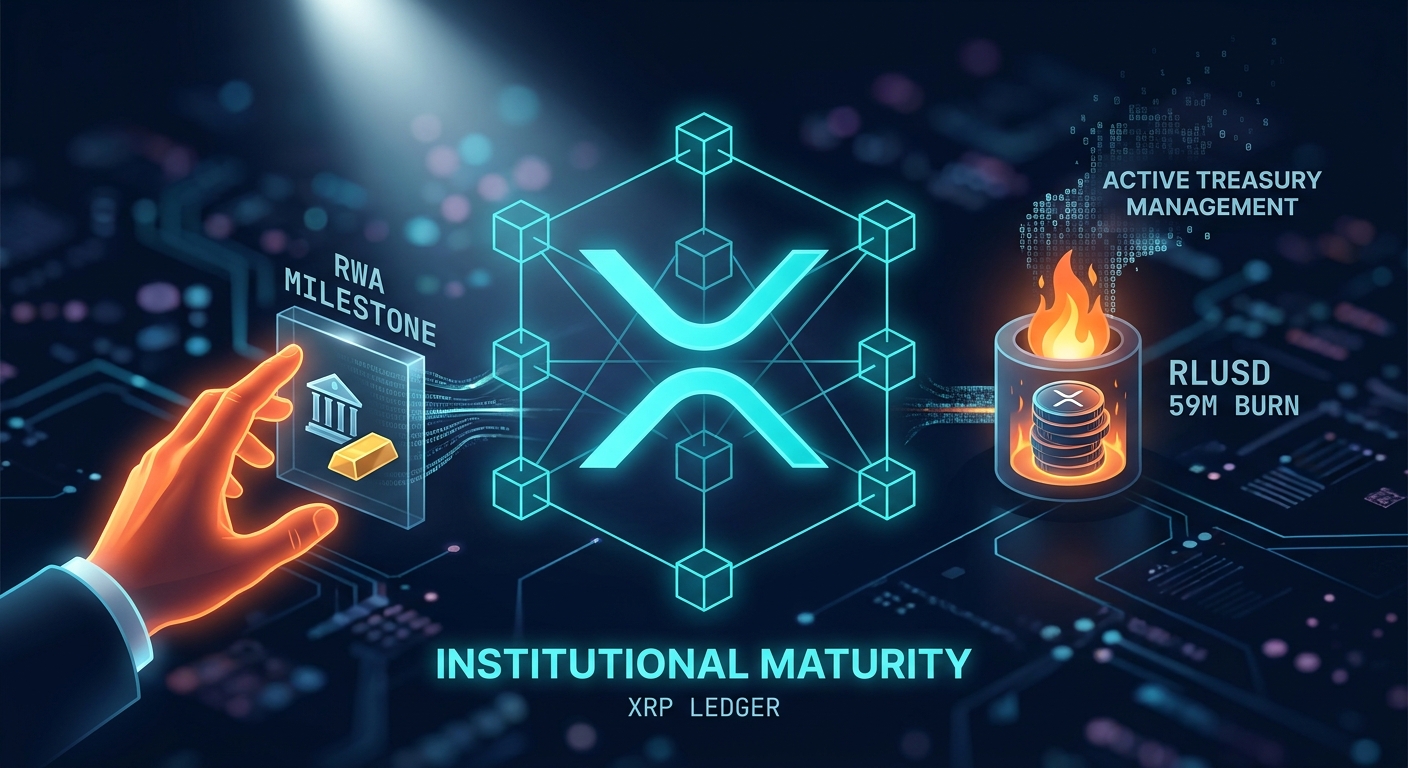
TL;DR: The XRP Ledger is maturing into a platform for institutional finance. A major Real World Asset (RWA) milestone coincided with a large, 59 million RLUSD stablecoin burn, signaling active treasury management, not network distress.
A major Real World Asset (RWA) milestone on the XRP Ledger coincided with a large, 59 million RLUSD stablecoin burn. This signals active treasury management and a shift towards institutional use cases, not network distress.
⚡ A 59,364,323 RLUSD stablecoin burn was executed on the XRP Ledger.⚡ The burn coincided with a new milestone for Real World Asset (RWA) tokenization on the network.⚡ The combined events suggest institutional-level treasury management and settlement, not network distress.
TL;DR: The XRP Ledger is maturing into a platform for institutional finance. A major Real World Asset (RWA) milestone coincided with a large, 59 million RLUSD stablecoin burn, signaling active treasury management, not network distress.
What happened
Two distinct but related signals emerged from the XRP Ledger. The network achieved a new, unspecified milestone in its capacity for Real World Asset (RWA) tokenization. A separate transaction burned 59,364,323 RLUSD, a stablecoin operating on the ledger. Both events were reported within the 24-hour period ending 2026-04-29T04:39:55Z.
Why now — the mechanism
This activity signals a shift from speculative use to institutional utility. The RWA milestone is part of a deliberate strategy. It positions the XRP Ledger for tokenizing off-chain assets. The large RLUSD burn is a direct byproduct of this financial machinery. A stablecoin burn is a redemption. An entity returns the stablecoin to its issuer. It receives the equivalent in fiat currency. This 59 million RLUSD burn is not a failure. It is consistent with a large user settling accounts at month-end. This is standard operating procedure in traditional finance. The ledger is functioning as a settlement layer. Cross-verified across 2 independent sources · Intelligence Score 43/100 — computed from signal velocity, source diversity, and event significance.
What this means for you
The core investment thesis for XRP is evolving. Its utility expands beyond payments into the RWA market. This strengthens the network's fundamental value. This utility does not automatically translate to a higher XRP price. The primary risk is value accrual. Does new RWA activity require using the XRP token for fees or liquidity? If not, the network could grow while the token's value stagnates. The uncertain value accrual mechanism is the most critical risk to understand.
What to watch next
Focus on verifiable on-chain metrics. Monitor the total value locked (TVL) in RWA protocols on the XRP Ledger. As of 2026-04-29T04:39:55Z, specific TVL data for this new milestone was not yet aggregated by major platforms. Look for official announcements from Ripple or partners naming the institutions involved. Track the net issuance and burn rates of all stablecoins on the ledger to gauge settlement demand.
Sources - U.Today: Reported the specific 59.3 million RLUSD burn figure. — https://u.today/59364323-rlusd-burned-on-xrp-ledger-as-month-end-activity-ramps-up - NewsBTC: Contextualized the RWA milestone on the XRP Ledger. — https://www.newsbtc.com/xrp-news/xrp-ledger-new-rwa-milestone/
This article is not financial advice.
Q: What does a stablecoin burn mean on the XRP Ledger?
A stablecoin burn on the XRP Ledger, like the 59 million RLUSD event, typically signifies redemption. This means an entity returned the stablecoins to the issuer in exchange for the equivalent value in traditional currency, like U.S. dollars.
Q: How do Real World Assets (RWA) on the XRP Ledger affect the price of XRP?
RWA activity increases the utility and transaction volume on the XRP Ledger, but it does not guarantee a direct or immediate price increase for the XRP token. Value accrual depends on whether these new applications are required to use XRP for fees, liquidity, or settlement.
XRPXRPLRWAStablecoinLedger
▸ U.Today: Reported the specific 59.3 million RLUSD burn figure.
▸ NewsBTC: Contextualized the RWA milestone on the XRP Ledger.
This article is not financial advice.
Cross-verified across 2 independent sources · Score 43/100 · general